

Hate Winter, Love Tertiary Care? Good. Most People Pick Regions Backwards.
Most physicians pick where to work based on vibes and anecdotes. Then spend 5 years complaining about weather, call, and traffic. That is backwards.
If you hate winter but love complex tertiary care, you cannot just say “I’ll go somewhere warm with a big hospital.” That is how you end up in a saturated market, getting lowball offers from a system that knows there are 20 of you lined up behind.
You need a framework. Not a listicle. A repeatable way to choose your region that balances three things:
- Clinical reality (tertiary vs community, case mix, resources)
- Lifestyle reality (climate, cost of living, commute, schools, partner job)
- Market leverage (supply–demand, saturation, payer mix, long‑term upside)
Let me walk you through a stepwise way to do this, especially if you are weather‑sensitive but still want big, interesting medicine.
Step 1: Decide What “Tertiary Care” Actually Means For You
“Love tertiary care” is too vague. I have watched residents say that, then be miserable in big centers that technically qualify, but do not match what they actually wanted.
Break it down into specifics:
A. Define your clinical non‑negotiables
Write these down. Literally.
Do you need:
- Level I trauma?
- ECMO?
- Advanced heart failure / LVAD / transplant?
- Complex cancer center with trials?
- Neurointerventional / comprehensive stroke?
- High‑risk OB / NICU level III/IV?
What volume feels right?
- Do you want 24/7 in‑house specialty coverage?
- Or is “phone back‑up and transfer option” enough?
If you are, say, an interventional cardiologist, your needs will be very different than general internal medicine. A “tertiary center” for a hospitalist might just mean:
- 500+ bed hospital
- Full subspecialty coverage (GI, ID, heme/onc, pulm/crit, neuro, nephro)
- Procedural back‑up and ICU run by intensivists, not you
But for a transplant surgeon, tertiary means active transplant programs, not “we ship those out.”
Make two lists:
- Must‑have tertiary features
- Nice‑to‑have tertiary features
If you cannot do this, you are not ready to pick a region. You are just daydreaming.
B. Decide how academic you actually want
Do not confuse “complex care” with “academic misery.”
Set your academic dial:
- 0/10: Purely clinical, no research, maybe informal teaching only
- 3/10: Some teaching (students/residents), no pressure for grants/pubs
- 6/10: Startups, clinical research, maybe a title, some scholarly output
- 9/10: Tenure track, grants, papers, committees, real academic hustle
Then answer:
- Are you willing to take:
- Lower salary for academic status?
- Higher RVU targets in pseudo‑academic “faculty” roles?
That dial will automatically rule some regions in and out. For example:
- True transplant/ECMO/advanced oncology + low academic expectation + warm winter + reasonable COL? Very limited markets. You need to know that up front.
Step 2: Get Real About Climate – Not Just “I Hate Winter”
“Hate winter” can mean:
- Hate ice and gray skies
- Hate driving in snow at 3 a.m.
- Hate seasonal depression
- Hate being cold all day
Very different problems. Different solutions.
A. Define your weather tolerances
Rank 1–5 (1 = absolutely no, 5 = fine):
- Snow at all
- Sub‑freezing temps
- Gray/cloudy days
- Humidity
- Summer highs above 95°F
- Major storms (hurricanes, tornadoes, etc.)
You might discover you do not hate winter. You hate driving in slush and scraping your windshield in darkness. Some cold, dry, sunny winters (Denver, Utah high desert) feel completely different from Midwest lake‑effect misery.
B. Understand where tertiary care and mild winters overlap
Here is the hard truth: the biggest, baddest academic/tertiary centers cluster in historically colder regions. Boston, New York, Philadelphia, Chicago, Cleveland, Minneapolis, Rochester, etc.
You want:
- Mild winter
- Big tertiary complexes
- Decent cost of living
That is a narrower set of regions than most people realize.
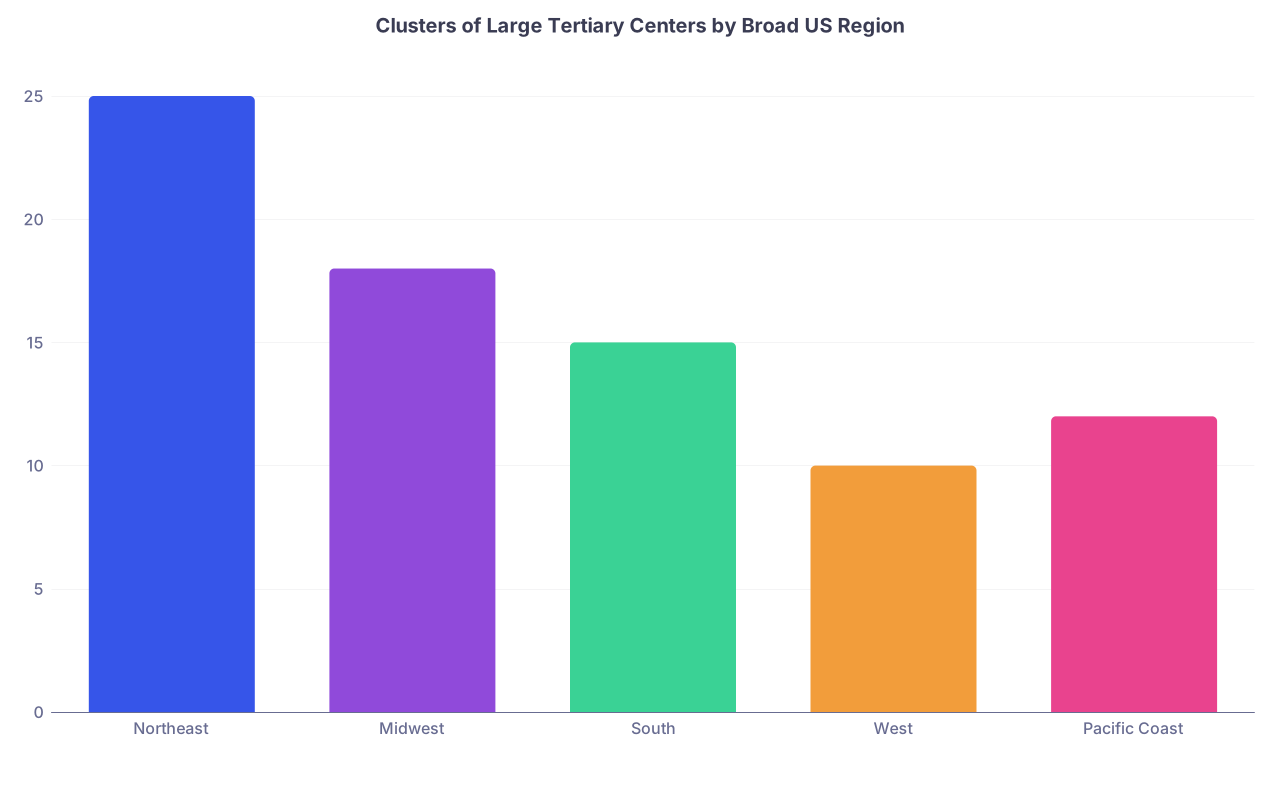
| Category | Value |
|---|---|
| Northeast | 25 |
| Midwest | 18 |
| South | 15 |
| West | 10 |
| Pacific Coast | 12 |
Point is: if you want Tier A tertiary + no winter at all, you are negotiating from a weaker position and a much shorter list.
Step 3: Choose the Right Tier of City – Not Just the Right State
The mistake I see constantly: “I want the Southeast. I like warmth.” Then they accept a job in a booming metro where 40 other people in their specialty already live.
Think in tiers:
- Tier 1 metros: >2 million people, multiple academic centers (e.g., Houston, Dallas, Miami, Atlanta, LA, Phoenix)
- Tier 2 metros: ~500k–2 million, usually one dominant tertiary center (e.g., Charlotte, Nashville, San Antonio, Tampa, Raleigh‑Durham)
- Tier 3 metros / large regional hubs: 150k–500k, regional medical center, maybe limited fellows/trainees, but serious complexity
You want tertiary care? That usually points to Tier 1 or Tier 2. But each tier has trade‑offs:
| City Tier | Pros | Cons |
|---|---|---|
| Tier 1 | Max complexity, subspecialty depth, spouse jobs | Saturation, higher COL, traffic, weaker leverage |
| Tier 2 | Strong tertiary center, better COL, still complex | Fewer niche programs, sometimes dominated by one system |
| Tier 3 | Good leverage, strong regional reach, lower COL | Less academic work, narrower case mix |
If you want:
- Big cases
- But are sick of huge urban hassles
Tier 2 and strong Tier 3 metros in warm or milder climates are your sweet spot (examples: Raleigh‑Durham, Charlotte, Tampa, Jacksonville, San Antonio, Tucson, Albuquerque).
Step 4: Match Climate + Tertiary Care + Market Leverage – By Region
Now we get practical. You have your:
- Tertiary care criteria
- Academic dial
- Climate tolerances
- City tier preference
Let us walk through how to apply this to real regions if you hate winter.
A. Southeast and Gulf Coast: Warm, Busy, But Saturated
Think: Atlanta, Miami, Tampa, Orlando, Jacksonville, Houston, New Orleans, Birmingham, Nashville.
Upsides:
- Winters are trivial compared to the Midwest/Northeast
- Tons of large hospital systems and tertiary centers
- Huge and growing populations, lots of pathology
Risks:
- High competition in desirable metros (e.g., coastal Florida, Nashville)
- Payer mix can be rough in some areas (more Medicaid/uninsured)
- Hurricanes, humidity, bugs, and brutal summers
How to “do” the Southeast correctly:
Do not fixate on the exact city people put on Instagram.
Tampa and Nashville are trendy. That means worse leverage and more physician saturation. Look at:- Jacksonville instead of Miami/Tampa
- Greenville or Columbia instead of only Atlanta suburbs
- Baton Rouge instead of just New Orleans
Target systems, not just cities.
Identify which large systems run the big tertiary centers:- HCA, Ascension, Baptist, Ochsner, etc.
Then see which locations they consider “flagship” vs “feeder.”
- HCA, Ascension, Baptist, Ochsner, etc.
Probe for true tertiary vs marketing fluff.
On calls, ask:- How many ICU beds?
- What is the transfer pattern? Do you accept from 5+ outside hospitals?
- Active transplant or advanced HF programs?
- How many fellowship programs exist on site?
If they dodge those questions, you are not getting real tertiary exposure.
B. Southwest and Mountain West: Mild Winters, Dry Heat, Surprising Complexity
Think: Phoenix, Tucson, Las Vegas, Albuquerque, Denver, Salt Lake City.
Upsides:
- Winters generally lighter than Northeast/Midwest (except high altitude snow, but usually sunnier)
- Fast population growth → demand for complex care
- Multiple academic/flagship centers in several of these metros
Risks:
- Summers can be brutal (Phoenix 110°F is not theoretical)
- Some markets are already getting crowded
- Certain states have challenging Medicaid reimbursement
How to use this region strategically:
- If “hate winter” really means “hate freezing + gray,” Denver and Salt Lake can actually work. Snow exists, but:
- More sun
- Different feel than icy Midwest
- For truly minimal winter: Phoenix/Tucson/Las Vegas. Focus on:
- Banner, Dignity, HonorHealth, UMC, Intermountain, etc.
- Look at medium metros: Colorado Springs, Reno, El Paso, smaller NM cities with regional referral centers.
Again, you want the hospitals where outlying towns are sending their sickest patients, not the glossy new suburban facility that mostly does elective ortho and low‑risk stuff.
C. West Coast: Great Climate, Elite Tertiary, Painful Cost
Think: LA, San Diego, Bay Area, Portland, Seattle.
If you hate winter, love tertiary care, and want coastal vibes, this is the fantasy. The reality:
- Climate: excellent if you like mild, especially coastal California.
- Tertiary complexity: exceptional in big academic centers.
- Cost of living: punishing in most of these markets.
- Leverage: often poor. Lots of applicants, strong academic pipelines.
How to approach:
Decide if you are willing to:
- Pay for housing that will limit lifestyle for years.
- Accept academic or quasi‑academic comp structures.
Look at second‑tier and inland cities:
- Inland CA (Sacramento, Fresno with big regional centers)
- Spokane instead of just Seattle
- Inland Empire tertiary centers rather than only LA proper
You are not going to out‑negotiate UCSF or Stanford for pay or lifestyle. But you might get a solid deal at a large regional system in a less glamorous part of the same state.
Step 5: Use a Hard Filter Matrix (Not Vibes) To Shortlist Regions
Time to get systematic. Build a short matrix for yourself.
Columns:
- Region / City
- Winter severity (1–5)
- Tertiary depth (1–5)
- Academic pressure (1–5)
- Cost of living (1–5; 1 = cheap, 5 = brutal)
- Physician saturation (1–5; 1 = wide open, 5 = packed)
- Partner job market (1–5, if relevant)
Example conceptually:
| City/Region | Winter | Tertiary | COL | Saturation |
|---|---|---|---|---|
| Tampa | 1 | 4 | 3 | 4 |
| Raleigh-Durham | 2 | 4 | 3 | 3 |
| Phoenix | 1 | 4 | 2 | 3 |
| Denver | 3 | 4 | 3 | 3 |
| Houston | 1 | 5 | 2 | 4 |
You are looking for high tertiary, low winter but then you must decide your tolerance for cost and saturation. You cannot get perfect scores across the board.
Step 6: Validate Tertiary Reality With Two Phone Calls, Not 200 Hours Of Googling
Do not trust hospital marketing copy. Or glossy “Top 100 Hospitals” lists. I have seen “centers of excellence” that transfer out routine complex cases nightly.
Here is a quick validation protocol:
A. Call or email current or recent trainees
- Target:
- Fellows and senior residents in your specialty
- Hospitalists, intensivists, ED docs if you are in medicine/surgery
Ask them explicitly:
- What actually comes here vs gets transferred out?
- Do outside hospitals send you their train wrecks, or do you send yours away?
- Which programs do you know that are actually the referral centers in this state/region?
People will tell you in plain language:
“We do okay stuff, but anything really high‑end goes to X downtown.”
That is your answer.
B. Check referral patterns and ICU load
When you interview or have screening calls, ask:
- How many outside hospitals do you receive transfers from?
- What was your transfer‑in volume last year?
- How many ICU beds exist, and who runs them?
- How many ECMO runs / LVAD implants / high risk surgeries / stroke interventions per year?
If they have to pull these numbers or hesitate, they are probably not proud of them.
Step 7: Do One “Lifestyle Reality Check” Visit Before Signing
You can fall in love with a job on paper and a city on Google Maps. That is how you end up stuck somewhere that looks nice in photos but feels wrong day‑to‑day.
For any region on your serious shortlist:
Go off‑season.
If you hate winter, visit in January or February.
If you worry about heat, visit in August.Simulate your commute.
- Drive from likely neighborhood to hospital at 6:30–7:30 a.m.
- Do the same around 4–6 p.m.
People underestimate how much daily traffic misery erodes job satisfaction.
Check where staff actually live.
Ask nurses, mid‑levels, junior attendings:- “Where do you live, and how long is your commute?”
Find out if everyone quietly drives 45 minutes because “that is where it is safe/affordable.”
- “Where do you live, and how long is your commute?”
Walk the unit at 10 p.m.
Late evening reveals:- Staffing: chronically short vs manageable
- Volume: ghost town vs slammed
- Culture: friendly banter vs burnt‑out silence
These are not things you see in a polished interview day.
Step 8: Separate “Starter Market” From “Forever Market”
Here is something no one told you in residency: your first job region does not have to be your forever region. Especially if you are trying to balance no winter + tertiary care + good offers.
A smart play:
Step 1 (years 1–5 out of training):
Take a job in a less saturated warm‑weather tertiary center with:- Strong case mix
- Solid comp
- Room to develop skills and leadership
Examples:
- Regional referral centers in Carolinas, Texas, inland Florida, New Mexico, Arizona, Colorado, inland California.
Step 2 (years 5+):
After building a track record, you have more leverage to:- Move to that very high‑desirability metro (San Diego, Seattle, coastal Florida)
- Negotiate better terms at a top‑tier academic or pseudo‑academic shop
Your leverage compounds once you:
- Bring niche skills (e.g., structural heart, advanced endoscopy, complex spine)
- Have a reputation and letters from a major regional center
- Can show volume and outcomes data
If you treat every job decision like it must be permanent, you will over‑optimize for lifestyle now and under‑optimize for skill and leverage later.
Step 9: Add One Cold‑Weather “Stretch Option” As a Benchmark
Even if you absolutely loathe winter, you should keep at least one cold‑weather tertiary giant on your comparison list. Not to accept. To benchmark.
Example:
- Cleveland Clinic, Mayo Rochester, Boston/NYC/Chicago flagship centers.
Why?
- They reset your expectations:
- Academic pressure
- Teaching load
- Night coverage
- RVU expectations
- Support staff ratio
- Compensation structures
Then, when you compare:
- Warm‑weather offer from a solid tertiary center
- “Gold standard” cold‑weather tertiary offer
You can more accurately judge whether the warm‑weather place is strong clinically or just decent.
It is like checking Zillow for a perfect house you will not buy. It calibrates your brain.
Step 10: Build A Short, Aggressive Target List And Go After It
By now, if you have done this right, you should not be “applying everywhere warm.” You should have a short, intentional list of:
- 3–5 regions
- 1–3 systems in each region
- Specific campuses (flagship vs satellite)
Then do this:
Contact physician recruiters, but do not rely on them exclusively.
They will push the jobs they need to fill, not necessarily the best tertiary + lifestyle fit.Email division chiefs / department chairs directly.
Something like:- Who you are
- Your training and niche skills
- The specific reason you are interested in their institution and region (tie it to tertiary scope and climate/lifestyle)
- Ask if they are open to talking, even if no posted position
Collect 3–5 offers if possible.
Warm regions with real tertiary centers are competitive, but if you are flexible on exact city, you can absolutely get multiple offers.Compare using your matrix, not pure salary.
Salary matters. But:- Case mix
- Call burden
- ICU / hospitalist support
- Commuting and real climate
will determine if you are actually happy three winters from now.

| Step | Description |
|---|---|
| Step 1 | Define tertiary needs |
| Step 2 | Set academic dial |
| Step 3 | Clarify climate tolerances |
| Step 4 | Choose city tier |
| Step 5 | Score regions with matrix |
| Step 6 | Validate with calls and visits |
| Step 7 | Shortlist targets and pursue offers |
Three Things To Remember
- “Hate winter, love tertiary care” is not a personality type. It is a set of constraints. You can absolutely satisfy them if you stop thinking in vague regions and start thinking in systems, city tiers, and transfer patterns.
- Your leverage lives in less‑saturated warm markets with real regional referral centers. Trendy metros are nice to visit. They are often lousy for your first serious job.
- Treat your first warm‑weather tertiary position as a launchpad, not a final destination. Build skills, build leverage, then upgrade location and terms once you have something the market actually chases.


