

What if you build your entire career plan around a country that quietly changes its visa rules halfway through your training—and you’re suddenly not eligible to stay?
If you’re visa-dependent, your “best place to work as a doctor” is not about beaches, prestige, or what your classmates are doing. It’s about something far more brutal: where you can actually get in, train, and not be deported the moment your contract ends.
I’ve watched smart, hardworking international doctors sink years and tens of thousands of dollars into the wrong country, the wrong visa path, or the wrong specialty for their situation. Not because they were lazy. Because they didn’t know what to watch out for.
Let’s fix that.
1. Treating All “Doctor-Shortage” Countries as Equally Friendly
“Country X has a doctor shortage — they’ll need me.”
Do not fall for that line without checking the fine print.
A country can be screaming about physician shortages and still make it nearly impossible for you to practice because:
- Your degree isn’t recognized
- Their licensing exams are a bottleneck
- Their immigration system is hostile to foreign-trained professionals
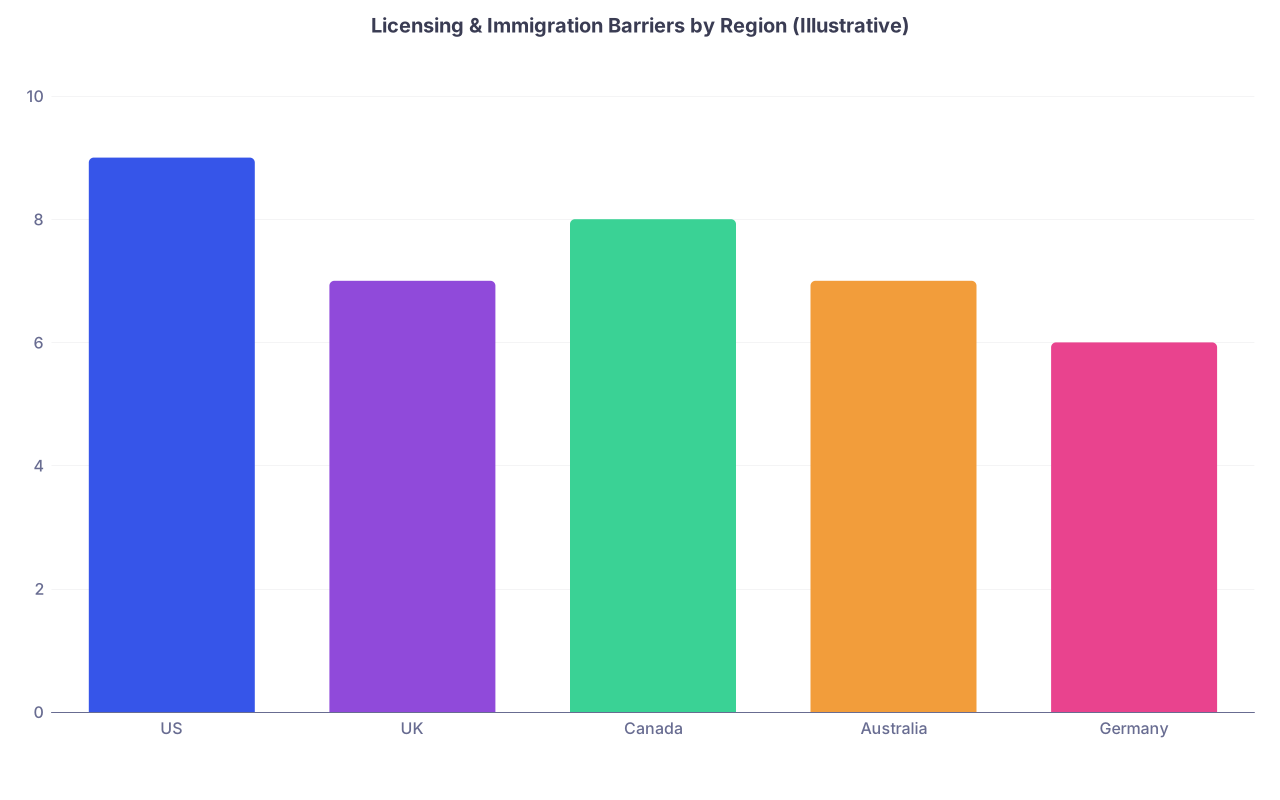
| Category | Value |
|---|---|
| US | 9 |
| UK | 7 |
| Canada | 8 |
| Australia | 7 |
| Germany | 6 |
(Scale 1–10: higher = more steps/barriers for visa-dependent IMGs.)
The mistake
Assuming:
- “Doctor shortage” = easy visas
- “High salary” = realistic path for foreign-trained doctors
- “They recruit nurses internationally” = they’ll do the same for doctors
These are not the same thing.
Red flags you’re ignoring if you aren’t careful
- Licensing authority website is vague or outdated
- No clear route for non-EU / non-local graduates spelled out
- Immigration website talks about “highly skilled migrants” but doesn’t explicitly mention foreign-trained doctors
- “Experience in our system required” with no clear way for you to get that experience as a newcomer
How to avoid this mistake
Before you emotionally commit to a country, verify three separate tracks, not just one:
Degree recognition
- Is your medical degree recognized as is?
- Do you need additional bridging courses, internship repetition, or supervised practice?
- Are there published rules for your school’s country?
Licensing feasibility
Ask:- Is there a standardized exam (e.g., USMLE, PLAB, AMC, MCCQE)?
- How many times can you take it?
- Is there an expiry date on scores?
- Are there limited test dates or test centers in your region?
Immigration alignment
- Are doctors on an official “shortage occupation” list with a clear visa type?
- Is that list stable, or changed every 1–2 years?
- Are there real people (not just consultants trying to sell you something) who’ve done it in the last 3–5 years?
If you can’t find recent success stories from people like you (same degree country, similar level of experience), be skeptical.
2. Ignoring the Visa–Training–Citizenship Timeline Mismatch
Here’s a nasty, common scenario:
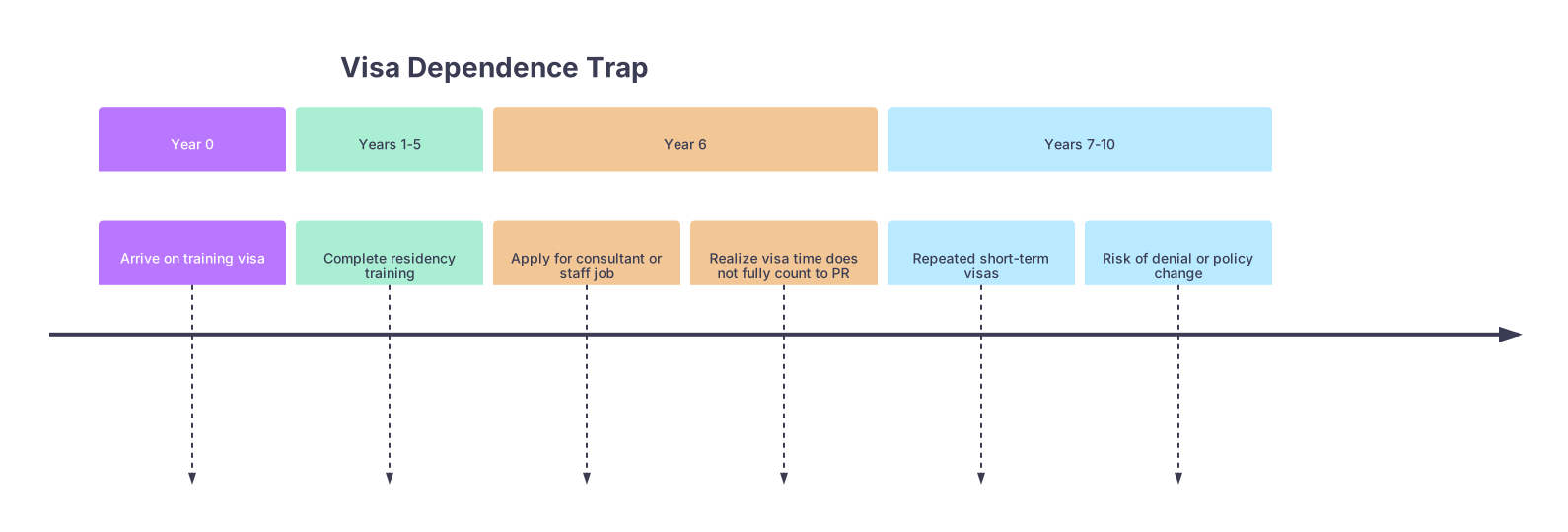
- You pick a country because you can enter on a student or training visa
- Residency lasts 5+ years
- Your visa doesn’t count fully toward permanent residency or citizenship
- After you finish training, you’re still “temporary” and at the mercy of job market, political climate, and arbitrary Home Office decisions
You did everything “right”—and still end up precarious.
The mistake
Looking only at:
- “Can I get a visa to start?”
Instead of: - “Where will I stand 5–10 years from now when I’m fully trained?”
You’re not just choosing where you train. You’re choosing where you may be stuck as temporary long after you’re highly specialized.
Questions you must answer for each country
For your main target country, map out:
Type of visa during training
- Is it a student visa? Training visa? Work visa?
- Does that visa category count toward permanent residency (PR) or indefinite leave?
Years required for PR / settlement
- How many years of the right kind of residence do you need?
- Does time as a trainee or fellow count fully, partially, or not at all?
Path from PR to citizenship
- Additional years after PR?
- Language tests? Integration exams?
Gaps that can break your timeline
- Do out-of-country fellowships reset your clock?
- Do you lose progress if you change employers or regions?
If you don’t do this, you risk finishing your training with weaker residency prospects than a junior software engineer who arrived on a straightforward work visa.
3. Choosing a Country Based Only on Exam “Difficulty”
“I’ll go to Country X because their exam is easier than USMLE.”
This is how people trap themselves into low-visibility pathways with poor long-term immigration options.
The mistake
You anchor on exam difficulty and completely ignore:
- Competition for training posts
- Visa caps for IMGs
- Long-term earning potential and working conditions
- The actual demand for your intended specialty
You pass the “easier” exam, then discover:
- There are almost no training positions for foreigners
- Local graduates are prioritized by law
- Your visa is tied to one employer who can underpay and overwork you
- You are locked out of certain specialties entirely as a foreign doctor
What you should actually compare
Stop obsessing over which exam is “harder”. Compare systems, not just tests:
| Country | Exam Difficulty (Relative) | Training Slots for IMGs | PR Path Clarity | Employer Dependence |
|---|---|---|---|---|
| USA | High | Moderate–High | Moderate | High |
| UK | Moderate | High early, tightening | High | Moderate |
| Canada | High | Low | High | Moderate |
| Australia | Moderate | Moderate | High | Moderate |
| Germany | Moderate (plus language) | Moderate | High | Lower |
Rough, but you get the idea: the exam is just one part of this puzzle.
A better framework
When choosing where to aim:
- Accept that all serious systems require hard exams
- Focus on:
- How many training spots are realistically available to visa-dependent IMGs
- Whether those spots align with your specialty interests
- Whether exam success actually leads to a visa-eligible job
Passing an exam that leads nowhere is not a victory. It’s an expensive hobby.
4. Ignoring Specialty–Country Alignment
Big mistake: choosing your specialty first, then assuming you can just “find a country later” that fits.
Some specialties are brutally hard for visa-dependent doctors in certain countries:
- Dermatology
- Plastic surgery
- Ophthalmology
- ENT
- Radiology
- Some surgical subspecialties
You might see an occasional success story on YouTube. What you don’t see are the hundreds who spent years chasing exactly those outlier outcomes and ended up in non-training jobs or forced career changes.
The mistake
Picking a country without asking:
- Are my top 2–3 specialties even realistic there for IMGs on visas?
- Are there published restrictions (or unwritten ones) on IMG access to these fields?
The questions you’re not asking but should
For each country you’re considering:
- Does the system classify you as IMG / OTD / foreign-trained for all competitive specialties, even after many years of work?
- Are certain residency programs legally or practically closed to non-citizens or non-residents?
- Do programs need extra approval to sponsor you (which many will avoid)?
If your heart is set on a hyper-competitive specialty, your country choice becomes even more critical. You may need to:
- Accept a longer path (research years, prelim years, lateral entry)
- Be flexible about location (less popular regions, smaller cities)
- Or be honest with yourself and choose a specialty–country pair that actually opens doors instead of slamming them.
5. Underestimating Language and Culture as Hard Barriers
If you think language is just “one more hurdle,” you’re not listening to what program directors actually say behind closed doors.
I’ve heard consultants and attendings flat-out state:
“I don’t care how strong their CV is. If I’m not confident they can communicate with patients, I’m not taking the risk.”
The mistake
Choosing a country where:
- You don’t speak the primary language at a near-native professional level
- Or where the exam is in English, but real-world practice is in another language
Europe is the classic trap here.
You see:
- “Doctors in Germany earn X”
- “Shortage of physicians in Scandinavia”
You ignore:
- You’ll need B2–C1 language level before serious job options appear
- Medical documentation, consent, litigation, team communication — all in that language
- Your accent + limited cultural context can very quickly work against you in high-risk settings
Language as a bottleneck, not an afterthought
Ask yourself, brutally:
- Can I realistically reach advanced medical-language proficiency in 1–2 years while also preparing for licensing exams?
- Will I still be competitive as a foreigner with weaker fluency than local graduates?
And don’t just think about speaking. Think:
- Reading long medicolegal documents
- Writing detailed notes at speed
- Handling angry or distressed patients alone at 3 a.m.
If your language skills hold you back, your training evaluations, references, and job opportunities will suffer.
6. Trusting Agents, Forums, and One-Off Success Stories
If your main source of information is:
- Facebook groups
- Telegram channels
- “Consultants” who charge for “placement services”
- YouTube videos with titles like “How I got into UK training easily as an IMG”
You’re setting yourself up for regret.
The mistake
Believing:
- Agents whose financial model depends on you applying (whether or not you succeed)
- Outlier success narratives that skip over luck, timing, and pre-existing advantages
- Advice that was true 8 years ago and is now completely obsolete
I’ve seen this pattern repeatedly:
- Rules tighten.
- People who succeeded under the old rules start monetizing their story.
- Hundreds follow that path after the gate has effectively closed.
Guess which group you’re in.
A sanity-check filter
Before you rely on any source:
- Ask: What do they gain if I decide to pursue this path?
- Check dates. Anything older than 3–4 years in immigration / training is suspect.
- Look for official documents: government immigration sites, medical council websites, training board circulars.
- Prioritize bitter, detailed failure stories over smooth, triumphant ones. The failures show you where the real landmines are.
If someone won’t show you links to official regulations that support their claims, walk away.
7. Ignoring Burnout Risk, Working Conditions, and Exit Options
You can technically “get in” and still end up miserable and stuck.
Some countries:
- Overwork foreign doctors in remote, underserved areas
- Offer poor support and little protection against discrimination
- Tie your visa so tightly to your employer that complaining is career suicide
The mistake
Only looking at:
- Gross salary
- “Lifestyle” images
- General claims of “work–life balance”
And ignoring:
- Realistic rota patterns
- Frequency of nights, weekends, unpaid overtime
- Culture toward foreign doctors (respect vs exploitation)
Ask the hard questions
Before you commit to any country, dig for:
- What happens if I lose my job? How many days do I have to find a new sponsor?
- Can I easily move between employers, or does that reset my visa/PR clock?
- Are there well-known issues with racism, bullying, or foreign-doctor scapegoating?
- Are there internal pathways to non-clinical roles (teaching, admin, industry) if frontline medicine becomes unsustainable?
You’re not just picking where to start. You’re picking where you might burn out. Leave yourself options.
8. Not Having a Plan B (or C) Country
This one bites harder than almost any other.
You:
- Fixate on one country (usually the US, UK, or Canada)
- Build your profile only for that system
- Underestimate visa quotas, exam competition, and policy changes
- Hit a dead end with no parallel path prepared
The mistake
Treating your country choice like a soulmate, not a strategy.
If you’re visa-dependent, you need redundancy, not romance.
How to actually protect yourself
You should have:
- Primary target country
- Where you aim first and structure most of your efforts
- Secondary option
- Where your exam prep / clinical experience still holds value
- Emergency option
- Where you can likely get some form of practice or related job if everything else fails
For many IMGs, that might look like:
- Primary: USA (USMLE, residency)
- Secondary: UK (PLAB/UKMLA, leveraging USMLE prep and clinical experience)
- Emergency: Home country or regional system where your degree is accepted more easily
Or:
- Primary: UK
- Secondary: Australia / New Zealand
- Emergency: EU country with language you can learn, or return to home region with better seniority prospects
You don’t need to love your backup countries. You just need them to be viable.
FAQ (Exactly 3 Questions)
1. Is it a mistake to start USMLE (or PLAB, or another exam) if I’m not 100% sure I want that country?
It’s a mistake to start blindly without checking transferability. Some exams (like USMLE) can also strengthen your CV for certain other countries or research positions. Others are almost completely system-specific and won’t help you elsewhere. Before you commit, ask: if this exam route fails, does the preparation still give me leverage in another country, or will it be a sunk cost?
2. Should I prioritize an “easier” country now and maybe move to my dream country later?
Generally, hopping systems as a visa-dependent doctor gets harder the more specialized you become, not easier. Many countries do not fully recognize foreign postgrad training, especially from less familiar systems. You might end up repeating big chunks of training. If you choose a “stepping stone” country, make sure its training is widely recognized and that you’re okay staying there long term if the second hop never materializes.
3. How early in my medical education should I start thinking about country choice and visas?
Earlier than you think. By clinical years at the latest. Why? Because choice of electives, research, exams, language learning, and even specialty exposure should be shaped by your target systems. Waiting until after graduation forces you into last-minute, panicked decisions. That’s when people overpay agents, fall for bad advice, and commit to countries that were never realistically open to them.
Open a blank page right now and write down three columns: Country A, Country B, Country C. Under each, list: visa type during training, PR path length, your realistic specialties there, language requirements, and how many real IMGs you personally know who’ve done it in the last 5 years. If one column is mostly question marks, stop calling it your “plan” until you fill those in with verified answers.


