

Myth of the Big Coastal City: Why Many Physicians Quietly Leave
Why do so many doctors spend a decade training for the prestige big-city coastal job—New York, LA, San Francisco, Boston—only to quietly move to Boise, Tulsa, or Greenville five years later?
You will not hear this in med school orientation talks or at glossy academic recruitment dinners. But I’ve watched it play out over and over: residents swear they’re “big city people forever,” then by mid‑career they’re interviewing in second‑tier metros or outright rural systems. And they’re not doing it for the “slower pace of life” brochure slogan. They’re doing it because the math and the reality do not match the myth.
Let’s pull this apart.
The Pay Myth: “You Make More Where the Prestige Is”
The first bad assumption: that you’ll be paid more in NYC, SF, LA, Boston because those markets are “top tier.” That’s not how physician compensation works in the U.S.
Here’s the basic pattern: high cost‑of‑living, high‑prestige coastal markets usually pay less in raw dollars and dramatically less in effective income (income after housing, taxes, and basic living costs).
Look at any of the big surveys—MGMA, Doximity, Medscape. Year after year, the top compensation numbers skew toward the Midwest, South, and interior West, not the coasts.
To put some structure to it:
| Market | Approx Pay (IM) | Cost of Living Index* | State Income Tax |
|---|---|---|---|
| New York City | $260k | 180 | Up to ~10.9% |
| San Francisco Bay | $270k | 190 | Up to ~13.3% |
| Boston | $270k | 150 | Up to ~9% |
| Minneapolis | $290k | 105 | Up to ~9.85% |
| Oklahoma City | $310k | 90 | Up to ~4.75% |
| Boise | $300k | 105 | Up to ~5.8% |
*Cost of living index: ~100 = national average. Numbers are approximate and vary by source/year, but the pattern is stable.
Now layer in specialties. The more procedure‑heavy you are (ortho, GI, cards, anesthesia), the more you see compensation pushed up by competition in “less sexy” markets and pushed down in saturated coastal markets.
Effective income is what actually matters: how much of your paycheck is left after rent/mortgage, taxes, transportation, childcare. When you run the numbers honestly, that “$270k in SF” often behaves like $150–180k in a normal city. If you are feeding $5–6k/month into rent or an absurd mortgage, you are basically donating a large fraction of your income to the privilege of saying you live there.
I’ve sat in lounge conversations where attendings in Manhattan making “good” money in academic subspecialty roles quietly admit they have less financial margin than friends in Arkansas or Indiana. Not a little less. A lot less.
The Lifestyle Myth: “The City Is Where Life Happens”
The second myth is emotional: that life is richer in big coastal cities. That the restaurants, culture, and “energy” compensate for all the downsides.
Let’s be blunt. Those perks are real. You actually can eat Burmese on Wednesday and Ethiopian on Friday. You can walk to a symphony. It is fun at 26.
But here’s what happens when you add a real physician schedule and actual adult responsibilities:
You’re working 50–60+ hours a week, plus call. You’re not strolling out of clinic at 4:15 to catch a gallery opening. You’re finishing notes, fielding portal messages, or getting paged about a crashing patient on the floor.
You add 45–90 minutes of commuting each way because the only place you can afford with a kid and a dog is 45 miles out. That cultural life you moved for gets converted into gridlocked time on a highway listening to a podcast about how burned out you are.
The “lifestyle perks” become something you use once or twice a month if you’re lucky. Meanwhile, the lifestyle costs—noise, traffic, crowding, constant low‑grade stress—are present every single day.
So when that friend messages you from a mid‑size city where they live 12 minutes from the hospital, have a backyard, and can be home in time for dinner most nights, the trade pretty quickly stops looking clever and starts looking like self‑inflicted misery.

Quiet Drivers of the Coastal Physician Exodus
Doctors don’t usually announce, “Big cities are a bad deal for us, I’m out.” They just quietly sign that contract in Colorado Springs or Raleigh and send a forwarding address. Underneath, a few consistent forces are pushing them out.
1. Housing and Family Life: The Hard Wall
You can ignore housing reality for a while. As a med student or resident, you expect to live in a cramped apartment with ugly flooring and unreliable heat. It’s baked into the training narrative.
But once you’re an attending, with six figures of debt and maybe a partner, kids, or aging parents, the math stops being theoretical. Try this:
– Two physicians, both hospital-employed IM in their first jobs
– One couple in Brooklyn, one in a mid‑size Midwest city
– Roughly similar salaries on paper (or sometimes the Midwest one is higher)
The Brooklyn duo faces:
- $4–6k/month rent or a 7‑figure mortgage
- Daycare that can easily break $3k/month per child
- Parking costs that feel like car payments
The Midwest duo:
- Mortgage that resembles NYC rent for a studio
- Reasonable commute
- Decent public schools actually in reach
That’s when people break. They do not put it up on Instagram. They just quietly sign elsewhere.
2. Oversupply and Leverage
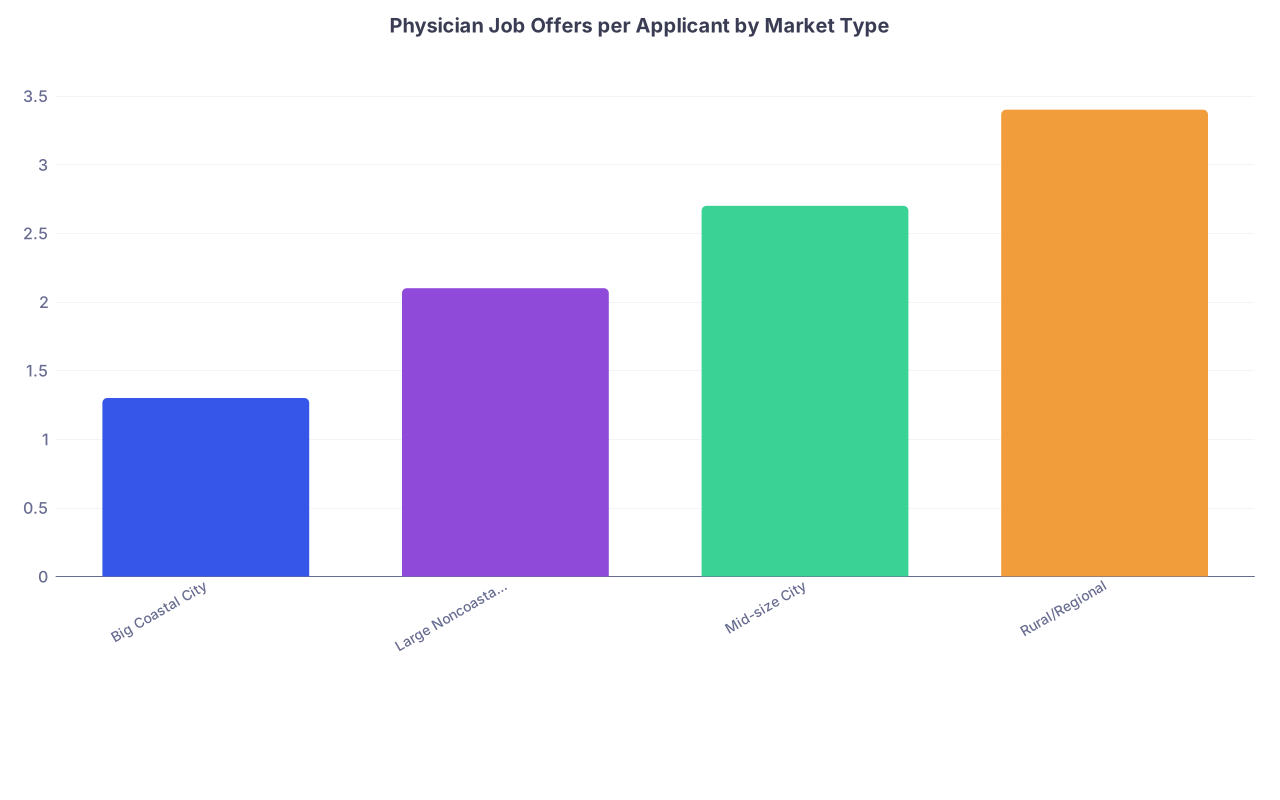
Another ugly truth: big coastal metros are where residents converge, where big-name fellowships are, where “brand-name” institutions cluster. Which means oversupply in many specialties.
Oversupply equals reduced leverage.
A nephrologist in a coastal city with a fellowship program has to compete with a steady stream of newly minted grads who want to stay. That keeps salaries capped and call expectations heavy.
The same nephrologist in a regional center where nobody wants to go? Suddenly the hospital is offering better pay, better sign‑on, and more flexible call schedules. Because they do not have twenty CVs in a pile for one job.
| Category | Value |
|---|---|
| Big Coastal City | 1.3 |
| Large Noncoastal Metro | 2.1 |
| Mid-size City | 2.7 |
| Rural/Regional | 3.4 |
I’ve heard this comment almost verbatim: “In Boston I had to beg for one mediocre offer. In Des Moines they’re practically fighting over me.”
And with leverage comes the ability to say no. No to extra unpaid admin work. No to endless committee meetings. No to punishing call ratios. Which brings us to burnout.
3. Burnout Amplifiers, Not Just Causes
Burnout isn’t unique to big cities. But big coastal markets stack several multipliers on top of the usual culprits:
- Higher patient volumes in some safety‑net systems
- More complex social issues and fragmentation of care
- Academic expectations layered on full clinical loads
- Bureaucratic bloat and layers of middle management in giant systems
- Commute and cost‑of‑living stress at home
It’s the stacking that breaks people. Not one factor.
The doctor in a smaller market is still fighting EMR nonsense and overnight calls. But they’re also more likely to have:
- A shorter commute
- A community where they’re not anonymous
- Slightly more control over their practice environment
Not always. But enough that, aggregated, those markets often bleed fewer mid‑career physicians.

| Step | Description |
|---|---|
| Step 1 | Residency in Big Coastal City |
| Step 2 | First Job at Prestigious System |
| Step 3 | Realize Housing and Commute Are Unsustainable |
| Step 4 | Burnout and Financial Frustration |
| Step 5 | Explore Jobs in Mid-size or Regional Cities |
| Step 6 | Sign Offer With Better Pay and Lifestyle |
| Step 7 | Quiet Departure From Big City |
The Prestige Trap: Academic Centers and Brand Names
Another myth that keeps physicians tethered to big coastal cities longer than they should be: “I need to stay at [famous institution] for my career.”
Sometimes that’s true. If you’re chasing a narrow academic niche, big NIH grants, or a very specific subspecialty, the coasts (and a few major noncoastal centers) may be non‑negotiable.
But for a huge chunk of doctors—hospitalists, outpatient IM/FM, EM, community subspecialists—chaining yourself to a prestige logo is often vanity disguised as strategy.
Actual career realities:
- Most patients do not care where you trained after the first five minutes.
- Your next employer usually cares about your reputation and productivity, not that you once rotated at Mass General.
- The marginal benefit of staying in a big academic system beyond early‑career CV building is often smaller than people admit.
I know multiple attendings who left big‑name coastal institutions for community groups elsewhere and saw:
- Higher pay (sometimes dramatically)
- More schedule autonomy
- Fewer meetings and “voluntold” committees
- Better day-to-day sanity
They did not see their careers implode. Nobody came to confiscate their diploma because they moved from SF to Spokane.
Why the Departures Stay Quiet
So why isn’t this talked about more openly? Why isn’t there a loud narrative saying, “Big coastal markets are often a lousy deal for most physicians”?
Three reasons.
1. Social Status and Narrative Control
Big coastal city = status, not just for laypeople, but within medicine. “I’m at Columbia” reads differently from “I’m at a community hospital in Iowa” in the minds of colleagues. Even if the person in Iowa is making double and sleeping through the night.
People rarely broadcast moves that feel like “status downgrades,” even when they’re actually quality‑of‑life upgrades.
2. Academic Echo Chambers
Medical training is heavily anchored in large academic centers, the majority of which are… in big coastal or mega-metro areas. The people shaping the narrative about what a “good career” looks like are, unsurprisingly, the people who stayed.
They’re not going to stand in front of residents and say, “Honestly, in five years many of you will be much happier in medium‑sized fly‑over cities where you earn more, have a house, and see your kids.” Even though that is exactly what happens.
3. Individualized Rationalization
Everyone tells themselves a story:
- “We’re staying for my partner’s job.”
- “We’ll move after we make partner.”
- “Just a few more years until the loan forgiveness.”
Then one random Tuesday, they get an email from a recruiter in North Carolina, run the numbers, visit, see the 15‑minute commute and the yard, and the story quietly updates. But nobody rewrites their narrative on social media to say, “Turns out my big‑city dream was a bad deal.”

Who Actually Should Stay in Big Coastal Cities?
Let’s be fair. Some physicians are logically better off in the big coastal ecosystems.
You probably should strongly consider staying if:
- You’re deeply committed to academic medicine with serious research ambitions and need proximity to major institutions and funding networks.
- You’re in a hyper‑subspecialized field where the case volume and complexity you need only exist at large tertiary and quaternary centers.
- Your personal life is anchored there—partner’s career, family health needs, immigration constraints—and moving is not a trivial option.
- You genuinely thrive on urban density, do not care about space, do not plan on kids, and are willing to trade money and quiet for that environment, fully aware of the trade.
But that is a minority of the physician workforce.
What’s dumb is the default assumption that “making it” means a lifetime in a Manhattan condo or a Bay Area bungalow where your call room is bigger than your bedroom.
For many doctors, the prestige is a sugar high, not a durable advantage.
What the Data and Lived Reality Actually Say
If you strip away marketing and ego, the picture is not complicated:
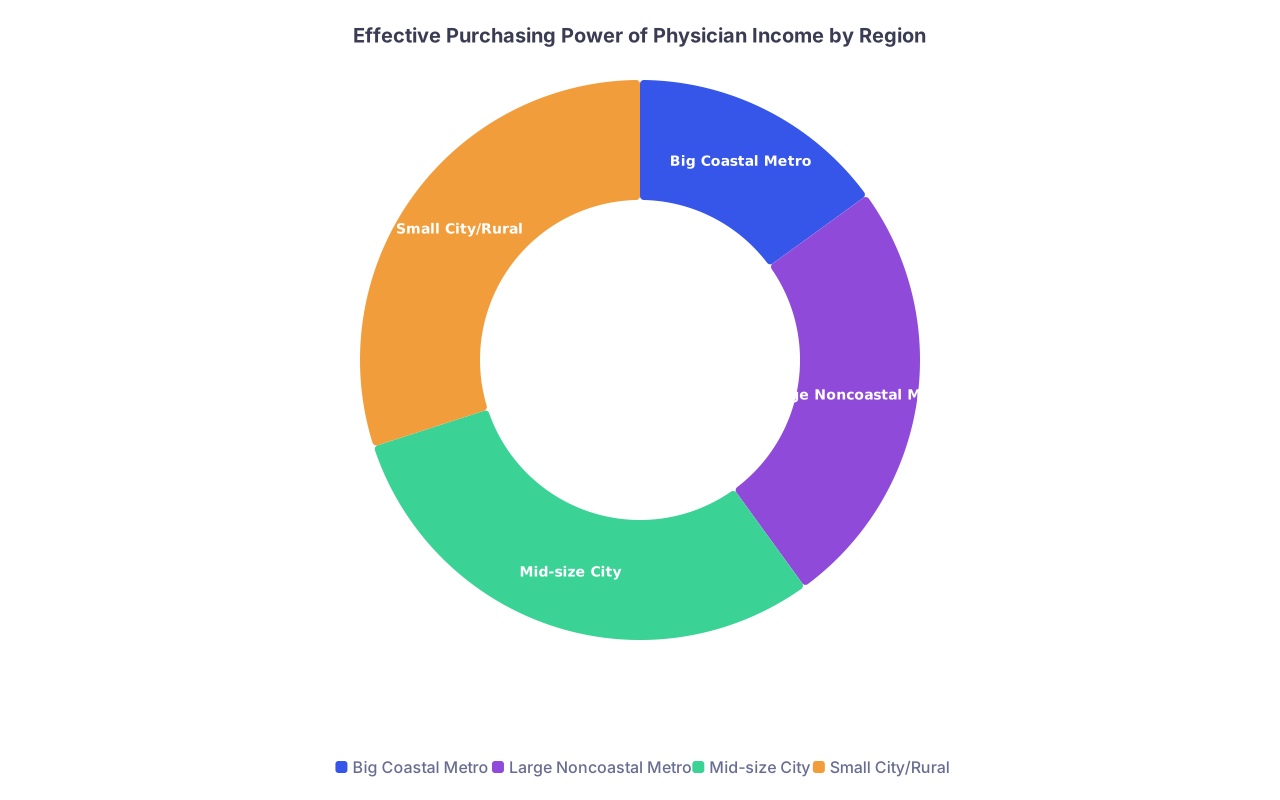
- Compensation is generally higher—often much higher—in noncoastal and less saturated markets.
- Cost of living is dramatically lower, especially for housing and childcare.
- Job leverage and negotiating power tend to be better when there are not twenty other physicians waiting to take your spot.
- Burnout drivers stack higher in crowded, expensive, status-obsessed coastal ecosystems.
| Category | Value |
|---|---|
| Big Coastal Metro | 15 |
| Large Noncoastal Metro | 25 |
| Mid-size City | 30 |
| Small City/Rural | 30 |
That’s why so many physicians quietly leave. Not because they hate cities. Not because they “failed” to cut it at marquee institutions. But because, when you actually run the numbers and weigh the daily lived experience, the myth of the big coastal city falls apart.
The short version
- Big coastal cities usually pay you less, cost you more, and give you less leverage.
- The “lifestyle perks” are mostly theoretical once you stack a physician schedule and long commute on top.
- For a large share of doctors, mid‑size and noncoastal cities offer a much better balance of income, autonomy, and actual life—no prestige filter required.


