

It’s Match Week. Your phone buzzes, you open the email, your heart is pounding… and then your stomach drops.
You matched.
But it’s in that city.
The one you swore you’d never live in.
Far from family. Bad weather. High crime. Or just… wrong vibes.
Everyone around you is saying “Congratulations!!” and you’re forcing a smile while your brain is already 10 steps ahead:
- What if I’m miserable there for 3–7 years?
- What if I can’t make friends?
- What if this ruins my relationship?
- What if I’m stuck forever because nobody hires me somewhere else?
You’re trying to be grateful you matched at all, but inside you’re spiraling: “Did I just blow up my life with one algorithm?”
Let’s sit in that feeling for a second. Because it’s real. And pretending it’s fine doesn’t make it go away.
I’m going to walk through the ugly questions you’re probably too embarrassed to say out loud and what actually happens to people who match somewhere they hate. Spoiler: people survive this. And many of them end up exactly where they want to be later.
First: Are You Really “Stuck” There?
This is the core fear, right? That Match Day locked you into a miserable future and there’s no way out.
That’s not how it actually plays out for most people.
Here’s the uncomfortable truth first:
Yes, for the short term, you’re basically stuck. The Match contract is real. You can’t just “opt out” because you don’t like the city. Programs expect you to show up and complete the training you matched to.
But zoom out.
Residency is not a life sentence. It’s a fixed term. Usually:
| Specialty | Usual Length (Years) |
|---|---|
| Internal Medicine | 3 |
| Pediatrics | 3 |
| Family Medicine | 3 |
| General Surgery | 5 |
| OB/GYN | 4 |
| Emergency Medicine | 3–4 |
Three to five years feels like forever when you’re 26 and staring down a move across the country. But look at any attending staff: almost everyone did training somewhere they didn’t grow up. Many did it somewhere they actively disliked.
And yet—there they are. Back in their home state. Or in the exact coastal city they fantasized about on call at 2 a.m. in the Midwest. It happens all the time.
The residency city is almost never the final city.
What is mostly fixed is this: you’re going there for now. So the actual problem isn’t “Am I stuck forever?” It’s:
“How do I get through these years without losing my mind, and get myself somewhere I actually want to live afterward?”
That’s a different question. And much more solvable.
How Bad Can It Really Be? (Worse Than You Think, But Also Better)
Here’s the thing no one says out loud: some people are genuinely miserable where they match. Not everyone “learns to love it.” Not everyone falls in love with the city by PGY-3.
I’ve seen:
- People from California matched to the Midwest who cried every time it snowed in April.
- Folks who matched in NYC and absolutely hated the crowds, cost of living, tiny apartments, constant sirens.
- Residents who matched in small towns and felt totally isolated—no friends, nothing to do, nearest Trader Joe’s 2 hours away.
So yeah. It can be rough. Especially when:
- You have a partner who can’t find a good job nearby.
- You’re very close to family and suddenly you’re a 5-hour flight away.
- You rely heavily on a particular cultural or religious community that won’t be easily found there.
- You have mental health stuff that’s triggered by, say, dark winters or extreme heat.
But here’s the part your brain keeps skipping when it’s spiraling: humans are disgustingly adaptable. Especially doctors.
You’re about to be so busy, stressed, and sleep-deprived that your relationship to the city will be weird anyway. Residency life in “your dream city” vs. residency life in “a city you hate” is… a little less different than Instagram makes it look.
You’re not doing long walks on the beach every evening after a chill 9–5. You’re walking from the parking lot to the hospital in the dark and maybe hitting a grocery store on the way home. On golden weekends, then the city matters more—but that’s a fraction of your time.
Stuff that often ends up mattering more than the city itself:
- The culture of your program
- How supportive your co-residents are
- How malignant or humane the attendings are
- Whether you find even 2–3 people you can vent to and laugh with
Most people who are “okay” during residency are not okay because the city is perfect. They’re okay because they have people and some control over their tiny off-duty life.
Which brings me to…
The Unsexy Reality: Most People Just Survive It
This is probably not what you want to hear, but it’s honest: most people don’t “fix” hating their match city. They endure it, then leave.
That sounds depressing, but it can actually be weirdly freeing.
Because the job of residency isn’t “live your best life.” It’s “get trained, don’t burn out completely, build a CV that lets you get out.”
You can think of it like a deployment. Or like an extreme, long-term away rotation. You’re not there to marry the city. You’re there to use it.
So what do people actually do?
They:
- Shrink their world to what they can control: apartment, commute, gym, 1–2 favorite coffee shops, a safe park to walk.
- Find a micro-community: co-residents, church, hobby group, immigrant community, queer community—whatever makes them feel like themselves again.
- Carve out tiny routines that protect their sanity: same brunch spot post-call, weekly FaceTime with family, running along the same river path.
- Build exit velocity: research, networking, fellowships that point toward Jobs In The City They Actually Want.
Is that glamorous? No. Is it doable? Yes.
And it beats the “I’m trapped and doomed” narrative your 3 a.m. brain keeps looping.
But Can You Ever Leave That City After Training?
This is one of the big panic thoughts: “If I train there, I’ll never get a job anywhere else. I’ll be that person who ‘just stayed’ because I couldn’t get out.”
Let me be blunt: that’s not how this works for most specialties.
Do some people stay on as faculty or in local jobs because they’re comfortable? Yes. But that’s a choice, not a curse. Many others leave.
Watch what actually happens at most programs:
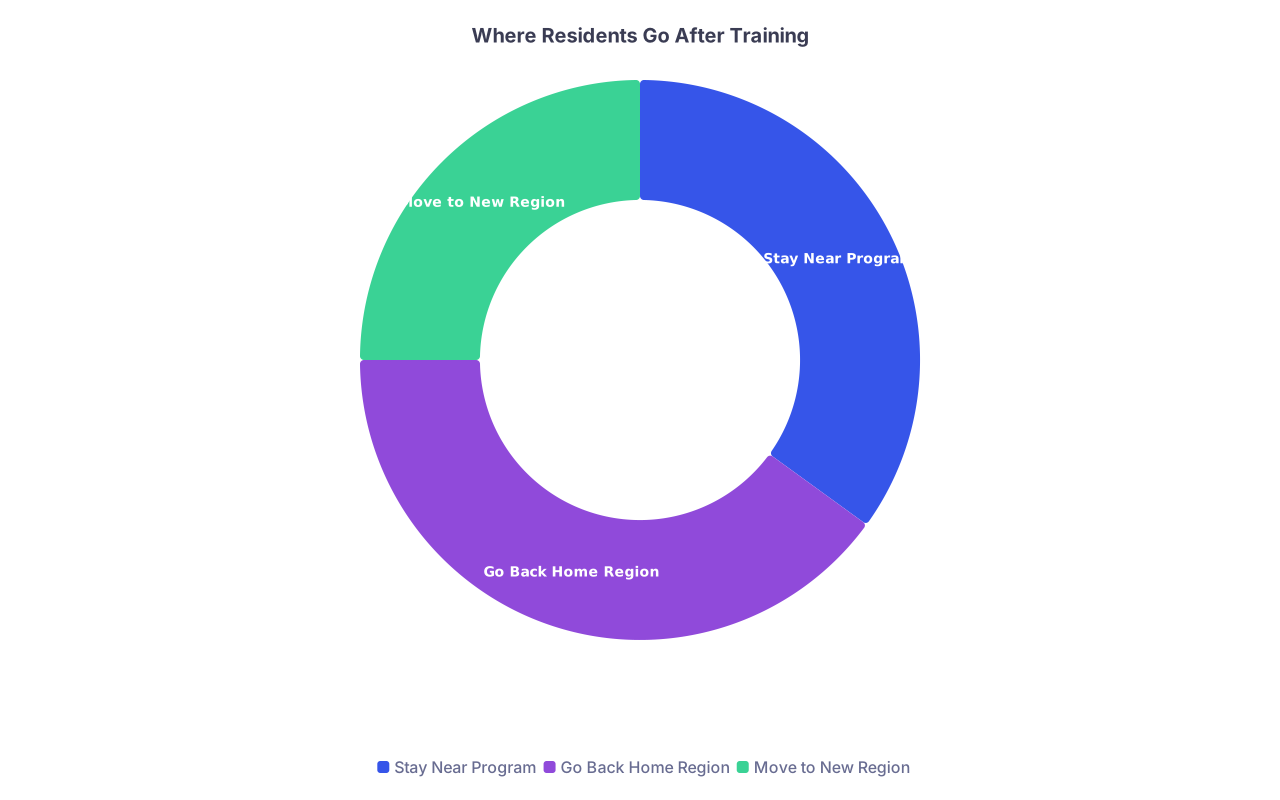
| Category | Value |
|---|---|
| Stay Near Program | 35 |
| Go Back Home Region | 40 |
| Move to New Region | 25 |
These aren’t official numbers from every program, obviously, but the pattern is common:
- A chunk stay local because a good job opens, or they set down roots.
- A big chunk head back “home region” once they’re marketable.
- Some seize the chance to try a completely new place, now that they’re not bound by the match.
The real keys that affect your ability to leave:
Your specialty
- Highly in demand ones (FM, IM, EM, psych) can move almost anywhere.
- Super competitive, niche procedural fields may have fewer spots, more networking needed.
Your reputation and skills
- Are you solid clinically?
- Do attendings trust you?
- Do you have anyone willing to call a future employer and say “This person is excellent, you should hire them”?
Whether you think ahead during residency
- Network at conferences in the region you want to end up in
- Line up away rotations/fellowships in your target area if possible
- Talk to grads who left and ask how they did it
I have watched residents match in places they hated and then:
- Go back to California after an IM residency in the Midwest
- Move from a cold northeast city to Texas for EM
- Leave a tiny town surgery program to an academic job in a major coastal city
So yes, you can get out.
Is it automatic? No. You can’t sleepwalk through residency, then snap your fingers and end up in your #1 dream city, #1 dream job. But you’re not chained to the place you matched.
Think of residency city as: “Where I’m building my launch pad.” Not “My forever home.”
What About Transferring Programs or Breaking Contract?
Here’s where your panic brain goes when it’s really overheating: “Maybe I can just transfer. Or back out. Or reapply. There has to be a way.”
Let me be very direct:
- Transferring for city preference alone is rare and hard.
- Breaking your Match commitment is a nuclear option. Programs talk. NRMP can sanction you. That can follow you.
Do transfers happen? Yes. I’ve seen:
- People change specialties (IM → Anesthesia, Surgery → Radiology, etc.)
- Folks leave for major family/health reasons and later land in a different program
- Programs that lose residents unexpectedly and quietly look for a PGY-2/3 from elsewhere
But almost never is it, “I don’t like this city. Can I go somewhere warmer?” That’s not going to sell to PDs who are giving up one of their precious spots.
If you’re truly in distress—like serious depression, unsafe situation, domestic violence, extreme family crisis—then you talk to:
- Your program director
- GME office
- A mental health professional
Sometimes there’s creative solutions: schedule adjustments, leaves of absence, or, in rare cases, a compassionate transfer. But those are extreme cases, not routine reshuffling.
For most people, the healthier mindset is: “I’m not banking on transferring. I’m going to treat this as my program and focus on making this livable.”
How Doctors Actually Cope in Cities They Hate
Let’s get tactical. Because “you’ll adapt” isn’t helpful when you’re staring at apartments in a place that makes you want to scream.
Here’s what I’ve seen actually help residents who landed somewhere they didn’t want:
1. Get ruthlessly practical about housing and commute
You cannot fix the weather. Or the crime rate. Or the fact that there is nothing open after 8 p.m.
But you can minimize daily misery.
- Prioritize safety over cool-factor. Seriously. If your spidey sense is off walking from your car to your building at night, that matters more than a cute coffee shop downstairs.
- Shorten your commute as much as you realistically can. That 10–20 minutes extra both ways, every day, when you’re exhausted… adds up.
- Don’t cheap out to the point you hate going home. You live there. Coming home to a depressing, dark, noisy, sketchy place makes everything feel worse.
This is where talking to current residents is gold. Ask them where they actually live, which complexes are quiet vs. hellish, which streets they avoid.
2. Front-load the “finding your people” part
You’re not going to like the city if you feel completely alone in it. That’s just how humans work.
So very early on, even in your first 1–2 months:
- Say yes to most PGY-1 social invites, even if you’re tired
- Make a point to grab coffee or a quick bite with co-residents you vaguely vibe with
- If you have a partner, help them plug into something: remote worker groups, gyms, volunteer stuff, local meetups
You don’t need 20 friends. You need like… 2. Two people you can text “Want to go to Target and complain about everything?” That’s enough.
3. Be brutally honest with yourself about mental health
If you already know you struggle with depression, anxiety, seasonal affective stuff, whatever—do not pretend that relocating somewhere that triggers you won’t matter.
From day 1 (or honestly, before you move):
- Identify a therapist in the new city or telehealth provider in your state
- Figure out how to access mental health through your residency benefits
- Decide in advance: “If X happens (e.g., I’m crying daily, I’m not sleeping, I’m having scary thoughts), I will reach out to Y person.”
You’re not weak if you hate the place. You’re not weak if the move shatters your baseline. You’re a human under extreme stress, doing a brutal job in an environment you didn’t choose.
4. Build tiny anchors of “you” into a city that doesn’t feel like you
A city you hate can make you feel like you don’t recognize your own life.
Your job: inject “you” back into it in small, almost stupid ways.
- If you love coffee, find one good shop and become a regular
- If you like lifting, join a gym you actually want to go to, not the cheapest dungeon
- If you love nature, locate the closest trail / park / even halfway decent walking loop and claim it
It’s easier to tolerate a city you dislike when you have specific pockets that feel like “mine.”
5. Quietly, systematically plan your escape route
Not in a dramatic, “I hate it here” meltdown way. In a calm, spreadsheet way.
Where do you want to end up eventually? Broadly. West Coast? Southeast? Close to your parents? Near your partner’s job?
Then start aligning little things toward that:
- Research fellowships or jobs in that region
- Go to a conference there if you can swing it
- Introduce yourself to alumni who ended up there: “Hey, I’m a PGY-2 at X program, considering moving to Y city after training. Can I ask how you did it?”
You don’t need a five-point master plan on day one. But even having a direction (“After this, I’m going back to the Pacific Northwest”) can make putting up with 3 years in a place you hate feel less pointless.
When the City Changes You (In Ways You Didn’t Expect)
One thing your anxious brain never gives any airtime to: you might not always hate it.
Not saying you’ll fall wildly in love with the place and never leave. But “despise” can easily turn into “tolerate” or even “we had some good years there.”
I’ve watched:
- People who dreaded rural programs discover they actually liked the slower pace, the outdoor stuff, the lower cost of living.
- Folks who hated big cities at first but then loved walking everywhere, the food, the anonymity.
- Residents who started off bitter about being far from family but ended up appreciating the independence.
And sometimes you hate the city the entire time—and still look back and say, “Those were horrible, but they made me tougher, and I’m proud I did that.”
You don’t have to be grateful for the place. But it might become part of your story in a way that feels less like a punishment and more like, “That’s where I sharpened my teeth.”
What You Can Actually Do Today
If you’re reading this in full-on panic mode, here’s something concrete you can do right now. Not someday. Today.
Open up a blank document or notes app and make three headings:
- Stuff I Can’t Control
- Stuff I Can Control in the Next 6 Months
- Where I Want to End Up After Training
Under:
Stuff I Can’t Control, write the things you keep obsessing about that you literally cannot change:
- The city you matched in
- The weather
- That your family is X hours away
- The length of your program
Look at that list and say, out loud if you have to: “I hate this, but I can’t change it. I’m allowed to feel upset, but I’m not going to spend all my energy fighting reality.”
Under:
Stuff I Can Control in the Next 6 Months, list tiny moves:
- Message 1–2 current residents and ask where they live and if they like it
- Look up at least 3 apartment complexes and list pros/cons
- Search for therapists in that city covered by your insurance
- Find 1 gym / 1 coffee shop / 1 park close to the hospital
- Block weekly video calls with whoever feels like “home” to you
And under:
Where I Want to End Up After Training, don’t be timid. Just write what you actually want:
- “Back near my parents in North Carolina”
- “A big coastal city with good food and an airport”
- “Somewhere warm where my partner can find a tech job”
You don’t have to know the exact job title. Just the direction.
That little exercise pulls your brain out of the white-noise panic of “I hate this city” and into: “Okay. This is where I am. This is what I can do while I’m here. This is where I’m heading afterward.”
You’re not the first person to match somewhere they didn’t want. You won’t be the last. And a surprising number of those people are now living in exactly the kind of place you’re afraid you’ll never reach.
Open that note right now. Write those three headings. Get the mess out of your head and onto something you can actually look at and work with.


