It's 11:47 PM on a Tuesday in late June. You just signed your first attending contract three weeks ago, a $340,000 base salary, $25,000 sign-on bonus, relocation package, the works. You're scrolling through your residency group chat when a colleague posts a screenshot: "Just got an email, board scores delayed until August 15th. Anyone else?" Your stomach drops. Your start date is July 1st. You pull up your contract and start reading the fine print with shaking hands. By midnight, you're Googling "healthcare contract attorney near me" instead of celebrating.
That panic is real. I've watched it happen to colleagues who did everything right in residency, passed every rotation, matched their dream job, negotiated a great salary, then watched it unravel because of a single overlooked clause about board certification timelines. This is not a hypothetical risk. It's a repeating, predictable disaster, and you're not immune just because you're a good doctor.
Disclaimer: This article is for educational purposes only and is not financial, legal, or tax advice. Contract terms, timelines, and outcomes vary significantly by employer, specialty, and state. If you are facing a contract issue, consult a qualified professional immediately.
The Midnight Wake-Up Call Every New Attending Dreads
Here's the trap, plain and simple: new attendings assume that graduating residency and passing their boards are simultaneous events. They are not. They are not even close to simultaneous for many specialties.
The American Board of Internal Medicine, the American Board of Surgery, the American Board of Pediatrics, they all have different score release windows. Some release in 4-6 weeks. Others take 8-12. A few lag longer. And none of them guarantee your score will arrive before your first paycheck clears.
Here's the scenario that keeps me up at night: You sign a contract in March or April. The contract language says your employment is "contingent upon obtaining and maintaining board certification or board eligibility." HR tells you verbally that "everyone passes, don't worry about it." You sign. You take your boards in May or June. You graduate residency on June 30th. July 1st rolls around, your first day as an attending. But your scores don't post until August.
The red flag you missed: That contract clause doesn't say "contingent upon passing." It says "contingent upon obtaining." Obtaining means having the certificate in hand. The certificate doesn't exist until the score is released, verified, and officially conferred. Until that moment, in the eyes of your employer, you are technically unlicensed for the purposes of that contract.
What happens next depends entirely on how the contract is written. In the worst-case scenarios, you get reclassified as an "unlicensed physician" or "pending provider." Your clinical privileges get suspended. Your malpractice coverage gets pulled. Your salary either gets reduced or frozen entirely until the board cert arrives. And your sign-on bonus? That's often a loan with clawback provisions. You might owe it back in full.
Don't be the person who finds this out from HR at 9 AM on their first day of work.
The Deadliest Mistake: Assuming Board Results Always Arrive on Time
Let me be blunt. Residents wildly underestimate the administrative buffer between "I finished my exam" and "my official certification exists." The boards are not a vending machine. You don't insert knowledge and receive instant certification.
Specialty boards operate on grading queues, psychometric validation, peer review of borderline scores, and administrative processing. A score that looks "ready" in the system on Tuesday might not get officially released until the following month. Pandemic-era backlogs taught us this the hard way. They also taught us that backlogs return without warning.
Danger zone #1: Scheduling board exams too close to July 1st. This is the single most common mistake I see. A resident thinks, "I'll just take boards in mid-June, have the whole summer to relax, and start fresh in August." Except your contract says July 1st. You've already committed. If your specialty's score release window is 6-8 weeks and you test on June 15th, you're looking at mid-August for results. That's a 45-day gap where you are technically unemployed, unboarded, and in default.
Danger zone #2: Booking a vacation right after residency without factoring in re-testing. Board exams are pass/fail, but they are not guaranteed passes. If you fail, most boards require a 30-90 day waiting period before a retake. Then add another 6-8 weeks for the second score release. You could be looking at October or November before your certification is official. Meanwhile, your new employer's patience has a hard limit written into paragraph 14, subsection B of your contract.
Danger zone #3: Trusting the "everyone passes" folklore. Pass rates vary wildly by specialty. Family medicine first-time pass rates hover around 95%. Some surgical subspecialties sit closer to 85-90%. Internal medicine is around 88-91%. That means 5-15% of your cohort will not pass on the first attempt. If you're in that group, the absence of a grace period in your contract becomes catastrophic.
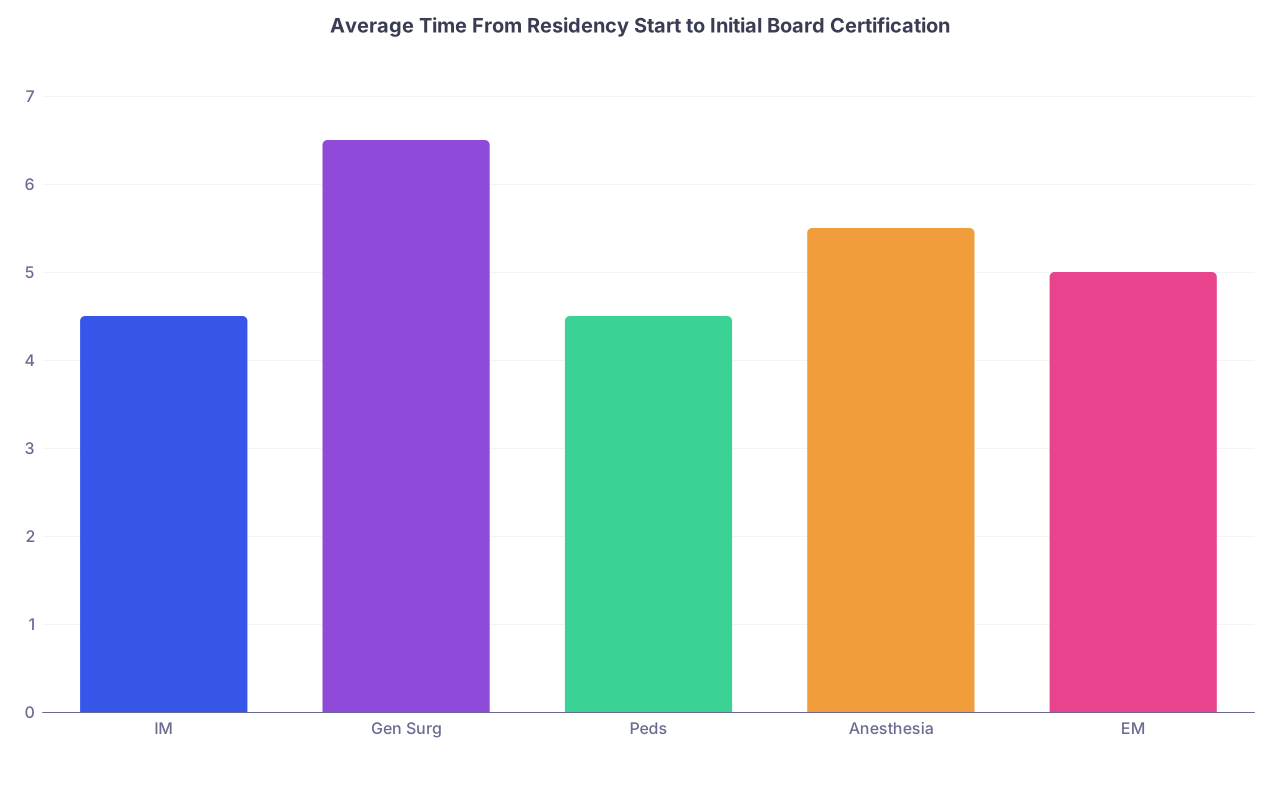
Look at that chart. The credentialing deadline often sits inside the score release window. That overlap is where defaults happen.
Anatomy of a Catastrophic Contract Default Clause
Let's read the contract language together, because most new attendings never do.
You'll see phrases like: "Employment is contingent upon the physician obtaining and maintaining board certification or board eligibility in [specialty] within [X] days of start date." Or worse: "Failure to obtain board certification within the specified timeframe constitutes a material breach of this agreement."
"Material breach" is a legal term. It is not a casual phrase. It means the contract is voidable at the employer's discretion. Once you're in material breach, several things happen simultaneously, and none of them are good.
Immediate financial fallout. Sign-on bonuses are typically structured as forgivable loans with a vesting period, usually 2-3 years. A material breach triggers immediate repayment of the unvested portion. That $25,000 you spent on relocation and a down payment? You owe it back within 30-60 days, often with interest. Base salary may be suspended, reduced, or withheld retroactively. Some contracts authorize the employer to claw back salary already paid during the period you were unlicensed.
Malpractice insurance nullification. Here's the part that scares me most. If your contract defaults and your employer pulls your malpractice coverage, you are practicing, or attempting to practice, without coverage. Any patient encounter during that gap becomes a personal liability exposure. If a patient sues, you have no insurer. You have no defense. You have no business being in a hospital.
Loss of hospital privileges. Privileges are tied to credentialing, which is tied to board certification status. Lose the cert status, lose the privileges. Lose the privileges, lose the ability to see patients. Lose the ability to see patients, and your employer has no use for you. That's when administrative leave, unpaid, kicks in.
This cascade is not theoretical. I've sat across from colleagues who went through it. The financial stress alone pushes some into bankruptcy. The career stress pushes others out of medicine entirely. Both outcomes are avoidable.
How to Bulletproof Your First Attending Contract Right Now
You have more power at the contract stage than you think. Most hospital systems expect negotiation on these clauses. Refusing to negotiate is the second biggest mistake new attendings make, after ignoring the timeline issue in the first place.
Step 1: Demand a "Board Results Grace Period" rider. This is the single most important protective amendment you can negotiate. The rider should specify a grace period, typically 90 to 180 days from your contract start date, during which delayed board scores will not trigger default, salary reduction, or privilege suspension. Get this in writing. Verbal promises from recruiters are unenforceable.
Step 2: Reframe "contingent upon obtaining" to "contingent upon sitting for and achieving a passing score." This subtle language shift protects you in cases of administrative delay versus actual failure. If you've passed but the certificate isn't issued yet, you're still in good standing under the contract.
Step 3: Negotiate sign-on bonus clawback terms. The standard 2-3 year vesting is reasonable. What is not reasonable is immediate repayment upon board delay. Push for a clause that excludes board-related delays from the repayment trigger, or at minimum extends the repayment window to 12 months.
Step 4: Clarify malpractice coverage during the gap. Your contract should explicitly state that malpractice coverage remains in effect during any grace period, regardless of board certification status. If it doesn't say that, the default assumption is that coverage ends when your certification lapses.
Step 5: Hire a healthcare attorney. Not a general business lawyer. Not your cousin who does real estate. A specialized healthcare attorney who reviews physician employment contracts for a living. They spot predatory default language in seconds. The cost is typically $500-$1,500 for a review. The cost of not having one reviewed can be six figures.

Don't let recruiters rush you. The "we need an answer by Friday" pressure tactic is a negotiation manipulation, not a real deadline. Legitimate employers give you at least 2-3 weeks to review. If they won't, that's a red flag about how the rest of the relationship will go.
Protecting Your Hard-Earned Attending Future
Here's the blunt version: you've spent 7-11 years of your life, hundreds of thousands of dollars in education costs, and untold personal sacrifice to reach this moment. The first attending contract is not the place to cut corners, skip legal review, or assume goodwill will protect you. Hospital systems are businesses. They protect themselves first.
Warning signs you should never ignore:
- Contract language using "obtaining" instead of "achieving a passing score"
- No grace period clause or grace period shorter than 60 days
- Sign-on bonus with immediate repayment trigger tied to certification
- Recruiter pressure to sign within 48-72 hours
- Vague language about "satisfactory credentialing" without defining criteria
- No explicit malpractice continuation clause during grace periods
Proactive steps to take today:
- Verify your specialty's average score release timeline directly with the board, not your program director, not your peers, the board itself
- Schedule your exam at least 8-10 weeks before your contract start date if possible
- Get a healthcare attorney contract review before signing anything
- Negotiate the grace period rider, even if you feel awkward asking
- Do not book any post-residency travel until your scores are officially released
Final caution: The recruiter is not your advocate. The HR representative is not your advocate. The medical staff office is not your advocate. Your advocate is your attorney and your own vigilance. Nobody else in that room is paid to protect your interests.
Key Takeaways:
- Never assume board score release dates align safely with your July 1st attending start date without verifying specialty-specific timelines.
- Predatory default clauses can force you to immediately repay your sign-on bonus and strip your clinical privileges if board eligibility is delayed.
- Always negotiate a 'Grace Period Rider' into your first contract to legally protect your salary and position in the event of administrative board delays.

You've done the hard part. You became a doctor. Don't lose the career you earned over a paragraph you didn't read. Get the contract reviewed. Negotiate the rider. Schedule the exam early. And never, ever sign under pressure without those protections in place.