
Board exam writers are not creative; they are predictable. Your job is to recognize their favorite imaging patterns before you are the one being tested at 2 a.m. in a silent testing center.
Let me break this down specifically. There are certain imaging patterns that show up again and again on ABIM, ABFM, ABS, neurology, EM, and subspecialty boards. You do not need to read an entire radiology textbook. You need to anchor on the “pattern + classic stem + default management” triads that the question writers love.
I am going to walk through the highest-yield recurrent imaging patterns you will see across specialties, not as a radiologist, but as a resident who has to answer questions fast and move on.
1. Head CT and MRI: The Boards’ Favorite Playground
Non-contrast head CT and a few classic MR patterns carry a disproportionate number of points. You should be able to name the pattern in under 3 seconds.
1.1 Hemorrhage Patterns You Must Nail
You will see these. Multiple times.
Epidural hematoma
Pattern:
- Biconvex / lens-shaped hyperdense collection
- Does not cross suture lines
- Often temporal region, associated with skull fracture
- Classically middle meningeal artery
Classic stem:
- Young patient with temporal head trauma
- Brief LOC → lucid interval → rapid deterioration
Board move:
- Answer: emergent neurosurgical evacuation (craniotomy)
- Do not pick “observe” or “repeat CT” if there is any sign of deterioration or mass effect.
Subdural hematoma
Pattern:
- Crescent-shaped hyperdense collection
- Crosses suture lines
- Can be acute (hyperdense), subacute (isodense), chronic (hypodense)
- Often over cerebral convexities
Classic stems:
- Elderly with fall, anticoagulated, gradual neurologic decline
- Shaken baby, abusive head trauma
Board move:
- Acute with mass effect/herniation: emergent neurosurgical evacuation
- Chronic in stable patient: planned burr hole drainage
Subarachnoid hemorrhage
Pattern:
- Hyperdensity in basal cisterns, sulci, circle of Willis
- CT can be normal if delayed; then the question flips to LP xanthochromia
Classic stem:
- Sudden “worst headache of my life”
- Photophobia, neck stiffness, maybe normal neuro exam
Board move:
- Initial test: non-contrast CT head
- If CT negative but suspicion high: LP for xanthochromia
- Once confirmed: CT angiography or digital subtraction angiography for aneurysm; neurosurgical or endovascular intervention; nimodipine to prevent vasospasm is the answer they want.
Intraparenchymal hemorrhage
Pattern:
- Hyperdense focus in brain parenchyma
- Locations matter:
- Basal ganglia (putamen): chronic hypertension
- Lobar: amyloid angiopathy in elderly
- Cerebellar or pontine: hypertensive, but with more catastrophic presentations
Classic stems:
- Uncontrolled HTN, sudden focal deficit
- Old patient with recurrent lobar hemorrhages → amyloid angiopathy
Board move:
- Recognize hypertensive ICH vs. amyloid angiopathy
- For pontine / cerebellar with rapid deterioration: neurosurgical vs. supportive based on location and mass effect; they often want “manage blood pressure aggressively” with nicardipine/labetalol and ICU care.
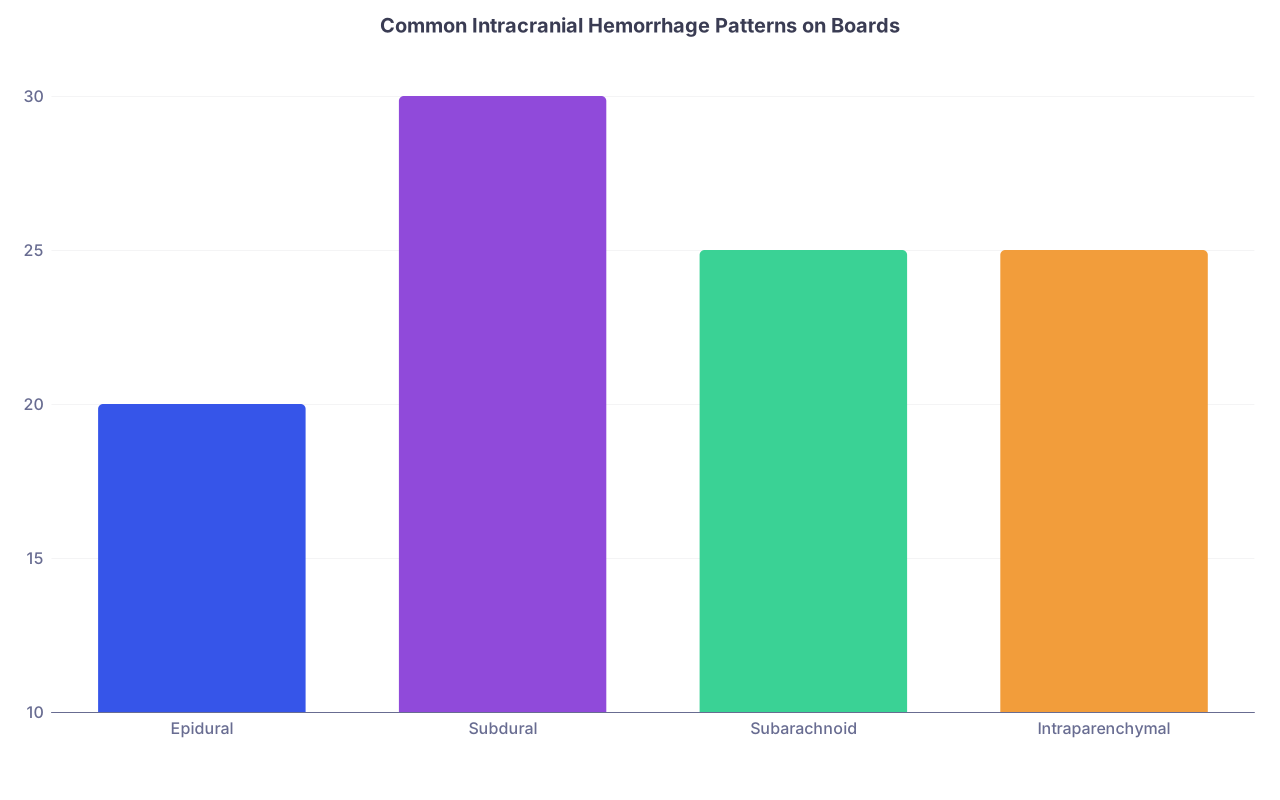
| Category | Value |
|---|---|
| Epidural | 20 |
| Subdural | 30 |
| Subarachnoid | 25 |
| Intraparenchymal | 25 |
1.2 Ischemic Stroke Imaging
Boards care less about subtle CT findings, more about what you do with a given imaging pattern and time window.
Non-contrast CT:
- Often normal in very early stroke
- Key use: rule out hemorrhage before tPA or thrombectomy
CT angiography:
- Large vessel occlusion: MCA “cutoff,” hyperdense MCA sign sometimes
- Posterior circulation occlusion: basilar or vertebral artery
MRI:
- Diffusion-weighted imaging (DWI) bright in acute infarct
- ADC dark in acute stroke (true diffusion restriction)
Classic board angles:
- Question: “First step” in stroke with unknown onset → non-contrast CT
- Question: tPA eligibility: time, blood pressure, glucose, hemorrhage exclusion
- Question: Large vessel occlusion imaging → CTA, then thrombectomy.
1.3 Classic Neuro Boards Patterns
Multiple sclerosis (MRI brain and spine)
Pattern:
- Periventricular ovoid lesions, often described as “Dawson fingers” radiating perpendicular from ventricles
- Infratentorial lesions, spinal cord plaques
- T2 hyperintense, FLAIR lesions, sometimes with gadolinium enhancement in active disease
Classic stem:
- Young woman with relapsing focal neurologic symptoms
- Blurry vision, internuclear ophthalmoplegia, sensory changes
Board move:
- MRI with gadolinium; lesions separated in time and space
- Answer disease-modifying therapy such as high-efficacy agents if progressive/active; but first-line boards classic: high-dose IV steroids for acute flare.
Brain metastases
Pattern:
- Multiple ring-enhancing lesions at gray–white junction
- Edema surrounding lesions
Classic stems:
- Known lung, breast, melanoma, RCC, colorectal cancer
- New seizures, focal deficits
Board move:
- If solitary and accessible: surgical resection ± radiation
- Multiple: whole-brain radiation or SRS depending on story; steroids for edema
2. Chest Imaging: Where Boards Hide Point-Heavy Questions
You will see chest X-rays and CT chest across IM, EM, ICU, surgery, and pulm boards. There are a handful of “must-recognize-in-2-seconds” patterns.
2.1 Pneumothorax, Tension Pneumothorax, and Your License
Simple pneumothorax (CXR)
Pattern:
- Visible pleural line
- No lung markings peripheral to that line
- Collapsed lung edge, absent vascular markings distally
Classic stem:
- Young tall male with sudden pleuritic chest pain (spontaneous)
- Post-line placement, trauma
Board move:
- Small, stable: oxygen and observation
- Larger or symptomatic: needle aspiration or small-bore chest tube depending on guidelines
Tension pneumothorax (CXR)
Pattern:
- Same as above + mediastinal shift away from affected side
- Depression of hemidiaphragm
- Distended intercostal spaces
Classic stem:
- Trauma or ventilated patient
- Sudden hypotension, tachycardia, JVD, tracheal deviation
Board move:
- Do not order imaging first. Immediate needle decompression followed by chest tube. The exam answer is the procedure, not the X-ray.
Massive hemothorax
Pattern:
- Near-complete opacification of one hemithorax
- Often mediastinal shift away or toward depending on volume/pressure
- Absent lung markings
Classic stem:
- Trauma, hypotension, dullness to percussion, decreased breath sounds
Board move:
- Large-bore chest tube
- If initial output ≥1500 mL or >200 mL/hr × 2–4 hours → thoracotomy (this exact number set appears frequently).
2.2 Classic Chest X-ray Patterns You Must Name
Congestive heart failure
Pattern:
- Cardiomegaly
- Cephalization of pulmonary vessels
- Kerley B lines (horizontal lines at lung bases)
- Perihilar “bat-wing” opacities
- Pleural effusions
Classic stem:
- Dyspnea, orthopnea, peripheral edema
- Acute pulmonary edema scenario
Board move:
- Recognize CHF vs ARDS (board-writer favorite confusion)
- CHF: cardiomegaly, pleural effusions, vascular redistribution
- ARDS: normal heart size, diffuse bilateral alveolar infiltrates
Pulmonary embolism (CT pulmonary angiography)
Pattern:
- Intraluminal filling defect in pulmonary artery or branches
- May show wedge-shaped peripheral opacities (Hampton hump), Westermark sign on CXR (usually board-only, not real life)
Classic stem:
- Post-op, OCP use, immobilization, malignancy
- Pleuritic chest pain, tachycardia, hypoxia
Board move:
- First test: CTA chest in stable patients
- If unstable and cannot get CTA: bedside echo or V/Q depending on context
- Massive PE with instability: thrombolysis or thrombectomy
Spontaneous pneumomediastinum
Pattern:
- Air outlining mediastinal structures
- “Continuous diaphragm sign”; subcutaneous emphysema in neck
Classic stem:
- Asthma exacerbation, Valsalva, forceful vomiting, trauma
Board move:
- Stable: oxygen, observation, treat underlying cause
- If concern for esophageal rupture: CT esophagram or water-soluble contrast swallow

2.3 Pulmonary Nodules and Masses
You are not trying to be a thoracic radiologist. Your job is to recognize “reassuring vs cancer until proven otherwise.”
Benign features of a nodule (CT)
Pattern:
- Small, well-circumscribed, central calcification or popcorn calcification (hamartoma)
- Stable size over 2+ years
Classic stem:
- Incidental 5 mm nodule in low-risk non-smoker
- Prior CT 3 years ago showing same size
Board move:
- Answer: No further workup or repeat CT at long interval depending on risk model.
Malignant features
Pattern:
- Spiculated margins
- Non-calcified or eccentric calcification
- Growth over time
- Size >8 mm in higher-risk patient
Board move:
- PET-CT, biopsy, or surgical resection depending on pretest probability
- Questions often require you to pick “low-dose CT surveillance” vs “biopsy” correctly.
3. Abdominal Imaging: CT Patterns That Scream the Diagnosis
You will see CT abdomen/pelvis patterns repeatedly. Most are surgical or high-acuity internal medicine problems.
3.1 Appendicitis and Mimics
Acute appendicitis (CT with contrast)
Pattern:
- Dilated, thick-walled blind-ending tubular structure from cecum
- Diameter >6 mm
- Periappendiceal fat stranding
- Possible appendicolith
Classic stem:
- RLQ pain migrating from periumbilical region
- Anorexia, low-grade fever, leukocytosis
Board move:
- Uncomplicated: appendectomy (laparoscopic)
- Perforated with abscess: percutaneous drainage + IV antibiotics, delayed surgery
Mesenteric ischemia
Pattern:
- Bowel wall thickening
- Pneumatosis intestinalis (air in bowel wall)
- Portal venous gas in severe cases
- Poor enhancement of bowel wall
Classic stem:
- Older patient with AFib or recent MI
- “Pain out of proportion to exam”
- Metabolic acidosis, elevated lactate
Board move:
- Immediate CT angiography
- Emergent surgical evaluation and revascularization
- Broad-spectrum antibiotics, resuscitation
3.2 Bowel Obstruction and Perforation
Small bowel obstruction (SBO)
Pattern:
- Dilated loops of small bowel proximal to obstruction
- Air-fluid levels
- Transition point with collapsed distal bowel
Classic stems:
- Prior abdominal surgery (adhesions)
- Hernias
Board move:
- Partial, stable: NPO, NG tube, IV fluids, watch
- Complete, strangulated (fever, leukocytosis, peritonitis, lactic acidosis): emergent surgery
Large bowel obstruction
Pattern:
- Markedly dilated colon, haustra that do not cross entire lumen (CXR/AXR)
- Transition lesion at tumor or volvulus
Classic stems:
- Old patient with weight loss, anemia (cancer)
- Younger with sigmoid volvulus: “coffee-bean” sign on X-ray
Board move:
- Sigmoid volvulus: flexible sigmoidoscopy detorsion first if no peritonitis
- Cecal volvulus or signs of ischemia/peritonitis: surgery
Free air / perforated viscus
Pattern:
- Air under diaphragm on upright CXR
- On CT: extraluminal free air, sometimes with contrast leak
Classic stems:
- Sudden severe abdominal pain, rigid abdomen
- History of PUD or recent NSAID overuse
Board move:
- Emergent surgery; do not waste time with more tests
- Broad-spectrum IV antibiotics, resuscitation

| Step | Description |
|---|---|
| Step 1 | Acute severe abdominal pain |
| Step 2 | CT abdomen with contrast |
| Step 3 | Emergent surgery |
| Step 4 | Targeted management |
| Step 5 | Ultrasound if RUQ or pelvic |
| Step 6 | CT if diagnosis unclear |
| Step 7 | Peritonitis signs |
| Step 8 | Free air or ischemia |
3.3 Pancreatitis and Its Complications
Acute pancreatitis
Pattern:
- Enlarged pancreas
- Peripancreatic fat stranding
- Fluid collections; sometimes necrosis (non-enhancing areas)
Classic stems:
- Epigastric pain radiating to back
- Elevated lipase/amylase
- Gallstones or heavy alcohol use
Board move:
- Recognition of necrotizing pancreatitis on CT → aggressive ICU-level care
- Pancreatic pseudocyst on later imaging (well-circumscribed fluid collection) → observation if asymptomatic; drain or surgery if symptomatic/complicated.
4. Musculoskeletal and Ortho Imaging: A Few Patterns Save You Many Points
You do not need to memorize every fracture classification, but there are patterns the boards absolutely love.
4.1 Ortho Emergencies You Must Not Miss
Septic arthritis (X-ray often normal early)
Pattern:
- Early X-ray may be normal or show joint effusion
- Later: joint space narrowing, erosions
Classic stems:
- Hot, swollen joint, fever
- IV drug use, prosthetic joint, RA, immunosuppressed
Board move:
- Always arthrocentesis first. Do not treat empirically before you aspirate.
Necrotizing fasciitis (CT / MRI)
Pattern:
- Gas in soft tissues along fascial planes
- Thickened fascia, fluid collections
Classic stems:
- Diabetic or immunocompromised patient
- Severe pain, systemic toxicity, rapidly progressive
Board move:
- Emergent surgical debridement + broad-spectrum IV antibiotics
- Do not pick “MRI first” in a clearly septic, unstable patient.
4.2 Classic Pediatric Imaging Traps
Slipped capital femoral epiphysis (SCFE)
Pattern:
- X-ray: posterior and inferior displacement of femoral head on neck
- Best seen on frog-leg lateral view
Classic stem:
- Overweight adolescent (esp. boys)
- Hip, groin, or knee pain, limping
- Limited internal rotation of hip
Board move:
- Non-weight bearing, bilateral pinning (they love “bilateral” because contralateral risk is high)
Developmental dysplasia of the hip (DDH)
Pattern:
- Early: ultrasound abnormal (not ossified yet)
- Later X-ray: shallow acetabulum, superolateral displacement of femoral head
Classic stem:
- Newborn, breech female, positive Ortolani/Barlow
- Asymmetrical skin folds, leg length discrepancy
Board move:
- Screening ultrasound for high-risk infants
- Pavlik harness in infants

5. OB, Gyn, and Pelvic Imaging: Ultrasound Patterns That Come Up Repeatedly
OB/Gyn exams and general boards heavily favor ultrasound. You should identify the pattern within two glances.
5.1 Early Pregnancy and Ectopic
Normal early intrauterine pregnancy (IUP)
Pattern:
- Gestational sac in uterine cavity
- Yolk sac, then fetal pole
- Cardiac activity by ~6 weeks
Classic board angle:
- Use β-hCG “discriminatory zone” (~1500–2000 mIU/mL for TVUS) to decide management.
Ectopic pregnancy
Pattern:
- No intrauterine gestational sac when β-hCG above discriminatory zone
- Adnexal mass ± yolk sac/fetal pole
- Free fluid in cul-de-sac if ruptured
Classic stems:
- First-trimester abdominal pain + vaginal bleeding
- Risk factors: prior ectopic, tubal surgery, PID
Board move:
- Stable, unruptured, small, no fetal cardiac activity, β-hCG below certain threshold → methotrexate
- Unstable, peritoneal signs, clear rupture → emergent surgery (salpingectomy)
5.2 Ovarian Pathology
Ovarian torsion
Pattern:
- Enlarged ovary
- Peripheral displacement of follicles
- Absent or decreased Doppler flow (but boards know it can be normal; still they emphasize reduced flow)
Classic stem:
- Sudden onset unilateral pelvic pain, nausea, vomiting
- Ovarian mass or enlarged ovary, often reproductive age
Board move:
- Emergent laparoscopy with detorsion
Ovarian cyst types
Rough pattern recognition:
- Simple cyst: anechoic, thin-walled, no septations → functional
- Dermoid (teratoma): complex with fat-fluid levels, calcifications (teeth)
- Endometrioma: “ground-glass” homogeneous low-level internal echoes
Board move:
- Simple small cyst in reproductive-age woman → observe
- Dermoid/endometrioma with symptoms or size → surgery (usually laparoscopy)
6. Vascular Imaging: Do Not Miss These in ICU and ED Style Questions
There are a few vascular imaging patterns that boards hammer.
6.1 Aortic Dissection
CT angiography
Pattern:
- Intimal flap separating true and false lumen
- Ascending aorta involvement = Stanford type A
- Descending only = type B
Classic stems:
- Sudden severe tearing chest or back pain
- Pulse/BP differential between arms
- New diastolic murmur, widened mediastinum
Board move:
- Type A: emergent surgery
- Type B uncomplicated: aggressive BP control (IV beta-blocker ± vasodilator)
| Type | Location Involved | Typical Management |
|---|---|---|
| A | Ascending ± descending | Emergent surgery |
| B | Descending only, distal | Medical BP control |
6.2 Deep Vein Thrombosis and Peripheral Arterial Disease
DVT (venous duplex ultrasound)
Pattern:
- Non-compressible vein
- Echogenic thrombus within lumen
- Absent color Doppler flow
Classic stems:
- Unilateral leg swelling, tenderness
- Recent surgery, immobility, malignancy
Board move:
- Start anticoagulation unless absolute contraindication
- If contraindication to anticoagulation + proximal DVT → IVC filter
Critical limb ischemia (arterial studies)
Pattern:
- On CT angiography: focal stenosis or occlusion
- On Doppler: monophasic low-flow waveforms distal to lesion
Classic stems:
- Pain at rest, ulceration, gangrene
- Diminished pulses, cool limb
Board move:
- Emergent vascular surgery consult
- Revascularization (endovascular or surgical) + antiplatelet therapy
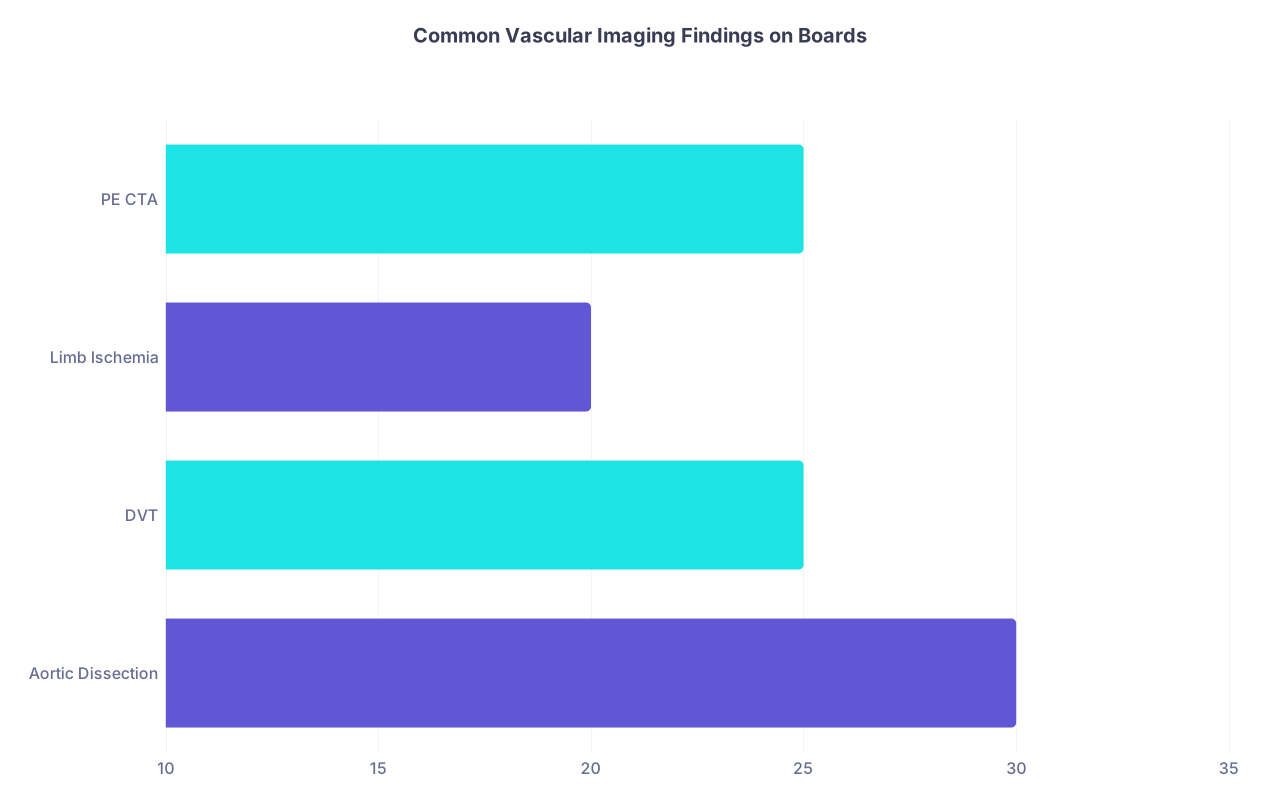
| Category | Value |
|---|---|
| Aortic Dissection | 30 |
| DVT | 25 |
| Limb Ischemia | 20 |
| PE CTA | 25 |
7. How To Actually Study Imaging Patterns for Boards
You already have too much to read. The trick is changing how you look at images, not adding hours.
Here is a practical system that works:
Pattern-first, not anatomy-first.
When you open a board review book or Qbank, ignore the text initially. Look at the image and force yourself to name the pattern in a sentence:
“This is a crescent-shaped extra-axial collection that crosses sutures” → subdural.
Then check the explanation. You are training a reflex.Build a mental “top 20” pattern deck.
Make a short list with one key phrase per pattern:- Lens-shaped bleed + temporal fracture → epidural
- Ring-enhancing brain lesions in HIV → toxoplasmosis vs lymphoma
- Air under diaphragm → perforated viscus
- Bowel wall pneumatosis + portal venous gas → mesenteric ischemia / impending necrosis
Review this list every few days in the last month before boards.
Use image-only drills.
Some Qbanks and resources let you filter to imaging questions. Use that. Do fast passes where you only answer based on the image and the prompt, before reading full stems.Tie each pattern to one management move.
Your brain remembers pattern + action better than pattern alone.- Tension pneumothorax → needle decompression now.
- Type A dissection → OR now.
- Ectopic pregnancy with free fluid and hypotension → emergent surgery.
- Sigmoid volvulus without peritonitis → endoscopic detorsion.
Accept that boards oversimplify.
Real life imaging is messy. Boards are cartoonish by comparison. Do not overthink: if an image looks stereotypical, it probably is.
FAQ (exactly 5 questions)
1. How many imaging patterns do I realistically need to memorize for internal medicine boards?
Roughly 30–40 core patterns will cover the vast majority of image-based questions: head CT hemorrhages, a few key MRI brain patterns, classic chest X-rays, basic CT abdomen emergencies, and staple vascular/OB ultrasound patterns. If you master the ones outlined above, you are not going to be surprised often.
2. Should I spend time learning detailed radiology language for the exam?
No. You do not need to sound like a radiologist; you need to recognize the pattern and pick the right next step. Focus on shape (lens vs crescent), distribution (periventricular vs cortical), and key associated features (midline shift, free air, fat stranding, Doppler flow). Reading full radiology reports is low-yield compared to targeted pattern recognition.
3. How do I deal with poor-quality or tiny images in the question interface?
Happens all the time. First, use any zoom tool the test software offers. Second, look for the obvious: where is the abnormal density or lucency, is there a shift, is there free air, is something missing (lung markings, joint space). If the image is genuinely unreadable, rely more heavily on the stem and pick the most consistent classic pattern.
4. Are MRI images high yield, or are CT and X-ray more important?
For most general boards, non-contrast head CT, chest X-ray, and CT abdomen dominate. MRI brain (for MS, tumors, and a few classic lesions) and spine appear, but far less frequently. For neurology and neurosurgery boards, MRI becomes central, but still revolves around a small number of recurring patterns.
5. What is the best way to integrate imaging review into my existing Qbank schedule?
Do not add a separate giant “radiology block.” Instead, for every question that includes an image, force yourself to study the image explanation carefully, even if you got the question right. Take 10–15 seconds to mentally label the pattern and restate the key management step. Over a few hundred questions, you will have seen the core patterns enough times that they become automatic.
Key takeaways: Board imaging is pattern recognition, not radiology training. Focus on the recurring shapes and distributions, link each to one default management move, and drill them quickly and repeatedly. If you can name the pattern in three seconds, the rest of the question usually falls into place.