
The myth that you need to be “scoring at your target score” before the real boards is wrong.
For most residents, you’re ready for the real exam when your practice tests are consistently in the passing range + a safety buffer, not when you’re magically hitting some idealized dream score.
Let’s cut through the noise.
The Core Rule: How Practice Scores Translate to the Real Exam
Here’s the blunt, practical version you actually need:
You’re generally ready to sit when you have:
- At least 2–3 recent practice exams at or above your target passing range,
- No catastrophic weak domain that repeatedly tanks sections, and
- Stabilized scores (not swinging wildly 20+ points between forms).
The exact number depends on the exam, so let’s anchor this in reality.
| Exam Type | Practice Target Before Real Exam | Notes |
|---|---|---|
| USMLE/COMLEX Level 3 | 5–15 points above passing | Focus more on blocks and fatigue than a specific 3-digit score |
| IM, FM, Peds, Psych Boards | 1 SD above passing cut on practice forms | Consistency > peak score |
| Surgical/Procedure Boards (written) | 5–10% above historical pass mark | Tool-specific norms matter |
Those are principles, not gospel. The real decision comes from pattern + trajectory, not a single score.
Forget One Score. Look at the Pattern.
You cannot call yourself “ready” based on one heroic practice test when you were well-rested, over-caffeinated, and on vacation.
You can call yourself close to ready if you see something like this:
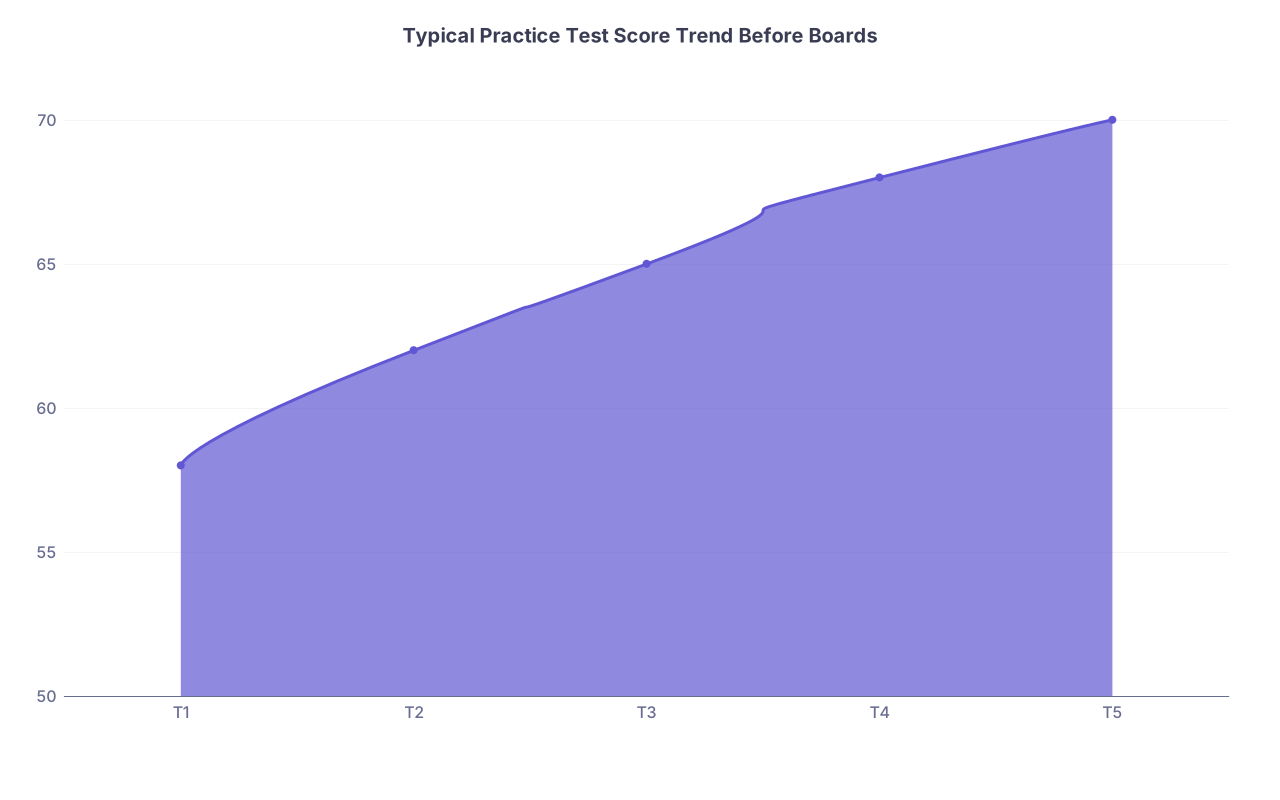
| Category | Value |
|---|---|
| T1 | 58 |
| T2 | 62 |
| T3 | 65 |
| T4 | 68 |
| T5 | 70 |
This is the trend you want: rising or plateauing at or above the passing threshold plus buffer.
Here’s the framework I use with residents:
Trend:
- Scores slowly rising or flat at a safe level? Good.
- Bouncing 55 → 72 → 58 → 74? That’s instability. You might know content but have test-taking, fatigue, or burnout problems.
Floor, not ceiling:
I care more about your lowest recent score than your best. If your last 3 tests are 66, 68, 70 and you need ~60% to pass, you’re probably okay. If they’re 70, 55, 69 – not okay yet.Time frame:
- Any exam you took more than 6–8 weeks ago is mostly motivational, not predictive.
- I want to see your last 2–4 weeks of data.
So if you’re asking “Am I ready?” pull your last 4 scores, write them down, and answer:
- Are they clustered around a safe number?
- Or are they chaotic?
That’s your first answer.
What “Safe” Actually Means (Passing + Buffer)
You don’t aim to barely scrape passing. That’s how you end up failing by 2 points and re-explaining everything to your PD.
You want a buffer.
For most written boards:
- Your target should be around 5–10 points (or ~5–8%) above the rough passing line on recent practice exams.
- If your exam uses scaled scores (e.g., 200 passing, 350 max), aim for about ½ to 1 standard deviation above passing on full-length practice forms, if the resource provides that.
Example scenario:
- Historical passing threshold: around 60% correct
- Good readiness target: consistent 65–70% on full-length, representative practice tests
Not once. Consistently.
Think of it like this:
- Minimum: You’ve demonstrated you can pass
- Buffer: You’ve demonstrated you can have a “bad day” and still probably pass
If your “good day” score is right at passing, your “call night before exam” version of you will probably fail.
Full-Lengths vs Question Banks: What Matters Most?
This is where people mess it up: they obsess over Qbank percentages and ignore test behavior.
Here’s the hierarchy that actually predicts readiness:
- Full-length timed practice tests from reputable sources
- Large mixed, timed blocks that mimic exam content distribution
- Untimed or heavily reviewed question bank sessions
You’re not taking a Qbank on test day. You’re taking a timed, mentally draining, multi-hour exam.
Use this mental model:
- Qbank average: “How good is my content base + pattern recognition?”
- Full-length practice test: “Can I actually perform under exam conditions for the full duration?”
If your Qbank average looks solid (say 60–70%) but your full-lengths collapse to the low 50s under time, you’re not ready. Yet.
How Many Practice Tests Before You Can Trust the Scores?
One practice test is a data point.
Two is the start of a line.
Three or more is an actual pattern.
If you’re trying to make a go/no-go decision:
- Minimum: 2 full-length practice exams, spaced at least a week apart
- Better: 3–4 full-lengths across your study period, with at least 2 in the last month
And don’t just look at the total score. Look at domains.

Ask:
- Am I consistently bombing the same section (e.g., endocrine, stats, psych, OB)?
- Do I have a repeated 15–20% gap in a domain that’s likely to be heavily tested?
You don’t have to be perfect in every area. But you can’t have a major section living at 30–40% correct while others are fine. That’s how borderline overall scores turn into failure when the real exam happens to be heavy in that weak area.
Common Score Patterns — And What They Mean
Let’s go through the patterns I see all the time.
Pattern 1: “Slow climb, then plateau above passing”
Example:
58 → 62 → 65 → 67 → 69 (passing line around low 60s)
If:
- The last 2–3 are at or above your buffer target, and
- No domain is catastrophically weak, and
- You’re not utterly exhausted or burning out
You’re probably ready or within 1–2 weeks of ready. Fine-tune, don’t reinvent your plan.
Pattern 2: “High variance, average above passing”
Example:
72 → 55 → 69 → 60 → 75 (passing ~60)
This screams instability. Could be:
- Wild schedule swings (post-call vs off days)
- Testing anxiety
- Time management issues
- Poor sleep or over-caffeination crash
Here, I’d tell you:
- You’re not yet safe.
- You need at least 2–3 stable scores above passing before walking in.
- Fix process: sleep, timing strategy, break use, nutrition, anxiety management.
Pattern 3: “Stable, but right at passing”
Example:
59 → 62 → 60 → 61 (passing ~60–62)
This is the danger zone. Everyone wants me to say, “You’re fine, go for it.”
I won’t.
You’re one bad test form away from failing. I’d push for:
- 2–3 more weeks if possible
- Targeted work on your lowest domains
- Another full-length aiming for that 5–10% buffer
If you absolutely can’t delay (contract, fellowship, GME policy), then you go in with eyes wide open, maximum focus on conditions (sleep, breaks, no extra shifts right before).
A Simple Decision Flow: Should I Sit or Postpone?
Here’s the stripped-down version of how I’d walk a resident through it:

| Step | Description |
|---|---|
| Step 1 | Last 2-3 practice tests |
| Step 2 | Postpone if possible and keep studying |
| Step 3 | Address sleep, timing, anxiety, repeat test |
| Step 4 | Target weak area 1-2 weeks, then reassess |
| Step 5 | You are reasonably ready to sit |
| Step 6 | At or above passing + buffer? |
| Step 7 | Scores stable, not wildly variable? |
| Step 8 | Any major domain <50% repeatedly? |
If you land at H, stop moving the goalposts on yourself. Perfect is the enemy of done.
How Close Are Practice Scores to the Real Thing?
Everyone wants a conversion formula. “If I get X% on Y test, what will I get on the real exam?”
There isn’t a clean rule that works for everyone, but here’s what I’ve seen in real humans:
- Most solid, well-designed practice full-lengths end up within about ±5 points (or ±5–7%) of the real thing for residents who:
- Take the practice tests seriously
- Simulate timing and breaks
- Don’t treat them like casual Qbank blocks
But the direction of the difference can go either way.
You’ll often see:
- Some residents underperform on practice (test anxiety improves when the “real thing” adrenaline hits).
- Others overperform on practice because they take it on an off day with perfect sleep and then walk into the real thing post-call and half fried.
That’s why the buffer exists. It’s not about predicting your exact board score. It’s about making a near-miss very unlikely.
What If My Practice Scores Are Still Low Close to the Exam?
If you’re within 2–4 weeks and your practice scores are not in the safe zone, you have three levers:
- Time (postpone or not)
- Intensity (how many hours and how focused)
- Strategy (what you’re doing with those hours)
If:
You can postpone without blowing up your job/fellowship/visa/etc
→ Strongly consider it if you don’t have at least one passing-level practice score yet.You can’t postpone
→ Then you stop hand-wringing about “am I ready” and move into maximize-every-day mode:- Mixed, timed blocks daily
- Focus review on recurrent weak domains
- One more full-length under true exam conditions to harden your stamina and timing
- Ruthless protection of sleep the final week

How Many Practice Tests Is “Too Many”?
Yes, there is such a thing.
If you’re cranking out full-lengths every 3 days, not deeply reviewing them, and your scores are flat or falling, you’re not “working hard.” You’re burning mental capital.
Healthy range:
- Full-lengths: 3–6 total in a study block
- Timing: About every 1–2 weeks, with 1–2 in the final month
The goal is to:
- Build stamina
- Test strategy
- Identify weak domains
Not to treat full-lengths as your primary learning method.
Quick Reality Checks Before You Call Yourself Ready
Before you lock in that exam date (or decide not to move it), answer these quickly and honestly:
Last 2–3 full-lengths:
- Are they at or above passing + buffer?
- Or are you “hoping” test-day adrenaline gives you a miracle?
Variance:
- Are your scores within a 5–7 point band?
- Or do they swing wildly?
Weak sections:
- Do you have any domain that’s chronically awful?
- Have you done targeted review and re-tested that area?
Stamina:
- Can you realistically sit for the full exam without your brain turning to mush halfway?
- Or are your last 2 blocks falling apart each time?
Life factors:
- Are you going into this with a reasonable week (not 6 nights of call, brand new baby, and moving apartments)?
If most of those line up, stop chasing perfection. Register, lock the date, do one more solid run-through of your plan, and then go take it.

FAQs
1. Do I need to be scoring above my “dream score” on practice tests to aim for it on the real exam?
No. You don’t need to be hitting your absolute dream score on practice to land near it on test day. Your target for readiness is usually a safe passing margin, not your fantasy percentile. If you’re consistently above passing + buffer and trending slightly upward, your real score will likely be in that neighborhood. Use dream scores for motivation, not as a pass/fail metric on readiness.
2. My Qbank average is high, but my practice tests are mediocre. Which one should I trust?
Trust the full-length, timed practice tests. Qbanks are great for learning, but they don’t fully simulate endurance, pressure, and decision fatigue. If your Qbank is 70% but your full-lengths are ~58% when you need ~60%, you’re not ready. You understand content but haven’t proven performance under real conditions yet. Fix timing, stamina, and strategy, not just knowledge.
3. How close to the real boards should I take my last practice test?
Usually 5–10 days before the real exam. That gives you:
- Enough time to deeply review mistakes and patch leaks
- Not so close that a bad score destroys your confidence the night before
Don’t take a full-length 1–2 days before. That’s recovery and light review time, not an all-out mental marathon.
4. What if my scores are slowly improving but I’m still a bit below passing two weeks before?
If scores are clearly trending up and you’re close (just below passing), you’ve got a decision:
- If you can postpone, another 2–4 weeks of focused, efficient study could legitimately move you into the safe range.
- If you can’t postpone, stop obsessing over the exact numbers and go all-in on targeted weak areas, mixed timed blocks, and optimizing sleep and schedule. But don’t pretend you’re in a safe zone – you’re taking a calculated risk.
5. How much can test-day adrenaline realistically boost my score?
Usually not as much as people hope. For most residents, the difference between practice and real scores is in the ±5 point / ±5–7% range. Some do a bit better, some worse. If you’re counting on a 15–20 point miracle jump, that’s not adrenaline – that’s denial. Plan so that even a slightly worse performance than your recent practice tests would still land you in passing territory.
6. Is failing a practice test a sign I’ll fail the real thing?
One failed or bad practice test? No. That’s a data point, not destiny. Look at:
- Your overall pattern over several tests
- Whether that bad day was due to exhaustion, distraction, or serious knowledge gaps
If multiple recent full-lengths are at or below failing, then yes, that’s a red flag. You should assume you’re at high risk on the real exam and either delay or radically adjust your prep and life setup before test day.
Key takeaways:
- You’re ready when your recent full-length practice tests are consistently at or above passing + a buffer, with no catastrophic weak domain.
- Look at patterns and stability, not one heroic best score.
- If you’re still borderline and have the option: more time + smarter strategy is almost always better than gambling on “maybe I’ll get lucky” on test day.