
The usual advice about question banks for boards is confused. You don’t need five Qbanks. You probably don’t even need three. Most residents should commit hard to one primary Qbank, then add a second only if it serves a specific purpose.
Let’s be blunt: the resident who hops between four different question banks “to cover everything” is usually the one burning out and scoring average. The resident who ruthlessly masters one high‑quality bank, reviews their mistakes properly, and maybe uses a targeted second bank—that’s the person walking out of the exam saying, “Yeah, that felt fair.”
Here’s how to decide what you should do.
The Short Answer: One Qbank Is Enough for Most Residents
If you want the simple rule:
- For most residents: One good, comprehensive question bank is enough
- Add a second only if:
- Your primary bank is weak for your exam or specialty
- You’re significantly below target on practice assessments
- You’ve fully exhausted your main bank (and reviewed it well) and still have time and mental bandwidth
Trying to juggle three or four Qbanks is almost always a mistake. You’re not a full-time test taker—you’re a resident with call, notes, and life. You don’t have infinite cognitive bandwidth.
What matters more than “how many Qbanks” is:
- Are you using at least one high‑quality, exam‑style bank?
- Are you reviewing explanations and consolidating learning, or just clicking through questions?
- Are you tracking weaknesses and revisiting them deliberately?
If those three aren’t happening, adding more Qbanks is like adding more dumbbells when your form is trash. It looks productive. It isn’t.
Pros and Cons: One Qbank vs Multiple
Let’s lay it out cleanly.
| Approach | Main Benefit | Main Risk |
|---|---|---|
| Single Qbank | Deep familiarity with style and content | Possible blind spots if Qbank is weak |
| Two Qbanks | Broader exposure, style variety | Time overload, shallow review |
| 3+ Qbanks | Huge question volume | Fragmented, inefficient, high burnout |
Using One Primary Qbank
Why one Qbank works so well:
- You quickly learn the style and patterns of the questions
- You can realistically finish it with proper review, not just “see” all questions
- You’re more likely to reset and redo blocks, which is where the real learning happens
- You keep one set of flags, notes, and performance data in one ecosystem
This is what I recommend for the majority of residents, especially:
- Busy inpatient months
- Residents with kids or heavy responsibilities
- People who historically struggle with focus or consistency
One Qbank mastered > three Qbanks sampled.
Using Multiple Qbanks
When is multiple Qbanks actually smart?
- You’re taking a very high‑stakes exam (e.g., board certification you can’t afford to fail)
- Your first Qbank isn’t great or is obviously misaligned with the blueprint
- You’re already doing well but aiming well above passing (e.g., for fellowship competitiveness, in‑training exam rankings, or personal pride)
The upside of multiple Qbanks:
- You see different question styles and phrasings
- You fill content gaps one vendor might miss
- You avoid the false confidence of “I’ve seen this question before”
The downside, which I see constantly:
- Residents half-finish three banks, review nothing deeply, and still feel anxious
- People blow time on “number of questions done” instead of learning from them
- Burnout spikes when they’re trying to cram 4,000–5,000 questions around call
So yes, multiple Qbanks can help—but only when your fundamentals (discipline, review method, time control) are already solid.
How to Decide: One or Several? A Simple Framework
Use this stepwise approach. Don’t overthink it.

| Step | Description |
|---|---|
| Step 1 | Start |
| Step 2 | Pick best primary Qbank and commit |
| Step 3 | Stick with one, focus on review |
| Step 4 | Intensify review of wrongs and weak topics |
| Step 5 | Add targeted second Qbank or assessments |
| Step 6 | Have you fully used one strong Qbank? |
| Step 7 | Are practice scores below goal? |
| Step 8 | Do you have 4-6 weeks and energy left? |
Step 1: Pick a Primary Qbank and Commit
Don’t start by juggling three. Start by answering:
- Which Qbank is most aligned with my exam (ABIM, ABFM, ABS, ABEM, etc.)?
- Which one has high-yield explanations, not just answer keys?
- Which one my seniors, fellows, or program director actually recommend based on results?
Once chosen, mentally commit: This is my core resource.
Step 2: Actually Finish Your Primary Qbank (Correctly)
“Finishing” doesn’t mean: “I clicked through all the questions once.”
It means:
- You did all or nearly all questions in timed, exam-style blocks
- You reviewed every explanation, not just the ones you got wrong
- You flagged:
- Concepts you truly didn’t understand
- Guess-corrects that felt shaky
- High-yield “this always shows up” topics
- You revisited your weak topics using:
- Notes / flashcards
- Review blocks focused on weak categories
- Re-doing selected questions or even the whole bank (if time allowed)
If you haven’t done that, you don’t need another Qbank. You need to use your current one better.
Step 3: Check Your Trajectory with Practice Assessments
Before you buy another Qbank:
- Take at least one decent practice test that mimics the real exam
- Look at:
- Overall score vs your pass goal
- Which domains are lagging
- Whether your issue is:
- Knowledge gap
- Test-taking / timing
- Fatigue / attention
If you’re close to your target and moving up—stick with one and refine. If you’re flat or low, then we talk about adding things.
When a Second Qbank Actually Makes Sense
Here are the specific scenarios where I’d say “Yes, add one more.”
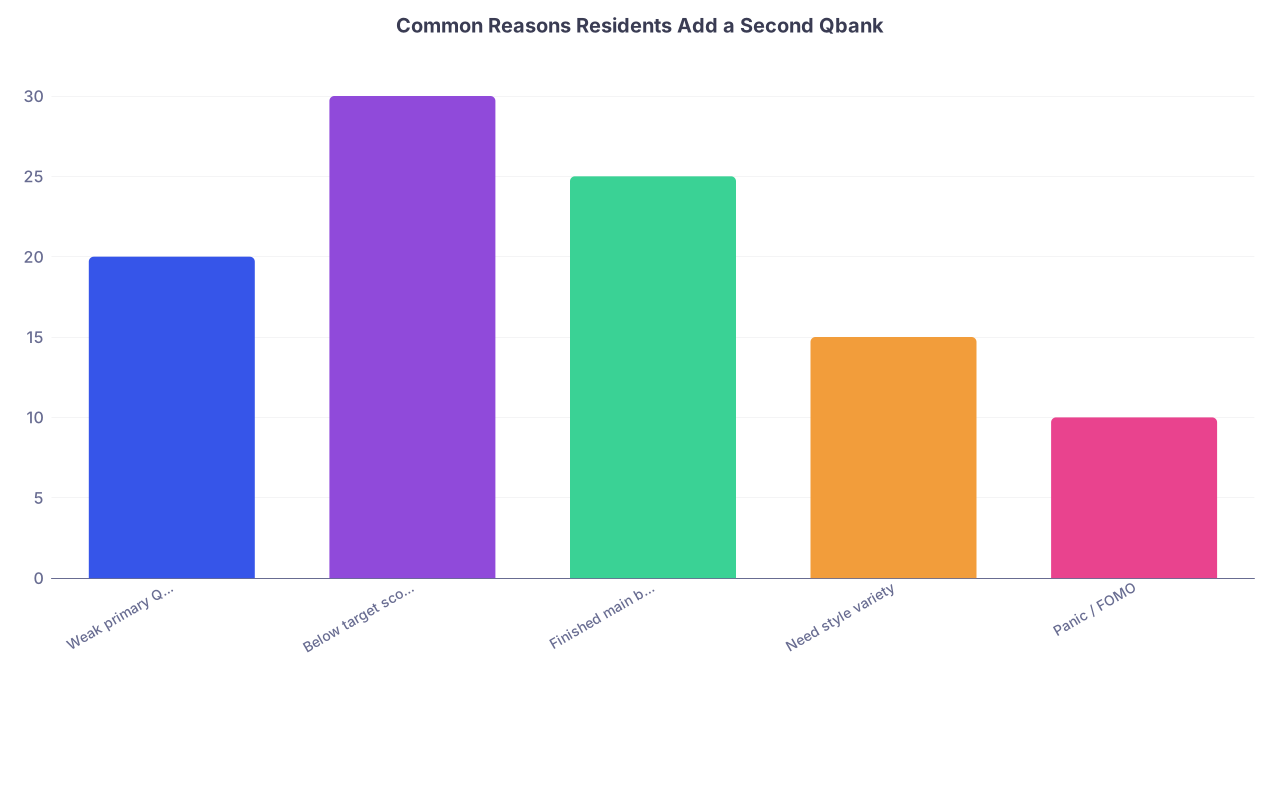
| Category | Value |
|---|---|
| Weak primary Qbank | 20 |
| Below target scores | 30 |
| Finished main bank early | 25 |
| Need style variety | 15 |
| Panic / FOMO | 10 |
1. Your Primary Qbank Is Clearly Weak or Mismatched
Examples:
- You’re studying for ABFM, but your Qbank is essentially generic internal medicine with little outpatient nuance
- You’re a surgery resident using a medicine-heavy bank that doesn’t touch enough operative decision-making
- The explanations are shallow (“Correct. Aspirin is used for this.”) with no teaching
In that case, don’t just add a second—replace or supplement with something exam-specific.
2. Your Practice Scores Are Well Below Where They Need to Be
You’ve:
- Finished most of a respectable Qbank
- Reviewed explanations reasonably
- Taken at least one or two practice forms
- Still scoring meaningfully below your target
Then a second Qbank can:
- Give you new question exposure
- Hit content areas your first bank under-emphasized
- Force you to think in a different style, which is closer to real boards
But this only works if you review just as seriously. If you’re too tired or too busy to review, more questions are just noise.
3. You Finished Your Primary Qbank Early and Still Have Time
You started early (good for you), knocked out your main Qbank, and now you’ve got:
- 4–8 weeks left
- Capacity for 20–40 questions most days
- No massive knowledge gaps
In that case, a second Qbank is a good way to keep your brain in test mode, as long as you prioritize:
- Timed blocks
- Focused review on surprises or misses
- Not obsessing over “finishing the whole thing” again
Who Should Stick to One Qbank (And Not Feel Guilty About It)
You’re not weak or lazy for using one primary Qbank. For a lot of residents, it’s just reality.
You should lean into a one-Qbank strategy if:
- You’re on heavy clinical months (ICU, nights, ED-heavy rotations)
- You’re consistently tired, behind on sleep, or sliding toward burnout
- You have family or caregiving responsibilities that limit your bandwidth
- You historically do better with depth over breadth
Your priority moves from “maximum number of questions” to:
- Tight daily routines (e.g., 10–20 questions on workdays, 40–60 on lighter days)
- Ruthless review discipline
- Using practice exams to check that you’re safely above the pass threshold
Residents in this camp often do just fine—and sometimes outperform the “over-Qbanked” crowd—because they actually process what they’re doing.
How to Use Multiple Qbanks Without Wasting Your Time
If you are going with more than one, do it strategically, not chaotically.
Don’t Run Them in Parallel from Day One
The worst model is:
- “I’ll do 10 questions from UWorld, 10 from TrueLearn, 10 from BoardVitals, 10 from random free bank…”
You end up:
- Resetting to new interfaces repeatedly
- Never developing comfort with any one style
- Losing time bouncing between platforms
Better model:
- Phase 1 (Foundation): One primary Qbank, 70–100% completed, with serious review
- Phase 2 (Reinforcement): Second Qbank or additional assessments, focusing on:
- Weak domains
- Question styles that feel harder
- Timed, full-length practice blocks
Use Each Qbank for a Different Job
Example in IM:
- Qbank A (e.g., UWorld): Core knowledge, main learning engine
- Qbank B (e.g., MKSAP Qs, TrueLearn): Board-style phrasing variety, outpatient nuance, repetition
For EM:
- Qbank A: Core ABEM blueprint coverage
- Qbank B: Image/ECG-heavy or trauma-heavy supplement if that’s a weak area
You’re not just doubling volume; you’re dividing roles.
Practical Daily Strategy (Regardless of How Many Qbanks)
Whether you have one or two Qbanks, your method matters more than the number.
Aim for:
- Timed blocks (even 10–15 questions) rather than casual untimed clicking
- Review that includes:
- Why the right answer is right
- Why each wrong answer is wrong
- One or two key “takeaways” per missed question
- A way to capture and revisit:
- Flashcards (Anki or simple digital cards)
- A running Google Doc or notebook by system/topic
- Tagged “marked” questions to redo later
If your life is hell that week (call, codes, disasters), scale the number of questions down. Don’t drop the habit completely. Consistency beats heroic single-day marathons.
One or Several? What I’d Tell You Face-to-Face
If you were sitting in my call room asking this, I’d say:
- If you’re asking because everyone else seems to have 3 Qbanks:
Use one. Stop comparing. Do it well. - If you’ve already crushed one bank, still feel shaky, and have a month or two:
Add a second, targeted. But only if you’ll truly review it. - If your program or specialty exam is notorious (failures hurt, remediation is brutal):
Use one main and one secondary—planned, not panic-added 3 weeks before.
The mistake isn’t “one vs several.” The mistake is using question banks as a security blanket instead of a learning tool.
FAQs
1. Is it bad if I only use one Qbank for my boards?
No. If it’s high quality and you use it properly—timed blocks, full review, repeated exposure to weak areas—one Qbank is completely reasonable. Many residents pass with margin using just one primary resource plus a couple of practice exams.
2. How many total questions should I aim to do?
For most core boards (IM, FM, EM, peds, etc.), somewhere in the 2,000–4,000 question range is typical across one or two banks. But “questions done” is not the prize. If you blast through 5,000 questions with shallow review, you’d have been better off doing 2,000 carefully.
3. If I’m short on time, should I start a second Qbank or redo questions from my first?
Redo your first. Repeating questions you missed (or guessed) with focused review will solidify patterns faster than brand-new low-yield questions you don’t have time to properly process. A second Qbank under time pressure usually just adds stress.
4. Should I switch Qbanks if I don’t like the one I started?
If “don’t like” means the interface is annoying but the content is strong—no, stick with it. If “don’t like” means explanations are thin, topics are off-blueprint, or seniors consistently say it underperforms for boards—yes, consider switching early rather than limping along with a weak core resource.
5. How do I know which Qbank is best for my specialty?
Ask one level up: PGY‑3s, chiefs, or recent grads who just took the exam. Ask, “What Qbank actually moved the needle for your score?” Focus on resources with: strong alignment to your board blueprint, deep explanations, and a track record in your specific specialty—not just whatever has the prettiest website.
Key points:
- Most residents should master one strong Qbank first before even thinking about a second.
- Add a second Qbank only for clear reasons: weak primary bank, low practice scores, or extra time after finishing your main one.
- Depth of review beats raw question volume. One Qbank used well will outperform three used poorly.