
The dirty secret about “protected board study time” is this: it’s rarely about fairness and almost never about educational ideals. It’s about leverage, numbers, and who the program cannot afford to lose.
Let me walk you through what actually drives whether you get real board study time, fake “lip service” time, or nothing at all.
What “Protected Time” Really Means To Your Program Director
Program directors love to say “We support our residents’ board prep.” On paper, nearly every program claims this. In reality, there are four very different levels of “support,” and they are not equal.
Here’s how PDs think about it behind closed doors:
True protected time
Clinic blocked. You’re not on busy inpatient. Pager off or handed to a co-resident. You’re scheduled on an easier rotation or explicitly on a “board prep” block. If you disappear for 3–4 hours a day to do questions, nobody is asking where you are. This is rare. And expensive for the program.Soft protected time
Officially: “You’ll have afternoons for study.”
Practically: nurses still page you, you still admit, attendings still round whenever they want. You’re supposed to study “when things are quiet,” which is code for “on your own time if the floor doesn’t implode.”Token gestures
Weekly “board review conference,” maybe a question-of-the-day email, access to a question bank. Call schedule and rotation intensity stay exactly the same. Zero structural change to your work.Nothing but vibes
You’ll hear: “Just do questions throughout the year,” or “Call me if you’re struggling.” No dedicated curriculum, no time, no expectation the schedule adjusts.
Here’s the part residents don’t see: giving even two weeks of true protected board time to a full class can completely wreck the service coverage grid. Somebody has to admit, cross-cover, answer pages, staff clinics. So when PDs decide who gets what, they’re making a cold calculation: “Can we afford to pull this person from clinical production without the hospital screaming at us?”
And that’s where things get unequal fast.
The Six Factors That Quietly Decide Who Gets Board Time
Some of this you can’t control. Some of it you absolutely can. But pretending it’s random is naïve.
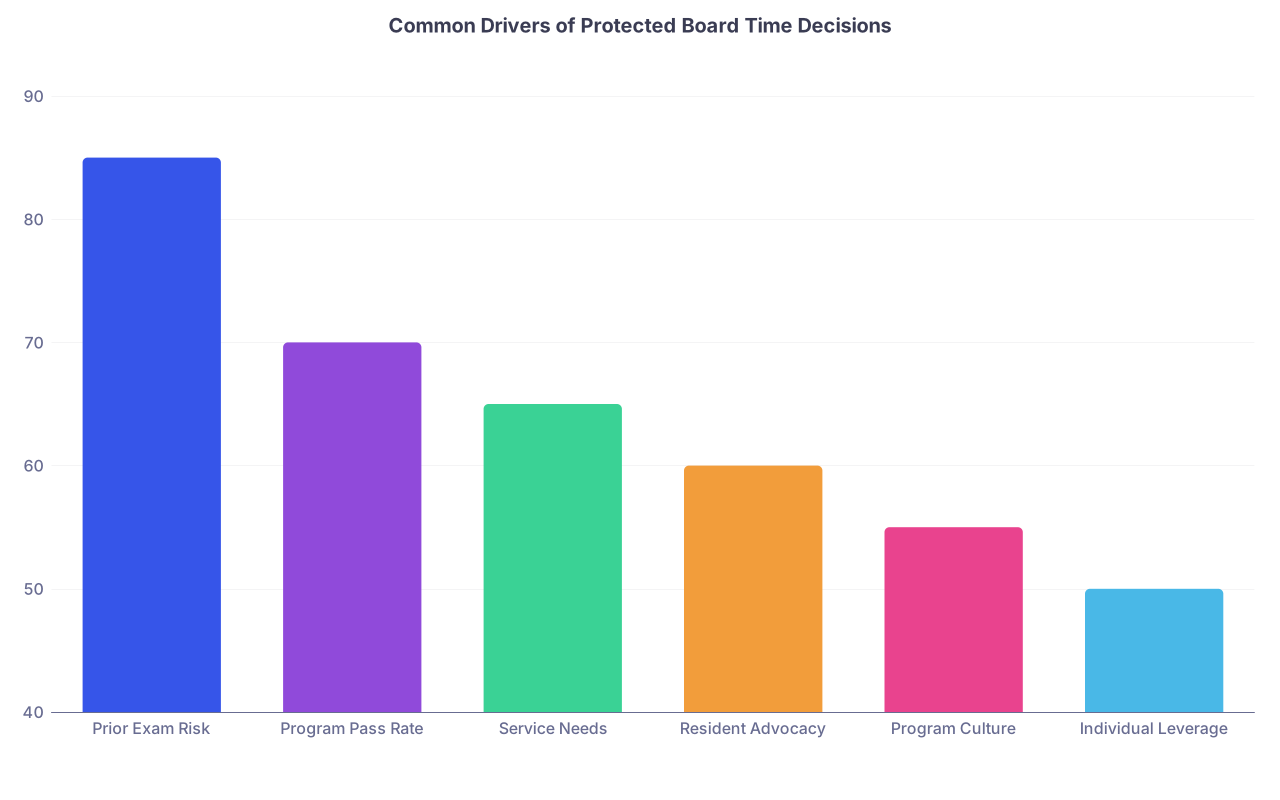
| Category | Value |
|---|---|
| Prior Exam Risk | 85 |
| Program Pass Rate | 70 |
| Service Needs | 65 |
| Resident Advocacy | 60 |
| Program Culture | 55 |
| Individual Leverage | 50 |
1. Your Program’s Board Pass Rate Problem
Programs do not care about your board exam out of pure compassion. They care because the ACGME and their specialty board track aggregate pass rates. When that number drops, the PD gets panicked emails and site visitors.
Here’s how conversations actually sound at Clinical Competency Committee (CCC) meetings:
“Our 3-year rolling pass rate just dropped to 85%. If it hits 80%, we’re on notice.”
“Who are our at-risk seniors? Can we pull them off nights in March and April?”
If a program has had a string of failures, suddenly you see miracles:
- “Board review electives” appear for PGY-3s or PGY-4s
- Senior residents get pulled off call for a month pre-exam
- Clinic schedules lighten mysteriously in May/June
If the program’s pass rate is sky-high? You’ll get less structural help. They already look good on paper.
So:
- Low pass rate program → more likely to give structured, protected time, but often only for those they think might fail.
- High pass rate program → more likely to assume “You’ll be fine” and push service.
2. Your Individual Risk Profile (As They See It)
They’re not supposed to say it out loud, but they absolutely stratify you by “board risk.” And they act on it.
They look at:
- Your in-training exam (ITE) scores
- Step 2 CK or COMLEX Level 2 performance
- Any past failures or near-failures
- Your pattern: do you improve annually, or stagnate?
Here’s the unvarnished truth:
If you’re scoring near the bottom of your class on ITEs, you’re far more likely to get real board time than the star resident crushing everything. Because you are a potential statistic. A red dot on their pass-rate graph.
I’ve watched this happen repeatedly:
- A PGY-3 IM resident with multiple ITEs below the 30th percentile gets an entire “exam prep” elective, removed from call and night float for 4 weeks before the ABIM.
- Another resident in the same class, ITE > 80th percentile, gets nothing extra. “You don’t need it. You’ll be fine.”
Is that fair? No. Is it logical from the PD’s perspective? Completely.
You want to know if they’ve already tagged you as “high risk”? Check how they talk to you in your semiannual meeting:
- If they’re quoting your ITE percentile and saying “We want to give you some extra support,” you’re on that list.
- If they just say “Good job, keep it up,” they’re not worried—and they’re unlikely to change your schedule.
3. Service Coverage and How “Replaceable” You Are
This is the one people don’t like hearing.
Protected time is expensive for the system. When you study, someone else works. That “someone” is usually:
- A co-resident
- A moonlighter
- An attending picking up more work than they want
So the question behind the scenes is: “Can we afford to pull you out?”
Examples:
- Small community IM program with barely enough residents to staff wards and ICU → almost no one gets real protected time. They literally can’t spare a body.
- Large university program with prelims, TYs, NPs, fellows, and hospitalists → much easier to carve out blocks for certain residents.
But it’s more specific than that. If you’ve made yourself indispensable on a high-volume service—say you’re the senior everyone trusts on a notoriously understaffed cardiology service—pulling you out hurts. A lot. It’s easier to protect the quiet PGY-3 on an outpatient-heavy track than the alpha resident who runs the ICU like a machine.
In practice, that looks like:
- Outpatient continuity clinic blocked or reassigned
- Easier electives rearranged for board-prep month
- Night float rebalanced so an at-risk senior gets days during the key period
The ICU senior? Often left to fend for themselves.
You can’t change your program’s staffing matrix. But you can avoid being the person who never says no and always volunteers to fill the worst coverage gaps. Those residents get praised to their faces—and sacrificed when it’s time to protect someone.
Why Some PGY-3s Get A Board Elective And You Don’t
Let me spell out what actually happens when the PD and chiefs sit down to plan PGY-3/4 schedules.
They’re looking at three things in combination:
- ITE trend lines
- Desired fellowship or career paths
- Who’s already done their “service penance”
They pull up a screen with everyone’s scores and schedules. The discussion sounds roughly like this:
“We need at least 2 seniors on wards in May because of graduations.”
“X and Y are high risk for boards. Let’s slide them from wards to clinic/elective that month.”
“Z wants cardiology fellowship and is solid on boards. Keep them on CCU. It looks good and they can handle it.”
So:
- The at-risk resident gets a lighter May/June.
- The gung-ho fellowship applicant gets the heavy cardiology or ICU block.
- Both might be equally strong clinically, but only one is perceived as a risk to the board pass rate.
And then there’s the “politics” layer.
4. Who Advocates For You (And How Early)
Some residents quietly arrange their own board time by being proactive six to nine months ahead.
The ones who get protected time are usually not the ones emailing the PD in May saying, “My board exam is next month, can we talk about lightening my schedule?” That’s dead on arrival.
The successful ones do this:
- In the winter of PGY-2 or early PGY-3, they meet the PD one-on-one.
- They show their ITE scores, their target exam date, and a concrete plan.
- They ask for a specific block: “Can we make my April an outpatient-heavy month so I can finish my question bank?”
That sounds “organized” and “serious” to a PD, not needy. And by then, schedules are still flexible.
I’ve watched PDs bend over backwards for residents who:
- Were consistently reliable on service
- Had clearly articulated board prep plans
- Came with a solution (“I talked with Dr. Smith and he’d be fine if we swapped my March and April electives.”)
In contrast, the chronic complainer who always feels mistreated and never has a plan? They get little. Everyone is tired of their drama by PGY-3.
Program Culture: The Hidden Variable No One Reads In Brochures
Two IM programs, both “mid-tier,” 20 residents per class.
On the website, both state: “We are committed to our residents’ success on the ABIM exam, with a comprehensive board review curriculum and protected time.”
Reality:
Program A (University-affiliated, education-focused):
- PGY-3s get a dedicated “board review” elective month, no nights, minimal weekends.
- Noon lectures switch to question-based review six months before exams.
- Chiefs quietly tell attendings, “Let the seniors out by 4 p.m. when possible—they’re in crunch time.”
Program B (Service-heavy, hospital revenue–driven):
- “Board review” is a once-a-month noon conference. Half the residents miss it because they’re admitting.
- Seniors are on nights and ICU right up until the exam.
- Any talk of “light call” gets shot down with “We need bodies.”
On interview day, both programs will show you a slide with “ABIM Pass Rate: 96%” and talk about their “supportive environment.” You won’t see the coverage grid or hear which PD got chewed out by hospital admin for “too much elective time.”
Here’s a quick comparison of how this culture difference plays out:
| Feature | Education-Focused Program | Service-Heavy Program |
|---|---|---|
| Dedicated board elective | Common | Rare |
| Pre-exam call reduction | Often | Almost never |
| Noon conferences protected | Pagers covered | Residents paged throughout |
| Flex scheduling for at-risk | Yes | Minimal |
| Admin pressure priority | Education | Service |
If you’re already in residency, you’re stuck with your program culture. But you can still play the game smarter within it.
How Residents Quietly Create Their Own “Protected” Time
There are residents who get consistent study time inside brutal programs. They don’t wait for a policy. They engineer it.
1. Strategic Rotation Choices
The savvy ones look ahead and say:
- “I’m taking boards in August. I want ICU in March, CCU in April, then two easier blocks May/June.”
They trade electives with classmates early, before the schedule hardens. They choose:
- Ambulatory-heavy blocks
- Research or quality improvement electives
- Night float earlier, not in the final lead-up to the exam
They also avoid:
- Back-to-back heavy inpatient services in the two to three months pre-exam
- Any rotation notorious for late discharges and endless scut
2. Pact With Co-Residents
The quiet deals between co-residents are often more powerful than any formal policy.
Example:
- You and a co-PGY-3 on the same easy elective. You agree: “You take the brunt of work until noon while I study. I cover you after lunch next week while you study.”
- On wards: “I’ll do all the admits one day if you let me disappear for 3 hours the next.”
People underestimate how much micro-trading happens:
- You cover an extra weekend early in the year.
- They owe you a lighter weekend pre-boards.
The chiefs don’t have to know every detail, as long as the schedule is technically covered and safe.
3. Ruthless Boundary Setting On “Non-Urgent” Stuff
In soft-protected settings, the residents who actually study are the ones who stop being pathologically nice.
They:
- Say “No, I can’t stay another two hours to do this discharge that isn’t urgent. I have a board exam in three weeks. This can be done tomorrow.”
- Push back gently but firmly when attendings want to round at 3 p.m. on a day everyone else knew was meant for study.
The resident who always “just does it” because they hate conflict ends up with zero true study time, every time.
What Attending and Faculty Really Think About Your Studying
Many attendings say they want you to pass boards. Very few will sacrifice their own convenience for it unless someone above them is watching.
Here are the three archetypes you’ll meet:
The Old-School Grinder
They brag: “We didn’t have protected time. I studied between codes.”
They see your request for board time as softness. They will not make your life easier.The Quiet Ally
Under the radar, they’ll say: “Finish rounds by 11. If everything’s stable, disappear and do questions. I’ll cover.”
These attendings protect you, but only if you show you’re serious and not gaming the system.The Lip-Service Mentor
They say all the right things. “Boards are so important! Are you doing questions?”
Then they start rounds at 2 p.m., keep you until 7, and “forget” that this was your supposed study half-day.
You need to identify the allies early. They’re the ones who:
- End rounds predictably and not absurdly late
- Actually say “Let’s cut it here—you all should go study”
- Do not lose their minds if you’re not physically present every second of an elective
When you rotate with them in the 2–3 months before your exam, you get de facto protected time, even if there’s no official policy.
The Ugly Truth: Some Residents Get Rescued, Others Don’t
Let me be blunt.
If a resident fails boards:
- A program will bust itself to rescue them the second time.
- They suddenly get a remediation plan, a board prep elective, faculty tutors, and real protected time.
Why? Because a second-time failure hits the metrics harder. And starts to look like a “program problem,” not just a “resident problem.”
So the program that gave you nothing the first time might shower you with resources after you fail.
You do not want to bank on that.
Better to act like you’re at risk—even if your scores are fine—and advocate early:
- “My ITE is okay, but I know I need dedicated time. Can we tweak May so I can finish my UWorld and review weak areas?”
- “I’m happy to front-load heavy rotations earlier in PGY-3 if I can get a comparatively lighter month right before boards.”
Programs respect residents who think like that. The ones who wait until they’re drowning get sympathy, not structural change.
A Simple Mental Model: Where You Land On The “Board Time Ladder”
Picture it as a five-rung ladder:

| Step | Description |
|---|---|
| Step 1 | No Support |
| Step 2 | Qbank and Lectures Only |
| Step 3 | Soft Protected Time |
| Step 4 | True Protected Time |
| Step 5 | Remediation Level Support |
- Rung 1 – No support: You’re in a service-driven program that cares about throughput and nothing else. You’re on your own.
- Rung 2 – Qbank and lectures: They give you resources, but your schedule doesn’t change.
- Rung 3 – Soft protected time: Light nod from attendings, but you have to fight for every hour.
- Rung 4 – True protected time: Structural schedule changes, explicit study blocks, and coverage baked in.
- Rung 5 – Remediation: Full-court press after a failure. Tutors, months of prep, sometimes even non-renewal threats.
Most residents live somewhere between 2 and 3. A minority at education-heavy, well-staffed programs hit 4 on the first attempt. Almost nobody starts at 5.
Your job isn’t to fantasize about 4 and complain you’re at 2. It’s to climb at least one rung through strategy:
- Articulate a plan.
- Time your requests smartly.
- Trade and rearrange where you can.
- Use allies.
Key Takeaways
- Protected board study time isn’t a moral judgment or a reward; it’s a coverage and risk calculation driven by pass rates, staffing, and your perceived risk profile.
- Residents who get the best board time almost always advocate early, bring concrete plans, align with program priorities, and quietly engineer lighter rotations pre-exam.
- You cannot fully control your program’s culture, but you can absolutely control how early you plan, who you ally with, and how strongly you protect the hours you do manage to carve out.