
It’s 11:47 p.m. You just signed out, scarfed down something vaguely resembling dinner, and now you’re staring at a Qbank login screen in the call room. You’re exhausted, the sign-out list is still buzzing in your head, and a tiny voice says, “If you don’t grind through 40 questions tonight, you’re going to fail your boards.”
This is exactly where residents wreck themselves.
Not because you are lazy. Not because you don't care. But because the wrong study habits, layered on top of residency chaos, quietly sabotage people who should pass easily.
I’ve watched solid residents with good clinical skills barely scrape by on boards, and some flat‑out fail – not for lack of effort, but because they fell into predictable traps. The same 10, over and over.
Let’s go through them. So you do not become the cautionary story everyone whispers about after results come out.
Trap #1: “I’ll Start When Things Calm Down”
This is the most common fantasy in residency: “After this rotation, I’ll finally have time to study.”
Reality: there is always another “crazy” month coming.
July is orientation chaos.
August is heavy floor month.
Then ICU. Then nights. Then recruitment season. Then holidays. Then you’re a senior. Then… exam is 6 weeks away and you’re in panic mode.
The mistake: tying your study plan to your rotation schedule instead of accepting that every rotation will feel too busy.
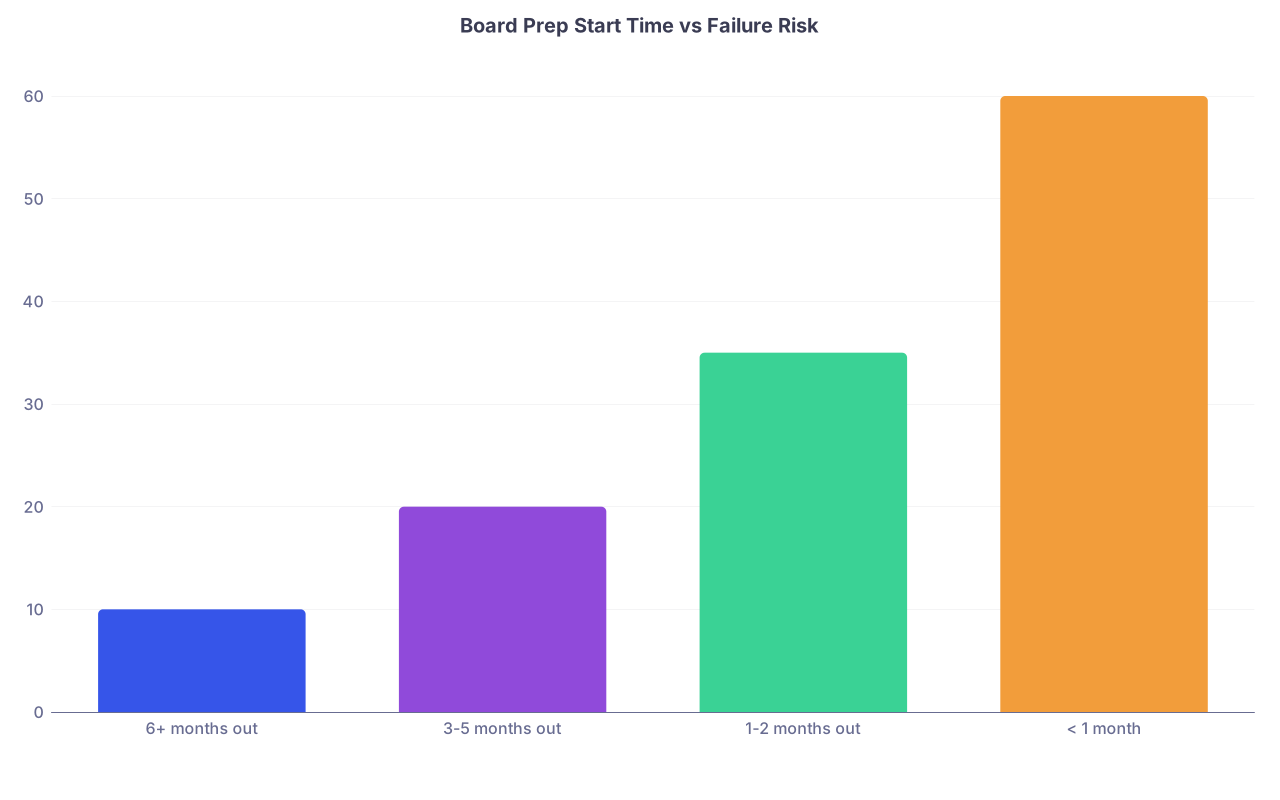
Residents who fail often show the same pattern when you look back:
| Category | Value |
|---|---|
| 6+ months out | 10 |
| 3-5 months out | 20 |
| 1-2 months out | 35 |
| < 1 month | 60 |
The later they “really” start, the steeper the slope.
The fix is boring but effective: you protect a small daily minimum, even on brutal rotations. Not a fantasy 3-hour block that never happens. Something like 20–30 minutes or 10 questions + 10 minutes of reviewing explanations.
Think of it like brushing your teeth. You do not wait until you have a free afternoon to handle dental hygiene.
If your plan can only work on “lighter months,” it’s not a real plan. It’s a wish.
Trap #2: Confusing Volume With Learning
Another classic: the “grind” flex.
“I did 120 questions yesterday.”
Cool. How many did you actually learn from?
Doing questions is not the same as doing effective questions. The trap here is speed and vanity metrics: you chase big daily numbers because they feel productive and look impressive in group chats.
The worst habits in this trap:
- Flying through questions in “exam mode” every day
- Skimming explanations to justify the next batch
- Ignoring why wrong answers are wrong
- Never writing anything down because “I’ll remember”
You will not remember. Not at 5 a.m. before rounds, not two months later.
Serious residents do fewer questions but squeeze them dry:
- They review each question until they can explain the concept clearly
- They note patterns: “I keep missing hyponatremia questions.” That becomes targeted review.
- They spend more time on explanations than on clicking choices
If your Qbank dashboard shows thousands of completed questions but your percentage correct isn’t budging, you’re not studying. You’re just clicking.
Trap #3: Treating Qbanks Like Netflix
You’ve got three different Qbanks open because everyone said a different one is “the best.” So you subscribe to all of them. And then you use them like streaming services – hopping around based on mood.
Little cardio here. Random renal there. Then a mixed block. Then “just a quick derm block before bed.”
This feels like variety. It’s actually chaos.
What happens:
- You never build depth in any single topic
- You keep re-learning the same half-understood factoids
- You can’t track whether you’re actually improving in a domain
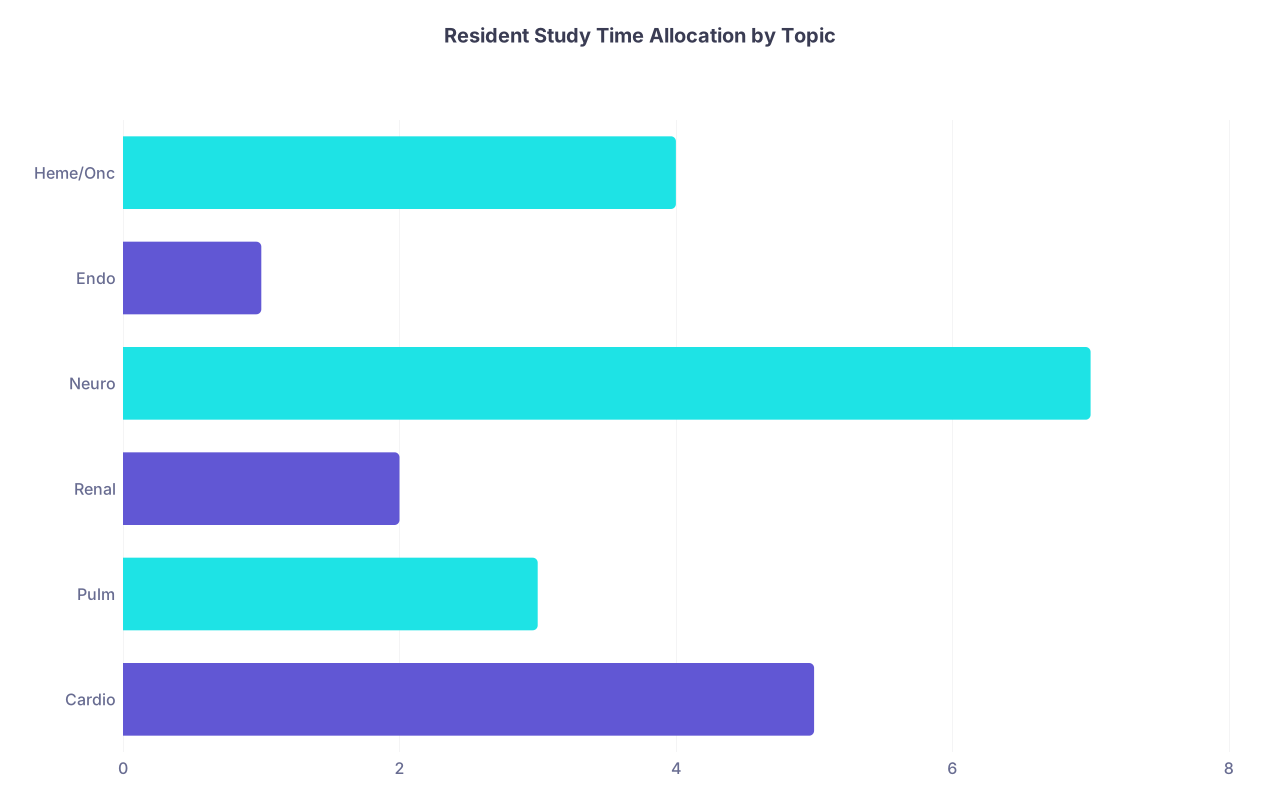
Residents who bounce all over the place usually end up with this kind of ugly pattern:
| Category | Value |
|---|---|
| Cardio | 5 |
| Pulm | 3 |
| Renal | 2 |
| Neuro | 7 |
| Endo | 1 |
| Heme/Onc | 4 |
You can see what’s coming: massive holes. Unforced errors.
Yes, the real exam is mixed. No, that doesn’t mean your studying should be randomness dressed up as “mixed blocks.”
Better: pick a system, hammer it for several days, then spiral back later:
- Do 20–30 cardio questions/day for a few days
- Review a concise cardio reference (your main text, videos, whatever is efficient)
- Then move on, returning to mixed blocks after you’ve cycled through major areas
If you like mixed blocks, cap them. Use them as assessment and integration, not your only mode.
Trap #4: Copying Someone Else’s Perfect Plan
You hear that PGY-3 who crushed the boards used XYZ video resource at 1.5x speed, did two Qbanks, annotated a review book, and re-watched everything twice.
So you try to copy their exact workflow. While working different rotations. With different baseline knowledge. And a different brain.
This backfires for three reasons:
- You don’t know what they were good or bad at initially
- You don’t see what they skipped or abandoned
- You don’t have their energy level or bandwidth
Your job isn’t to emulate the most impressive-sounding plan. Your job is to build the minimum effective system that fits your actual life.
Use other people’s success stories as raw material, not commandments. If your plan sounds heroic on paper but collapses after three days on nights, it’s a bad plan. I don’t care who did it on Reddit.
A decent sanity check:
If your schedule for a “normal” day involves:
- More than 2 different major resources
- More than 80–100 questions
- More than 2.5 hours of net study time (for most residents)
…it’s probably unrealistic long-term.
Trap #5: Resource Hoarding and Switching
This is one of the fastest ways to tank your prep: the constant search for the “best” resource.
You start with one Qbank. Then someone says it’s too easy. You add another.
Then you hear about a “high yield” video series. You buy it.
Then a friend whispers about a secret PDF everyone at another program is using.
By January, you’re subscribed to:
- 2+ Qbanks
- 1–2 full video series
- 1 main review book
- A pile of random PDFs
And you’re 20% through all of them.
Here’s the ugly comparison I keep seeing:
| Approach | Qbank Completion | Main Resource Completion | Stress Level | Pass Rate (informal) |
|---|---|---|---|---|
| Focused (1 Qbank + 1 main resource) | 80–100% | 70–90% | Moderate | High |
| Resource Hoarder | 20–40% each | 30–50% | High | Mixed |
You don’t get credit for owning resources. Only for finishing and absorbing them.
Pick:
- One primary Qbank as your spine
- One main content resource (text or video) that you will actually complete
You can add a small number of supplements later if you genuinely finish your core plan. But hoarding from the start is usually a fear response, not strategy.
Trap #6: Ignoring Fatigue (and Lying to Yourself About It)
Residency fatigue is not undergrad fatigue. It’s not even med school clerkship fatigue. It’s chronic, accumulative sleep-deprivation with decision fatigue piled on top.
A mistake I see a lot: residents trying to study at times when they are physiologically useless – and then blaming themselves instead of the timing.
Examples:
- Forcing dense learning at midnight after a 14-hour shift
- Trying to memorize pharmacology on post-call morning
- Doing long Qbank blocks after a brutal code-heavy night
What happens:
- You read the same sentence 4 times
- You miss easy questions
- You internalize the wrong lesson: “I’m dumb” instead of “I’m fried”
You are not lazy for being unable to focus at 1 a.m. after cross-covering 60 patients. You’re human.
You need to respect your brain’s limits:
- Schedule your hardest thinking (new material, tough Qbank blocks) during your best cognitive window – for many, that’s early morning or first hour after a nap/short break
- Use low-energy tasks when you’re wrecked: flashcards you’ve seen before, light video review, skimming notes
If every study session feels like wrestling your own brain to stay awake, your schedule is wrong. You’re not “pushing through”; you’re training yourself to associate board prep with misery and failure.
Trap #7: Only Doing “Fun” or Comfortable Topics
Everyone has comfort specialties. The cards person. The neuro nerd. The renal avoider.
Under stress, we all gravitate toward what feels good. So the cards lover does 500 cardiology questions and 40 endocrine. Guess what shows up on the score report? Not your flex topic.
The exam doesn’t care what you like. It punishes gaps.
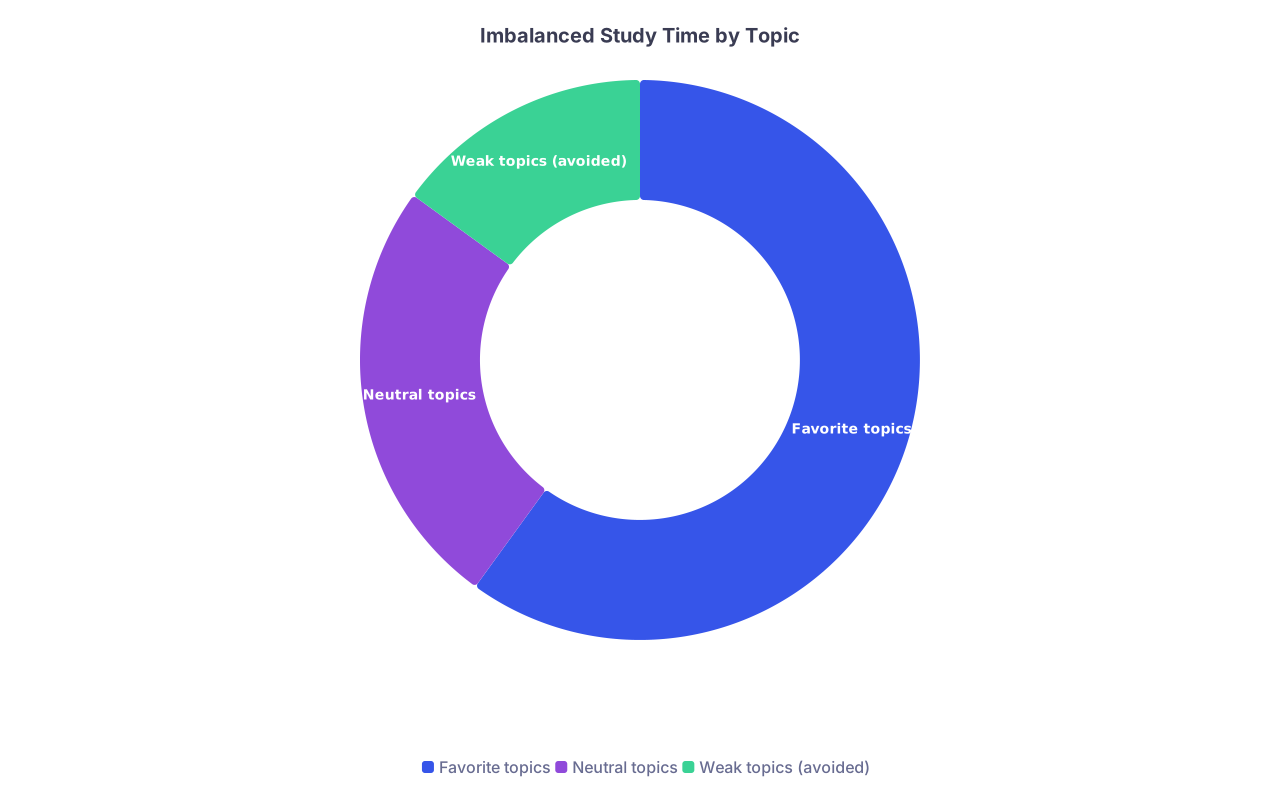
I’ve literally sat with score reports where the resident says, “But I’m so good at GI” and yeah, they are. GI is 80th percentile. Renal and endocrine are 10–20th. Net result: borderline or failing.
Here’s the internal distribution you should avoid:
| Category | Value |
|---|---|
| Favorite topics | 60 |
| Neutral topics | 25 |
| Weak topics (avoided) | 15 |
Your weak areas aren’t just “opportunities.” They’re landmines. And the boards are a minefield exam.
How to not fall into this:
- Regularly look at Qbank performance by category
- Force yourself to schedule “ugly days” – e.g., Monday is endocrine + nephrology hell
- Measure time, not just questions. Weak areas often need slower, deeper review.
If your study week looks like: “Cards, neuro, cards, pulm, random mixed,” you’re hiding from something.
Trap #8: Treating Boards as Purely Knowledge-Based
This one gets smart residents all the time.
You think, “I know my stuff clinically; I just need to refresh the details.” So you focus almost entirely on content absorption and ignore test-taking as a skill.
Then you walk into a 7-hour exam you are not physically or mentally conditioned to handle.
Boards are not just about knowledge:
- They’re about endurance: can you think clearly in hour 6?
- They’re about pacing: can you avoid rushing at the end of each block?
- They’re about decision‑making under stress: can you eliminate and move on, or do you obsess and burn time?
Residents who never simulate exam conditions make rookie mistakes:
- Spending 3 minutes on an early question because “I almost know this”
- Panicking the first time they hit a brutal block and letting it poison the next one
- Running out of time and rapid-guessing the last 5–7 questions repeatedly
You need at least a few full-length or near full-length practice sessions. Not just for knowledge. For your body and brain to experience:
- Sitting for multiple consecutive blocks
- Managing breaks
- Practicing “good enough” pacing
If you keep saying, “I’ll do a full practice once I’m ready,” you may never do it. And the real exam will be your first long run. Bad idea.
Trap #9: Studying in Isolation and Hiding Struggles
There’s a particular kind of resident who is secretive about their prep. They don’t tell their PD they’re behind. They don’t admit to co‑residents they’re overwhelmed. They quietly panic and silently drown.
This is how small issues turn into actual failures.
The fear is understandable: you don’t want to look incompetent. But trusteeship goes both ways. Your program actually needs you to pass. They want to catch problems early.
Bad pattern:
- You fall behind in Qbank schedule
- You feel ashamed, so you avoid discussing it
- You get a mediocre in‑training exam score and pretend it’s fine
- You don’t ask anyone for a targeted plan
- Six months later, you’re cramming and hoping
Residents who do well almost always have some combination of:
- An accountability buddy for weekly check‑ins
- A faculty member or chief they send occasional updates to
- Willingness to say, “I don’t get nephrology; what did you use that actually worked?”
If your default is, “I’ll just fix it myself later,” that’s ego talking, not strategy.
You’re not a med student anymore. The stakes are higher. Use the support that exists instead of trying to cosplay the lone genius.
Trap #10: Misreading the In-Training Exam (Either Way)
The in‑training exam gets abused in two equal and opposite ways:
Overconfidence trap
- You score above average
- You decide, “I’ll be fine if I just do a few questions here and there”
- You underestimate how much material you’ve forgotten since med school
- You put off real studying until it’s uncomfortably late
Panic trap
- You score poorly
- You freak out and impulse‑buy three new resources
- You try to “do everything” and burn out quickly
- You conclude you’re just bad at tests (you’re probably not)
The in‑training exam is not prophecy. It’s feedback.
Treat it like a diagnostic, not a verdict. Break it down by section. Look for trends: are you chronically weak in endocrine, or did you just blow one block because you were flustered?
Then adjust your plan surgically:
- 1–2 clear focus areas based on data
- Slightly more aggressive Qbank and review in those domains
- Maybe one targeted resource (e.g., a short endocrine review) – not five
Your goal is not to “beat” the in‑training. Your goal is to turn it into a roadmap, even a painful one. Eye‑rolling at it or obsessing over it are equally unhelpful.
Bonus Trap: Letting Guilt Run Your Schedule
One last pattern I see all the time:
You miss a study day. Maybe two. Then guilt kicks in. So you overcompensate by declaring, “Tomorrow I’ll do 120 questions, plus 3 hours of videos.”
Tomorrow comes. You’re tired, slammed, and you hit 25 questions, then crash. More guilt. More unrealistic promises. The cycle repeats.
You’re trying to negotiate with physics. There are only so many coherent hours in a resident’s day.
The fix is simple and unsexy:
- Define a realistic minimum (for example, 10–20 questions + 10–15 minutes of review)
- If you miss a day, you do NOT double the next day. You just resume the minimum.
- If you have a lighter day, you can do extra on that day, not carry a guilt balance forward
This is how residents quietly pass without constant crisis mode. They’re not better people. They just don’t let guilt design their schedule.
What To Do Today
Do not “think about this later.” That’s how half these traps start.
Right now, do this one concrete thing:
Take a sheet of paper (or open a notes app) and write down three columns:
- Column 1: “My likely traps” – circle at least 2 from this list that sound uncomfortably familiar
- Column 2: “What I currently do that feeds this trap” – be honest and specific
- Column 3: “One rule I’ll follow for the next 7 days to block it” – small, realistic, measurable
Example:
- Trap: Resource hoarding
- What I do: I’m using 2 Qbanks and 3 video series, 20–30% done with each
- 7‑day rule: For the next week, I will only use Qbank A and Resource X. I will not open anything else.
Then set a 7‑day reminder to revisit that note and adjust.
Do that, and you’re already ahead of the residents who will keep promising themselves they’ll “get serious” next month.