
You are post‑call, sitting in your car in the hospital parking garage. It is 8:37 a.m. Your night float block just ended. Your board exam is six weeks away. And you have a sinking realization: you barely touched UWorld or your question bank this entire month.
You told yourself nights would be “quiet” and you would get tons of board prep done between admits. That fantasy evaporated sometime around night three when you were drowning in cross‑cover pages, endless blood sugar checks, and a septic patient at 4 a.m. Now you are behind. And the calendar does not care.
Let me be blunt: combining night float and serious board prep can go very wrong, very fast. Most residents underestimate how badly nights disrupt cognition, discipline, and any illusion of a predictable schedule. The scheduling mistakes are boringly consistent. I have watched smart residents repeat them year after year—and pay for them on exam day.
This is your warning label.
Mistake #1: Assuming Night Float Is “Free Study Time”
The most common self‑sabotage starts before the block even begins: you build your entire study plan on the delusion that nights will be light and you will “crush questions between pages.”
You know the script:
- “I’ll just do 80 questions every shift, it’s fine.”
- “Nights are slower on this service.”
- “I can read during cross‑cover; it will actually help.”
Then reality hits: admissions that never stop, delirious patients trying to climb out of bed, 3 a.m. rapid responses, nurses paging you about potassium orders every fifteen minutes, and a resident room that is too loud, too cold, or too chaotic to support any kind of focused work.
The mistake is not that you hoped for downtime. The mistake is building your core board prep around that hope. That is like planning a marathon training plan around “days it might not rain.”
What usually happens:
- First week: you are too disoriented and sleep‑deprived to study meaningfully.
- Second week: you get one or two decent nights and think, “Okay, I can still salvage this.”
- Third week: admissions spike, someone is out sick, you are covering extra patients, and your study plan collapses.
- End of block: you have a pile of guilt and half‑remembered questions you rushed through at 5 a.m. with caffeine and tunnel vision.
Do not anchor your board prep to an unpredictable, high‑noise, high‑interruption shift. Nights are for survival, safe patient care, and minimal cognitive damage. Anything you get done academically is a bonus, not a pillar.
If your master schedule needs night float to “work,” then your schedule is already broken.
Mistake #2: Treating Post‑Call Like a “Bonus Study Day”
The second trap: packing your post‑call day with ambitions that completely ignore sleep biology.
You log out at 7:30 a.m., tell yourself, “I’ll nap for a bit, then crank out a full block of questions and some Anki,” and then act confused when you wake up feeling like you were hit by a truck and your “bit” became five hours.
Post‑call is not a normal day, and it will not behave like a normal day, no matter how determined you are. Your frontal lobe is trash. Your decision‑making is worse than you realize. Studying heavily post‑call is like lifting heavy weights with bad form—you feel productive, but you are reinforcing garbage patterns and burning energy on low‑quality reps.
Typical post‑call mistake pattern:
- Over‑scheduling: “Do 120 questions, review 2 chapters, clean up missed Anki.”
- Under‑sleeping: You force yourself to wake up after 2–3 hours so you can “salvage the day.”
- Low‑quality studying: You push through dense questions, reread explanations three times, but nothing sticks.
- Guilt spiral: You are too tired to be efficient, so you underperform, then beat yourself up, then do inefficient “panic studying” late at night, destroying your next day of sleep too.
Post‑call needs to be pre‑decided and protected. Not negotiated with in the moment when you are exhausted and irrational.
Here is a safer structure:
- Core rule: Sleep comes first. You are not a hero for sacrificing sleep to stare at questions you will not remember.
- Hard cap: If you study post‑call at all, limit it to 30–60 minutes of low‑friction tasks (light review, flashcards you already know, skimming your own notes). No heavy new content. No 40‑question blocks.
- Non‑negotiable: A defined cut‑off time in the evening. You stop all “catch up” fantasies and go to sleep to protect your next night shift.
If you keep treating post‑call as your “makeup day,” you will constantly rob your future self of functional brainpower.
Mistake #3: Ignoring How Night Float Wrecks Your Memory
You cannot out‑willpower circadian biology. Residents try anyway.
Sleep deprivation does not just make you sleepy. It directly impairs the exact functions boards demand: working memory, executive function, encoding new information, and integrating patterns across multiple pieces of data.
So when someone tells me they will “finally do all the heme‑onc” during a night block, I know how this story ends. They read the words, they do the questions, they check the boxes in their spreadsheet. Then, six weeks later, on exam day, those topics feel strangely unfamiliar.
That is not a weakness. That is physiology.
Your board prep during a night block will suffer in three predictable ways:
Surface learning instead of deep learning
You skim explanations. You tell yourself you “get it” without truly connecting mechanisms, exceptions, and edge cases. Under fatigue, you chase completion, not comprehension.Poor encoding to long‑term memory
Tired hippocampus, weak consolidation. You may recognize the question tomorrow. A month out? Gone.Increased cognitive biases
On low sleep, you rely more on pattern recognition and gut feeling. That is fine in some clinical scenarios. It is disastrous when trying to teach yourself new, non‑patterned content.
The mistake is assuming that all “study hours” are equal. An hour of rested, focused study on a day off is worth three or more scattered, foggy hours in the middle of a night float block.
If you are within 6–8 weeks of your board exam, you must ruthlessly guard your high‑utility hours. Do not trade them away by pretending that your 3 a.m. question block is doing the same job as your 2 p.m. focused session on a day off.
Mistake #4: Building a Calendar That Ignores Rotation Reality
Another major self‑inflicted wound: crafting a beautiful, color‑coded study calendar that treats every week of residency the same.
You map it out:
- “X questions/day”
- “Y chapters/week”
- “Anki all reviews, no matter what”
Then you paste that same template across your MICU month, your trauma nights, your ED block, your vacation, and—of course—night float.
Here is the problem. Rotations are not interchangeable units. Night float is not “just another month” with shifted hours. It is often the most cognitively brutal, schedule‑disrupting time you will have.
I have seen residents schedule an ambitious “final push” during their night float block right before boards, under the logic of “I will have my days free.” It sounds clever. It is usually catastrophic.
What you are not accounting for:
- Fragmented daytime sleep → never fully rested, always in cognitive debt.
- Social disruptions → harder to maintain routines that anchor studying (meals, gym, family).
- Erratic shift intensity → some nights crushing, others dead. Impossible to forecast.
- Administrative spillover → sign‑outs, follow‑up tasks, messages bleeding into your so‑called off time.
Instead of pretending nights are normal, your calendar needs to bend around rotation type.
| Rotation Type | Safe Study Load | Risk if Ignored |
|---|---|---|
| Elective (light) | High | Under-using time |
| Ward days | Moderate | Burnout if overloaded |
| ICU | Low | Complete collapse |
| ED | Variable | Unpredictable gaps |
| Night float | Very low | Low-quality studying |
Night float should usually be scheduled as:
- Maintenance phase: keep the wheels on, protect gains.
- Not growth phase: do not plan to massively expand content coverage or add new resources.
If your “big content push” or full‑length practice exams land on a night float block, you made a planning mistake upstream. Fix that before you ever start the rotation.
Mistake #5: Wasting Your Best Hours On The Wrong Tasks
Even during nights, you still have better and worse hours. Residents routinely waste their best cognitive windows on low‑yield nonsense, then try to study in their worst mental state.
Common inversion:
- Mid‑afternoon (relatively awake): scrolling, errands that could wait, unstructured complaining, unfocused chart review that is not urgent.
- Late night / early morning (deeply tired): board questions, dense reading, high‑stakes material.
This is backwards.
You only have a few “sharp” hours per 24 hours during a night block. Maybe 2–4 at most. If you use those for board prep, you actually preserve momentum. If you give them away to random tasks, you will be stuck studying in the cognitive junkyard.
During a night float block:
- Identify your cleanest waking segment consistently. For many people, that is 1–3 hours after they wake up from daytime sleep.
- Pre‑decide what those hours are for on most days: board‑relevant questions, reviewing high‑yield mistakes, or practice blocks on days off.
- Dump low‑value tasks—email, minor errands, mindless notes—into your lowest‑energy time, not the other way around.
Think of it this way: you are too tired to win every hour. Fine. Just do not be foolish enough to waste the ones you still can win.
Mistake #6: Scheduling Full‑Length Practice Exams Around Nights
This one deserves its own section because it derails people every year.
You cannot “get a realistic score” on a full‑length board practice exam if you take it:
- After a night shift
- On one day off, sandwiched between nights
- While chronically underslept during the middle of a night float block
Yet residents do this constantly. Why? Because they wedged their schedule so tightly that their only open day for a NBME, COMSAE, or practice exam falls between night shifts. Then they pretend that score accurately represents their knowledge.
It does not. It represents:
- Fatigue level
- Circadian misalignment
- Attention drift
- Decision fatigue
The damage is twofold:
- You get an artificially low (or weirdly inconsistent) score that destroys your confidence or sends you into a panic resource‑shopping spree.
- You burn a precious practice exam on a day when your brain was never capable of doing its best.
Do not make this trade.
Full‑length exams belong on:
- Days when you are well slept, at least reasonably aligned with test‑day timing.
- Preferably off‑rotation, elective, or at the beginning / end of a normal day block.
- Not within 24–36 hours of a night float shift unless you are forced and fully accept that the number is “noise data,” not a prediction.
If your schedule forces you to put an NBME in the middle of nights, you do not have a content problem. You have a planning problem.
Mistake #7: Failing To Simplify During Night Float
A quieter but very real mistake: trying to keep all your usual board resources active during nights.
You have:
- A main question bank
- A secondary question bank “just for extra”
- Anki or flashcards
- A main review book or video series
- A notes document from morning report
- Some high‑yield PDFs your seniors sent you “that everyone uses”
Then you roll into a night float block and try to keep satisfying all of them. That fragmentation is brutal when you are well rested. Under sleep debt, it is lethal.
What usually happens:
- You bounce between resources, never building traction.
- You keep adding “I will catch this up after nights” to an already impossible future list.
- You lose the thread of what you are actually trying to learn.
Night float demands simplification. Aggressively.
During the block, you should strip your plan to the core:
- One primary question source (usually your main board Qbank).
- One review mechanism: missed questions spreadsheet, flashcards, or annotated notes—but not all three.
- Maximum one short, high‑yield reference for weak areas (e.g., rapid review chapters, short topic summaries). Not an entire video course.
Anything else gets paused. Not forever. Just for the block.
You will not “fall behind” on a resource that you pause for three weeks. You will absolutely fall apart if you spread your limited attention across six platforms while waking up at 4 p.m. and rounding half‑asleep.
Mistake #8: Overestimating How Much You Will “Make Up” After Nights
The final landmine: fantasy recovery.
Residents tell themselves, “Night float will be rough, but I will make up the lost ground the month after.” Then the schedule comes out and that “recovery” month is wards, ED, or another demanding service.
Even if you somehow get a lighter rotation after nights, you will spend the first part of it just digging out of sleep debt and re‑stabilizing your life: laundry, relationships, appointments you have been putting off, basic errands.
The belief that “Future Me will fix it” is one of the most dangerous cognitive errors in board prep. Future You will not have more time. Just different constraints.
So do not:
- Plan to do double questions for weeks after nights.
- Tell yourself you will “redo” entire sections you half‑learned when exhausted.
- Schedule additional resources “for after nights” that you already could not fit in before.
Instead:
- Protect a minimum viable volume of high‑quality study during nights (e.g., smaller, consistent blocks on off days).
- Accept slightly slower progress for that period as a feature, not a failure.
- Plan your larger pushes and full‑length exams in months less likely to explode.
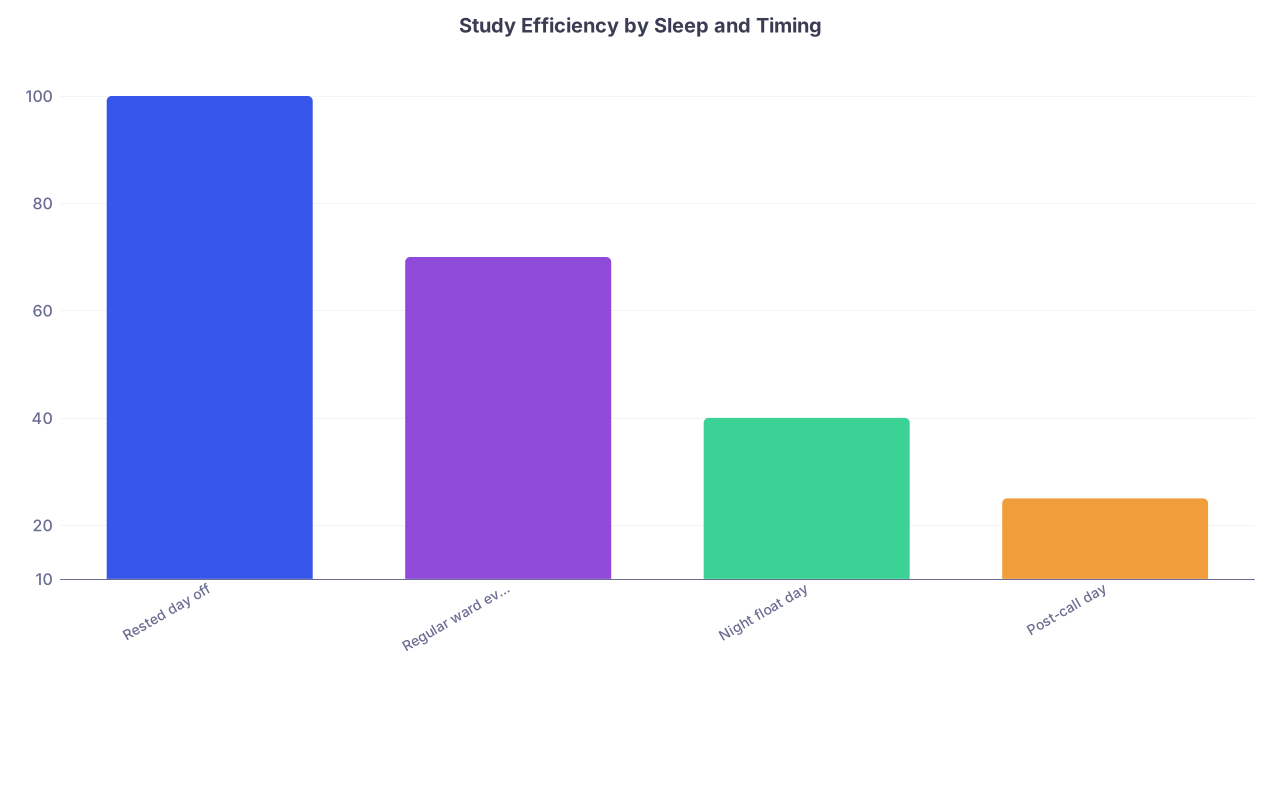
| Category | Value |
|---|---|
| Rested day off | 100 |
| Regular ward evening | 70 |
| Night float day | 40 |
| Post-call day | 25 |
How To Actually Schedule Board Prep Around Night Float (Without Sabotage)
Let me give you a more realistic template so you have something concrete to work with. Adjust the numbers, not the logic.
Before the Night Float Block
- Move your heaviest content (new systems, long video blocks, big question volume) into the 4–8 weeks before nights if possible.
- Front‑load at least one solid full‑length exam while you are still on day shifts.
- Decide in advance:
- Your minimum daily or every‑other‑day target during nights (e.g., 20–30 questions + quick review).
- Which resources are paused.
- That you will not introduce anything new during the block.
During the Block
On work days:
- Sleep first, no heroics.
- Aim for a short, focused session in your sharpest mental window. Quality over quantity.
- Let go of guilt if your volume is lower. The win is consistency, not maxing out.
On days off:
- Use one day for life maintenance and actual rest.
- Use the other for a moderate study push, but do not schedule a full‑length exam unless you are rested and your sleep is semi‑normalized.
On post‑call:
- Light touch only. Flashcards, review of your recent misses, or nothing at all.
- Hard stop in the evening to protect sleep.
After the Block
- Give yourself 2–4 days of stabilization before expecting peak study performance.
- Do not immediately schedule a full‑length exam in the first 3–4 days post‑nights. Wait until your sleep is at least semi‑reset.
- Re‑evaluate your remaining content honestly. Trim, do not just stack more.

| Step | Description |
|---|---|
| Step 1 | Identify Board Date |
| Step 2 | Map Rotations Before Exam |
| Step 3 | Front-load heavy study before nights |
| Step 4 | Distribute study more evenly |
| Step 5 | Set minimal goals for night float |
| Step 6 | Schedule full-lengths on rested days |
| Step 7 | Avoid new resources during nights |
| Step 8 | Adjust plan after block based on reality |
| Step 9 | Night float within 8 weeks of exam |
FAQ (Exactly 3 Questions)
1. Should I delay my board exam if my last month before it is night float?
Maybe. If your last 4 weeks before the exam are pure nights with no real recovery period and you are already behind, that is a serious red flag. I would strongly consider moving the exam if:
- You have not completed at least ~70–80% of your main Qbank with real review.
- Your recent practice scores are well below your target range.
- Your “plan” relies on heavy studying during or immediately after nights.
If you are reasonably prepared and nights are earlier (6–8 weeks out) with some normal rotations after, you can often keep the date and just treat the night block as a maintenance phase.
2. Is it ever worth trying to study on shift during night float?
Only if you are meeting three conditions: patient care is stable, your documentation is done, and your brain is not completely fried. Then, and only then, you can do small, low‑friction things: a handful of flashcards, skimming topics that directly relate to patients you are seeing, or reviewing your own notes. Do not plan 40‑question blocks on shift. Do not start new, dense content at 3 a.m. If you get unexpected downtime and can use it, fine. But it should never be the backbone of your plan.
3. How many questions per day is realistic during night float?
For most residents: far fewer than they think. A realistic range is 20–40 questions on days you are not post‑call, plus genuine review of the explanations. On bad nights or post‑call days, zero is acceptable. What matters more than the number is that you are doing them when you are awake enough to actually learn something, not just to “keep the streak alive.” A clean 20‑question block done well beats a miserable 80 done half‑asleep.
Key takeaways:
First, do not build your board prep on fantasy downtime during night float or the illusion of post‑call heroics. Second, respect what sleep deprivation does to learning and plan your heavy work for rested periods, not the middle of a brutal rotation. Third, simplify your resources and set realistic, minimal goals during nights so you preserve quality instead of burning yourself out on low‑yield effort.