
What if your EMR habits are quietly stealing more study time than your call schedule ever did?
Not the dramatic stuff. Not codes, not cross-cover chaos. I mean the invisible minutes: the extra click, the third re-read, the novel-length note you did not need to write. Those are the minutes that turn into the missing 5–10 hours per week you swear you do not have for boards.
I have watched residents fail boards, or barely scrape by, not because they were lazy or careless, but because their entire day leaked time through bad documentation habits. They thought they had a “knowledge problem.” Often, they had a workflow problem.
Let’s walk through the mistakes that quietly eat your board study hours and how to stop making them.
The Hidden Cost of EMR Overload
You already know documentation is painful. What most residents underestimate is how much time it is actually stealing.
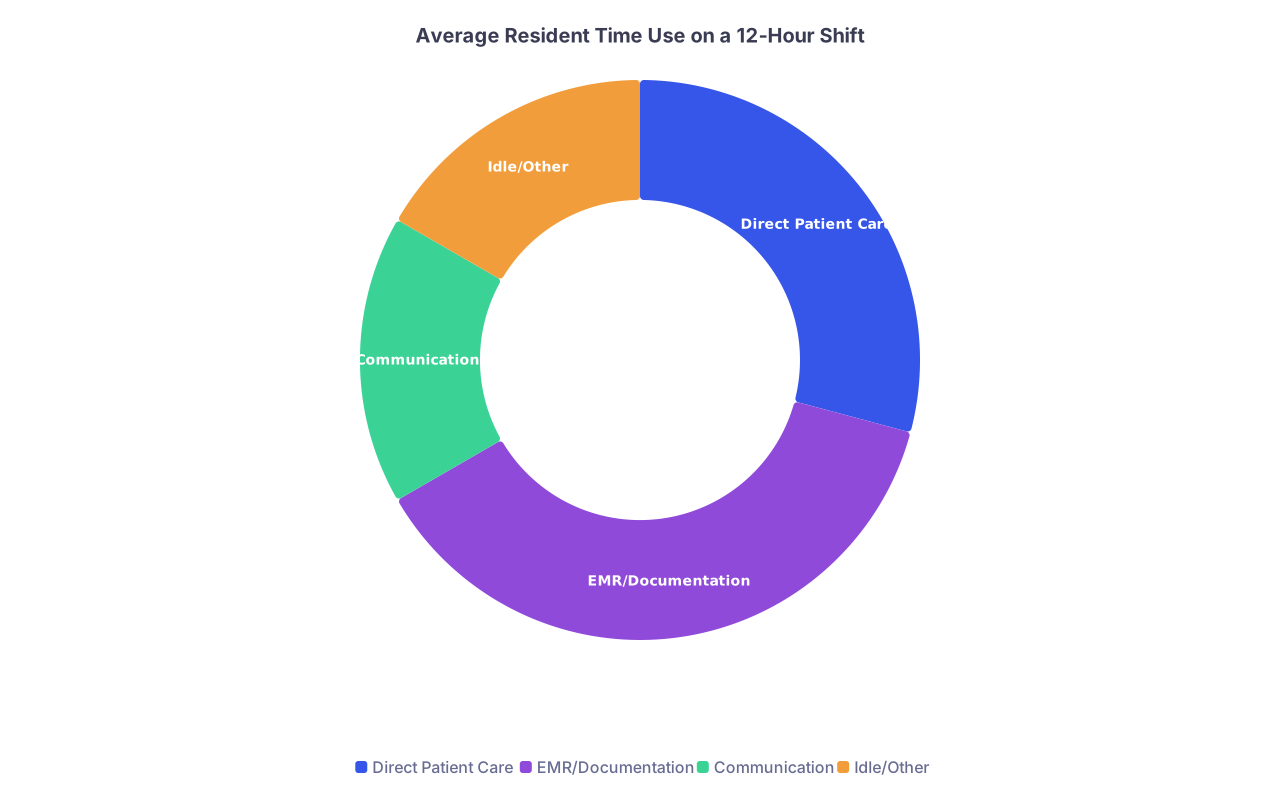
| Category | Value |
|---|---|
| Direct Patient Care | 210 |
| EMR/Documentation | 270 |
| Communication | 120 |
| Idle/Other | 120 |
That is 4.5 hours per 12‑hour shift on the EMR. If your habits are even slightly inefficient, you easily burn an extra 30–60 minutes a day. That is:
- 3–5 hours a week
- 12–20 hours a month
- 150–250 hours a year
That is multiple full board review passes. Gone. To copy‑paste and scrolling.
The dangerous part: those hours do not vanish in one dramatic event. They dissolve quietly into:
- Overdocumenting to “look thorough”
- Re-writing the same note 6 different ways
- Hunting for data because your own note is bloated and unreadable
- Clicking through 20 templates to find the “perfect” one
You feel slammed all the time and start saying, “I do not have time to study.” Some of you really do not. Many of you think you do not because your documentation has taken your day hostage.
Mistake #1: Confusing “Thorough” With “Verbose”
I see this constantly: residents equate more words with safer notes. Or with “looking smart.” Bad assumption.
Typical pattern:
- 3–4 paragraph HPI that repeats the same fact 4 times
- Full review of systems every single day, even in an ICU patient sedated for a week
- Complete retype of the overnight course already documented in nursing and cross-cover notes
Why this steals board time:
- It slows you down now. Obviously.
- It slows you down later when you re-read your own wall of text trying to figure out what actually changed.
- It creates cognitive fatigue. After 10 notes like that, your brain is mush. Good luck starting a question block at 9 pm.
The legal myth
People over‑document because they are afraid of medico‑legal issues. I have sat in risk meetings. No one said, “We wish this note had been three times longer.” What they say is, “I cannot tell what the plan was,” or “The rationale for the decision is missing.”
Courts care about clarity, not word count. Attendings who tell you to write novels are often just repeating what they were taught in the paper-chart era.
What you actually need in a daily note:
- Brief delta: what changed in the last 24 hours
- 3–5 key data points relevant to today’s decisions
- Clear assessment with problem-based bullets
- Explicit plan with contingencies
That is it. The rest is fluff.
Overlong note = underdeveloped assessment. Residents hide weak reasoning under a mountain of copy‑pasted data. That habit wastes time now and makes you worse at the kind of clear thinking boards test.
Mistake #2: Copy‑Paste Addiction That Backfires
Copy‑forward is not evil. But mindless copy‑forward is one of the fastest ways to destroy both your time and your clinical credibility.
The ugly patterns:
- Carrying forward the entire prior note, including a 12‑line problem list, then tweaking 2 words
- Lab trends pasted daily in full, even when unchanged
- Fictional exams: “No edema” copied forward on a patient with 3+ pitting that nursing charted hours ago
Why this kills your board hours:
- You spend extra time editing massive imported text blocks that you did not need to copy in the first place.
- Attendings stop trusting your notes and ask you more questions in person, during rounds, at sign‑out. More talking, less finishing.
- When something real changes, you miss it because your note is 80% old junk.
You think copy‑paste is saving time. Often, you are just moving work around and making future-you pay double.
A safer rule set:
- Copy forward structure, not content. Problem list headings? Yes. Entire paragraphs? No.
- Never copy an exam you did not just perform. If you did not check it, do not chart it.
- If you paste a big block (e.g., consult recommendations), immediately trim it down to the key points.
Your goal: by the end of intern year, you should be writing shorter notes that take less time and say more. Not larger, Frankenstein notes that require 10 minutes of surgery each day.

Mistake #3: Writing Notes at the Worst Possible Time
Some of you make your day harder purely by timing.
Common bad patterns:
- Batch‑documenting everything at the end of the day
- Leaving all discharges until 4–5 pm
- Starting progress notes only after rounds are fully done
- Doing notes during your only realistic study window “because I’m already at the computer”
That last one is lethal. If your usual post‑shift window is 7–9 pm, and you fill it with documentation you could have done earlier in the day, you have voluntarily traded your board prep for EMR time.
You probably know your own “mental cliff.” For many residents, it hits between 9–10 pm. After that, you are physically awake but cognitively useless. That is not when you want to be memorizing murmurs or immunodeficiency syndromes.
You need to protect your one or two decent brain-hours like they are ICU beds.
A better approach:
- Front-load note skeletons. On pre‑rounds, open your notes and drop in the outline and key vitals/labs. Then add details live during rounds. By the time rounds are done, you are 60–70% finished.
- Discharges before lunch whenever possible. Afternoon discharges are chaos magnets.
- Use micro‑windows: 5–10 minutes between tasks to knock out small documentation pieces instead of doom-scrolling or chatting.
You will not eliminate late‑day documentation on busy services. But you can shrink it enough that you still have an actual block for studying.
Mistake #4: EMR Navigation Without a System
Another time leak: wandering through the EMR like a tourist instead of following a route.
Here is how I know a resident is inefficient: they click through 6–8 tabs every single patient, every single time, in no particular order. Labs, then notes, then meds, then imaging, then back to notes. They keep “checking one more thing” because their mental model is scattered.
Every click costs a second or two and a small cognitive reset. The seconds add up. The resets drain you.
You need a set, consistent pattern for pre‑rounding and note‑writing. Something like:
- Vitals + I/Os
- Overnight events / nursing notes
- Labs + micro
- Imaging / procedures
- Meds / drips
- Then note, in that same order
Same path, every patient. You stop re-deciding where to look next. That frees up attention for what matters: Is the patient better, worse, or the same? What do I need to change?
Also: learn your EMR shortcuts. I am amazed how many PGY‑3s still:
- Manually type common phrases instead of using dot phrases
- Click through 5 menus instead of key commands
- Do not know how to bring up last labs, last imaging, or trend views instantly
Spending 1–2 hours one time to learn keyboard shortcuts and build your own smart phrases might save you 50–100 hours over residency. That is not an exaggeration.
Mistake #5: Treating Every Patient Like a Board Question Stem
Residents who are serious about boards often make this mistake: they turn every chart into a “learning opportunity” in the worst possible way.
Here is what I mean.
You are admitting a COPD patient. Reasonable thing: quickly confirm GOLD staging, check guideline‑driven therapy, maybe skim a summary. Unreasonable thing: spending 25 minutes during admission reading UpToDate, 3 primary papers, and a CHEST guideline, while four other patients are still unadmitted and your senior is wondering where you disappeared.
You are not studying. You are procrastinating under the costume of “being thorough.”
Board‑oriented learning at work should be:
- Targeted: 3–5 minute focused look‑ups, max
- Written down: capture one board‑style takeaway per key patient (“Alpha‑1 suspicion triggers,” “When to anticoagulate in subsegmental PE,” etc.)
- Reviewed later: used to guide or annotate your dedicated question blocks
If you blur the boundary between clinical work and deliberate board prep, you will feel like you “studied all day” and then still crush 30 questions at 11 pm. That is how burnout plus poor retention happen.
Clinical time: be safe, be efficient, collect questions.
Study time: answer those questions in a structured way.
Blend them too much and both suffer.
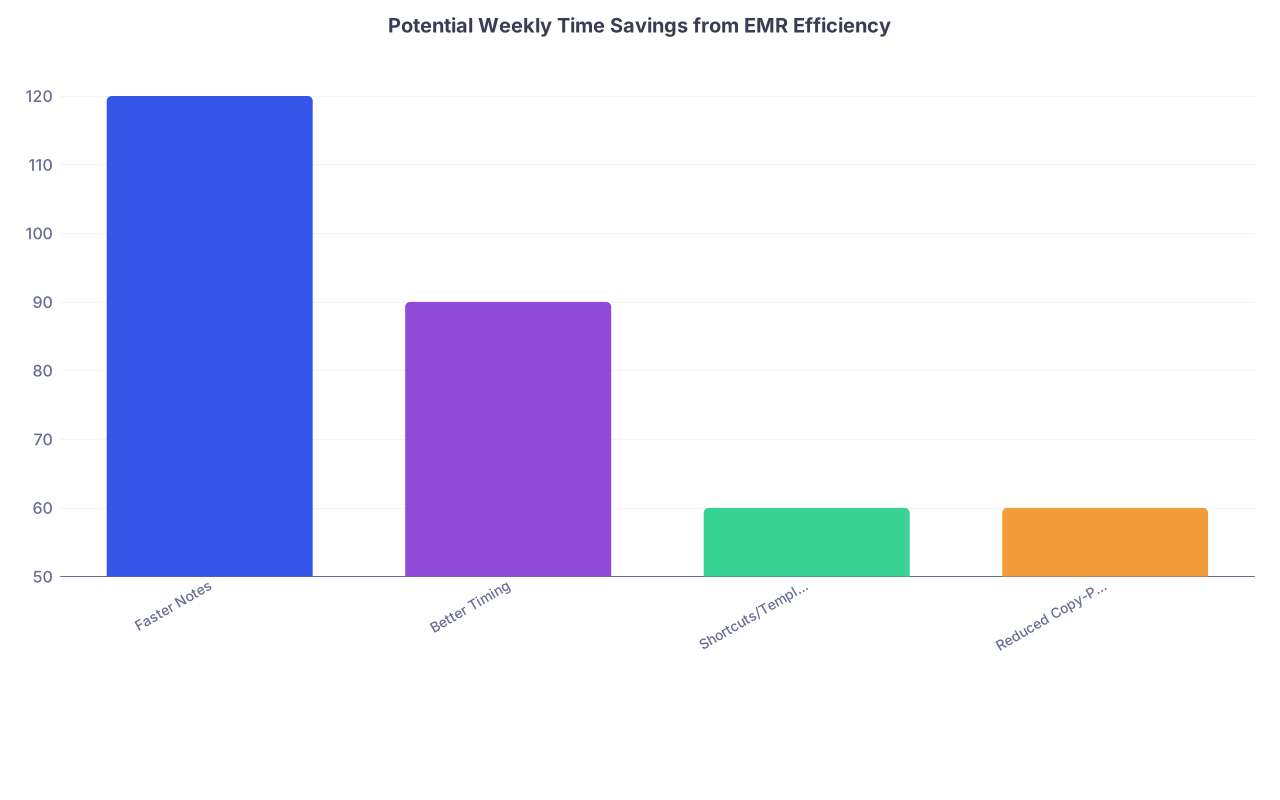
| Category | Value |
|---|---|
| Faster Notes | 120 |
| Better Timing | 90 |
| Shortcuts/Templates | 60 |
| Reduced Copy-Paste Cleanup | 60 |
(Values are in minutes per week – conservative estimates for a busy resident)
Mistake #6: Letting Templates Control You
EMR templates can save you. Or own you.
Bad patterns I see:
- Using the same monster template for everyone, regardless of complexity
- Leaving in entire autopopulated sections that you did not review (“EKG: normal” on someone admitted for AF with RVR)
- Spending 5–10 minutes per note fighting the template formatting and deleting irrelevant sections
Residents often adopt whatever their co‑intern or random senior gave them, then never question whether it fits their style or service.
You need three template categories, that is it:
- Brief daily note for stable patients
- Moderate‑complexity note for typical floor cases
- High‑complexity / ICU note
Each should be:
- Short
- Problem‑based
- With only 1–2 free‑text sections that require real thinking
Everything else should be dot phrases (or your EMR equivalent) that you can drop in when actually needed.
Examples of targeted phrases worth building:
- Typical anticoagulation plans (including contingencies)
- Common discharge instructions for CHF, COPD, DM, etc.
- Standard pre‑op risk language
If you are typing the same sentence more than 3–4 times a week, you should not be typing it at all. Make it a phrase. Protect your time.
Mistake #7: Letting EMR Anxiety Bleed Into Your Study Time
Here is the part no one talks about: EMR guilt.
You finally sit down to study. First question block open. And your brain says:
- “Did I sign that note?”
- “Did I put in the PRN pain med order?”
- “Did I actually change the dose or just think about it?”
Now you are half‑in questions, half‑in the chart. You have not actually forgotten anything yet; you are just anxious because your system is chaos.
Sloppy documentation habits do not just steal time. They steal mental bandwidth.
You need a simple, repeatable “I’m done” checklist for each shift so your brain can turn off work mode and turn on study mode. Something like:
- All notes signed
- All orders entered and reconciled
- Task list checked and cleared
- Sign‑out updated and confirmed
Write it on a sticky note until it is automatic. No checklist, no clean exit from the day. And no clean entry into real study.
Turning EMR Efficiency Into Board Time: A Practical Reset
Here is what I suggest if you are reading this and thinking, “This is me”:
For one week, track where your documentation time is going. Not in a perfect spreadsheet. Just rough notes:
- When you start and finish notes
- How much time you spend cleaning up copy‑paste disasters
- When you are doing discharges
- Where your documentation spills into your best study window
Then:
Pick one service or rotation.
Fix just three things there:
- Shorten your daily template by 30–50%
- Set a hard rule for when discharges must be drafted (e.g., by 11 am)
- Learn 5 EMR shortcuts and build 3 new dot phrases
Use whatever time you save to protect a single, consistent study block every day (even 30–45 minutes). No “I’ll do it later tonight” fantasy. A real, scheduled time.
You do not need a massive reinvent‑everything plan. You need small, ruthless cuts that stop documentation from cannibalizing the only hours you have for boards.
| Habit Type | Time Cost / Benefit per Week |
|---|---|
| Verbose notes | +90–150 min (lost) |
| Smart templates/phrases | -60–90 min (saved) |
| Late-day batch charting | +120 min (lost) |
| Front-loaded documentation | -90 min (saved) |
| Chaos navigation | +60 min (lost) |
FAQs
1. My attending wants long, detailed notes. How do I push back without getting in trouble?
Do not start by arguing. Start by getting precise. Ask them, “What parts of my notes do you feel are missing or risky?” Most of the time, they care about:
- Clear medical decision‑making
- Why you did or did not do something
- Documentation of discussions with consultants / family
Once you know that, you can keep those parts robust while trimming everything else. If they insist on specific phrases or sections, build dot phrases so you are not retyping them every time. You can be compliant without being inefficient.
2. Is it safe to write much shorter notes as a resident?
Yes, if you are cutting fluff and not substance. A short, structured, problem‑based note with explicit assessment and plan is far safer than a long, repetitive one with vague thinking. The key is:
- Document changes from prior day
- Show that you recognized and addressed key problems
- Make clear what you will do if X or Y happens
If you are nervous, ask one trusted attending to review a few of your “lean” notes and give feedback. But do not confuse length with safety. They are not the same thing.
3. How many hours per week should I aim for board study during a busy rotation?
For heavy inpatient rotations, 5–7 solid hours a week is a realistic floor. That is 45–60 minutes most days. You will do more on lighter months. The point is not the exact number; it is that those hours actually exist, consistently. If you claim you cannot find even that, your schedule or your documentation habits are broken. Fix those first.
4. Is reading about my patients during work enough “studying” for boards?
It helps, but it is not enough. Patient‑driven learning is biased. You will see a ton of common bread‑and‑butter problems and almost none of the rare, classic exam‑style zebras. You need:
- Systematic question blocks
- Intentional coverage of low‑frequency, high‑yield topics
- Repeated exposure to classic test patterns
Use work learning to make questions stick better, not to replace them.
5. How do I convince myself that EMR efficiency is “worth” investing time in now?
Look at the math. If you spend 3–4 hours over the next two weeks tightening templates, learning shortcuts, and changing your note timing, and that saves even 30 minutes a day, you break even in about a week. Every day after that is profit. Over a year, that is dozens of extra study hours—or just fewer nights feeling like residency is swallowing your life. The only reason residents do not do it is because they underestimate how destructive their current habits are.
Key points:
- Your EMR habits can quietly erase 5–10 board study hours every week through verbose notes, bad timing, and chaotic navigation.
- Short, structured, problem‑based notes plus smart templates and a consistent EMR workflow will shrink documentation time without sacrificing safety.
- Protect your best daily brain‑hour ruthlessly for boards—and stop letting documentation creep into that space.