
The way most residents use question banks is broken—and the Qbank companies are not going to fix it for you.
They’re happy to let you stare at flashy dashboards, obsess over meaningless “percent correct,” and draw wild conclusions from garbage data. That’s how people fail boards they were perfectly capable of passing.
You’re in residency. You do not have unlimited time, unlimited cognitive bandwidth, or unlimited chances. You cannot afford to misuse Qbank data.
Let me walk you through the biggest traps I see over and over—and how to avoid becoming another “I don’t know what happened, my UWorld percentage was fine” story.
1. Blind Trust in Qbank Percentages
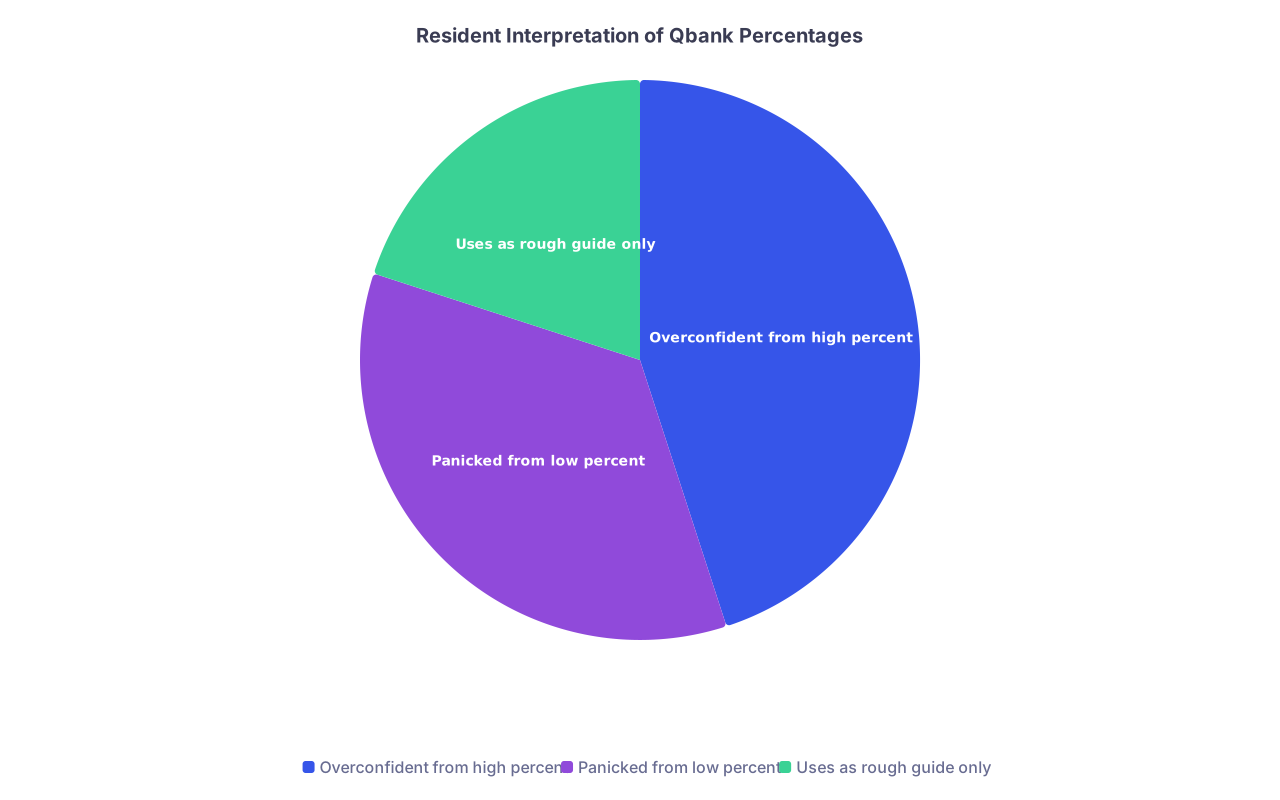
| Category | Value |
|---|---|
| Overconfident from high percent | 45 |
| Panicked from low percent | 35 |
| Uses as rough guide only | 20 |
This is the classic mistake: treating your Qbank percentage like a Step/boards predictor.
“I’m at 68% on UWorld, so I should be good.”
No. That’s not how this works. Here’s why that thinking is dangerous:
- Different residents do Qbanks in completely different ways: timed vs untimed, random vs system-based, fully read explanations vs skimming
- Many reset their Qbanks, mixing old and new questions
- Some guess quickly, some spend 5 minutes per item
- Qbanks constantly add/remove questions and re-norm their stats
You’re comparing your “68%” to a ghost population you don’t understand.
The key errors here
Treating “percent correct” as a score, not a process metric
That number is mostly telling you: “Given the way you’re currently using this Qbank, you’re getting X% right.”
It is not telling you: “You will score Y on the real exam.”Ignoring how you got that percentage
- Did you do 60% of your questions sleepy on night float?
- Did you pause the timer and look things up?
- Did you redo questions you’d seen before? Your 68% might actually represent a weak understanding propped up by bad testing behavior.
Letting a single number dictate your emotional state
I’ve watched residents spiral because their “percent correct” dipped by 2%. That’s noise. Question selection alone can swing your percentage day to day.
How to use Qbank percentages correctly
Use them like this:
- As a trend, not an absolute: are you generally improving over weeks?
- As a rough flag: if you’re consistently <50% after a few hundred fresh, timed, random questions, something is wrong
- As context, not verdict: combine with NBMEs / shelf exams / in‑training exams, not instead of them
If you take nothing else from this section, remember:
A pretty Qbank percentage has lulled more residents into false security than almost anything else in exam prep.
2. Misreading Qbank “Performance by System” and “By Topic”

Those colored bars by system/topic? They’re useful—but they’re very easy to misinterpret.
I’ve watched people waste weeks chasing fake weaknesses and ignoring real ones because they didn’t understand what those charts actually mean.
The biggest mistakes with system/topic breakdowns
- Ignoring the denominator problem
If you’ve done:
- 12 nephrology questions (58% correct)
- 120 cardiology questions (62% correct)
And you decide “Nephro is my weakness” because its bar is redder than cardio—you’ve just made a classic stats error.
Twelve questions is not data. It’s noise.
- Treating tightly related topics as separate
You see:
- “Electrolytes” weak
- “Renal” average
So you think, “I’ll just do more electrolyte questions later.”
Except… those are renal. And endocrine. And ICU. You don’t have an electrolyte problem. You have a pathophysiology problem showing up in multiple areas.
- Using topic bars to micromanage daily study
Residents will sit there and say:
- “I’m at 54% in GI, 62% in heme/onc, 48% in endocrine. So I’ll spend 90 minutes on GI, 70 minutes on endocrine…”
Stop. You’re optimizing noise. You don’t have that kind of time in residency to run a personal RCT on your own learning.
A smarter way to use these breakdowns
Use system/topic data to:
- Identify massive outliers: any system where you’ve done ≥80–100 questions and your percent correct is >10–15 points lower than your overall average
- Flag true knowledge gaps, not small dips: persistent underperformance after you’ve revisited the content
- Guide block-level focus, not day-to-day micromanagement: “Cardio and endocrine are trailing, so I’ll emphasize them this week”
But do not:
- Chase every red bar
- Panic over a system with 10–20 questions done
- Abandon random blocks for months just to “fix” a single topic bar
You’re a resident, not a data scientist with infinite time. Act like it.
3. Confusing Qbank Difficulty With Real Exam Difficulty
| Misbelief | Reality Check |
|---|---|
| “This Qbank is harder than boards” | It’s harder in *some* ways, easier in others |
| “If I can do these, the exam is easy” | Not if they don’t match the style/blueprint |
| “Low Qbank scores mean I’ll fail” | Only if they’re consistent across sources and time |
Here’s a nasty trap: residents love to declare, “UWorld is way harder than the real exam.”
Sometimes that’s true. Sometimes it’s the opposite. The problem is pretending that “harder” or “easier” is one-dimensional.
Qbanks can be:
- More detailed than the exam
- More nitpicky about rare variants
- Less faithful to actual question style
- Poorly aligned with the latest blueprint
So yes, maybe that GI Qbank is giving you zebra questions on obscure autoimmune gastritis patterns. But the real exam might hit you with more “simple” but integrative problems you’re still not actually good at.
Where people go wrong
- Writing off low Qbank scores with “this is just harder than the real thing”
I’ve heard this exact sentence:
“Yeah, but UWorld is brutal. I’ll be fine on the in‑service.”
That same person failed their in‑service. Twice.
If a Qbank is consistently beating you—especially on core bread-and-butter topics—it’s not “too hard.” You’re not solid.
- Over-valuing “hard” Qbanks that are off‑blueprint
Another pattern:
- Resident picks the “hardest” Qbank on the market
- Gets crushed with insanely detailed questions
- Spends all their time memorizing minutiae that aren’t tested
- Neglects core physiology, management, and guidelines
They feel like they’re working so hard. They are. At the wrong things.
- Assuming all Qbanks are equally calibrated
They’re not. Some:
- Overestimate test difficulty
- Underestimate it
- Are strong in certain systems and weak in others
- Are outdated in specific guideline-heavy areas (cardio, ID, OB, oncology)
You cannot blindly trust that “doing fine” on any one Qbank = board-ready.
4. Using Qbanks as a Crutch Instead of a Diagnostic Tool

Qbanks are supposed to help you diagnose your thinking. Most residents use them like a video game.
Click. Guess. See green or red. Read a paragraph. Move on.
That’s entertainment, not preparation.
The subtle ways residents misuse Qbank data every day
- Speed-running blocks to feel “productive”
“I did 80 questions today” sounds great.
If you:
- Rushed through
- Didn’t deeply analyze misses
- Barely reviewed explanations
You just did 80 shallow reps of your current mistakes. That’s how you entrench bad patterns.
- Using explanations as the “truth” instead of a conversation
Qbank explanations are not sacred. They:
- Sometimes emphasize secondary details
- Occasionally reflect one author’s pet approach
- Can be misaligned with current guidelines
Your job is to:
- Identify why you missed the question
- Connect it to your mental model
- Decide what needs updating
Not just absorb 400 words of text passively and move on.
- Never tracking why you missed questions
Every miss falls into a different category:
- Didn’t know the basic fact
- Misread the question stem
- Knew the fact but couldn’t apply it
- Got distracted by irrelevant details
- Time pressure / test anxiety
If all you see is “Incorrect,” you’re ignoring the most useful data point: the type of error.
How to turn Qbanks back into a diagnostic tool
For each block, at minimum:
- Mark: pure knowledge gap vs reasoning/reading error
- For knowledge gaps, list what concept you actually needed
- For reasoning errors, describe your faulty thought process in one sentence
Example:
- “Knew this was likely DKA but over-weighted the normal potassium and forgot about total body K+”
- “Anchored on sepsis because of fever, ignored rash pattern and med history”
Is this extra work? Yes.
Is it the work that actually prevents repeat mistakes on the real exam? Also yes.
5. Over-Fitting Your Preparation to One Qbank’s Style
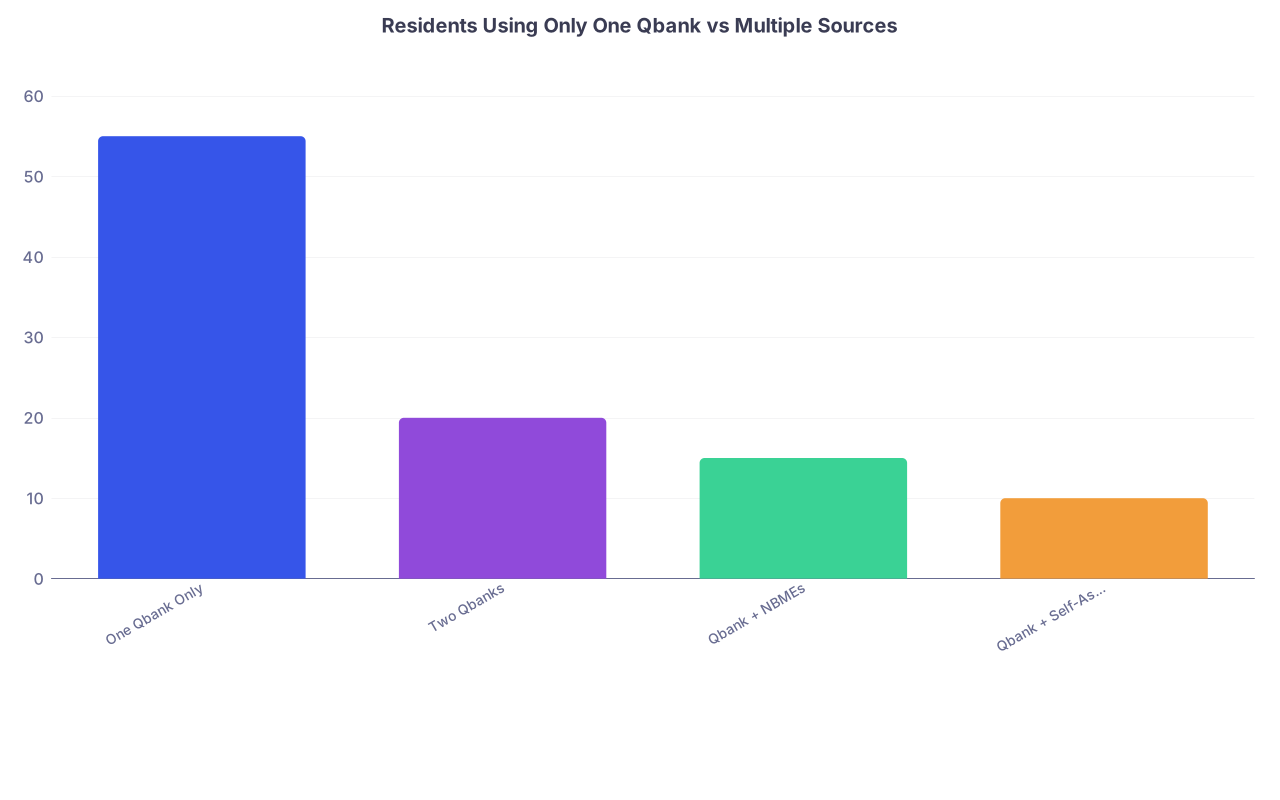
| Category | Value |
|---|---|
| One Qbank Only | 55 |
| Two Qbanks | 20 |
| Qbank + NBMEs | 15 |
| Qbank + Self-Assessment Mix | 10 |
Another quiet error: shaping your entire test-taking brain around a single company’s style.
Every Qbank has a personality:
- How long the stems are
- How much irrelevant fluff they include
- How often they use “best next step” vs “most likely diagnosis”
- How they structure answer choices
If you only ever see one flavor, you get very good at:
- Reading those stems
- Spotting that style of distractor
- Predicting that company’s pet topics
Then you walk into an exam written by a different committee, and your pattern recognition collapses.
The specific risks here
- Assuming stem length = difficulty, because that’s what your Qbank does
Some Qbanks:
- Love long, story-like stems for simple questions
- Use short, punchy stems for genuinely hard ones
The boards might flip that. If you’ve internalized, “long = hard, short = easy,” you’ll misallocate your attention.
- Learning to game their distractors, not real-life ambiguity
Every Qbank has quirks:
- “They always put the obviously wrong answer at the bottom”
- “They love to test this one odd side effect”
- “They rarely use this antibiotic in their vignettes”
You’re learning their internal pattern—not universal clinical reasoning.
- Developing a false sense of “I’ve seen it all”
You did:
- All of Qbank A
- All of Qbank B So you think you’ve basically seen every possible type of question.
You haven’t. You’ve seen two companies’ interpretation of the exam blueprint. That’s it.
How to counteract over-fitting
You don’t need five Qbanks. But you do need variety in:
- Self-assessment format: at least a couple NBMEs / official practice exams in the actual style of your boards
- Question length: mix shorter and longer stems
- Source: ideally 1 primary Qbank, 1 smaller supplemental or a block or two from a different source before test day
The point isn’t to max out questions.
The point is to stress-test your reasoning across multiple question-writing styles.
6. Ignoring the Context of Residency Life in Your Data

| Step | Description |
|---|---|
| Step 1 | Clinical Duties |
| Step 2 | Fatigue |
| Step 3 | Personal Life |
| Step 4 | Reduced Focus |
| Step 5 | Shallow Qbank Review |
| Step 6 | Misleading Performance Data |
| Step 7 | False Confidence or Panic |
| Step 8 | Poor Exam Outcome |
This is the part Qbank dashboards never account for: your life.
You’re not a full-time test-prep student. You’re a resident. You’re pulling 28‑hour calls, dealing with sick patients, charting for hours, maybe raising kids or taking care of family.
Your Qbank data is contaminated by all of that.
Ways residency warps your Qbank results
- Night shifts and fatigue depression
Blocks done:
- At 2 a.m.
- Post-call
- In a busy ICU week
are not comparable to:
- Blocks done on a golden weekend off with full sleep.
Yet residents look at those percent-correct numbers side by side like they’re equivalent.
- Multitasking blocks
I’ve seen this:
- Resident “doing questions” while pre-rounding
- Stopping midsentence to answer nurse calls
- Coming back and clicking what “seems right” to just finish
Those blocks are trash data. They’re not telling you about your knowledge. They’re telling you about your ability to guess half-distracted.
- Emotional contamination
Bad day on the wards. Attending chewed you out. You sit down to “redeem yourself” by doing 40 questions.
You’re not calm, methodical, thinking logically. You’re rushing and overthinking. And then you log those scores like they’re neutral metrics.
What to do differently
You’re not going to magically get ideal conditions. But you can:
- Label blocks by context:
“Fresh, rested, protected time” vs “Post-call, distracted”
When you look at performance, compare like with like. - Protect a few “clean” blocks weekly:
40–80 questions:- Phone away
- Not during active clinical chaos
- Fully timed
- Discount the junk data:
If a block was done in the middle of a disaster shift, don’t over-interpret the percentage. Read the explanations, learn, but don’t let that number drive your anxiety.
If you pretend every Qbank block is equally valid data, you will make bad decisions.
7. Practical Guardrails: How Not to Let Qbank Data Ruin You

Let me pull this together into something you can actually apply this month.
Here are concrete guardrails to stop Qbank misuse before it sabotages your boards:
1. Define what each metric is allowed to mean
Percent correct overall
Rough gauge, trend only.
Allowed use: “Am I generally improving?”
Not allowed: “This number equals my board score.”Percent by topic/system
Mid-level guide.
Allowed: “I consistently lag in cardio after 100+ questions, I need a focused review.”
Not allowed: “This bar is red after 12 questions, I’ll reorganize my whole week around it.”Self-assessment/official practice scores
High-weight.
Allowed: “This is the closest thing to a prediction; I’ll use it to adjust my overall strategy.”
Not allowed: “I’ll ignore this because my Qbank percentage looks better.”
2. Track error types, not just correctness
Keep it dead simple. For each missed question, jot down:
- K = Knowledge gap
- R = Reasoning/logic error
- M = Misread / rushed
- T = Test-taking trap (overthinking, second-guessing, pattern-based error)
If you see:
- 70% K → you need more content review
- 70% R/M/T → you need to fix how you think during questions, not just memorize more
3. Anchor your prep to the actual exam format
At least:
- 2–4 official-style practice exams (NBMEs, in‑training, or specialty-specific self-assessments)
- A couple of full-length, timed sessions matching exam length
Then use Qbank data to support, not replace, what those higher-fidelity tests show you.
4. Protect your headspace from fake signals
You’re vulnerable to:
- Overconfidence from inflated percentages
- Panic from context-contaminated bad blocks
So:
- Don’t check your cumulative stats every day; once a week is plenty
- After a bad block on a brutal day, ask: “Is this really new information, or just fatigue talking?”
- After a great block, ask: “Were these topics I’ve just reviewed? Was this random or system-based?”
You want to respond to signals, not noise. Residency life throws enough noise at you already.
FAQ (Exactly 3 Questions)
1. How many Qbanks should I use during residency prep?
One primary, done well, is usually enough. Add a second only if:
- You actually finish the first with quality review
- You still have time before the exam
- You’re using the second to get variety in question style, not to chase more and more raw question counts
If you’re struggling to deeply review even one Qbank’s explanations, a second one will just dilute your effort.
2. My Qbank percentage is low, but my in‑training exam was fine. Who do I believe?
Trust the exam that looks more like your actual boards. If your in‑training exam or official self-assessments are decent and your Qbank percentage is low, it probably reflects:
- How you’re using the Qbank (fatigued, distracted, rushed)
- A mismatch in difficulty or style
Still review your Qbank misses, but don’t catastrophize based solely on the Qbank number.
3. Is it a bad idea to reset a Qbank and start over?
Resetting can be useful once, but it corrupts your performance data. After resetting:
- You’ll inevitably remember some questions
- Your percent correct will be artificially high
- System/topic performance will look “better” than your actual knowledge
If you reset, stop using percentages as any kind of predictive tool. Focus instead on:
“Can I explain why each option is right or wrong without looking?” If the answer is often “no,” you’re not done, no matter what that shiny dashboard tells you.
Core reminders:
- Qbank numbers are context-dependent, noisy, and easily misread.
- Your job is not to “beat” the Qbank—it’s to train thinking that holds up on the real exam, under real resident conditions.