
The blunt truth: you can work without having passed every board exam yet—but only in specific roles, under tight rules, and on a short clock.
If you're in residency or just finishing med school, here’s the tension you’re feeling: programs want you working; hospitals want you credentialed; states want you licensed; certifying boards want you examined. Those systems overlap but are not the same thing—and confusing them is where people get burned.
Let’s cleanly separate it: can you still work, what kind of work, for how long, and what actually happens if you have not passed your boards yet?
First, define what “boards” and “credentialing” actually mean
People mash these together and end up panicking about the wrong thing. There are three separate lanes:
Licensure (state medical license)
- This is your legal permission to practice medicine in a state.
- Can be a training license (intern/resident) or a full unrestricted license (attending-level).
Board exams (USMLE/COMLEX and specialty boards)
- Step 1, Step 2 CK, Step 3 (or COMLEX levels), plus specialty boards like ABIM, ABEM, ABP, etc.
- These are required or strongly expected for training progression and later board certification, but they are not the same as your state license.
Credentialing & privileging (hospital/employer-level)
- Hospitals and groups verify your license, training, malpractice history, NPDB queries, etc.
- Privileges = what you are allowed to actually do in that institution (admit, operate, perform procedures).
Here’s the key:
You can often start or continue residency without having passed all your boards.
You usually cannot start as an independent attending without finished exams and proper licensure/credentialing.
Can I work in residency if I haven’t passed my boards yet?
Short answer: usually yes—up to a point. Residency runs under a different set of rules than independent practice.
Most residency positions rely on a training license (or institutional license), which:
- Is tied to your GME program, not to you independently hanging a shingle.
- Often does not require board certification; it does require you to be exam-eligible and progressing reasonably.
- Is renewably yearly—programs vouch for you.
But there are landmines.
Common residency scenarios
Let’s break down what “haven’t passed” can mean:
| Situation | Typical Impact on Residency Job |
|---|---|
| Failed Step 1 but passed on second attempt | Usually no impact once matched; past history only |
| Failed Step 2 CK and still not passed by residency start | Riskier; some programs won’t let you start until passed |
| In residency, failed Step 3 once | Often allowed to continue; program may require retake by set date |
| Multiple failed attempts (Step 2 or 3) | Real risk to contract renewal, promotion, or remediation |
| Completely untested (delayed exam) | Program-specific; many require completion by a deadline |
Here’s how it actually plays out:
Starting PGY-1 without all boards passed
Many programs let you start with Step 2 CK or COMLEX Level 2 still pending as long as you’re licensed or eligible under a training license.
However, more programs are writing into contracts:
“You must pass Step 2 CK/Level 2 by X date to continue.”
You need to know what your contract says, not what your co-residents think it says.Progressing PGY-2 and beyond without Step 3
Common: programs require Step 3/Level 3 by the end of PGY-2 (or sometimes PGY-1 for certain visas).
Miss that? You may still keep working temporarily, but:- Your promotion may be delayed.
- Your salary step-up might be held.
- Your renewal contract could be conditional or not renewed.
Multiple failures
I’ve seen residents allowed one fail with a clear remediation plan. Two, three fails—program directors start talking words like “fitness for independent practice,” “graduation risk,” and “GME committee review.”
Bottom line:
Yes, you can usually keep your resident job even if you haven’t passed every exam yet—as long as:
- Your training license is valid.
- Your program contract doesn’t explicitly require a pass by that date.
- You are not repeatedly failing without a clear plan and progress.
Can I get an attending job if I haven’t passed my boards yet?
This is where the answer changes sharply.
To work as an independent attending, you generally need three things lined up:
- A valid state license (full, unrestricted; not just a training license).
- Hospital privileges at the site(s) you’ll practice.
- Often, board certification or board eligibility as defined by that employer or hospital.
You can sometimes get an attending job without being board certified yet, but working as an attending without passing key exams (like Step 3 or your specialty board) is much harder.
Typical attending hiring reality
Most employers fall into one of these buckets:
Large health systems and academic centers:
- Require you to be board eligible at hire.
- Expect board certification within a fixed timeframe (e.g., 3–5 years).
- Require full state license, which usually means all USMLE/COMLEX steps done and passed.
Community hospitals and private groups:
- Often require at least board eligibility (completed an ACGME/ACGME-I/RCPSC/ACGME-equivalent residency).
- Some will hire “board eligible, not yet certified” attendings, but:
- They still require a full state license.
- Many have bylaws stating: “Must achieve board certification within X years of hire.”
Locums agencies:
- Typically strict about clean licensure and finished exams.
- They make money by placing someone who can start working immediately with full privileges. Half-finished paperwork is expensive for them.
So, can you get an attending job without having finished specialty boards yet (e.g., ABIM, ABEM)? Often yes, if you’re board eligible and licensed.
Can you get an attending job without having passed Step 3 / COMLEX Level 3 and therefore without a full license? In most states and most jobs: no.
Understanding “board eligible” vs “board certified”
People throw these terms around like they’re interchangeable. They’re not.
Board eligible (BE)
You completed an accredited residency in that specialty and meet requirements to sit for the specialty board exam. You haven’t passed it yet, or haven’t taken it yet.Board certified (BC)
You passed the specialty board’s initial certification exam (and often have to maintain it with MOC/recert).
Why this matters for your job:
- Many hospitals will credential BE candidates with a written deadline:
“Must become BC within 5 years of initial eligibility.” - Some high-competition specialties (derm, ortho, neurosurg) and top-tier systems practically treat BE-but-never-certify as a red flag longer-term.
- Insurance panels and payors: some contracts pay differently or even restrict practice based on BC status, especially in certain specialties.
So yes, you can get an initial attending job with BE-only status in many places.
No, you cannot comfortably ignore your boards “indefinitely.” Someone will care—hospital bylaws, your group, or payors.
How credentialing actually works (and where boards fit in)
Credentialing is slow, annoying, and painfully detailed. Expect multiple months. Here’s the typical sequence:

| Step | Description |
|---|---|
| Step 1 | Job Offer Accepted |
| Step 2 | Submit Credentialing App |
| Step 3 | State License Verified |
| Step 4 | Board Exam Status Checked |
| Step 5 | Training and References Verified |
| Step 6 | NPDB and Background Check |
| Step 7 | Medical Staff Committee Review |
| Step 8 | Approve Privileges |
| Step 9 | Start Clinical Work |
Where your “not passed boards yet” status bites:
State licensing board
- Many states require all Steps/COMLEX levels passed for a full license.
- Some allow full licensure with certain combinations and international variations, but all of them want to see passing scores by the time you’re an independent attending.
Hospital medical staff office
- They pull primary-source verification on:
- Your degree
- Your residency completion
- Your board certification or board eligibility
- Your exam attempts (sometimes especially if there are multiple failures)
- If their bylaws say “must be board certified or eligible” and you’re neither because you never completed required exams, they simply won’t grant privileges.
- They pull primary-source verification on:
Malpractice carriers
- More failures and/or non-completion of boards can increase premiums or trigger extra review.
This is where the distinction matters:
A hospital can be okay with “board eligible, exam scheduled” but not okay with “never passed Step 3, no license.”
What if I fail my specialty boards—can I still work?
Yes, but with caveats.
If you finished residency and have a full state license, you can technically practice without being board certified in many settings as long as:
- The hospital bylaws allow non-board-certified physicians.
- Your group/employer is okay with it.
- You’re still eligible to retake the boards (within your eligibility window).
But there are friction points:
- Some groups will write into contracts:
“If you do not obtain board certification by X date, your employment may be terminated.” - Some hospitals give temporary or provisional privileges pending your board results, and if you fail, they may require:
- A corrective plan.
- Reappointment review.
- In rare cases, non-renewal of staff privileges.
Can you salvage a career after failing a specialty board exam? Yes. People do. Repeatedly ignoring it and not re-taking? That’s how you box yourself into fewer and fewer job options over time.
Visa holders: tougher rules
If you’re on a J-1 or H-1B, the “haven’t passed my boards yet” problem is more severe.
H-1B
- Often requires full state license, not just a training license.
- That usually means Step 3 passed before starting residency or employment (varies by state).
J-1
- ECFMG rules, state licensing rules, and program policies all pile on.
- Many J-1 residents are required by their programs to pass Step 3 by a firm deadline to maintain training and future employability.
If you’re in this group, “I’ll just push Step 3 another year” is not a small decision. It can wreck both visa and job timelines.
Tactical advice if you haven’t passed yet—but need a job
Here’s what you do, not in theory, in practice.
Know exactly what box you’re in
- Still in training license only?
- Eligible for full license if you pass Step 3?
- Already BE for specialty boards?
Get it on paper—email from GME, screenshot of state board requirements, not just hallway gossip.
Read your contract and your program/hospital bylaws
Look specifically for:- Requirements to pass specific exams by promotion/renewal.
- Language about board eligibility/certification timelines.
- Any stated consequences of not meeting those.
Have an honest, early conversation with your PD or department chair
Something like:
“I’m concerned about my [Step 3/boards] timing. I want to be transparent and figure out the latest acceptable date to pass without affecting my ability to renew or get a letter for jobs.”
Get clarity, not vague reassurance.If you’re job hunting while not fully passed
Be upfront with recruiters and employers:- “I’m board eligible with exam scheduled for [month/year].”
- “I’ve passed all USMLE Steps; specialty boards exam is pending.” Do not let them find out from the credentialing office as a surprise—it makes you look dishonest even if you weren’t.
Schedule the exam strategically—but soon
Every month you “wait for a better study block” is a month you damage:- Your licensure timeline.
- Your job start date.
- Your negotiating power.
Plan for credentialing delay
Assume 3–6 months from job offer to full privileges.
If you’re taking your exam too late in that window, your start date could slip, which some employers will not tolerate indefinitely.
The crisp bottom line
- Residency:
You can usually keep your residency job without having passed every exam, as long as:- Your training license remains valid.
- You meet your program’s internal deadlines and remediation plans.
- Attending roles:
You almost never can start as an attending without:- A full state license (which requires completed basic boards).
- At least board eligibility for your specialty in many institutions.
Failed or pending boards are not an automatic career death sentence.
Ignoring them, or pretending they are “just another test” with no consequences—that’s the problem.
Open your current contract and your state medical board’s website today.
Highlight every sentence that mentions “board eligibility,” “board certification,” “USMLE/COMLEX,” or “licensure requirements.” Then write down the earliest hard deadline you’re actually facing—on paper, in front of you. That’s the date you should be planning your life, your studying, and your job search around.
Now you’re dealing with reality, not vibes.
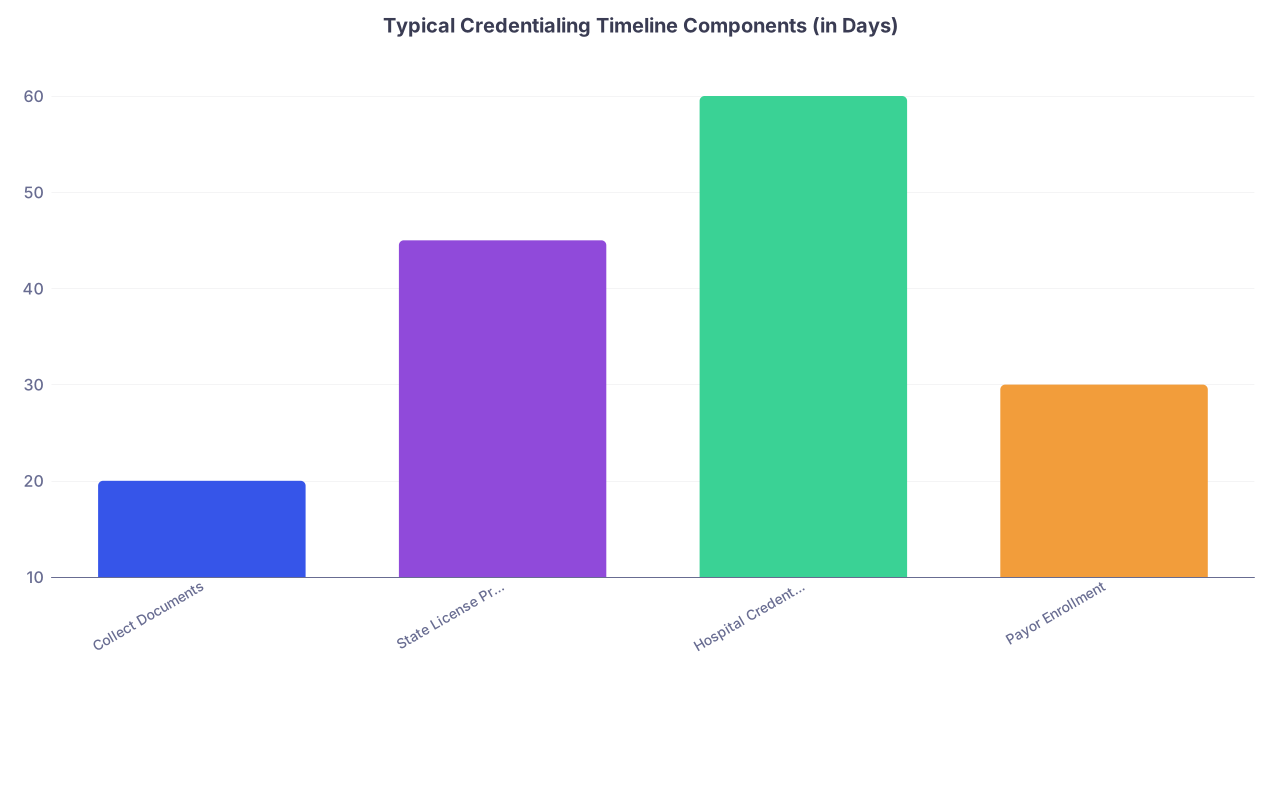
| Category | Value |
|---|---|
| Collect Documents | 20 |
| State License Processing | 45 |
| Hospital Credentialing | 60 |
| Payor Enrollment | 30 |