
The way most residents pick board review resources is backwards. They obsess over which brand is “best” instead of which combo is best for their situation, timeline, and weaknesses.
Let me cut through the noise for you.
You do not need the “perfect” resource. You need a small, coherent stack you’ll actually finish before exam day. Everything else is marketing.
Below is a concrete framework you can use today to choose between competing board review tools in your specialty—IM, EM, Peds, Anesthesia, Surg, whatever. The logic is the same.
Step 1: Identify What Type of Exam You’re Actually Taking
Before you compare any resource, you need to be brutally clear on what your board exam is testing.
There are three broad exam “profiles”:
Question-Pattern Heavy – Classic board-style vignettes, pattern recognition, buzz phrases, management next steps.
Examples: ABIM, ABFM, Pediatrics general boards, many subspecialty boards.Detail / Fact Heavy – Niche guidelines, drug doses, staging systems, weird eponyms.
Examples: Some surgical boards (written), anesthesia in-depth topics, certain subspecialty written exams.Image / Interpretation Heavy – EKGs, imaging, pathology slides, waveforms.
Examples: Cardiology, radiology, EM, neuro, ICU boards.
Most exams are a blend, but usually one style dominates. Get confirmation from:
- Recent test-takers (the most honest source)
- Official board content outlines
- Question-bank dashboards that categorize questions by topic/format
Once you know which of the three profiles dominates, you can rank resource types:
- Pattern-heavy → Qbank + concise text or videos
- Detail-heavy → Structured text/outlines + targeted questions
- Image-heavy → Image-heavy Qbank + dedicated atlas or image bank
If a resource does not match your exam’s dominant profile, it’s probably secondary, not core.
Step 2: Decide Your “Core Stack” Before Buying Anything
Your “core stack” = 2–3 resources that will do 80–90% of the work.
General rule of thumb for nearly every specialty:
- 1 primary Qbank
- 1 primary content summary (review book, outline, or video series)
- Optional: 1 practice exam source (NBME/board-supplied or reputable mock exams)
Everything else is noise until you’ve maxed those.
| Exam Style | Core Qbank Priority | Core Content Priority | Extras Priority |
|---|---|---|---|
| Pattern-heavy | Very High | Medium | Medium |
| Detail-heavy | Medium | Very High | Medium |
| Image-heavy | High | Medium | High (image sets) |
If you already have three core resources “you plan to maybe use,” you’re overdoing it. Finish one Qbank and one content source first. Then decide if you truly need more.
Step 3: Compare Qbanks Using Hard Criteria (Not Vibes)
Let’s talk about question banks, because this is where most residents waste money.
Here’s how to compare them in a sane way:
Content Match with the Actual Exam
- Does the Qbank say explicitly it targets your exam (e.g., “ABIM Certification” vs generic “Internal Medicine questions”)?
- Ask seniors: “Which Qbank felt most like the real exam—question length, difficulty, vibe?”
- Check sample questions. Are they:
- Bloated and wordy in a Step 1 style?
- Or tight vignettes with board-style answer choices?
If the feel is wrong, the resource might still be useful for learning, but not as your main exam simulator.
Number of Questions vs Your Timeline
Rough math:
- Short prep (2–3 months) with 60–80 questions/day → 3,000–5,000 realistic questions.
- Longer prep or lighter pace → 5,000–8,000.
If one Qbank has 7,000 questions and another has 2,000, but you only have 2 months, the 7,000-item monster is pointless if you’ll only do 30%.
Choose the one you can finish once, maybe 1.5 times, not the one with the biggest marketing number.
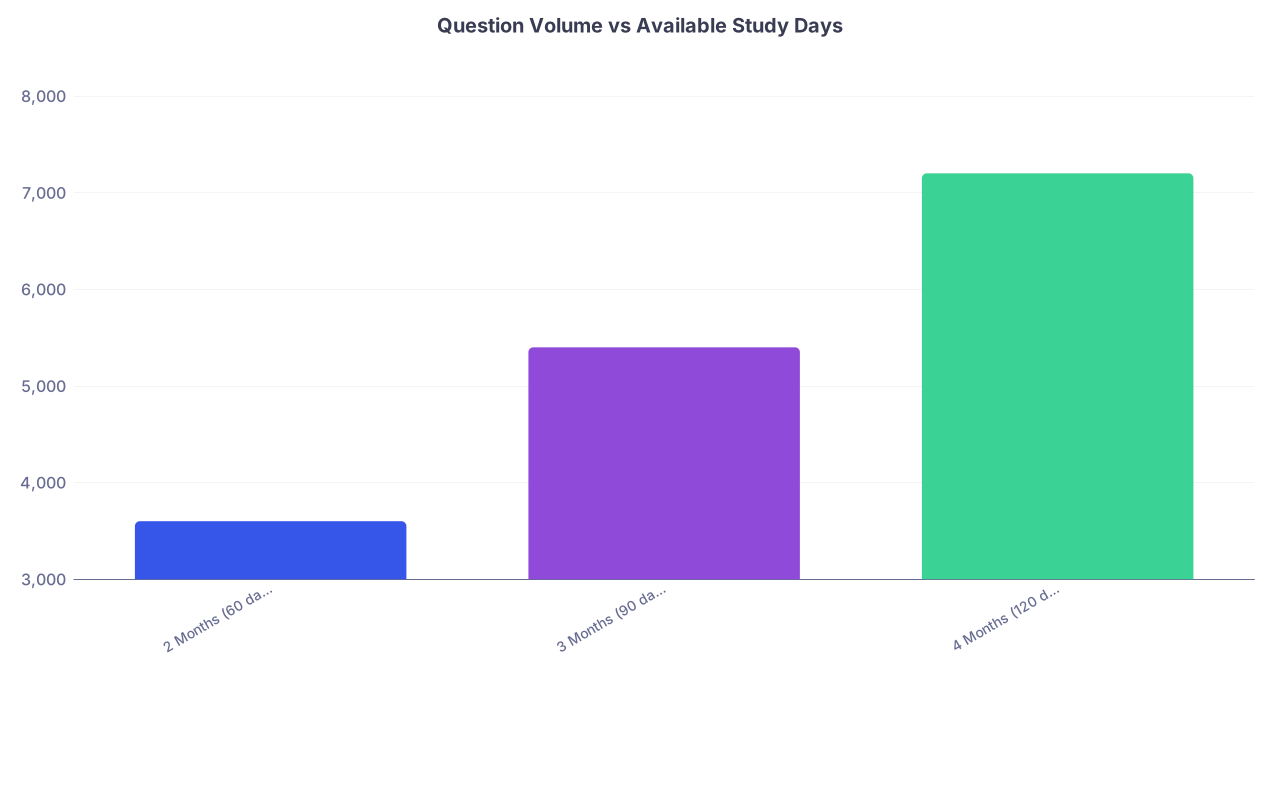
| Category | Value |
|---|---|
| 2 Months (60 days) | 3600 |
| 3 Months (90 days) | 5400 |
| 4 Months (120 days) | 7200 |
(That chart assumes 60 questions per day. Adjust for your actual pace.)
- Explanations Quality
You learn from explanations, not from the question stem.
Look for:
- Clear why each wrong option is wrong
- Guideline references and dates (you’d be surprised how many use ancient data)
- High-yield summary tables or “take-home” bullets
If explanations feel like a textbook copy-paste or are vague hand-waving, that Qbank will waste your time.
- Interface and Features
You’re going to live in this Qbank. If the interface annoys you, you’ll “accidentally” stop using it.
Prioritize:
- Exam-like interface (flag questions, highlight, timed/untimed modes)
- Good mobile app if you rely on bus/clinic downtime
- Solid analytics: breakdown by topic, question type, and performance over time
Do not overvalue gimmicks (gamification coins, avatars, flashy UI) over core usability.
- Social Proof That Actually Matters
Ignore anonymous Reddit hype. Listen to:
- 1–2 years ahead residents who passed your exact exam
- Your PD or chief residents’ consistent recommendations
- Passing stats in your program with specific resources, when available
Ask people:
“If you had to do it over with just one Qbank, which one, and why?”
If the same name keeps coming up, that’s data.
Step 4: Compare Content Summaries with a Simple Test
For content sources (review books, video series, outlines), the main question is:
“Will this help me recall and apply concepts on test day, not just feel smart while watching/reading?”
Here’s how to choose between contenders:
- Match to Your Learning Style—But Be Honest
You probably fall into one of these:
- You retain best from reading and annotating → Lean book/outlines.
- You retain from hearing + visual scaffolding → Lean videos with good slides.
- You retain from doing questions, then reviewing → Short written summaries integrated with a Qbank.
Be ruthless with yourself. If you’ve “watched” hundreds of hours of medical videos before and remembered almost nothing, stop pretending you’re a video learner.
- Density and Finishability
Open 10 random pages or 10 random minutes of different resources:
- Is it all microscopic font and zero emphasis? That’s a reference book, not a board review.
- Is it so watered down it feels like a premed crash course? Too light.
You want a dense but survivable resource you can reasonably finish 1–2 times.
As a rule:
- If your exam is in < 3 months: your core content source should be finishable in 30–45 days at a moderate daily dose.
- If your exam is 6–12 months away: you can afford a slightly more detailed text or longer video series.
- Update Frequency & Guideline Alignment
In guideline-heavy fields (IM, cardiology, critical care, ID, heme/onc), outdated content is dangerous.
Check:
- Last major update or edition
- Whether they explicitly reference recent guidelines (e.g., 2021 HF guidelines, updated sepsis criteria, etc.)
If a flashy resource glosses over huge practice changes from the last 3–5 years, that is a red flag.
Step 5: Weigh Cost vs Expected Return (Not Sticker Shock Alone)
Residents are understandably cost-sensitive. But under-buying the one resource that will double your pass probability is false economy.
Use a simple calculation:
- Estimate your realistic daily study time and prep length.
- Translate that into:
- How many question blocks you’ll complete
- How many content passes you’ll do
- Divide the price by hours you’ll actually use it.
| Resource | Cost | Use Hours (est.) | Cost per Hour |
|---|---|---|---|
| Qbank A | $300 | 120 | $2.50 |
| Qbank B | $220 | 40 | $5.50 |
| Review Book | $90 | 60 | $1.50 |
| Video Package | $600 | 30 | $20.00 |
I’ve seen residents buy a $600 video package, watch 10%, and then panic-buy a Qbank 6 weeks before the exam. That’s paying top dollar for guilt, not learning.
If a resource is expensive but you’ll use it daily for months, that’s usually fine. If it’s expensive and passive (hours of lectures), be skeptical.
Step 6: Don’t Double Up on the Same Function Without a Reason
The classic mistake: buying two full Qbanks + two big review books + a video course “just in case.”
Here’s how overlap usually plays out:
- Two Qbanks: start both, finish neither.
- Two big books: skim both, remember neither.
- Videos + full book: you’re passively consuming the same info twice.
When is overlap justified?
- You’ve completed your entire primary Qbank (not 40%, not 70%—all of it) and still have time. Adding a smaller second Qbank for variety can help.
- You have a clear, documented weakness in a specific domain (e.g., EKGs, imaging, biostats). A targeted extra resource for that domain makes sense.
- Your first choice is clearly misaligned with the real exam vibe. Then, and only then, pivot or add.
Otherwise, more is not better. It’s just diluted attention.
Step 7: Build a Simple, Firm Plan Before You Commit
Once you’ve short-listed your resources, pressure-test them with a quick planning exercise.
Take 10 minutes and write:
- Exam date (real, not hypothetical)
- Number of weeks left
- Average study hours per week (day off? post-call days? be honest)
Then set targets:
- Qbank: X questions per week, finish by Week Y
- Content source: X chapters/videos per week, finish first pass by Week Z
- Practice tests: Dates you’ll take each and review them
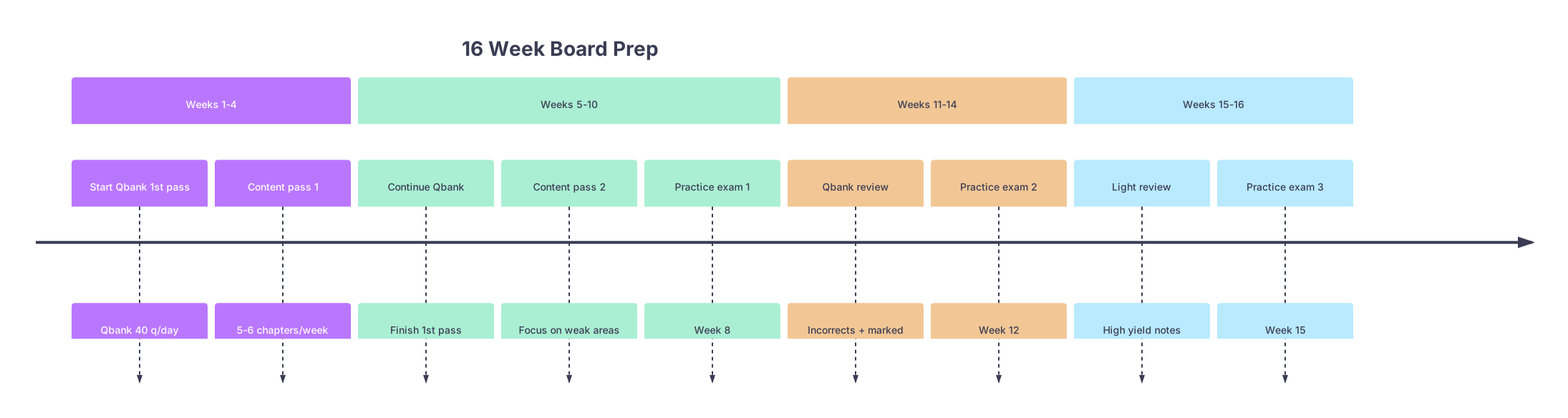
| Period | Event |
|---|---|
| Weeks 1-4 - Start Qbank 1st pass | Qbank 40 q/day |
| Weeks 1-4 - Content pass 1 | 5-6 chapters/week |
| Weeks 5-10 - Continue Qbank | Finish 1st pass |
| Weeks 5-10 - Content pass 2 | Focus on weak areas |
| Weeks 5-10 - Practice exam 1 | Week 8 |
| Weeks 11-14 - Qbank review | Incorrects + marked |
| Weeks 11-14 - Practice exam 2 | Week 12 |
| Weeks 15-16 - Light review | High yield notes |
| Weeks 15-16 - Practice exam 3 | Week 15 |
If your planned pace for a resource is something absurd like “160 questions/day on top of 60-hour weeks,” that resource is not realistic. Cut it now, not in three months.
Step 8: Recognize Marketing Red Flags
You’re being sold to constantly. Recognize these red flags:
- “Most comprehensive on the market” – Translation: bloated, hard to finish.
- Lifetime access – You only care about the next exam date, not 2040.
- Hyper-polished branding with suspiciously vague outcome claims.
- Influencer discounts where the influencer clearly hasn’t taken your exam.
Strong signals instead:
- Specific pass-rate improvements in your exam with transparent data.
- Endorsements from your own program / specialty societies.
- Honest discussions of limitations (e.g., “We’re not meant to replace primary guidelines.”)
Specialty-Specific Nuances (Briefly)
A few patterns I’ve consistently seen:
Internal Medicine / Family / Peds
One solid Qbank aligned with your board (e.g., MKSAP-style for IM) + a lean review book is usually enough. Do not drown yourself in duplicative text.Emergency Medicine
Image-heavy and quick pattern recognition. Prioritize Qbanks that mimic the fast, focused nature of EM questions + a resource that hits bread-and-butter ED presentations.Anesthesia / Critical Care
Details and physiology matter. A strong, updated text plus a Qbank that hits core physiology and scenarios. Don’t rely on superficial MCQs alone.Surgery
For written boards: heavy on detail, anatomy, indications/contraindications. You’ll want a strong outlines book + questions, and do not ignore classic texts recommended by your attendings.
You still apply the same framework—core Qbank + core summary—but the weight shifts slightly.
Visual Snapshot: Decision Flow
Here’s the bird’s-eye decision process you should be running:

| Step | Description |
|---|---|
| Step 1 | Know exam profile |
| Step 2 | Pick 1 core Qbank |
| Step 3 | Pick 1 core content source |
| Step 4 | Choose smaller Qbank |
| Step 5 | Lock Qbank |
| Step 6 | Choose leaner content |
| Step 7 | Lock content |
| Step 8 | Add practice exams |
| Step 9 | Target weaknesses or add small 2nd resource |
| Step 10 | Stop buying and execute plan |
| Step 11 | Can finish before exam? |
| Step 12 | Can finish before exam? |
| Step 13 | Time left after 1 pass? |
If a resource does not survive this flow (i.e., you cannot reasonably finish it), it does not deserve your money.
FAQ: Choosing Between Board Review Resources
Should I use the same resource everyone else in my program is using, even if I don’t love it?
Generally yes, as your core resource—if your seniors using it are passing at a high rate. Customization can come later. It is safer to follow a proven, program-tested path and layer minor tweaks (like a different atlas or targeted videos) than to reinvent the wheel because of aesthetics.Is it worth buying a second full Qbank if I’m 3–4 months from the exam?
Only if you have already finished your first Qbank and thoroughly reviewed incorrects, and you can realistically complete at least 50–70% of the second. If you’re still at 30–50% completion of your primary bank at three months out, buying another is a distraction, not a booster.How do I know if a resource is too easy or too hard for my exam?
Do 40–50 questions from the demo or early blocks: if you’re scoring <30% but the explanations make sense and feel learnable, that’s probably fine—boards will feel easier after prep. If you’re at 80–90% consistently and bored, that bank may be too soft or too unlike the real exam. Aim for a resource where 50–70% correct feels like a real challenge early on.Where do official board practice exams fit with commercial resources?
They sit at the top of the food chain. Whatever Qbank or review source you use, you should still do every official practice test offered by your board if possible. Use them to calibrate your readiness, benchmark scores, and adjust your study focus. Do not treat them as just “more questions”—treat them as mock exams and review them in detail.What if I already bought too many resources—how do I triage now?
Ruthlessly pick one Qbank and one content resource as your “core” going forward. The rest become optional references. Build a realistic schedule based on your exam date and ignore sunk costs: money spent on unfinishable resources is already gone. Maximizing pass probability now matters more than “getting your money’s worth” from everything.How early should I start using board-specific resources during residency?
Earlier than most people think, but lighter. In your PGY-1 or early PGY-2, doing small steady chunks of a good Qbank (e.g., 10–20 questions a few times a week) cements core knowledge and makes the final 3–6 month push far less brutal. Do not watch full board review video series a year out; prioritize Qbank exposure and targeted reading aligned with your current rotations.
Key takeaways:
You do not need every shiny board product. You need one strong Qbank, one finishable content source, and a plan that fits your actual life. Judge resources by alignment with your exam, finishability, and explanation quality—not by hype or FOMO.