
7–12% of residents in several major specialties fail their first attempt at board certification. In some subspecialties, that number spikes above 20%.
That is not “a few unlucky people.” That is one or two residents on almost every medium‑sized program’s graduating class. If you have not seen someone in your program quietly disappear from the group email thread around exam time, you will.
Let me walk through what the data actually show, specialty by specialty, and what it means for how you structure your life in residency.
The Baseline: How Often Do Residents Fail Boards?
We do not have perfect, unified data across every specialty, but the major boards publish enough for a clear pattern. I will use rounded, recent multi‑year numbers; individual years bounce a bit, but the hierarchy is stable.
Here is the reality for primary board certification (first attempt pass rate for residents completing ACGME training):
| Specialty | Initial Pass Rate | Approx. Failure Rate |
|---|---|---|
| Family Medicine (ABFM) | 88–92% | 8–12% |
| Internal Medicine (ABIM) | 88–93% | 7–12% |
| Pediatrics (ABP) | 88–95% | 5–12% |
| General Surgery (ABS QE) | 80–88% | 12–20% |
| Anesthesiology (ABA) | 88–93% | 7–12% |
| Emergency Med (ABEM QE) | 90–96% | 4–10% |
Translate that into human terms. In a categorical IM program graduating 24 residents per year, an 88% pass rate means 2–3 people fail the boards on the first try. Every single year.
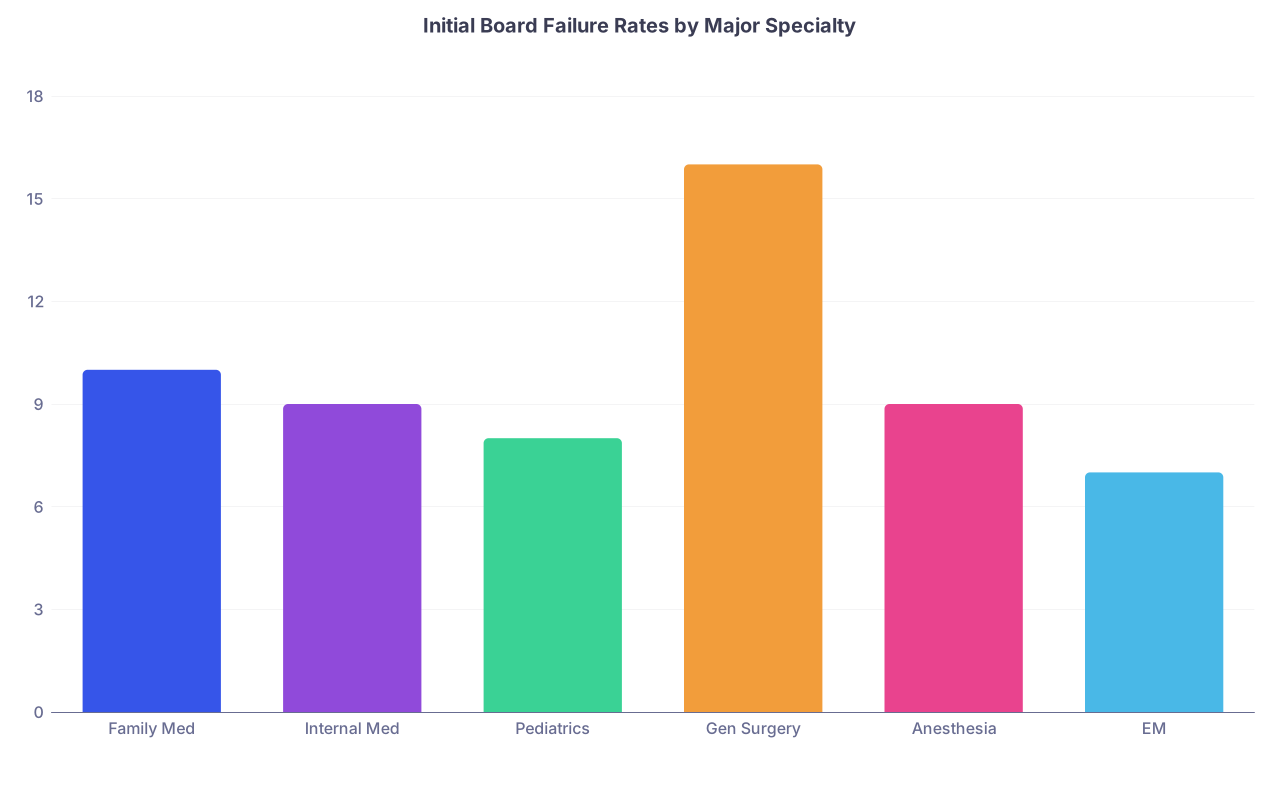
| Category | Value |
|---|---|
| Family Med | 10 |
| Internal Med | 9 |
| Pediatrics | 8 |
| Gen Surgery | 16 |
| Anesthesia | 9 |
| EM | 7 |
The data show three big points right away:
- Surgical boards are objectively harsher. General surgery has reliably higher failure rates than medicine or peds.
- The “cognitive” specialties (IM, FM, peds) hover around a 5–12% failure band despite being considered less competitive on the front end.
- Even in “high‑achieving” specialties like anesthesia and EM, roughly 1 in 10 still fail.
If you are in residency and you assume “people like me pass,” you are already thinking incorrectly. The denominator is “people like you.”
Why Some Specialties Bleed More: Exam Structure and Training Realities
The failure rates do not come out of nowhere. They track pretty cleanly with three design choices:
- How many steps the board requires (written vs oral/OSCE).
- How broad and fast‑changing the tested knowledge base is.
- How protected (or not) resident time is for exam preparation.
Medicine and Pediatrics: High Volume, Moderate Risk
Internal medicine (ABIM) and pediatrics (ABP) both run large, well‑studied written exams:
- ABIM exam: ~240 multiple‑choice questions, one 10‑year cycle for re‑certification (for those still on the older model) or ongoing “knowledge check‑ins” for MOC.
- ABP exam: similar scope, heavy on bread‑and‑butter plus guideline updates.
Both boards publicize pass rates by program. I have sat in program director meetings where people quietly scroll down to see exactly where their program sits against the national median, then start emailing chiefs about their underperforming residents.
Predictably:
- Programs with in‑service exam percentiles >60–70 tend to have board pass rates >95%.
- Programs with in‑service performance in the bottom quartile show board pass rates in the 70s–80s.
So yes, those “annoying” in‑training exams (ITE, ITE‑Peds, etc.) are not just busywork. They are leading indicators. The data show that being consistently under the 30th percentile on ITE raises your first‑attempt failure risk to somewhere in the 25–40% range, depending on specialty and program support.
General Surgery: The Two‑Stage Gauntlet
Surgery is different. You have:
- ABS Qualifying Exam (QE) – written exam, taken after residency.
- ABS Certifying Exam (CE) – oral exam, taken after passing the QE.
The QE pass rate for first‑time takers has lived roughly in the 80–88% band. That is already worse than medicine and peds. Then you add an oral exam that historically has a 70–85% pass rate for first‑timers.
Do the math across both stages. If 84% pass QE and then 80% of those pass CE on the first try:
- Net first‑pass certification proportion = 0.84 × 0.80 = 0.672, or 67.2%.
- That means roughly one out of three general surgery grads does not sail straight through both stages on the first attempt.
Not all of those are “failures”—some delay, some skip cycles—but from a resident’s perspective, the risk profile is absolutely higher than most medicine fields.
The drivers:
- Study time: surgical workloads are heavier; post‑call “reading” is often theoretical.
- Exam design: the oral board penalizes weak synthesis and poor communication style, not just knowledge gaps.
- Case mix: community programs with limited complex cases can produce blind spots that show up on the oral exam.
I have seen residents who crushed ABSITE scores stumble on the oral boards because nobody ever drilled them on concise, safe, exam‑style case presentations.
Hidden Patterns: Program and Resident-Level Predictors of Failure
You can not control national pass rates. But you can absolutely understand which individual factors move your personal probability up or down.
Correlation #1: In‑Training Exams vs Board Failure
Across multiple specialties, the correlation is boringly consistent. Lower ITE percentiles → higher chance of failing the real thing.
A simplified mental model I use with residents in IM and FM:
- ITE ≥ 70th percentile: Board failure risk typically under 5%.
- ITE 40–70th percentile: Risk ~5–10%, modifiable with structured prep.
- ITE 20–40th percentile: Risk climbs to 15–25% without targeted intervention.
- ITE < 20th percentile: You are in the high‑risk group; unstructured prep is asking for trouble.
This is not magic. The ITE is literally built to be a predictive tool. If you are consistently underperforming, your cognitive reservoir is not keeping up with what the board expects for that PGY level.
Correlation #2: Duty Hours and Case Volume
Residents love to argue that “high volume equals better training equals higher pass rates.” The data do not completely support that.
For medicine:
- Programs with extreme service loads and poor didactics disproportionately appear on the lower end of ABIM pass rate lists.
- Residents pulling regular 80‑hour weeks with fragmented call schedules report significantly less dedicated reading time, which tracks with lower ITE and boards performance.
For procedural fields (surgery, anesthesia, EM):
- There is a U‑shaped curve. Low‑volume programs have weaker clinical exposure and lower pass rates. But extremely high‑volume “malignant” programs also start to slide, particularly on more cognitive or oral components.
I have watched high‑volume urban EM programs with burned‑out seniors see their ABEM pass rates sag, then rebound after they instituted protected review blocks and enforced real sign‑out instead of “shadow” work after didactics.
Correlation #3: Visa Status and Non‑US Med Graduates
This is the uncomfortable one programs skirt around.
In several board reports (especially ABIM), non‑US graduates and visa‑holding residents show lower pass rates as a group. The gap can be 5–15 percentage points in some cohorts.
It is not about intelligence. It is about:
- Language nuance on dense, tricky multiple‑choice questions.
- Less familiarity with US‑centric guidelines and practice norms.
- Often higher financial and family stress, plus immigration paperwork layered on top of residency.
If you are an IMG or on a visa, you are not doomed. But pretending the risk profile is identical to your US‑grad peers is fantasy. You need earlier, more aggressive board‑style question work and tighter feedback loops.
The Consequences: What Failure Actually Does to Your Career
Failing boards is not the end of your career, but it is not trivial either. The concrete downstream effects are quantifiable.
1. Income Loss and Delay
Take a general internist:
- Board certified hospitalist offer: $260–280k in many US markets.
- Non‑board‑certified offers: often $20–60k lower or restricted to less desirable settings.
If failing the exam delays board certification by 1–2 years, you are looking at:
- Annual income gap of $30–50k.
- Over 2 years, that is $60–100k, not including compounded salary increases or bonuses tied to certification.
Now add in exam fees, extra materials, and maybe unpaid time off for remediation. A failed exam can realistically cost a six‑figure amount in combined direct and opportunity costs over a few years.
2. Licensing and Credentialing Barriers
Some states and hospitals are tightening language:
- Many hospital bylaws expect board certification within 5–7 years of completing training.
- Certain insurance panels and academic promotions essentially require certification.
One failure does not lock you out, but multiple failures, or a pattern of failure plus gaps in practice, can absolutely limit where you can work and whether you can hold faculty or leadership roles.
3. Psychological and Reputational Impact
The soft side is harder to quantify but very real:
- Residents who fail often report steep drops in self‑efficacy. “Maybe I am not cut out for this” comes up a lot.
- Within programs, everyone knows who failed, no matter how “confidential” it is supposed to be.
I have seen outstanding clinicians become risk‑averse, avoid academic paths, or stop pursuing fellowships because they internalized a single exam failure as a global verdict.
Specialty‑Specific Risk Profiles: How Worried Should You Be?
Let me rank this in plain terms for a typical resident taking their initial boards, focusing on first‑attempt risk. This is not about prestige; it is raw probability of failure.
Lower‑Risk Cluster (but not zero): EM, Pediatrics, Pathology, Neurology
Emergency medicine (ABEM QE) and pediatrics (ABP) often sit at the top of pass‑rate tables, in the low‑ to mid‑90s.
- EM: Residents do tons of question‑style learning (case‑based, rapid‑fire). Exams map well to daily practice. Failure rates ~4–10%.
- Peds: Strong culture of structured didactics and board review during residency. Failure ~5–10% in many years.
Pathology and neurology also tend to have favorable numbers, but with fewer residents overall, data are noisier year to year.
Translation: If you are average and you do minimally competent prep, odds are in your favor. But if you have red flags—poor ITEs, language barriers, chaotic life circumstances—you can easily end up in that 5–10% who fail.
Middle‑Risk Cluster: Internal Medicine, Family Medicine, Anesthesiology, OB/GYN
IM (ABIM), FM (ABFM), anesthesia (ABA), and OB/GYN (ABOG) occupy the 7–15% failure band most years.
Common themes:
- Very broad knowledge base. You cannot cram 3 years of medicine into a 6‑week boot camp.
- Mix of outpatient and inpatient content. Residents who skew heavily to one side (e.g., pure hospitalists during residency) may be disadvantaged.
- OB/GYN and anesthesia have both written and oral components at some stage, adding complexity.
If you are in these fields and your ITE performance is shaky, you are playing with a 1 in 4 or worse failure risk unless you intervene aggressively.
Higher‑Risk Cluster: General Surgery and Some Subspecialties
We already went through surgery’s two‑step minefield. Some high‑stakes subspecialty boards (e.g., certain cardiology or interventional exams) also show notable failure rates, often in the 15–25% band.
The consistent pattern:
- Complex, rapidly evolving content.
- Heavy procedural focus in practice, which may crowd out formal study.
- Often oral or performance‑style components that test reasoning under pressure, not just recall.
These are exams where “I will just do questions for a month” is frankly delusional.
Turning Data Into Strategy: How Residents Should Respond
Data without action is just trivia. Here is how I would advise a resident, specialty by specialty band, using the numbers as a guide.
Step 1: Quantify Your Personal Risk
Do not hand‑wave. Put actual numbers on it.
Look at:
- Your last 2–3 in‑training exam percentiles.
- Any standardized test history (USMLE/COMLEX failures or barely passing scores).
- Program board pass rate (your PD has this; some boards publish anonymous program lists).
Rough mental categories:
- Low risk: ITE >70th percentile, no prior exam failures, program pass rate >95%.
- Moderate risk: ITE 40–70th, no prior failures OR high ITE but weak program pass rate.
- High risk: ITE <40th, any prior major exam failure, IMG with language challenges, or in a specialty/program with known lower pass rates.
Be brutally honest, not optimistic.
Step 2: Align Study Time with Actual Risk
Residents consistently under‑budget. They treat a 10–15% risk as if it were 1–2%.
Looking at actual performance data and prep patterns I have seen:
- Low risk: ~150–250 hours of focused board prep, spread over 4–6 months, plus routine reading.
- Moderate risk: ~250–350 hours, with a structured plan: question bank completion, at least one full practice exam, early start (6–9 months).
- High risk: 350+ hours, often including:
- Formal review course or weekly group sessions.
- Multiple full‑length practice tests with targeted remediation.
- Early and ongoing PD involvement and mentorship.
If those numbers sound impossible, remember: this is over many months. Forty‑five minutes per day on average over 8 months is roughly 180 hours.
Step 3: Use Objective Feedback Loops
Your perception of readiness is useless. Use data.
- Track question bank performance by domain (cardiology, renal, neuro, etc.).
- Track trends, not snapshots. Moving from 50% to 65% over 2 months is huge; stagnant at 55% is a problem.
- Take at least one validated practice assessment if your board offers it, and do it 3–4 months before the real exam, not 3 weeks.
When practice test predictors put you in the “borderline” bucket, do not ignore it because you “felt okay.” Your feelings do not correlate with psychometrics.
Program Responsibilities: How Training Environments Change the Numbers
This article is aimed at residents, but I am going to be blunt about programs too, because their choices show up in your risk profile.
Look at any board’s program‑level pass rate data, and you will see:
- A wide middle of programs around the national mean.
- A long tail of underperformers with pass rates in the 60s–70s.
- A smaller tail of stellar programs consistently >98–100%.
The programs at the top usually do three things:
- Treat ITEs as real data, not just a checkbox. Low scorers get mandatory remediation plans, not vague encouragement.
- Protect didactics and exam prep time. When senior residents are consistently pulled from conference to cover floors, pass rates follow.
- Close the loop on board outcomes. They review exam content domains where graduates underperformed and adjust curriculum accordingly.
If your program does none of this and has mediocre or poor pass rates, you do not get the luxury of assuming “the system will carry me.”
You need to:
- Build your own study structure.
- Seek out faculty with a track record of helping past residents who struggled.
- Use external resources (review courses, external mentors, online communities) more aggressively.
What the Data Really Mean for You
Board failure rates by specialty are not trivia for Step‑obsessed med students. They are a real risk profile that should change how you behave as a resident.
The numbers say:
- Even in “easy” specialties, 1 in 10 residents will fail on the first try.
- In surgery and some subspecialties, your chance of sailing straight through is closer to 2 out of 3.
- Program culture, workload, and your personal exam history shift your odds dramatically, often more than you are willing to admit.
You do not have to become paranoid or turn residency into a permanent board boot camp. But you do have to stop pretending this is automatic.
You are already living physician life: night float, admissions stacking up at 6:45 pm, discharge summaries after sign‑out. Board prep does not magically fit into the cracks. You carve out time, or the failure risk that looks like “8–12%” on a chart becomes your personal 100%.
With a clear look at the numbers and a realistic assessment of where you stand, you can build a plan that quietly moves you out of the red zone and into the large majority who pass, certify, and move on.
Once you are there, the questions shift: maintenance of certification, subspecialty boards, and how to keep your clinical skills and test skills running in parallel over a 30‑year career. With these foundations in place, you're ready for that next phase. But that is a story for another day.
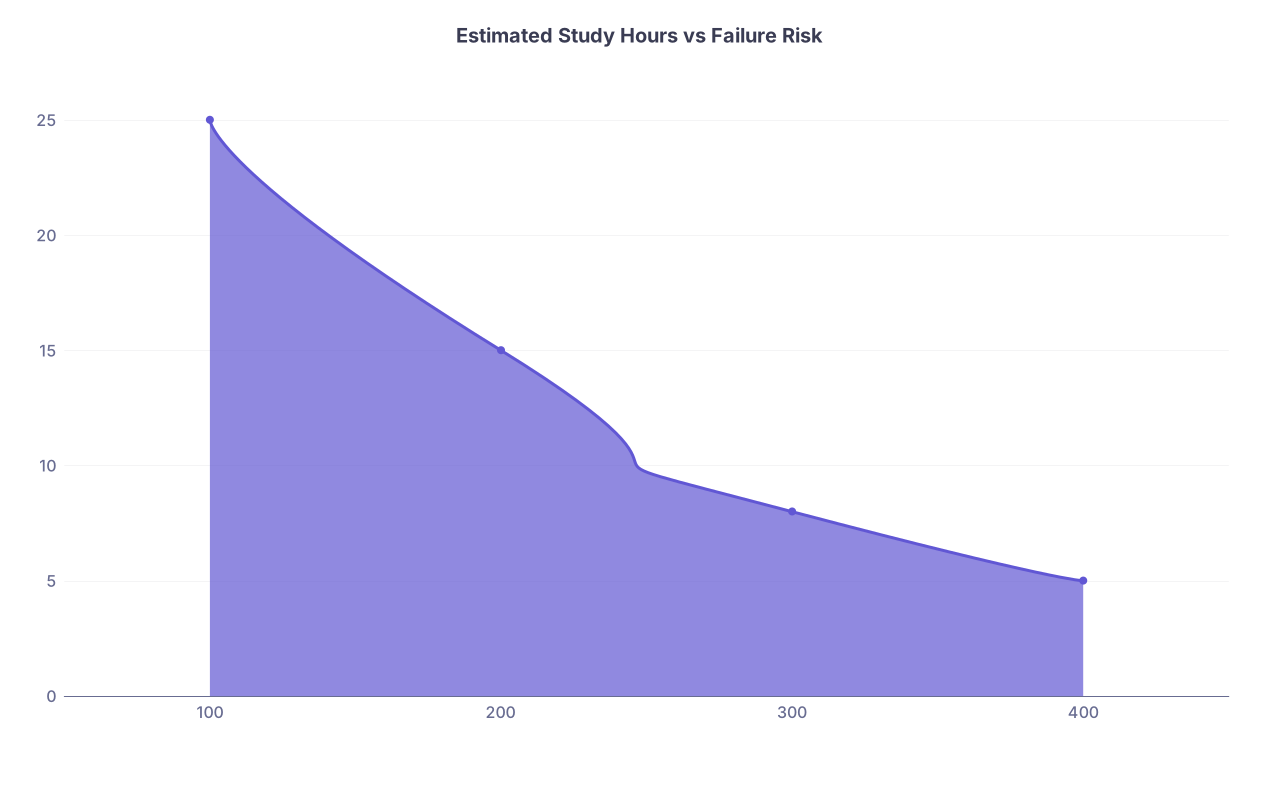
| Category | Value |
|---|---|
| 100 | 25 |
| 200 | 15 |
| 300 | 8 |
| 400 | 5 |

| Step | Description |
|---|---|
| Step 1 | Review ITE scores |
| Step 2 | Plan 150-250 hours |
| Step 3 | Plan 250-350 hours |
| Step 4 | Plan 350 plus hours |
| Step 5 | Question bank and 1 practice exam |
| Step 6 | Qbank, 2 practice exams, faculty support |
| Step 7 | Formal course, multiple exams, PD plan |
| Step 8 | Take boards |
| Step 9 | Risk level |