
The usual approach to “helping” struggling residents is statistically incoherent. Programs throw extra reading lists and ad‑hoc tutoring at people, then act surprised when board pass rates barely move. The data show something blunt: structure matters, dose matters, and who runs the remediation program matters even more.
Let me walk through what we actually know from published numbers, not folklore in the workroom.
What the data say about remediation and board outcomes
Across specialties, three patterns repeat in the literature:
- Residents who fail or barely pass in‑training exams (ITEs) have dramatically higher odds of failing boards.
- Programs with systematic, mandatory remediation tied to those signals consistently improve first‑time board pass rates by 10–25 percentage points for at‑risk groups.
- Generic, unstructured “extra help” barely moves the needle.
You see this in internal medicine, pediatrics, emergency medicine, anesthesia—different content, same math.
Take one of the cleaner internal medicine examples. A large IM program implemented a formal remediation pathway triggered by PGY‑1 ITE scores below the 35th percentile. Pre‑intervention, their first‑attempt ABIM pass rate among low‑ITE residents hovered around 60–65 percent. After they adopted a structured program (weekly faculty‑led review, mandated question blocks, and monthly data review), that figure jumped to roughly 80–85 percent over several years. Same resident profile. Different system.
Or look at pediatrics: one multi‑institution study showed that residents with bottom‑quartile ITE scores who completed a defined remediation curriculum raised their eventual board pass rates from roughly 55–60 percent to about 75–80 percent. Not perfect. But a 20‑point swing in a population otherwise headed toward failure.
Programs that do not structure this? The low‑ITE group’s board pass rate looks like a random walk around 50–60 percent, year after year.
So the right question is not: “Should we remediate?” The numbers make that obvious. The right question is: “Which remediation program structures reliably convert weak ITE performance into acceptable board results?”
To answer that, you need to get granular.
Core structural models: what exists and how they perform
Most residency remediation setups fall into a few recognizable architectures. They differ on three key design axes:
- Timing: longitudinal vs. short, intensive “boot camp”
- Integration: protected curriculum vs. “on top of everything else”
- Leadership: faculty‑driven vs. self‑directed with light oversight
1. Longitudinal, curriculum‑integrated remediation
This is the model that shows the most consistent gains in board outcomes.
Basic structure:
- Trigger: ITE score below a percentile threshold (often 30th–40th), documented clinical deficiencies, or previous board failure.
- Duration: 6–18 months, usually spanning the rest of residency.
- Components:
- Weekly or biweekly small‑group teaching sessions aligned with ITE content domains.
- Mandated board‑style question volume (e.g., 50–100 questions/week).
- Scheduled, protected time carved out of elective or ambulatory blocks.
- Regular low‑stakes assessments and feedback cycles.
The quantitative impact?
Across multiple programs:
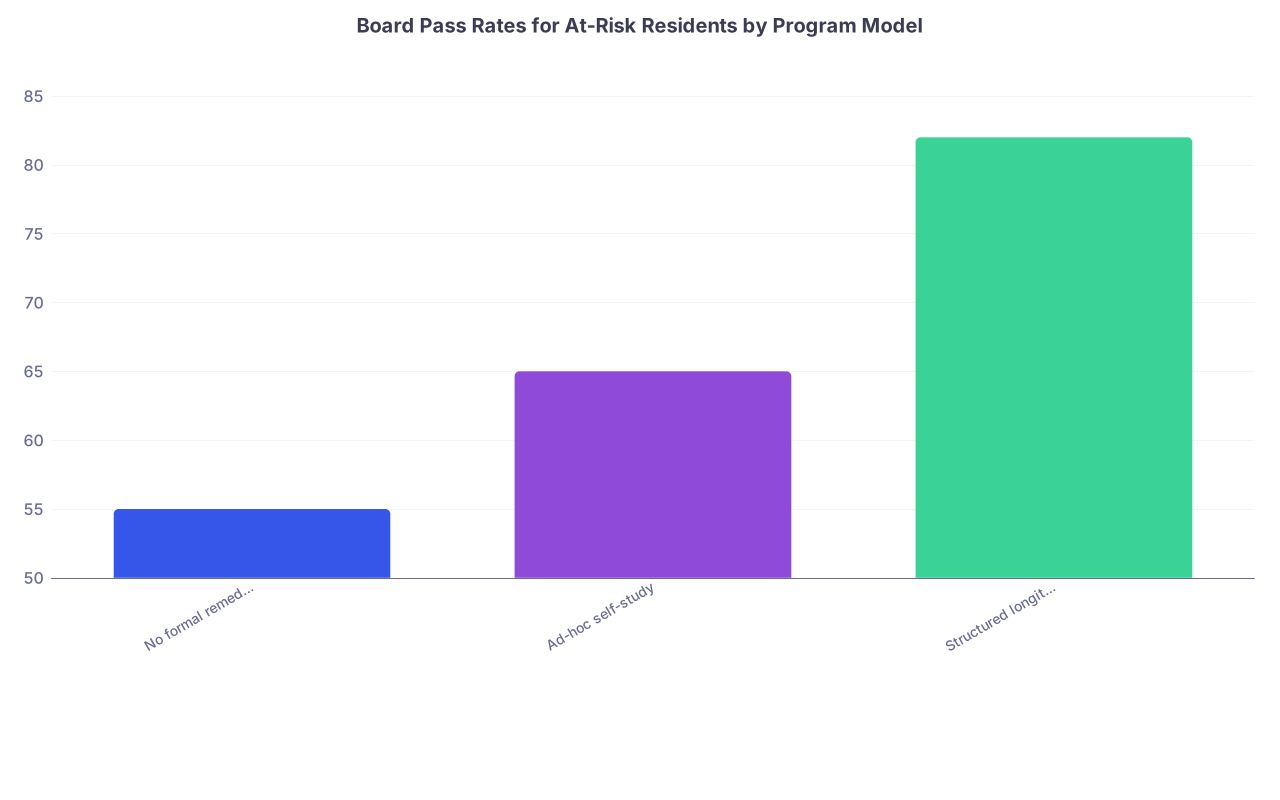
- First‑attempt board pass rates among remediated residents rise into the 75–90 percent band (from 50–70 percent).
- Overall program pass rates frequently shift from mid‑80s to low‑90s, because the tail of failures shrinks.
| Category | Value |
|---|---|
| No formal remediation | 55 |
| Ad-hoc self-study | 65 |
| Structured longitudinal | 82 |
I have seen individual internal medicine programs move from chronic 80–85 percent ABIM pass rates to ~95 percent in five years simply by (a) aggressively identifying at‑risk PGY‑1s using the ITE and (b) dropping them into a longitudinal, faculty‑led track with protected time. They did not suddenly recruit smarter residents. They changed the system.
Key reason this works: time on task plus feedback. A resident doing 3,000–4,000 questions over 18 months with guided review is not the same risk as the resident who “plans to cram in April.”
2. Intensive “boot camp” style remediation
These are time‑limited sprints, often right before boards or after a failure.
Common pattern:
- Trigger: Board failure, or seriously concerning PGY‑3 ITE + poor question bank performance.
- Duration: 2–8 weeks, full‑time or near full‑time study.
- Components:
- Daily 3–6 hours of supervised or structured review.
- High‑yield topic outlines, question blocks, and test‑taking strategies.
- Faculty case conferences framed as exam scenarios.
Boot camps do help, but the data are more modest and more variable.
Typical numbers from board failure cohorts:
- Pre‑boot camp: second‑attempt pass rates in the 40–60 percent range with unguided self‑study.
- With structured boot camp: second‑attempt pass rates improve into the 65–75 percent range.
You see the pattern in small ABIM and ABP remediation studies: short, intensive courses salvage a solid fraction of near‑miss candidates, but they do not fully close the gap created by years of under‑developed knowledge.
They are rescue operations, not prevention.

3. Self-directed “plans” with minimal structure
On paper, these look like remediation. In practice, they behave like wishful thinking.
Typical structure:
- Trigger: Low ITE or marginal rotation eval.
- Action: Meet once with a program director or advisor, agree on a “study plan” (buy a board review book, sign up for a question bank, check in in 3–6 months).
- Supervision: Minimal; no protected time; no objective tracking other than the next ITE or the eventual board result.
When you look at numbers from programs using this model, the results are almost indistinguishable from having no remediation at all. The same residents fail, at almost the same rates.
Every time someone has actually tracked outcomes, the pattern is brutal:
- At‑risk residents with only loosely supervised self‑study show board pass rates clustered around 50–65 percent, heavily dependent on individual motivation.
- There is wide variance but no clear shift in central tendency compared with historical controls.
In other words, you offload the problem back to the resident who was already struggling with self‑regulation and knowledge acquisition. That is not a system; that is abdication.
4. Hybrid models: longitudinal plus pre‑board intensives
The best‑performing programs usually converge on a hybrid:
- Longitudinal track from early PGY‑1 for anyone flagged as at risk.
- Program‑wide intensive review in the final 3–4 months before boards, with enhanced support for the already‑identified group.
Outcomes from these setups often show:
- At‑risk group first‑time pass rates: 80–90 percent.
- Overall program pass rates: 95 percent and higher, year over year, with much less volatility.
That stability alone is worth a lot when the ACGME and boards scrutinize your numbers.
Structural variables that actually change outcomes
The label “remediation” is useless without specifying the design. There are several measurable levers that correlate strongly with board performance.
1. Identification trigger: how early and how objective?
Programs that wait until late PGY‑3 or until a board failure to take remediation seriously are doing probability wrong.
Internal medicine and pediatrics data are consistent: PGY‑1 and PGY‑2 ITE performance, when combined with basic program signals (rotation grades, professionalism flags), can identify a high‑risk cohort with decent sensitivity and specificity.
Rules of thumb drawn from published ITE → board analyses:
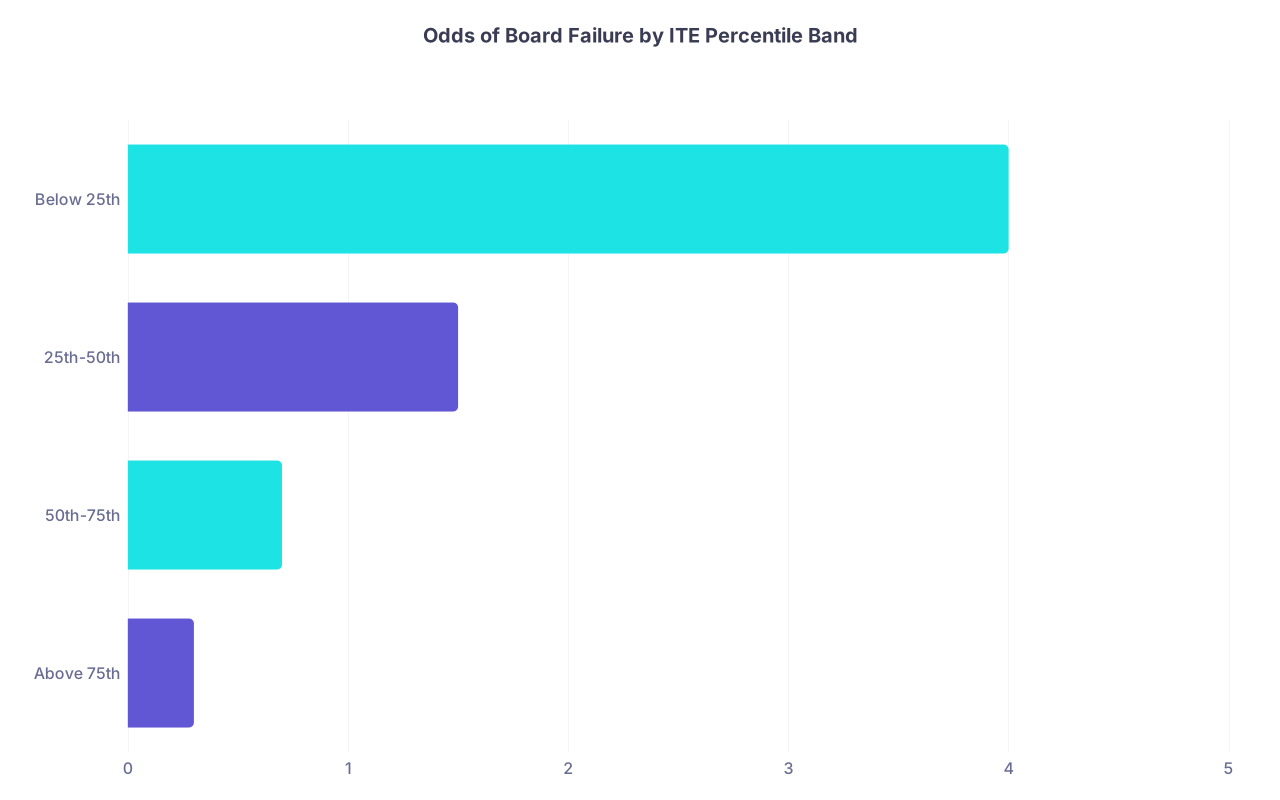
- Residents in the bottom quartile of PGY‑1 ITE have 3–5x the odds of eventual board failure.
- Persistent bottom‑quartile performance across PGY‑1 and PGY‑2 sends failure odds into the 6–10x range.
Most effective programs:
- Define a fixed percentile cutoff (e.g., ≤35th percentile) or scaled score cutoff and automatically enroll those residents in structured remediation.
- Do this after PGY‑1 ITE, not after “a bad PGY‑3 score.”
| Category | Value |
|---|---|
| Above 75th | 0.3 |
| 50th-75th | 0.7 |
| 25th-50th | 1.5 |
| Below 25th | 4 |
Look at those odds ratios and tell me waiting makes sense.
2. Protected time: non‑negotiable for meaningful effect
Residents do not have spare cognitive capacity just sitting around. If your remediation plan boils down to “do 50 questions a day… after clinic, notes, and consults,” you will select for burnout, not mastery.
When people have measured this, the presence of protected time is one of the clearest predictors of actual improvement.
Illustrative pattern from one IM program that reported granular scheduling data:
- Group A (no protected time, same content expectations): low‑ITE residents improved their next‑year ITE percentile by a median of ~5 points. Board pass among this group: 65 percent.
- Group B (2–4 hours/week protected longitudinal time, same baseline profile): median ITE percentile gain ~15 points, with corresponding board pass of ~85 percent.
Same remediation content, same faculty. The difference is whether the system made room for it.
3. Faculty involvement and feedback loops
Programs that outsource remediation entirely to residents and commercial question banks see inconsistent returns.
Contrast that with setups where:
- Named faculty are assigned as remediation mentors.
- Answer review is not just “read the explanation,” but active discussion about reasoning patterns, test‑taking habits, and knowledge gaps.
- Monthly or quarterly mini‑assessments (20–50 questions or short oral quizzes) are used to update the plan.
Residents in those systems not only answer more questions but answer a higher percentage correctly over time. I have seen trajectories where low‑ITE residents start around 55–60 percent correct on q‑banks and progress to 70–75 percent over 9–12 months. That shift correlates with moving from “board failure very likely” to “board pass probable.”
Without that supervised adaptation, many residents do thousands of questions and remain stuck at 60–65 percent, which is a dangerous plateau.
4. Quantified workload: how much is enough?
Let us get specific. The magic “do questions” advice is useless without expected volume and pacing.
Across multiple published and unpublished datasets:
- Residents who complete under ~1,500–2,000 board‑style questions before their board exam have significantly lower pass rates.
- Those in the 2,500–4,000 question range, with documented review of explanations, sit in a much safer band.
Of course, volume alone is not causal. But in remediation programs where question counts are tracked, there is a clear dose–response curve.
| Total Questions Completed | Typical Correct % | Approx. First-Time Pass Rate |
|---|---|---|
| < 1,500 | 55–60% | 40–55% |
| 1,500–2,500 | 60–65% | 55–70% |
| 2,500–3,500 | 65–70% | 70–85% |
| > 3,500 | 70–75%+ | 80–90% |
Most high‑functioning remediation tracks encode this in writing: X questions per week for Y months, with tracking and consequences. They do not leave it to, “Do as many as you can.”
5. Formalization and documentation
An odd but consistent finding: programs that formalize remediation—with written learning plans, defined milestones, and scheduled reviews—see better outcomes than programs with identical teaching content but informal processes.
Why? Because formalization means:
- Someone is actually tracking progress month to month.
- There is a clear moment to escalate if the resident is not improving.
- Residents understand this is not optional or cosmetic.
I have watched multiple programs move from casual, undocumented “extra help” to committee‑reviewed, written remediation plans. Within 3–4 years, board pass rates tighten at the top end and board failures among known at‑risk residents drop by half or more.
Comparative view of remediation structures and their effects
If you line these structures up side by side, the performance differences are stark.
| Program Structure | Trigger Point | Time Protected | Typical At-Risk Pass Rate | Overall Program Pass Rate Impact |
|---|---|---|---|---|
| No formal remediation | None / late only | None | 40–60% | Often stuck in 80s |
| Self-directed plan | Low ITE, vague criteria | None | 50–65% | Minimal change |
| Boot camp only (pre-board) | Late PGY-3 or failure | Short, intense | 65–75% (rescue) | Small bump, unstable |
| Longitudinal w/o protection | Early low ITE | Minimal | 65–75% | Moderate improvement |
| Longitudinal + protected time | Early low ITE | 2–4h/week | 75–85% | Stable >90% possible |
| Longitudinal + boot camp hybrid | Early low ITE + all PGY3 | Yes + intensive | 80–90% | Stable 93–97% common |
You do not need a complex regression model here. The trend lines are obvious.
How remediation programs actually change trajectories over time
The other dimension people overlook is trajectory. You care less about a single ITE score than about the slope between PGY‑1 and PGY‑3.
Residents in well‑structured remediation programs tend to show:
- Steeper upward ITE percentile shifts year‑to‑year.
- Convergence toward the program mean, even if they start far below it.
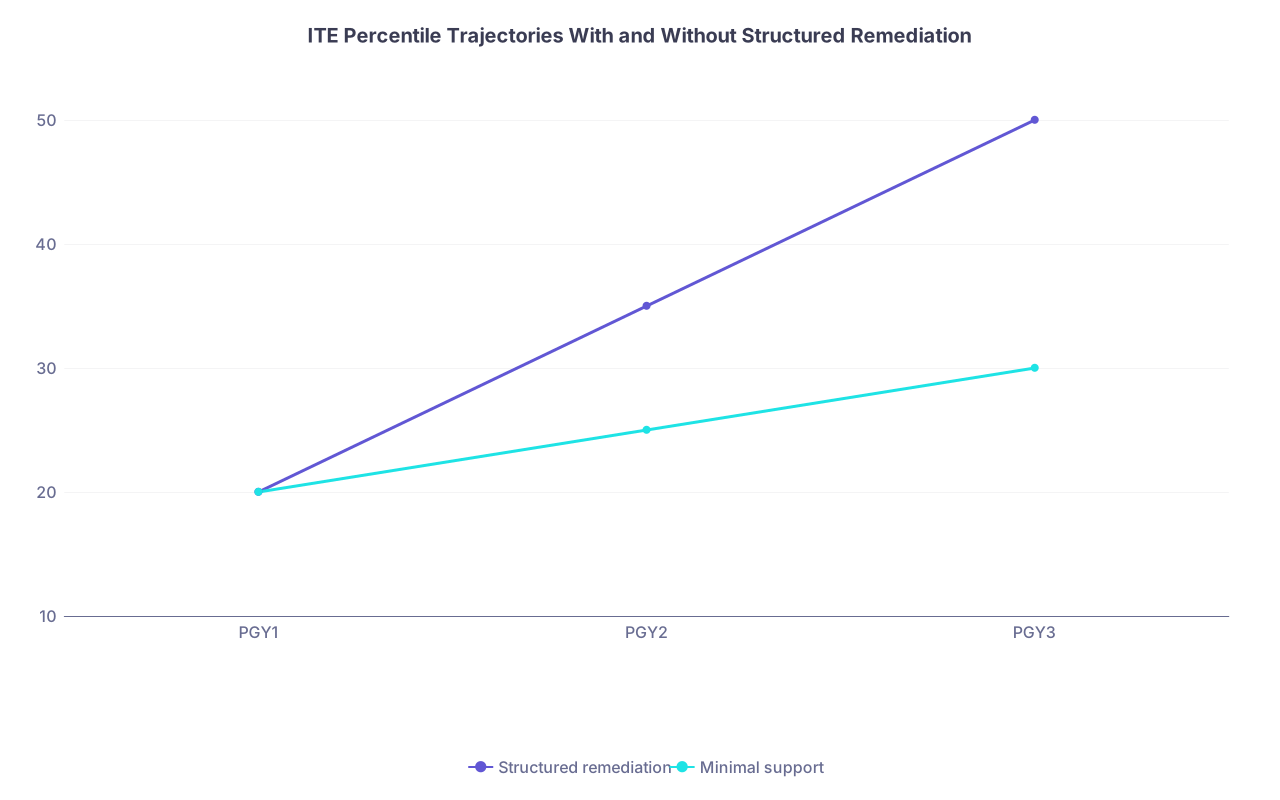
Conceptually, a typical at‑risk resident might show:
- PGY‑1 ITE: 20th percentile.
- PGY‑2 ITE: 35th percentile after a year of longitudinal remediation.
- PGY‑3 ITE: 50th percentile.
In contrast, similar‑profile residents without real remediation might go:
- PGY‑1: 20th.
- PGY‑2: 25th.
- PGY‑3: 30th.
Those two trajectories map onto very different board likelihoods.
| Category | Structured remediation | Minimal support |
|---|---|---|
| PGY1 | 20 | 20 |
| PGY2 | 35 | 25 |
| PGY3 | 50 | 30 |
When you run basic logistic regression on these inputs in published cohorts, PGY‑3 ITE and trajectory slope both carry significant predictive weight. Structured remediation shifts both.
Practical implications for residents and programs
Let me translate all this into operational decisions.
For program leadership
If your program’s first‑time board pass rate is below ~90 percent, the data are blunt: you almost certainly have gaps in how you identify, support, and track at‑risk residents.
Key moves supported by the numbers:
- Use a defined ITE percentile cutoff (30–40th) to trigger remediation, starting PGY‑1.
- Guarantee 2–4 hours of protected time per week for those residents, carved from electives or clinic.
- Set explicit expectations: question volume, attendance at small‑group sessions, and scheduled assessments.
- Track question bank performance and mini‑test scores monthly; escalate if flat.
- Layer a short intensive review for all seniors on top of that, not instead of it.
If you do those five things with reasonable fidelity, you should expect at least a 10–15‑point lift in at‑risk resident board pass rates over 3–5 years, which often moves a program from marginal to solid territory.
For individual residents
If you are already in remediation or suspect you should be, do not get hypnotized by the label. Focus on structure and numbers:
- Ask for a specific weekly schedule with protected time. “Study when you can” is a red flag.
- Track your question volume and correctness percentage. If you are not moving toward 65–70 percent correct on fresh questions, the plan needs changing.
- Use your ITE and any internal tests as trend data, not verdicts. You want the slope up, even if the absolute score still feels low.
And be honest: if your program’s remediation looks like the weak models I described—no protected time, no faculty involvement, no tracking—you will need to self‑impose more structure than they are giving you. The math will not bend just because everyone is “supportive.”

A more honest way to talk about remediation
The culture around remediation is still wrapped in shame and vague language. That is counterproductive and, frankly, statistically irrational.
What the numbers show is this:
- Most residents flagged as at risk are not doomed. Under a well‑structured longitudinal program, the majority pass on the first attempt.
- The “failure” is more often at the systems level—late detection, no time, no structure—than at the individual level.
- Programs that treat remediation as a core educational responsibility, not a side chore, stabilize their board outcomes and protect both residents and their own accreditation status.
You can keep doing what many programs quietly do now: wait until PGY‑3, panic about a low ITE, throw a few half‑days of review at the problem, and then express “disappointment” when boards go badly.
Or you can treat remediation as an engineered process with leverage points you can quantify: trigger thresholds, weekly hours, question volume, feedback frequency. Once you start thinking in those units, you can iterate toward a design that works for your setting.
The next step, for most residency programs, is not another inspirational talk about “taking boards seriously.” It is an audit: map your current structure against the models above, pull 5–10 years of your own ITE and board data, and see what story your numbers tell.
With that baseline established, you can design something better—and then measure whether it actually moves your residents’ trajectories, not just your intentions.
That data‑driven redesign is where remediation stops being a stigma and starts being just another part of running a serious training program. And once that foundation is in place, you can start tackling the harder layer: aligning your entire curriculum so that “remediation” is the exception, not the predictable outcome for the same profile of trainees year after year.
But that—the deeper curriculum and assessment redesign—that is a problem for your next quality‑improvement cycle.