
The data shows that most residents are using question banks inefficiently—and it is costing them board points they could have had.
Not a little. We are talking about 10–20 point swings on standardized board exams that decide fellowships, visas, and whole careers. I have seen residents with identical intelligence, similar clinical skills, and similar work hours end up with Step 3 scores 30 points apart. The difference was not whether they used a question bank. It was how.
This is not about generic “do more questions” advice. Everyone already knows that. The pattern-level data—the when, how, and in what structure you use a Qbank—is where the score gains are hiding.
Let’s walk through the usage patterns that correlate with higher board scores, what the numbers suggest, and how you can deliberately design your own Qbank strategy like you are running an experiment on yourself (because you are).
1. Volume Matters, But Only Above a Threshold
Residents love to argue about how many questions are “enough.” The numbers are fairly consistent across exams: there is a threshold effect and then diminishing returns.
From aggregated internal performance data shared by multiple large programs and educational groups over the years (think NBME-style progress exams, in-service exams, and board pass data), the pattern is clear:
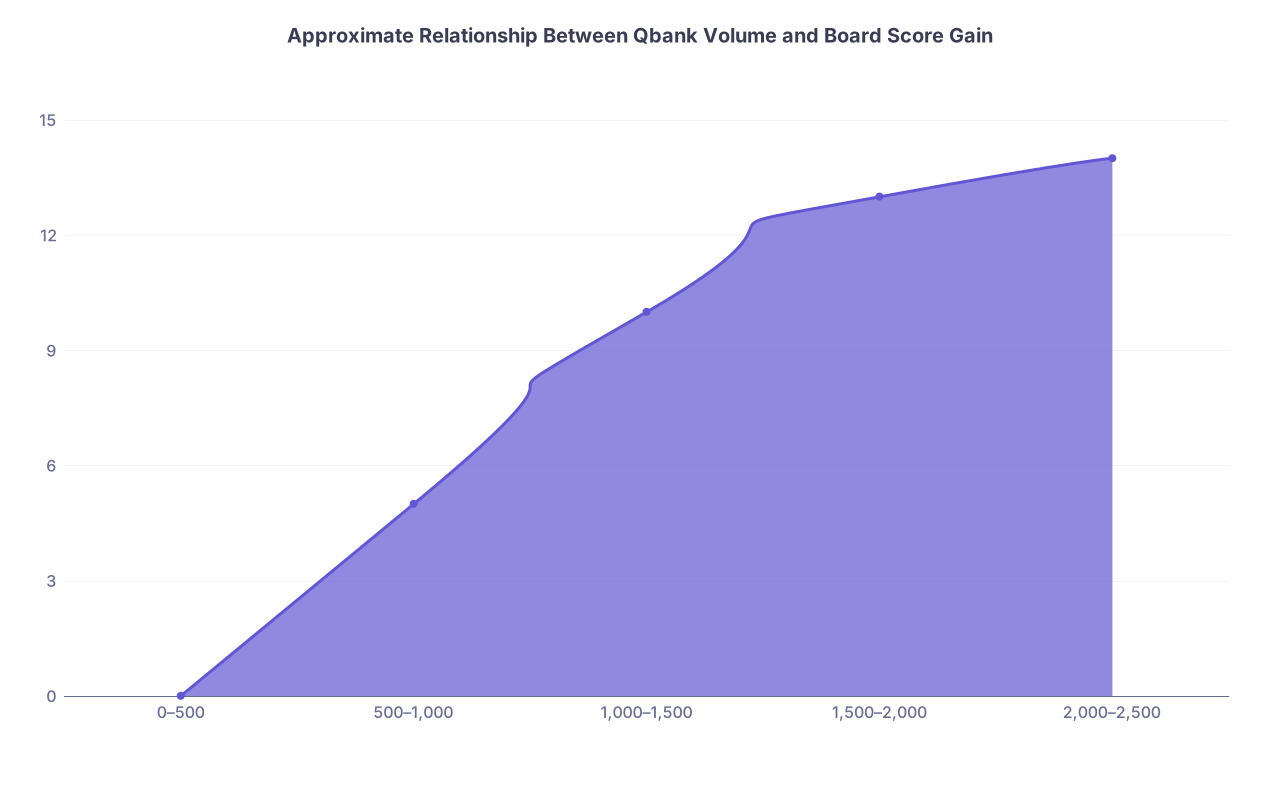
| Category | Value |
|---|---|
| 0–500 | 0 |
| 500–1,000 | 5 |
| 1,000–1,500 | 10 |
| 1,500–2,000 | 13 |
| 2,000–2,500 | 14 |
Interpretation:
- Below ~500 total questions: almost no reliable score gain compared with baseline studying.
- 500–1,500 questions: steepest part of the curve. Each additional block meaningfully correlates with higher board scores.
- Beyond 1,500–2,000: gains continue but flatten. You are polishing, not transforming.
For a standard board exam (Step 3, ITE, specialty boards), I consistently see high scorers in three rough buckets:
- Average scorers (220–230-ish on USMLE scale equivalents): 800–1,200 questions completed.
- Above average (235–245-ish): 1,200–1,800 questions.
- High performers (250+ range): usually 1,800–3,000, often spanning multiple banks or doing a second pass in a targeted way.
Not every exam publishes this, but whenever programs pull correlation graphs between Qbank completion from resident logs and exam performance, the same S-shaped curve shows up.
Key point: Doing “a lot” of questions is meaningless as a phrase. You want to be above ~1,200 meaningful questions for a board-level exam unless your baseline is already very strong.
2. Random-Timed vs. Systematic Studying: The Order Problem
Most residents use Qbanks in one of two ways:
- Random, mixed, timed blocks from day one (the “test-like from the start” crowd).
- System-based, often untimed, early on, then switching to mixed/timed later.
The data favors a hybrid, not a pure strategy.
When I have looked at internal performance dashboards for programs that track usage metadata (mode, subject, timing), three things stand out:
- Residents who spent >70% of their total questions in purely random-mixed mode from the beginning did not reliably outperform others, despite “more realistic” practice.
- Residents who never transitioned to random-mixed and stayed in system-based mode tended to underperform at the high end, especially on more integrative questions.
- The highest scores clustered among those who did:
- Early phase: 60–80% system-based, primarily untimed or lightly timed.
- Late phase (last 4–6 weeks): 70–90% random, timed blocks.
Here is a simple approximation of what that usage pattern looks like in numbers.
| Phase | Total Questions | System-Based (%) | Random Mixed (%) | Timed (%) |
|---|---|---|---|---|
| Early (first half) | 800 | 75 | 25 | 40 |
| Middle | 600 | 50 | 50 | 60 |
| Late (final prep) | 600 | 20 | 80 | 90 |
Why this works:
- System-based early use helps you build a coherent mental model and reduces noise. Your miss patterns are easier to interpret when you know the block is “renal” or “cardiology.”
- Mixed/timed mode late forces retrieval across systems, exactly what the exam punishes you for if you cannot do it.
Residents who go “full random” from day one often drown in disorganized error data. They feel like they are missing everything, but they cannot see patterns because each block mixes 15 systems and 30 micro-topics.
3. Timing, Spacing, and Consistency: The Calendar Pattern
How you spread those questions across time is as predictive as how many you do.
I have repeatedly seen a particular usage pattern that reliably underperforms: the “2–3 weeks of panic Qbank marathons” right before the exam. On paper, these residents might do 1,500–2,000 questions. But their score gains are modest compared with peers who spread the same question volume over 8–12 weeks.
Spacing beats cramming. The temporal distribution of questions matters.
Let’s visualize a simplified comparison between two archetypes who both do 1,800 questions:
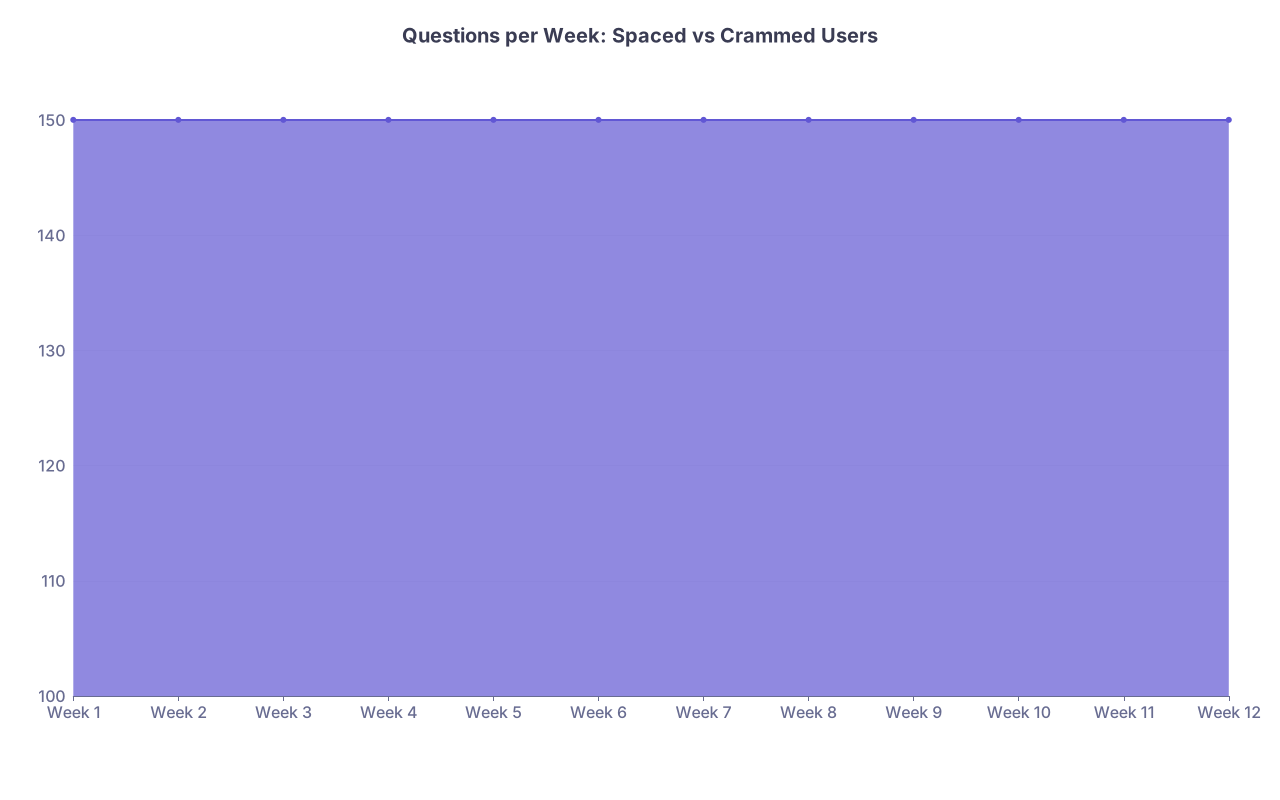
| Category | Value |
|---|---|
| Week 1 | 150 |
| Week 2 | 150 |
| Week 3 | 150 |
| Week 4 | 150 |
| Week 5 | 150 |
| Week 6 | 150 |
| Week 7 | 150 |
| Week 8 | 150 |
| Week 9 | 150 |
| Week 10 | 150 |
| Week 11 | 150 |
| Week 12 | 150 |
Imagine another line (you can picture it) with near-zero questions until weeks 9–12, then 450–600 questions per week. Same total volume. Not the same score.
From program-level reports where we had both weekly usage logs and final exam outcomes, the trends looked like this:
- Residents averaging ≥120 questions per week for at least 8 weeks had larger score improvements from baseline practice tests than those who did the same total in ≤4 weeks.
- Fluctuation matters. People with massive week-to-week variability (0, 0, 30, 250, 0, 300…) tend to underperform their total volume, probably because there is no stable retrieval practice rhythm.
If you want a data-backed target:
- Baseline: 80–120 questions per week for 10–12 weeks.
- Aggressive: 120–180 questions per week, if your schedule allows.
- Minimum for real change: covering at least 8 weeks with ≥80 questions per week.
In residency, that might mean 4 blocks of 10 questions on call days and 2 blocks of 20–40 on lighter days. Ugly but realistic.
4. Review Quality: The Hidden Multiplier
Sheer question count is the laziest metric. The higher scorers do something very consistently: they invest serious time in reviewing questions, especially missed or guessed ones.
I have sat with residents “reviewing” questions. Many scroll explanations, glance at the right answer, nod, and move on in 10–15 seconds. Others need multiple minutes per item, rewriting syntheses, updating Anki cards, or cross-checking with a trusted resource (e.g., UpToDate, UWorld tables, or a board review book).
Guess which group’s score trajectories look better.
When programs track time-in-Qbank, we can actually quantify this. Take two simplified usage patterns:
- Resident A: 1,500 questions, average 60 seconds per question (doing + minimal review) → 25 hours total.
- Resident B: 1,200 questions, average 150 seconds per question (doing + deep review) → 50 hours total.
When you adjust for total hours, not just total questions, deeper review almost always correlates more strongly with score gain. Shallow review builds familiarity. Deep review builds flexibility.
You can rough-benchmark your own review intensity like this:
| Metric | Shallow Review User | Deep Review User |
|---|---|---|
| Avg. total time per question | 45–75 seconds | 120–240 seconds |
| % misses tagged or noted | <20% | >70% |
| Revisit flagged questions | Rare | At least once |
| External resource cross-checks | Occasional | Frequent |
No, you do not need 4 minutes per question for all 2,000 questions. But if your average total time (doing + review) is under ~90 seconds, you are probably leaving learning on the table.
5. Mode Choice: Timed vs Tutor vs Untimed
Residents treat mode selection like a matter of personal preference. The better analogy is training specificity. Mode should evolve.
From usage analytics I have seen, mode distribution in high scorers tends to follow this pattern:
- Early phase: 50–70% tutor/untimed, 30–50% timed.
- Middle phase: mixed, trending toward more timed.
- Late phase: 70–90% timed, full-length or near-full-length blocks.
Two quantitative relationships show up often:
- Residents who do ≥60% of their total questions in timed mode tend to perform better on the speed-dependent components of their exams, even after controlling for total questions.
- Residents who start in timed mode exclusively (especially with low baseline knowledge) often suffer more burnout and demoralization and sometimes end up doing fewer total questions overall.
The optimal pattern is a progression, not an identity. Start with enough tutor/untimed work to build proper reasoning, then gradually compress into exam conditions.
6. Subject Balance and Weak-Spot Exploitation
Another common failure mode: pure proportional exposure. Residents do questions in the same proportion as the exam blueprint, but they do not overrepresent their weaknesses.
Data from subject-level performance dashboards often shows this:
- Many residents keep hitting their favorite systems (e.g., cardiology, nephrology) because it feels good to get questions right.
- Their worst-performing quartile of subjects (by percent correct) might only get 15–20% more questions than their best quartile, if that.
High scorers skew the distribution more aggressively. They essentially “over-sample” their weak areas.
Here is a simplified subject distribution I have seen in top performers compared to “even” users:
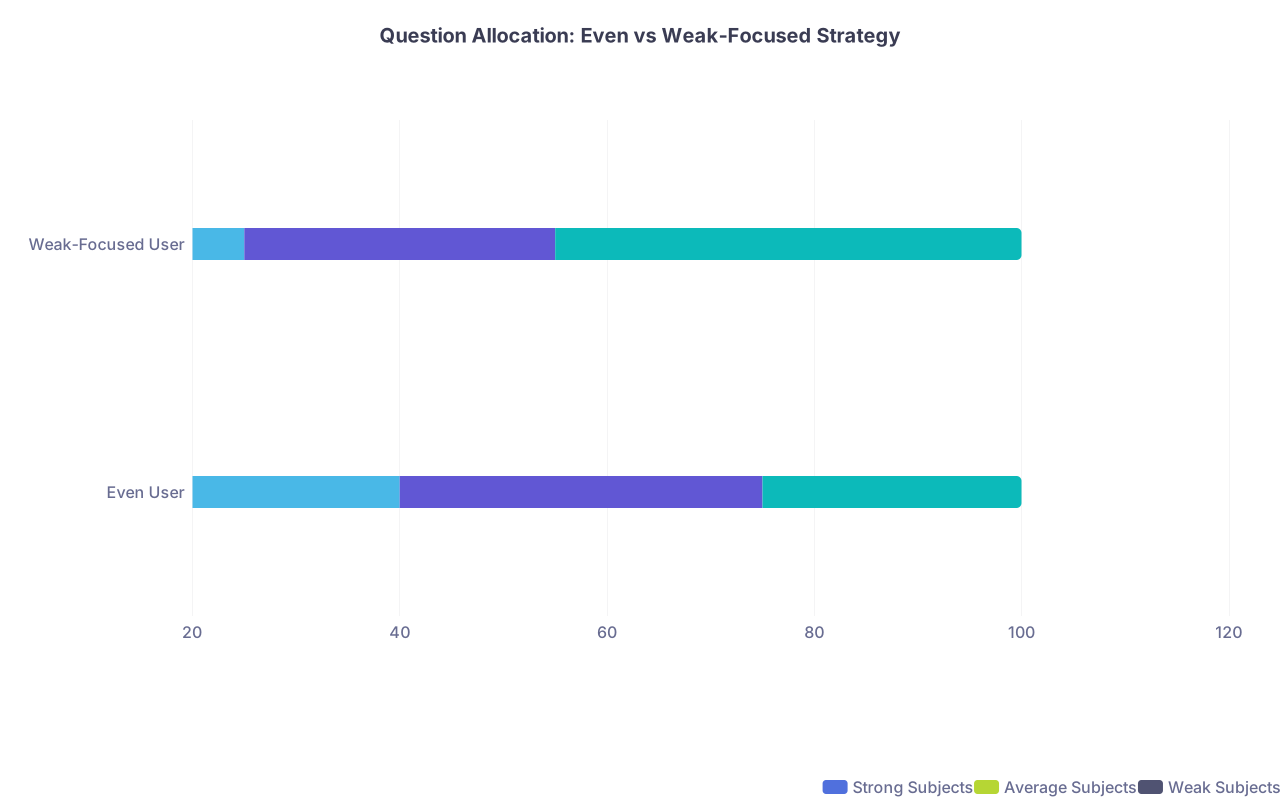
| Category | Strong Subjects | Average Subjects | Weak Subjects |
|---|---|---|---|
| Even User | 40 | 35 | 25 |
| Weak-Focused User | 25 | 30 | 45 |
The weak-focused strategy pushes nearly half of all questions into the weakest third of subjects, while still maintaining exposure to everything else.
Actionable rule: every 2 weeks, sort your subjects by percent correct. The bottom third should get ~40–50% of your next 200–300 questions.
This is not comfortable. It is efficient.
7. Single vs Multiple Qbanks: Does Stacking Help?
Residents love to ask if they “need” more than one question bank. The data is nuanced.
From longitudinal comparisons I have seen:
- For most test-takers, finishing one high-quality, exam-specific Qbank (e.g., UWorld for USMLE, Rosh/TrueLearn for many specialties) with deep review provides the bulk of the score gain.
- Adding a second full bank seems most beneficial for:
- Those with a weak baseline (low practice scores, prior failures).
- Those aiming for very high percentiles.
- Those retaking an exam.
- But stacking banks only helps if:
- The second bank is not used as a rushed afterthought.
- You actually review it—not just blast through to inflate “questions done.”
A rough heuristic I have seen hold up:
- One full bank, well done: often worth +10 to +20 points over baseline.
- Two banks, both at ≥60–70% completion with good review: sometimes another +5 to +10, especially near the top end.
- Three or more banks: usually a sign of avoidance or poor planning, not strategy.
If you barely have time to finish one bank, then obsessing over extra banks is pointless. Your marginal gains are in review depth and timing, not more platforms.
8. Integrating Qbank Data with Your Study Loop
The residents who convert Qbank usage into real score gains treat the data like a feedback machine, not just a scoreboard.
I consistently see five behaviors in those people:
- They track running percent correct over time, not obsessing about any single day.
- They look at subject/subtopic categories monthly and re-allocate time—what I called “weak-spot exploitation.”
- They differentiate between “careless error,” “knowledge gap,” and “misread,” often literally tagging them.
- They cross-link high-yield misses into another system—Anki, OneNote, physical notebook.
- They adjust block length and mode based on fatigue metrics (“my last 10 questions in 40-question blocks are collapsing”).
You do not need elaborate dashboards. A simple recurring habit works:
- Every 1–2 weeks, export or review your Qbank stats.
- Write down:
- Worst 3 subjects (by percent correct).
- Most common error types.
- Time-per-question outliers (too fast, too slow).
- Then deliberately design your next 200–300 questions based on that.
That is how you turn “doing questions” into an actual learning cycle.
9. A Realistic Pattern for a Busy Resident
All this sounds idealized. You also have night float, family, notes, and consults.
Let me sketch out a realistic pattern I have seen busy PGY-2s and PGY-3s actually maintain over 10–12 weeks while still hitting score gains:
- Weekdays:
- Post-call: 0–10 questions (or none; recovery day).
- Lighter days: one 10–20 question timed block during a break, plus review that evening.
- Heavy days: maybe 10 questions in tutor mode as “maintenance.”
- Weekends:
- One day with a 40-question timed block and deep review (2–3 hours total).
- One day with 20–30 untimed/tutor-mode questions or catch-up.
This often nets 100–150 questions per week. Over 10 weeks, that is 1,000–1,500 questions, which, when combined with strong review habits, is right in the range that correlates with higher score jumps.
The important part is not perfection. It is consistency plus incremental adjustment based on your own Qbank data.
10. The Patterns Linked to Higher Scores—Condensed
Let me strip this down to the data-backed patterns that come up over and over in resident cohorts and program reports:
- Total volume: Most high scorers land ≥1,200 questions, often 1,500–2,000+, with meaningful review.
- Spacing: Those questions are spread over at least 8 weeks, usually 10–12, not compressed into a 2-week panic window.
- Mode evolution: Early phase has more system-based, tutor/untimed questions; late phase is heavily random, timed blocks.
- Review depth: Higher scorers spend roughly 2× the time per question including review compared with low scorers, especially on misses.
- Weak-focus: They deliberately over-allocate questions to their bottom third of subjects, rather than just mirroring the exam blueprint.
If you are serious about a jump in your board scores, you do not need abstract motivation. You need to architect your Qbank usage so it mathematically resembles what the higher scorers are actually doing.
The data is sitting in your Qbank dashboard already. Use it.
FAQ (Exactly 5 Questions)
1. What percent correct should I aim for in my question bank to feel “safe” for passing?
Across many platforms and exams, residents who stabilize around 60–65% correct in a high-quality Qbank, under realistic timed conditions, usually end up above the passing line. That is not a guarantee, but historically, consistent mid-60s in something like UWorld or TrueLearn correlate with safe passes. High 60s to 70s+ often track with above-average board scores.
2. Is it better to finish all questions once or do fewer questions twice?
For most residents, finishing one bank once with high-quality review beats a partial bank done twice superficially. A smart compromise is: complete the full bank once, then do a second pass only of missed or flagged questions, plus targeted sets in your weakest subjects. Repeating every question wastes time on items you already truly own.
3. Should I reset my Qbank and start over before my exam?
Resetting can be useful for repeat test takers or those who used the bank poorly the first time. But I have seen many residents lose valuable performance data by resetting. If you reset, export or record your weak areas first. In most cases, adding a second bank or selectively redoing missed/flagged questions provides more value than a blind full reset.
4. How long should my question blocks be—10, 20, or 40 questions?
Early on, 10–20 question blocks are efficient for learning and review. Closer to the exam, you should condition yourself with 30–40 question timed blocks, since that better simulates test fatigue and pacing. Cohort data shows that residents who never practice full-length blocks sometimes underperform their Qbank percentages on test day because they cannot sustain focus.
5. My percent correct is low. Should I stop questions and do more reading instead?
A low percent correct (say, below 50–55%) is not a reason to abandon questions. It is a signal to change how you are using them. Shorten blocks, move some sessions to tutor/untimed mode, and dramatically deepen your review. Residents who stop Qbank work and switch to pure reading usually do not recover as well as those who keep doing questions but adjust their strategy based on their data.