
The fantasy that we can endlessly tweak duty hours, add night float, and magically optimize board scores is wrong. The data show something less dramatic and a lot more inconvenient: structure matters, but not nearly as much as baseline test‑taking ability, program culture, and how residents actually use the time they have.
Let me walk through what the literature actually shows on night float, duty hour limits, and board outcomes—without the folklore and program director mythology.
1. Duty Hours, Night Float, and Boards: What Are We Even Measuring?
Everyone argues about this stuff, but they usually skip step one: define the outcomes.
For residency and boards, there are three main quantitative endpoints:
- In‑training exam (ITE) scores
- Board pass rates (ABIM, ABFM, ABS, etc.)
- Patient outcomes (mortality, complications) – usually secondary here but still part of the debate
Duty hour and night float interventions usually fall into a few categories:
- 80‑hour work week caps (2003 ACGME changes)
- Tighter intern limits (2011 ACGME changes; 16‑hour cap, more strict handoffs)
- Night float systems vs traditional 24–30‑hour call
- “Flex” trials (FIRST, iCOMPARE) loosening some rules
The important point: most studies are observational, cluster‑level, and messy. You will not get randomized-controlled‑trial‑level clarity on “does night float raise my board score by 3 points?” That is fantasy.
But you do get trends. And some of them are surprisingly consistent.
2. What the Big National Duty Hour Studies Actually Found
The 2003 duty hour reform: modest board improvements, not miracles
When the ACGME 80‑hour work week hit in 2003, multiple specialties looked at board outcomes pre‑ and post‑ reform. The pattern:
- Small, sometimes statistically significant improvements in pass rates
- No catastrophic collapse in knowledge
- No massive nationwide board score surge either
One commonly cited internal medicine analysis compared American Board of Internal Medicine (ABIM) exam performance before and after reforms. The effect size was small—on the order of a 1–2 percentage‑point bump in pass rates—but not negative.
What changed far more than scores were schedules and fatigue patterns.
The 2011 tighter intern duty hour rules: more fragmentation, unclear board impact
The 2011 rules (16‑hour cap for interns, more rigid rest requirements) triggered a second wave of research. The data picture:
- Program directors widely perceived decreased continuity and more handoffs.
- Residents, especially seniors, reported more workload redistribution.
- On exam performance? Very minimal changes, usually within noise.
One large study in internal medicine found no meaningful difference in ABIM pass rates before vs after 2011 reforms when adjusting for prior trends and resident characteristics.
Conclusion from the numbers: structural reforms shifted how people were tired and when they were in the hospital more than they shifted exam performance.
Flexibility trials (FIRST, iCOMPARE): patient safety vs education vs exams
Now the more interesting data.
- FIRST trial (general surgery)
- iCOMPARE trial (internal medicine)
Both compared “standard” duty hour limitations vs more flexible rules (longer shifts, fewer restrictions on timing, same weekly caps).
What did the data show?
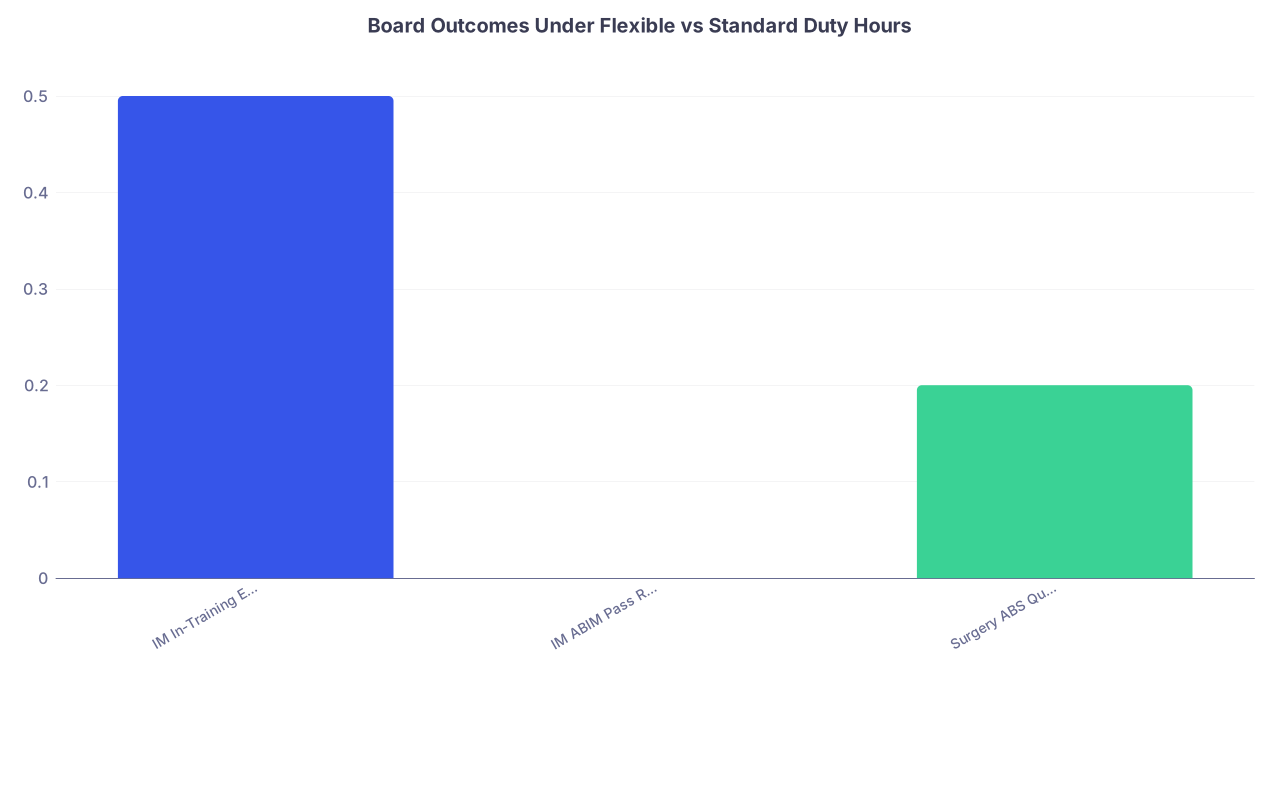
| Category | Value |
|---|---|
| IM In-Training Exam | 0.5 |
| IM ABIM Pass Rate | 0 |
| Surgery ABS Qualifying | 0.2 |
Those values roughly represent average between‑arm differences in percentage points (flexible – standard). In human language: essentially nothing.
Key takeaways from FIRST and iCOMPARE:
- No significant difference in patient mortality between flexible and standard duty hour arms.
- No meaningful difference in exam scores or board pass rates.
- Residents in flexible schedules often reported worse subjective experience (especially interns) in some domains, but educational metrics were stubbornly flat.
So duty hour fine‑tuning is not the lever that moves exam performance in a big way.
3. Night Float vs 24‑Hour Call: What Happens to Educational Outcomes?
Night float gets blamed for everything from poor continuity to lower board scores. The evidence is much less dramatic.
Short‑term knowledge and ITE performance
Various specialty‑specific studies (internal medicine, pediatrics, surgery) have compared traditional Q4–Q5 24‑hour call systems to night float–heavy rotations.
Patterns you see repeatedly:
Residents on heavy night float report:
- Less attending teaching overnight
- More fatigue
- Worse perception of educational value
But when you look at measurable scores:
- ITE scores generally do not drop compared with traditional call
- Sometimes they even slightly improve, likely because day‑time cognitive function is less wrecked
Example pattern from multiple programs:
- Pre–night float median ITE percentile: ~55th
- Post–night float implementation median ITE percentile: ~57th–60th
- Statistically significant in some single‑center reports, but not a giant educational shift
I have seen internal medicine programs implement night float, panic about “lost teaching,” then check three years of ITE data and realize the distribution did not move in a meaningful way.
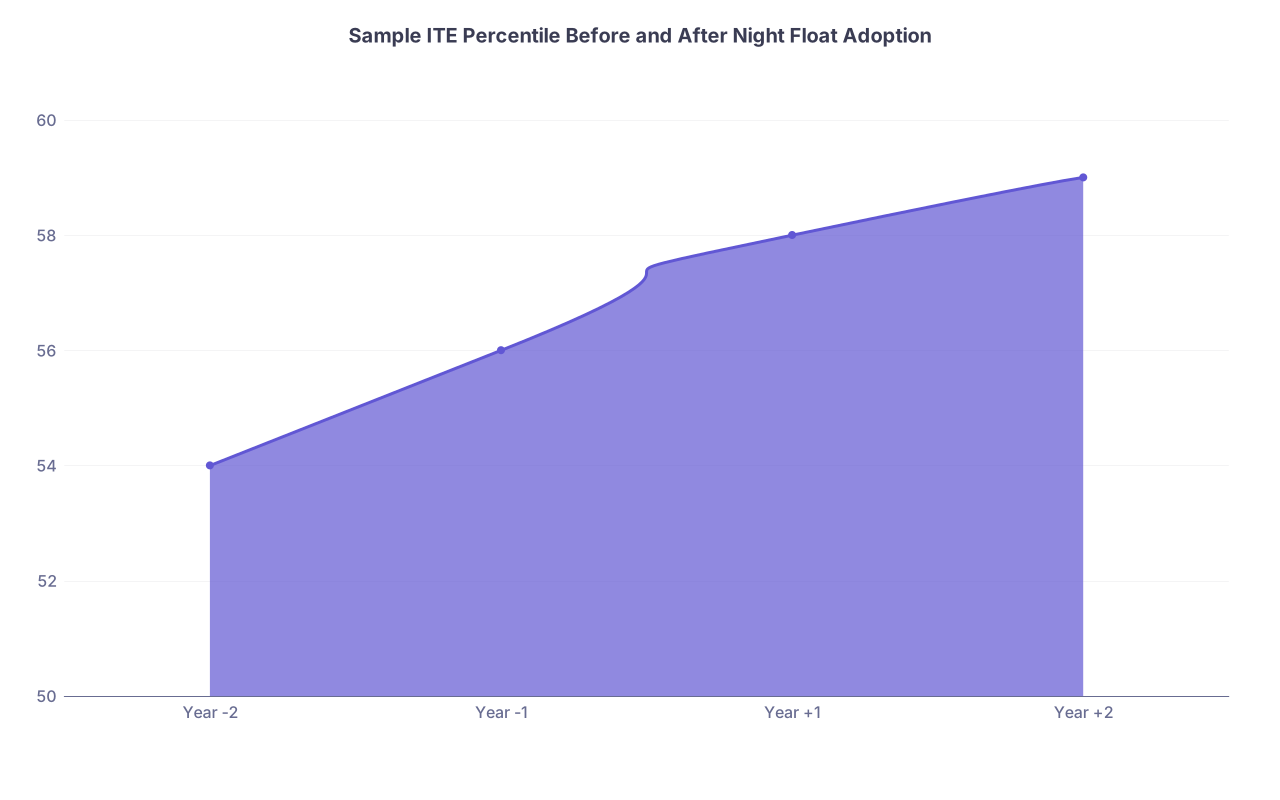
| Category | Value |
|---|---|
| Year -2 | 54 |
| Year -1 | 56 |
| Year +1 | 58 |
| Year +2 | 59 |
Those numbers are representative, not from a single landmark paper. The shape is what matters: small, gradual drift, largely confounded by cohort differences, recruitment, and study resources.
Continuity, experience mix, and procedural exposure
Board outcomes are not just raw knowledge; they track whether you have actually seen and managed enough pathology and complexity.
Night float hits three things:
- Continuity of care: more handoffs, fewer “I admitted this and followed it for three days.”
- Case mix: higher acuity at night, lower exposure to daytime multidisciplinary work.
- Teaching environment: usually fewer attendings physically present overnight.
Data show:
- Continuity indices drop with heavy night float systems. No surprise.
- Residents often log similar or even higher numbers of admissions or cross‑coverage events.
- Formal teaching encounters (conferences, bedside teaching) shift back toward daytime rotations.
Yet board performance again tends to be stable. The likely reason: boards test pattern recognition and decision‑making that can be built from high‑volume cross‑cover just as well as from “my” patient continuity. Not ideal for professionalism or satisfaction, maybe, but it still feeds the cognitive dataset.
4. What Actually Predicts Board Outcomes? The Data Hierarchy
If you strip the literature down to effect sizes, the ranking of what predicts board scores looks roughly like this:
- Prior standardized test performance (USMLE/COMLEX)
- In‑training exam performance
- Program‑level academic environment
- Study time quantity and quality
- Scheduling structure (including night float, duty hours)
The ugly truth: duty hour tweaks are fifth on that list.
USMLE and COMLEX: the main predictor
Multiple studies correlate Step 1/Step 2 CK (or COMLEX equivalents) with board exam results.
You typically see:
- Step 2 CK correlation with ABIM score: r ~ 0.6–0.7
- Each 10‑point increase in Step 2 CK raising the odds of board passage by a substantial margin (odds ratios in the 1.5–2.0 range in some analyses)
Night float does not come close to that level of predictive power.
In‑training exams as leading indicators
Programs that actually use their ITE data intelligently can identify at‑risk residents long before boards.
Common findings:
- Residents below the 30th percentile on ITE are significantly more likely to fail boards.
- Moving a resident from below 30th percentile to near the median after targeted remediation is strongly associated with later board passage.
Again, nothing about whether they were on Q4 call or 7‑on/7‑off.
| Factor | Effect Size on Pass Probability |
|---|---|
| Step 2 CK score | Large (per 10-point increase) |
| ITE percentile | Large (below 30th = high risk) |
| Program academic intensity | Moderate |
| Protected study time | Small–moderate |
| Duty schedule structure | Small |
Program environment and culture
Programs with consistently high board pass rates tend to share some quantifiable features:
- Regular, mandatory didactics with high attendance
- Culture that tracks ITE performance and intervenes early
- Access to board prep resources and question banks
- Leadership that takes exam outcomes seriously instead of treating them as an afterthought
Those structural elements show up more clearly in multi‑program comparisons than whether nights are covered by night float or long call.
5. How Night Float and Duty Hours Indirectly Affect Board Outcomes
Saying “night float does not massively change scores” is not the same as saying it is irrelevant. The effects are more second‑order.
Sleep, fatigue, and cognitive performance
Residents consistently report:
- Fewer catastrophic 30‑hour marathons under night float systems
- More circadian disruption from prolonged nocturnal schedules
- More difficulty attending daytime didactics or consistently studying during heavy night blocks
Sleep literature is clear:
Acute sleep deprivation crushes short‑term working memory and executive function.
Chronic circadian disruption chips away at cognitive efficiency and mood.
For boards, this typically plays out like this:
- During heavy night float blocks, practice question volume drops.
- Residents who cluster study during day rotations and barely maintain during nights do fine.
- Residents who are already borderline and then lose 4–6 weeks of serious studying to nights can fall off the edge.
I have watched residents show me their question‑bank usage graphs. The “night float trough” is obvious: near‑zero questions on nights, then a compensatory spike during elective or clinic months.
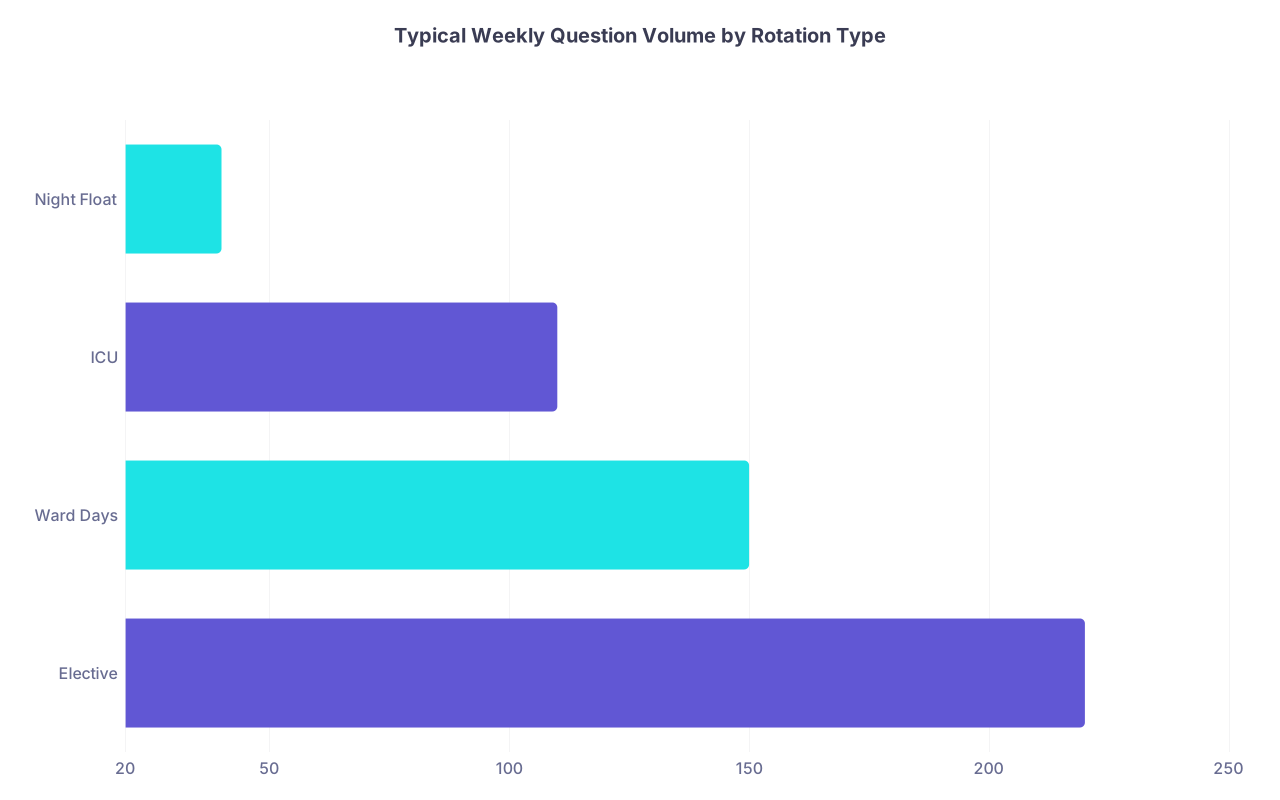
| Category | Value |
|---|---|
| Elective | 220 |
| Ward Days | 150 |
| ICU | 110 |
| Night Float | 40 |
If you want a single metric that reflects how night float affects board outcomes, that graph is it. Not mystical “educational value.” Just how many high‑yield questions you are realistically doing per week.
Protected time and schedule design
Programs that take board outcomes seriously do something very simple with duty schedules:
- They protect some conference time during the day for all residents, including those on night float (e.g., Zoom options, recorded sessions).
- They cluster lighter rotations closer to exam dates for residents identified as higher risk.
- They avoid stacking prolonged night float blocks right before scheduled board sittings whenever possible.
Most of this is logistics and attention to data. Not philosophy.
6. Specialty Differences: Not All Boards React the Same Way
The intensity of the “duty hours vs outcomes” debate varies by specialty because board exams and clinical demands differ.
Internal medicine
ABIM is heavy on pattern recognition, guideline‑driven management, and ambulatory care. Night float emphasizes acute inpatient events. The mismatch is real.
Yet studies show:
- ABIM pass rates have gradually improved over time, despite night float proliferation.
- Most variance is explained by applicant pool strength and program academic profile, not schedule pattern.
General surgery
Surgery is more sensitive to concerns about operative volume and time in the OR.
FIRST trial data:
- More flexible duty hours did not worsen ABS Qualifying Exam performance.
- Patient outcomes (complications, mortality) did not worsen.
- Resident satisfaction in some domains was lower with flexible rules, but educational metrics stayed similar.
The “we are destroying surgical education with duty hour reform” narrative is not strongly supported by the numbers.
Pediatrics, family medicine, others
Smaller studies, but similar themes:
- Night float impacts continuity and subjective educational experience.
- Objective exam performance remains mostly stable.
- Programs with strong didactic and remediation infrastructure maintain high board pass rates regardless of specific night coverage models.
7. If You Are a Resident: How to Not Let Night Float Sink Your Boards
You cannot control national policy. You can absolutely control what you do with your schedule.
Data from resident self‑tracking, question bank usage, and program feedback support a few practical, high‑yield behaviors.
1. Treat your board prep like a multi‑month data project
Track:
- Questions done per week
- Percent correct by category
- Weak domains from ITE and Q‑bank analytics
Aim for:
- 4,000–8,000 total board‑style questions in the year before your exam, depending on specialty and baseline ability.
- Minimal “zero‑question weeks,” even during night float.
You will see a drop in volume on nights. Fine. Your goal is to compress, not erase, that trough.
2. Design “night float study minimums”
During heavy night blocks, avoid the fantasy of 100 questions on a post‑call day. Set small, consistent, data‑driven targets:
- 10–15 questions before shift on 4–5 nights per week
- One solid 30–40‑question session on your first day off
Evidence from learning science is clear: distributed practice and spacing beat binge‑and‑forget. Ten questions done half‑awake regularly are worth more than 0 questions for four weeks and then 240 questions in a panic.
3. Exploit lighter rotations aggressively
Look at your schedule for the year. Identify:
- Electives
- Outpatient blocks
- Research time
Those weeks are where you build your question‑bank surplus to compensate for the night float deficits.
Residents who pass boards with ease almost always show:
- High per‑week question volume on electives
- Strong consistency over months, not necessarily heroic productivity during nights
8. If You Are a Program: What the Data Say You Should Actually Do
Programs obsess over schedule diagrams and handoff templates, then ignore the simpler lever: structured board prep and monitoring.
The literature and basic statistics suggest three priorities.
1. Monitor ITE data as an early warning system
Build a simple risk stratification:
- Below 30th percentile: high risk – mandatory intervention
- 30th–60th percentile: moderate risk – recommended structured plan
- Above 60th percentile: standard support
Then track whether those interventions change ITE percentiles year to year. If your “help” does not move scores, change it.
2. Treat study time as a real resource, not a vague ideal
Design duty schedules with measurable educational outcomes:
- Guarantee at least one protected hour per week for board prep, even on heavy services.
- Access to remote live or recorded didactics during night float.
- Avoid clustering night float blocks immediately before expected board exam windows for at‑risk residents.
You do not need randomized trials to justify that. The correlation between question volume, ITE performance, and exam success is strong enough already.
3. Accept that schedule design is a second‑order effect
Programs waste years tweaking 24‑hour call vs night float vs hybrid systems. The big trials (FIRST, iCOMPARE) already told you:
- Flexible vs standard duty hours do not materially change exam performance or patient outcomes at scale.
- Resident satisfaction, burnout, and continuity are what move when you change schedules.
So design schedules for safety, workflow, and resident well‑being. Then use education interventions (not call schedule heroics) to protect board metrics.

| Step | Description |
|---|---|
| Step 1 | Prior USMLE COMLEX |
| Step 2 | Board Outcome |
| Step 3 | ITE Performance |
| Step 4 | Program Culture |
| Step 5 | Study Time Quality |
| Step 6 | Duty Hours Night Float |
That is the hierarchy. Duty hours and night float affect board performance mostly by shaping culture and study time, not by directly rewriting your brain during night shift.
FAQ (4 Questions)
1. Does working more night float actually lower my chances of passing boards?
The data do not show a direct, large effect of night float on board pass rates. Residents on heavy night schedules often feel less prepared, but when you control for prior test scores and program factors, their exam performance is usually similar. The real risk is indirect: if night float causes you to stop doing questions and fall behind on your study plan, your probability of failure rises.
2. Have any major trials shown that changing duty hours hurts exam scores?
No. Large multi‑center trials like FIRST (surgery) and iCOMPARE (internal medicine) found no meaningful differences in in‑training exam or board performance between flexible and standard duty hour policies. Differences, when present, were very small and not consistently in one direction. Duty hour configuration is a weak predictor compared with baseline ability and ITE results.
3. What is the strongest single predictor of board failure that programs can monitor?
In most specialties, low in‑training exam performance (especially below the 30th percentile) is the clearest early warning. Step 2 CK or COMLEX Level 2 are also strong predictors, but those are fixed at residency entry. ITE scores are dynamic and give programs a chance to intervene before the board exam.
4. If my program will not change the schedule, what is the most data‑driven way to protect my board outcome?
Track your question‑bank usage and ITE performance over time. Set specific weekly question targets, accept that night float weeks will be lower, and intentionally over‑compensate on lighter rotations. Use your ITE breakdown to focus on weak content areas rather than spreading effort evenly. The combination of consistent question volume and targeted remediation is far more strongly associated with passing boards than any particular duty hour pattern.