It is 9:45 p.m. You just signed out your last ED boarder, scarfed half a granola bar, and you are finally sitting down in an empty workroom. Your friends at big-name programs talk about weekly board review conferences, protected didactics, and mentors who email them practice questions.
You? Your “educational curriculum” is a once-a-month noon conference that gets canceled half the time because there are “too many patients to cover.”
Board exams are coming. Your program is under-resourced, leadership is scattered, and you feel like your education is 100% DIY.
Here is how you play this hand. Not the hand you wish you had. The one you actually have.
Step 1: Be Honest About Where You Are
Before you talk strategy, you need a brutally clear picture of your situation.
Ask yourself, tonight, in writing:
- What formal teaching does my program actually deliver? (Not what is promised. What is real.)
- What has been done for prior residents’ board prep here?
- Where are recent board pass rates? (If you can get that info.)
- Who, if anyone, seems to care about education?
You are not doing this to be depressed. You are doing it to stop lying to yourself that “it will probably be fine.”
If:
- Noon conference is mostly pharma lunches and random case presentations
- There is no structured in-training exam review
- Nobody tracks who is struggling or offers remediation
…then you are in a “you are your own program director for board prep” situation.
Fine. Then act like it.
Step 2: Build Your Own Curriculum (In 30 Minutes)
You cannot depend on your program to create a structured path. So you create one—fast and dirty, then refine.
Take 30 minutes and sketch this out on paper or a notes app:
- Your exam date (or rough expected period).
- Weeks from now until then.
- The main content domains for your specialty.
- How many question-bank questions you realistically can do per week.
- Slots in your actual schedule: post-nights, golden weekends, pre-rounding time, post-call.
Now assign content.
Concrete example for an IM PGY-2 with ABIM in 14 months:
- 14 months ≈ 60 weeks
- Goal: 4,500–6,000 questions total (UBS + another bank)
- Needed: 75–100 questions/week average
You then block content:
- Weeks 1–12: Cardio, Pulm, ID
- Weeks 13–20: Renal, GI, Endo
- Weeks 21–28: Rheum, Heme/Onc, Neuro
- Weeks 29–40: Mixed blocks, weak areas targeted
- Final 20 weeks: Full-length practice exams + review, heavy on prior misses
Not elegant. But it is a plan. That already puts you ahead of many in “good” programs.
To make this real, use a simple target tracker:
| Item | Target per Week |
|---|---|
| Question bank questions | 75–100 |
| Dedicated review sessions | 3–4 (30–45 min) |
| Long study block | 1 (2–3 hours) |
| Flashcard sessions | 4–5 (10–15 min) |
| Practice exam blocks | 1 every 3–4 wks |
You are not aiming for perfect. You are aiming for consistent.
Step 3: Use the Right Tools Like They’re Your Program
Your program is under-resourced. The internet is not.
You essentially “outsource” what your program should provide:
- A structured content roadmap
- Question-driven learning
- High-yield explanations
- Benchmarking of performance
Pick your “core” tools
For most specialties, you want this stack:
- One primary Qbank (UWorld, TrueLearn, Rosh, Amboss, specialty-specific bank)
- One concise review resource (e.g., Boards & Beyond for IM, OnlineMedEd for some core topics, targeted board review books)
- Some kind of spaced repetition (Anki or built-in spaced review from your Qbank)
If your program offers a free bank: use it, but do not rely on it exclusively if it is weak. I have seen programs give residents terrible institutional Qbanks and then act shocked at low pass rates.
If money is tight:
- Ask co-residents for hand-me-down notes/resources
- Use institutional access (library often has review books and sometimes Qbanks)
- Ask your PD or chief directly: “Does the program fund at least one Qbank subscription per resident for board prep?”
- Look for resident-discount codes and periodic sales
Then you treat these tools like your “shadow faculty.”
Qbank is your attending. Anki is your repetition. Review videos are your core lecture series.
Step 4: Turn Your Clinical Days Into Board Prep
In an under-resourced program, your advantage is this: you see everything. The chaos is actually content.
You just have to capture it.
Here is how you convert trash days into exam points:
- Every shift/day, pick 1–2 cases and write 2–3 board-style learning points from them.
- Example: DKA admission overnight → write: diagnostic criteria; initial fluid choice; potassium thresholds.
- When something confuses you on rounds, write it as a question to answer later.
- “Why is this AECOPD patient not getting BiPAP?” becomes: indications/contraindications for NIPPV in COPD exacerbation.
- On your next short break, do 5–10 Qs tied to that topic.
You are doing “micro-boards” all day long.
I have seen residents from rough community programs crush boards because their clinical volume forced them to see real patterns. They just bothered to tie those cases to questions.
If you are on a soul-sucking service (like floor nights with 18 admits), keep the bar low: one learning point per shift. But do not let yourself go to zero.
Step 5: Manufacture a “Study Culture” From Thin Air
You probably do not have a strong educational culture. So you create a micro one: 2–4 people. That is it.
Things I have seen work in weak programs:
“Question-of-the-day” group text:
One person posts a Qbank screenshot every day. Everyone answers in the thread, then someone posts the explanation. Low effort, daily exposure.Weekly 45-minute rapid-fire Zoom (or in-person) on post-call or golden weekend: Each person brings 3–5 questions they got wrong that week. You go around, teaching each other. No slides. Just problem-solving.
Shared “Hall of Shame” document: Google Doc of the most confusing or frequently missed questions. You review it once a month.
Do not wait for chiefs or faculty to run it. They are not coming. This is resident-run.
If nobody wants to join you at first, start with one other person. Two people is enough to create accountability. I have seen this in a severely under-resourced FM program: two PGY-2s did exactly this and both crushed their boards. Their co-residents who studied “whenever” did not.
Step 6: Get What Limited Support You Can From a Weak Program
Even in a dysfunctional program, there are usually 1–2 humans who actually care. Your job is to find them and use them strategically.
People to identify:
- One faculty who recently took boards or recertified.
- A chief resident who actually reads emails and gets things done.
- That senior who seems oddly calm about exams and has a system.
Then you ask specific, narrow questions:
- “What did you use for boards that actually helped?”
- “How did you pace your Qbank during a bad rotation?”
- “If I am weak in [X], what’s the highest-yield way to shore that up in 2–3 months?”
Do not go in with: “I feel behind and overwhelmed, help?” That leads to generic platitudes.
Push (gently) for minimal structural help
Your PD may not be able to create a Harvard-level curriculum. But you might be able to get:
- One protected board review session per month
- Program-paid Qbank access if enough residents ask
- Shared in-training exam review sessions for your class
- A little extra time off before boards (half-day, 1–2 days) if you frame it as “safeguarding pass rates”
You approach it like this:
“Dr. X, the class is worried about boards given our schedule. If we could get one structured board review a month and funded access to [Qbank], that would really help. Prior classes said the program did not have this, and our pass rates suffered.”
PDs care about pass rates because ACGME cares. Use that.
Step 7: Handle Rotations That Destroy Study Time
Every under-resourced program has those rotations: ICU with home call that is actually “you basically live here,” or an ED month that annihilates your sleep.
Plan for them like weather.
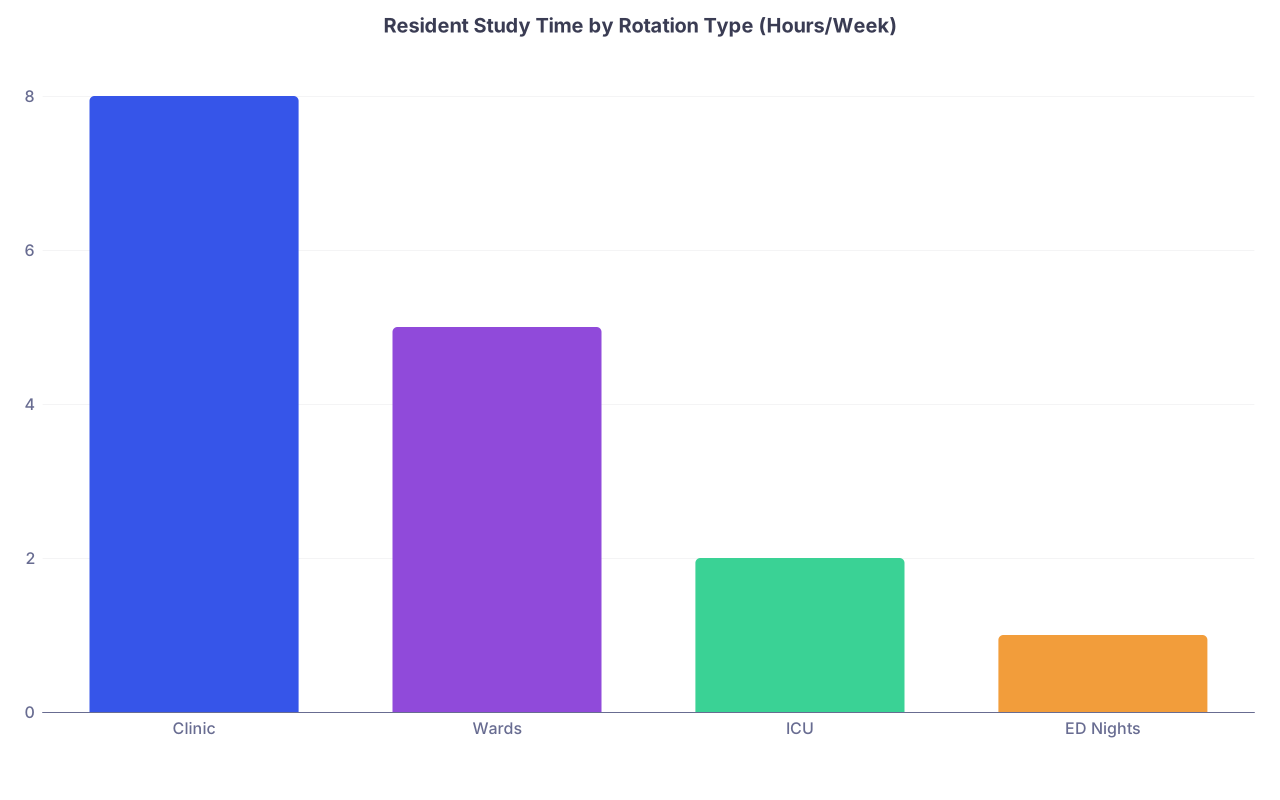
| Category | Value |
|---|---|
| Clinic | 8 |
| Wards | 5 |
| ICU | 2 |
| ED Nights | 1 |
When you see those coming:
- Front-load study the month before: aim higher (100–125 Qs/week) to buffer.
- During brutal months, shrink your target, don’t delete it.
- ICU month might be: 20–30 Qs/week + 1 short review session.
- Use micro-study: 5–10 Qs on your phone during:
- Waiting for CT
- Sitting in ED triage
- Post-call before collapsing (very few, but some)
You cycle intensity:
- High-yield/light months: push hard
- Kill-you months: keep the habit alive, even at 20%
Consistency beats heroics. I have watched residents “take a break” for 2–3 months during hard rotations and never recover their momentum.
Step 8: Use the In-Training Exam Like a Weapon, Not a Report Card
In an under-resourced program, the in-training exam (ITE) is your practice boards. You cannot treat it like another annoying test.
Make it work for you:
Before the ITE
- Aim to have at least 30–40% of a good Qbank done.
- Focus on breadth, not perfection. You are warming up, not peaking.
After the ITE
Do not just glance at your percentile and move on. That is how people fail.
You want:
- Domain breakdown (e.g., weak in nephro, strong in cardio).
- Question-level report if available (copy or screenshot the topics you missed).
- A short meeting with someone (PD, associate PD, or a decent attending) to review and set a plan.
You then build a 2–3 month “ITE recovery plan” focused on your worst 2–3 areas. That is your priority list.
If your program ignores ITE results completely? Red flag. You treat your own ITE as gospel and self-remediate anyway.
Step 9: Protect Your Brain From Burnout While You DIY Your Education
Here is the part nobody in under-resourced places wants to talk about: the emotional tax of having to build your own curriculum while working unsafe volumes is huge.
If you try to “grind" your way through this with no boundaries, you will burn out and then quit studying entirely.
So you do the minimum mental health maintenance that actually works:
Non-negotiable sleep floor.
Not ideal sleep. Minimum. For a lot of residents, that’s 5–6 hours most days, 7–8 when you can.Automatic reset activities on post-call/golden days:
- 20–30 min walk outside
- One decent meal not eaten in 3 minutes while standing
- 1–2 hours of actual non-medical life (friend, show, hobby)
No “self-hate study sessions.” If you catch yourself thinking, “I am so behind, I am screwed, I have to do 200 questions tonight,” you are already off the rails. Cut the target to something survivable—maybe 25 questions—and hit that.
Being in a neglected program already loads you with chronic stress. Your study plan has to be sustainable in that reality, not in fantasy land where you get out at 4 p.m. every day.
Step 10: Know When to Ask for Serious Help
There is a point where DIY will not cut it.
Red flags that you need extra support:
- You failed or barely passed a prior board exam (Step 1/2/3).
- Your ITE performance is very low (e.g., <20–30th percentile for your specialty).
- Your Qbank performance is not improving despite months of effort.
- You are so depressed, anxious, or burned out that you are barely functioning.
In those cases:
Speak to someone in leadership you trust. Be direct:
“Given my prior scores and my ITE, I am at real risk of failing boards. I need a structured remediation plan. Can we set that up?”
Consider external help:
- Formal board prep courses (pick ones with outcomes data, not just flashy marketing).
- Learning specialist (sometimes medical schools or hospitals still have access for grads).
- Therapist if anxiety/depression are wrecking your focus.
Adjust expectations: On the worst rotations, your only job might be: survive, keep your job, do tiny study steps, and protect your body. Then you do the heavy lifting when the schedule loosens.
Pretending you are fine is how people quietly fail and then have to navigate remediation or extension.
A Quick, Realistic Weekly Template
Let’s put this together in a template that would actually work in a rough IM or surgery program.
Say you work 6 days a week, average 70–80 hours.
You aim for:
- 3 days: 20–25 Qs each (on lighter or medium days)
- 2 days: 10–15 Qs each (busy but not hell)
- 1 post-call day: 0–5 Qs (mostly rest)
- 1 golden day: 40–60 Qs + 1–2 hours review
Total: ~100–130 Qs/week. If that sounds insane, fine—scale it down. Maybe your number is 60–80/week. The details matter less than the habit.
Use something visual to track progress. A simple cumulative graph helps some people stay honest:
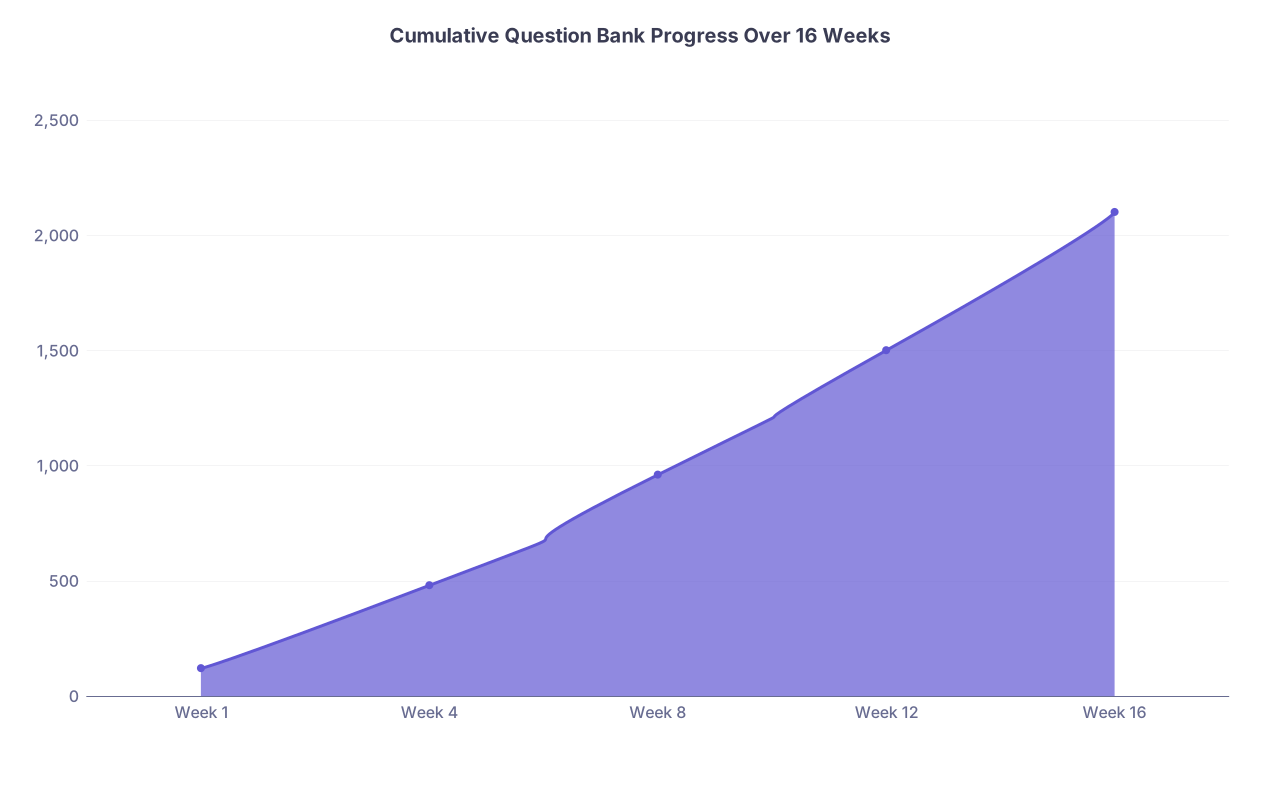
| Category | Value |
|---|---|
| Week 1 | 120 |
| Week 4 | 480 |
| Week 8 | 960 |
| Week 12 | 1500 |
| Week 16 | 2100 |
The point: when the program gives you nothing, you create your own scaffolding.
Remember What This Is Actually About
Under-resourced programs with minimal support are demoralizing. People at fancy places will tell you to “advocate for yourself,” as if emailing your PD magically creates faculty where there are none.
So, be clear with yourself:
- You are not doing all this to make your program look good.
- You are doing it so that when you are out, you actually feel competent, safe, and employable.
- Board exams are one gate. Real competence is the longer game, and ironically, the grind you’re doing now probably makes you a more independent physician than many residents in plush environments.
You did not choose to be in a program that runs on fumes. But you do get to choose whether that becomes your excuse or your origin story.
FAQs
1. I am so behind that my Qbank progress is embarrassing. Should I reset it or keep going?
Do not reset. That is almost always a bad move.
What you should do:
- Sort your questions to “incorrect” and “unused.”
- First, work through “incorrect” in tutor mode, 10–20/day, focusing on understanding why you missed them.
- Simultaneously, do small blocks of “unused” in timed mode to build test stamina.
Resetting wipes out the data on your weak spots and gives you the illusion of a fresh start. It feels good for 48 hours and then you are right back where you started.
2. My program’s board pass rate is terrible. Should I consider transferring?
Transferring during residency is hard but not impossible. Ask yourself:
- Are you early PGY-1 with no major red flags and decent scores?
- Is your life truly unsafe/toxic, not just “busy and disorganized”?
- Do you have faculty willing to write strong letters to another program?
If yes, you can explore options, but expect limited spots and a lot of hassle. Most residents I have seen in this position ended up staying and focusing on maximizing their own prep rather than banking on a transfer. If the environment is abusive or non-compliant with duty hours, involve GME or your DIO first.
3. How do I balance fellowship applications with board prep in a weak program?
You prioritize by timeline:
- During peak application season (ERAS, interviews), lower your Qbank targets but keep the habit alive—maybe 30–50 Qs/week.
- Use interview travel downtime for flashcards or small question blocks.
- Once interviews quiet down, ramp board prep back up aggressively.
If you are applying to a competitive fellowship from an under-resourced program, strong board performance and in-training scores are a big plus. Do not sacrifice your board preparation entirely for the application circus; they are both part of your long game.
Now, do one concrete thing: open your Qbank or notes right now and write down a 7-day plan with actual numbers. Not “study more.”
“75 questions. 3 review sessions. 1 group session.”
Then protect those like they are clinic appointments.