
Qbank Scores Stuck at 55%? Practical Adjustments That Actually Work
If your qbank scores are stuck around 55%, your problem is not “intelligence.” Your problem is system failure. And systems can be fixed.
I have watched plenty of sharp residents spin their wheels at 50–60% for weeks, then jump into the 70s within a month. Same brain. Different process. You do not need more willpower. You need to stop studying like a pre-clinical student and start operating like a resident with constraints.
Let me walk through what actually moves the needle when you are plateaued in the mid-50s.
1. Diagnose the Real Problem: It Is Rarely “I Just Suck at This”
“Yeah, I am just bad at standardized tests.”
No. That is almost never the full story. There are 5 common failure modes when people are stuck at ~55%:
- Question approach is sloppy and inconsistent
- Review is passive and superficial
- Question volume and spacing are wrong
- Content gaps are unacknowledged but massive
- Life as a resident (fatigue, shifts, chaos) is destroying any illusion of a plan
You need a quick diagnostic before you start “fixing” the wrong thing.
A. Run a 2-Day Diagnostic
For the next 2 days, do this exactly:
Day 1:
- 2 timed blocks of 20 questions (same qbank you have been using)
- Conditions: no phone, no interruptions, timed mode, exam interface
- After each block, write down:
- How many “I was between two and picked the wrong one” errors?
- How many pure “I had no clue” errors?
- How many “I misread the question / missed a key detail” errors?
Day 2:
- 1 untimed block of 20 questions
- Spend as long as needed per question to:
- Identify the exact stem clue(s) supporting the right answer
- Articulate in 1–2 sentences why all wrong options are wrong
Your goal: figure out whether you have a thinking problem, a knowledge problem, or a fatigue/attention problem.
Rough guideline:
| Pattern You See Most | Likely Core Problem |
|---|---|
| Lots of “between two choices” | Weak question strategy / pattern recognition |
| Lots of “no idea at all” | True content gaps |
| Lots of “missed that detail” | Attention, rushed pace, fatigue |
| Mix of all three, no clear pattern | Bad review process, everything is leaky |
Once you know which bucket you live in, you stop guessing and start fixing.
2. Fix Your Question Approach: How You Read Is Costing You 10–15%
If you are hovering around 55%, you are almost definitely leaking points from bad process. You read too fast. You lock into a diagnosis early. You chase buzzwords instead of building the story.
Here is the protocol I use to clean up question approach. It is simple and not glamorous, but it works.
A. The 4-Pass Method for Every Question
For the next 3–4 weeks, force yourself to use this structure on every single qbank question, especially timed blocks:
Pass 1 – Last Sentence First
- Read the last line of the stem first.
Example: “What is the most likely diagnosis?” or “Which of the following is the best next step in management?” - Decide: is this Dx, Mx, Dx test, Prognosis, or Mechanism?
- Only then go to the top of the stem.
- Read the last line of the stem first.
Pass 2 – Story, Not Buzzwords
- As you read from the top, force yourself to build a 1-line mental summary:
- “Middle-aged man with painless jaundice and weight loss – concerning for pancreatic cancer.”
- “Young woman with acute onset dyspnea and pleuritic chest pain after surgery – PE until proven otherwise.”
- If you cannot summarize the stem in your own words, you did not read it properly.
- As you read from the top, force yourself to build a 1-line mental summary:
Pass 3 – Predict Before You Look
- Before you look at the answer choices, ask: “What do I actually expect the correct answer to be?”
- Could be a diagnosis, a test, a next best step.
- Say it (literally whisper it if you are alone) or write a cut-down version on scrap paper.
- Before you look at the answer choices, ask: “What do I actually expect the correct answer to be?”
Pass 4 – Then Use the Choices
- Now look at the answer list.
- Compare your prediction to what is in front of you.
- If your prediction is not there, slow down. You probably:
- Misread the question
- Missed a key modifier (first-line vs next step vs best long-term)
- Or are in a true knowledge gap (fine, then treat it as such)
This alone reduces random guessing and “between two” errors. You are forcing your brain to anchor to the clinical reasoning, not to the prettiest answer choice.
B. Strict Elimination: Demand Evidence for Every Option
You should not just pick the right answer. You should be able to argue against every wrong one. That is exam-level thinking.
For each question, try:
- Ask: “What is my evidence against this choice based on the stem or known guidelines?”
- If you do not have a clear reason, mark it with a small “?” in your scratch notes. Those options are your danger zone.
During review, pay special attention to any question where:
- You did not have explicit reasons to eliminate wrong choices
- You went mostly on “vibe” or pattern recognition
These are exactly the questions you will miss on exam day.
3. Stop Wasting the Review: How to Turn 55% Blocks into 70% Learning
Most residents “review” like this:
Read explanation → Glance at highlighted sentence → Think “ah, okay, makes sense now” → Next.
That style will keep you locked around 55–60% forever. You are not building retrieval. You are bathing in recognition.
You need a review protocol that is short, brutal, and repeatable.
A. The 5-Minute-Per-Question Rule
Cap yourself at 5 minutes of review per question, max, including creating any notes. If you spend 20 minutes on one question, you will never get through enough volume as a resident.
For every incorrect question (and any correct guess), do this sequence:
Label the Error Type (10 seconds)
- Knowledge gap
- Misread / missed detail
- Poor elimination / fell for distractor
- Poor test-taking (rushed, changed correct answer)
Write a 1-Line Takeaway (30–45 seconds)
- Format: “In [scenario], do [specific action] because [key mechanism or guideline].”
- Example:
- “In painless jaundice + weight loss, think pancreatic adenocarcinoma and order abdominal CT with contrast.”
- “In symptomatic hyponatremia with seizures, give hypertonic saline bolus, not fluid restriction.”
Cover the Explanation and Recite (60 seconds)
- Cover the explanation text with your hand.
- Using only the stem and your 1-line takeaway, explain:
- Why the right answer is right
- Why each wrong answer is wrong
- Then uncover and compare. Anything you missed, adjust your takeaway.
Tag for Future Review (30–60 seconds)
- If this is a concept you have missed more than once, tag it:
- “Cirrhosis complications”
- “Renal tubular acidosis”
- “Acute coronary syndrome management”
- These tags will feed into your later spaced review (we will get there).
- If this is a concept you have missed more than once, tag it:
Optional: Micro-Card (60–90 seconds)
- Only for truly high-yield concepts you clearly cannot retain.
- Build a 1–2 line digital card (Anki, Notion, simple note) with:
- Very short stem cue
- Very short answer
- Example:
- Q: “Primary treatment for symptomatic Wolff-Parkinson-White with atrial fibrillation?”
A: “Procainamide or cardioversion – avoid AV nodal blockers.”
- Q: “Primary treatment for symptomatic Wolff-Parkinson-White with atrial fibrillation?”
If you actually stick to ~5 minutes per missed question, a 40-question block with 20 wrong answers is maybe 90–120 minutes of review. That is sustainable on residency.
B. Stop Collecting Notes You Will Never See Again
The giant 40-page Word document of “Important Things” is a graveyard. You will not read it. Delete that habit.
Instead:
- Keep:
- A short list (15–30 items) of “Recurring Weak Concepts” that you revisit every 3–4 days.
- Use:
- Flashcards or micro-notes for things that repeatedly burn you.
- Drop:
- Copy-pasting whole explanations
- Screenshotting entire question stems “to look at later”
If you have not reviewed a note in 7 days, it is probably dead weight.
4. Adjust Volume and Schedule: Residents Cannot Study Like Dedicated Students
You are in residency. Your life is not a neat 8-hour board prep block. Night float, 28-hour calls, clinic, codes, random family emergencies. Your qbank plan has to survive chaos.
The big mistake: “I will do 80 questions per day, every day, no matter what.”
You will do that for 3 days, then crash, then do 0 questions for 4 days. Net result: inconsistent learning, unstable scores.
You need a **floor and ceiling** system instead.
A. Set a Realistic Floor and Ceiling
Pick two numbers:
- Daily floor – the absolute minimum questions you will do even on call days.
- Daily ceiling – the maximum you will attempt, even when free, to avoid burnout.
Example for a busy IM resident:
- Floor: 10–15 questions
- Ceiling: 40–50 questions
This means:
- On brutal days: minimum 10, even if you are half-asleep on post-call.
- On light clinic or admin days: stop at 40–50. Even if you “feel good” and want to push to 100. You are protecting tomorrow’s brain.
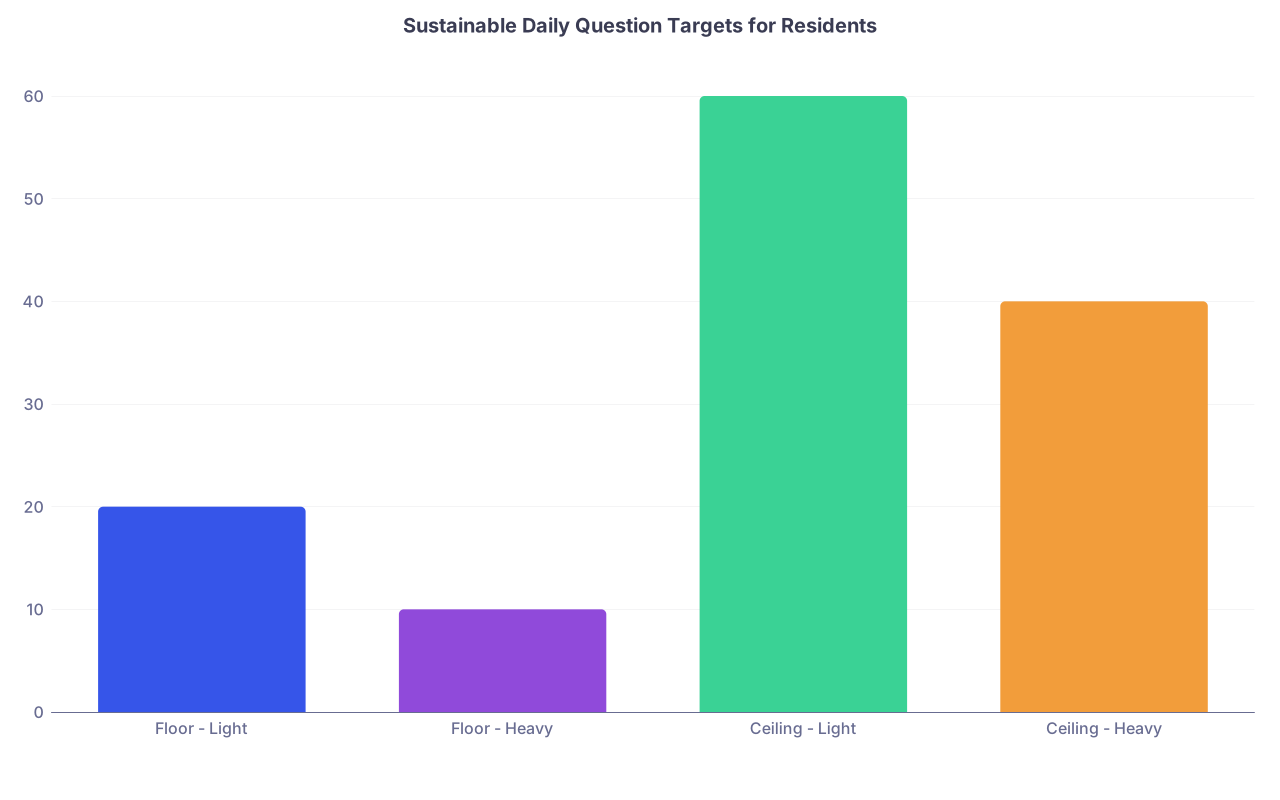
| Category | Value |
|---|---|
| Floor - Light | 20 |
| Floor - Heavy | 10 |
| Ceiling - Light | 60 |
| Ceiling - Heavy | 40 |
Adjust numbers based on specialty and exam timeline, but keep the structure.
B. Batch Your Review Blocks
Trying to review questions in 2–3 minute fragments between pages and consults is mostly useless. You forget the stem before you finish the explanation.
Better:
- Do questions in small chunks (10–20) when you can.
- Do review in 30–45 minute protected blocks, even if that is only 3–4 times per week.
Example weekly pattern on a busy ward month:
- Mon–Fri:
- 10–20 questions in the evening post-call / pre-bed
- Flag questions for review
- Sat:
- 2–3 focused review blocks of 30–45 minutes
- Sun:
- 1–2 review blocks + 20–40 fresh questions
That alone will make your learning less leaky.
5. Patch the Actual Content Gaps: Targeted, Not Endless Review
When you are at 55%, there are entire subject chunks you simply do not know well enough. No question strategy will fix “I never understood acid–base” or “I always mix up vasculitis types.”
You need a tightly focused content repair loop, not a full curriculum review.
A. Build a “Hit List” from Your Qbank Data
Every 1–2 weeks, pull data from your qbank and write it out. Not 20 categories. Just the worst offenders.
Example:
- Endocrine: 48%
- Hematology/Onc: 52%
- Pulm: 60%
- Cardio: 68%
- Nephrology: 45%
Your Hit List is the bottom 2–3 systems from that snapshot. Nothing else.
For each of these, define 3–6 micro-topics that actually hurt you. Granular, not vague.
Example, Nephrology at 45%:
- Acute kidney injury workup and staging
- Glomerulonephritis patterns (IgA, PSGN, RPGN, etc.)
- Dialysis indications
- Acid–base disorders and compensation
- Nephritic vs nephrotic presentation patterns
B. Use a Tight Repair Cycle for Each Micro-Topic
For each micro-topic, do this:
Short Content Burst (20–30 minutes)
- Use a targeted resource:
- Single UWorld explanation cluster
- One board review chapter section
- One 15–20 minute high-yield video
- Goal: get a clean, organized framework in your head, not memorize details yet.
- Use a targeted resource:
Immediate Application (10–20 questions)
- In tutor mode, filter qbank (or a second qbank) to that topic/system.
- Force yourself through 10–20 questions on that micro-topic immediately after content.
Mini-Review in 48–72 Hours (5–10 questions)
- Schedule a tiny block 2–3 days later:
- 5–10 more questions from the same micro-topic
- If you are still blowing it, repeat step 1 but with a different teaching style or resource.
- Schedule a tiny block 2–3 days later:
Promote or Recycle
- Once you are consistently 70%+ on that micro-topic across 2–3 small sessions, take it off the Hit List and add the next one.

You keep cycling this Hit List process while maintaining your general mixed blocks. Over 3–6 weeks, your biggest weaknesses stop bleeding points.
6. Use Spaced Repetition Like an Adult, Not a First-Year
Anki can save you or destroy you. Most residents drown in 4,000-card decks and then declare “Anki does not work for me.”
What works at the resident level is micro-spaced repetition:
- Very small number of cards
- Only on concepts that repeatedly cost you points
- Extremely concise phrases and cues
A. Set Hard Limits
- Total active cards: 200–300 maximum
- New cards per day: 5–10
- Daily review time: 10–15 minutes max, preferably:
- On commute
- While waiting for sign-out
- During coffee break
If your Anki is taking 45 minutes a day, you will quit. Then you lose everything.
B. Write Cards that Match Exam Thinking
Bad card:
“Describe the pathophysiology, clinical features, diagnosis, and treatment of nephrotic syndrome.”
You will never review that meaningfully.
Good cards are:
- Very short
- Very specific
- Tied to a real question that burned you
Examples:
Q: “Nephrotic syndrome with Hep B – likely diagnosis?”
A: “Membranous nephropathy.”Q: “First-line agent for rate control in stable atrial fibrillation with RVR?”
A: “Beta-blocker or diltiazem, unless decompensated heart failure.”Q: “What test to confirm acromegaly after high IGF-1?”
A: “Oral glucose tolerance test – GH fails to suppress.”
You are not trying to memorize the textbook. You are hardening the exact handles the exam expects you to grab.
7. Debug Your Mental Bandwidth: Fatigue and Focus Are Part of the Exam
Let me be blunt: if you are doing 40 questions when you are half-delirious post-call and then calling that “data” on your readiness, your score plateau is not a mystery.
Board exams are endurance events. You cannot train for a marathon by stumbling around at 2 a.m. once a week.
You need blocks under semi-real conditions at least once per week.
A. One Protected Block Per Week (Non-Negotiable)
Once a week, do:
- 40–60 questions
- Timed, exam interface, no interruptions
- Starting time similar to your actual exam day plan
Then treat this block differently:
- Track:
- First 10 questions vs last 10 questions performance
- Error type distribution early vs late
- If your last 10 drop by more than 10–15 percentage points, you have an endurance/focus issue, not just knowledge.
B. 3 Simple Focus Adjustments That Actually Help
These are not wellness platitudes. These are test-score levers.
Pre-block ritual (5–10 minutes)
- Bathroom
- Water
- 3–5 deep breaths with 4-7-8 pattern (inhale 4, hold 7, exhale 8)
- Quick mental script: “Next 60 minutes is exam mode. Everything else can wait.”
Micro-reset every 10 questions
- Look away from the screen for 5–10 seconds.
- Take one slow breath.
- Do not check your phone. Just reset your visual and attention system.
Strict “no double-change” rule
- You are allowed to change an answer once if you see new evidence.
- You are not allowed to change it a second time.
- People sabotage themselves revisiting one question 4 times. That is anxiety, not reasoning.

| Step | Description |
|---|---|
| Step 1 | Weekly Plan |
| Step 2 | Daily Mini Blocks 10-20 Qs |
| Step 3 | One Long Timed Block 40-60 Qs |
| Step 4 | 2-3 Review Sessions |
| Step 5 | Tag Weak Topics |
| Step 6 | Analyze Endurance and Focus |
| Step 7 | Update Hit List |
8. When to Add or Change Qbanks (And When to Stop Blaming Them)
“I think this qbank is just not good for my style. Maybe I should switch to another one.”
Sometimes valid. Often avoidance.
Here is the truth:
If you are <60% through your main qbank and sitting at 55–60%, you do not need a new qbank. You need to:
- Fix your approach
- Fix your review
- Patch your hit-list topics
If you have:
- Finished 70–100% of a major qbank honestly
- Implemented the changes above for at least 3–4 weeks
- Still stuck at 55–60% on fresh blocks
Then yes, a second qbank can reveal blind spots and give fresh pattern exposure.
Use a second qbank for:
- 20–40 question blocks 2–3 times per week
- Mixed systems
- Timed mode, to simulate exam style
But do not collect qbanks like Pokémon. One primary + (optionally) one secondary is enough.
9. How Long Until 55% Becomes 65–70%?
If you genuinely implement the changes above, a typical trajectory for a resident with a 55% baseline looks like this:
Week 1–2:
- Scores feel volatile
- Some blocks jump to low 60s, some stay mid-50s
- You are still learning the discipline of the new system
Week 3–4:
- Average creeps up into 60–65%
- Fewer “I have no idea” misses, more misses are subtle or guideline-based
- You start seeing repeat patterns and crushing them
Week 5–8:
- Consistent 65–72% on mixed timed blocks
- Hit List topics are now assets, not liabilities
- Fatigue drop-off across a 40-question block is smaller
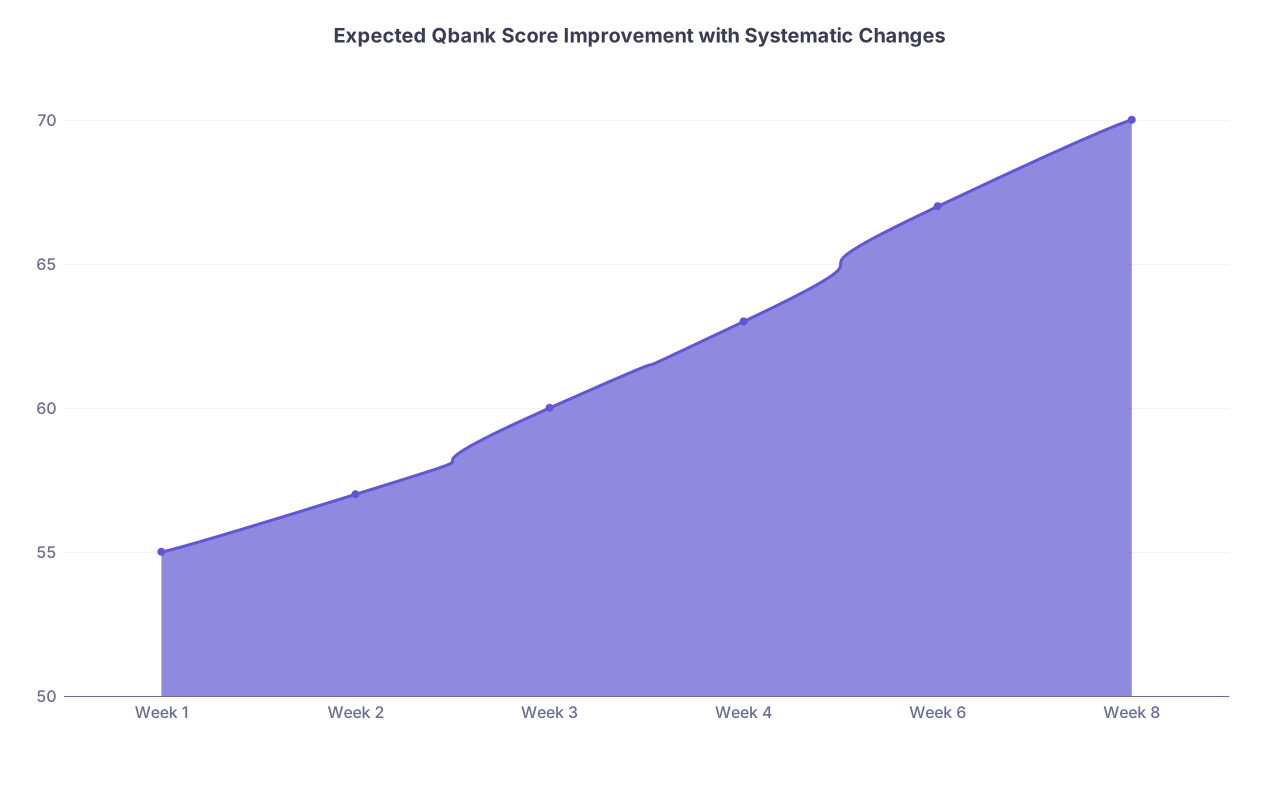
| Category | Value |
|---|---|
| Week 1 | 55 |
| Week 2 | 57 |
| Week 3 | 60 |
| Week 4 | 63 |
| Week 6 | 67 |
| Week 8 | 70 |
Of course, if your exam is in 2 weeks and you are at 55%, that is a different emergency conversation. But if you have at least 6–8 weeks, systematic change is absolutely worth it.
10. Put It Together: A Sample 2-Week Reset Plan
To make this concrete, here is what a 2-week “reset” could look like for a resident stuck at 55% with 8–10 weeks left before boards.
Week 1
- Daily:
- 20–30 mixed questions (timed)
- Full 5-minute-per-question review for all wrong/guessed
- Twice this week:
- 40-question timed block under semi-exam conditions
- Once this week:
- Pull qbank stats → build Hit List (2–3 systems, 3–6 micro-topics each)
- Hit List:
- Pick 2 micro-topics to repair (each gets 1x 30-minute content burst + 20 questions + 5–10 questions at 48–72 hours)
Week 2
- Daily:
- Floor: 15 questions; Ceiling: 40 questions
- Keep 5-minute-per-question review
- Focus:
- Maintain mixed blocks but bias selection to include at least one Hit List topic in each
- Once:
- 60-question timed block, analyze first vs last 15 for fatigue
- Hit List:
- Rotate to 2–3 new micro-topics while revisiting the prior ones with 5–10 follow-up questions
If you do this honestly—without skipping review, without cheating time limits—you should see at least some shift upward within 2–3 weeks.
Key Takeaways
- A 55% plateau is a system problem, not a fixed ceiling. Fix how you approach questions, how you review, and how you patch your weakest topics.
- As a resident, you must study with volume realism: daily floors and ceilings, one protected long block per week, and ruthlessly efficient review.
- Progress comes from tight feedback loops: label your error types, build a small Hit List of weak topics, repair them systematically, and use micro-spaced repetition to lock in what you keep missing.