
Balancing research, clinical work, and board prep is not about “time management.” It is battlefield triage. You save what must live. You let go of what can die. And most residents get this completely wrong.
You are not going to “do it all.” The sooner you stop chasing that fantasy, the sooner your performance in all three domains will improve. What you need is a clear triage protocol you can run every week—sometimes every day—when the service explodes, an attending dumps a paper on you, and your in‑training exam is three weeks away.
Let us build that protocol.
1. Set the Hierarchy: What Actually Comes First
If you do not establish a non‑negotiable hierarchy, everything will feel equally urgent, and you will end up chronically behind on boards and half‑finishing research projects.
Here is the order. Argue with me if you like, but this is how you survive and still match into competitive fellowships.
| Priority | Domain | Timeframe |
|---|---|---|
| 1 | Clinical Care | Daily / Immediate |
| 2 | Board Prep | Weekly / Longterm |
| 3 | Research | Weekly / Project |
1. Clinical work (non‑negotiable)
- Patient safety and care.
- Program requirements (duty hours, notes, sign‑out, conferences).
- Anything that gets your name in a negative email to the PD if it slips.
2. Board prep (career‑critical)
- Step 3, IM/Anesthesia/Surgery boards, in‑training exams.
- This is what determines how many doors stay open when training ends.
3. Research (leverage, not life support)
- Abstracts, manuscripts, QI projects.
- Huge upside for fellowships and academic careers, but far more flexible on timing than the first two.
Let me be blunt. If you sacrifice core clinical competence or board performance consistently for research, you are playing a long game with a broken foundation. The PD who praises “research productivity” will drop you in a second if you are unsafe on the wards or consistently bombing in‑training exams.
Your triage rule of thumb:
Clinical fires first, boards second, research third—unless you consciously reverse that for a specific, time‑limited window.
We will get to those exceptions.
2. Build Your Weekly Template: The Baseline Before Chaos
You cannot triage on the fly if you do not have a baseline plan to push against. You need a default weekly template that covers minimum viable progress in all three domains.
Think in time blocks, not “I’ll study when I can.”
Step 1: Define minimum viable doses
This is the smallest sustainable weekly dose that still moves the needle.
Board prep minimum viable dose
- 5 days per week.
- 45–60 minutes / day.
- At least 20–40 high‑quality questions with review (UWorld, BoardVitals, TrueLearn, Amboss—pick one primary).
Research minimum viable dose
- 2–3 blocks of 45–90 minutes / week.
- Very specific task per block:
- “Revise Introduction paragraph 2–4.”
- “Extract data for patients #41–60.”
- “Draft methods for statistical analysis.”
- Multi‑hour stretches are nice, but unrealistic on heavy weeks.
Clinical work
- There is no “minimum.” The schedule is given to you.
- What you control is your off‑duty waste, not your on‑duty hours.
Step 2: Place protected board prep anchors
On most rotations, you can carve out short, high‑yield, near‑daily sessions.
For a typical ward month:
- Pre‑round or post‑sign‑out
- 30–45 minutes:
- 30 minutes questions
- 10–15 minutes quick review
- 30–45 minutes:
- Post‑call
- Light, but not zero:
- 10–15 very easy questions or flashcards
- Or watch one short video on a weak topic
- Light, but not zero:
Concrete example (early intern or resident):
- Mon–Fri:
- 30–40 min board prep after sign‑out or after dinner
- Sat:
- Optional 30–60 min “catch‑up or targeted topic”
- Sun:
- 60–90 min longer review session + weak‑topic reading
Step 3: Assign research blocks where you are actually awake
This is where most residents make a terrible mistake. They “plan” to write after a 28‑hour call. Of course it never happens.
Better pattern:
- Lighter days (clinic, elective, consults) → research.
- Post‑call, heavy ward days → you only aim for board minimums, no research.
Example weekly skeleton on a moderate rotation:
- Tuesday, Thursday evenings: 45–60 min research block.
- Sunday afternoon: 60–90 min research block.
Very important: you schedule tasks, not vague goals like “work on manuscript.”
Write down exactly what your future tired self will do.
3. Create a Triage Protocol for Each Week
Here is where it becomes a real protocol, not wishful thinking.
Every Sunday (or your first “off” half‑day) you run a repeatable 10–15 minute triage meeting with yourself.
Step 1: Quick status scan
Ask yourself three hard questions:
- Clinical: Any upcoming evaluations, feedback issues, new responsibilities?
- Boards:
- Exam or in‑training date?
- Question bank progress %?
- Weak subject clusters?
- Research:
- Hard deadlines: conference submission, IRB, co‑author expectations?
- Any deliverables someone else is waiting on (methods draft, figures)?
Step 2: Set that week’s priority tier
Each week, explicitly designate the week as:
- Clinical‑dominant week
- Heavy wards/ICU, tons of admits, new role, or on probation / under scrutiny.
- Board‑dominant week
- 4–8 weeks out from boards or in‑training exam.
- Research‑dominant week
- Abstract/manuscript deadline in ≤ 2–3 weeks.
You do not treat all weeks equally. You rotate emphasis.
Step 3: Apply the Triage Rules
Here is your decision tree in plain language.

| Step | Description |
|---|---|
| Step 1 | Start Weekly Review |
| Step 2 | Clinical dominant week |
| Step 3 | Board dominant week |
| Step 4 | Research dominant week |
| Step 5 | Balanced week |
| Step 6 | Protect clinical energy, keep board minimums, cut research |
| Step 7 | Increase board time, reduce research to bare minimum |
| Step 8 | Protect 2 to 3 long research blocks, shrink board time slightly |
| Step 9 | Run baseline schedule for all three |
| Step 10 | Major clinical issue or new heavy rotation? |
| Step 11 | Board exam within 8 weeks? |
| Step 12 | Research deadline within 3 weeks? |
Interpretation:
Clinical‑dominant week
- You are starting ICU, night float, or you just got feedback that you are behind.
- Protocol:
- Maintain board prep minimum (30–40 min most days, even if split).
- Research gets cut or radically downgraded:
- Only meet pre‑existing deadlines.
- Say “no” to new research asks or defer: “I am on X rotation this month; I can pick this up after.”
Board‑dominant week
- Coming up on exam or you just did terribly on a practice test.
- Protocol:
- Increase board time to 60–90 min most days.
- Research goes down to one short block per week or only those tasks that others truly depend on.
- Non‑critical research emails get scheduled replies: “Let us revisit this after my exam on [date].”
Research‑dominant week
- Abstract or manuscript is due soon and is strategically important (major conference, critical mentor).
- Protocol:
- Protect 2–3 substantial research sessions (60–120 minutes) that you treat like clinics.
- Board prep does not stop. But it can reduce to the bare minimum (20–30 min) and focus specifically on maintaining question rhythm.
Balanced week
- No major crises, no near‑term exams or deadlines.
- Protocol:
- Run your baseline template:
- ~5 days of board questions.
- 2–3 research blocks.
- Run your baseline template:
This is triage. Not “balance in all things” nonsense.
4. Micro‑Scheduling Inside a Brutal Day
Weekly plans fall apart at 3 p.m. when your list doubles and two new consults arrive. So you need in‑the‑moment triage rules as well.
Rule 1: Never steal from your future self twice
You will have days where your planned evening study block evaporates. Fine. Happens to everyone. The mistake is responding with, “I’ll just double tomorrow.”
You won’t. Instead:
- If you miss a night:
- Next day: add 10–15 minutes to your next block, not 60.
- Or shift that content to your weekend longer block.
Closing the gap gradually beats wild overcorrection and burnout.
Rule 2: Use “micro‑blocks” for board prep
On truly insane days, you can still get work done in small fragments.
Typical micro‑blocks:
- 10–15 questions while:
- Waiting for a page back.
- Sitting in a lecture you already know.
- Riding the shuttle or commute (if not driving).
- Review 5–10 missed questions:
- Over lunch when you are alone.
- Between admissions when the workroom is quiet.
You are not aiming for deep conceptual review in these windows. Just volume and pattern recognition. Save deeper dives for your protected blocks.
Rule 3: Research is “deep work” only
Stop pretending you can write a results section in 10‑minute chunks between pages. That is how you end up staring at the same paragraph for three weeks.
Guideline:
- If you have <30 consecutive minutes realistically, skip research that day.
- Use that time for:
- Reading papers you already downloaded.
- Quick data cleaning that needs less cognitive effort.
- Drafting bullet points, not full sections.
When you see a 60–90 minute window appear, then you attack the high‑cognitive pieces.
5. How to Say “No” (or “Not Now”) Without Burning Bridges
What actually buries residents is not the scheduled work. It is the constant mission creep:
- “Do you want to be added as a co‑author on this case series?”
- “Can you help with this QI project? It won’t take long.”
- “We just need someone to organize the figures for this paper.”
The default resident answer is yes. Because it feels like opportunity. Sometimes it is. Often it is a time sink.
You need a response script for research and extra tasks, tied to your triage assessment.
Script for a clinical‑ or board‑dominant month
Use something like:
“I appreciate you thinking of me. I am on [ICU / nights / heavy rotation] through [date] and also preparing for [boards / in‑training exam] in [month]. I do not want to commit and not deliver. Could we revisit this after [date], or is there a shorter, clearly defined piece I could handle?”
This does three things:
- Signals you are responsible.
- Protects your bandwidth.
- Leaves the door open for future collaboration.
Script when research‑dominant and strategically important
“Yes, I can take this on. I can give it [X hours / week] for the next [N] weeks. Can we define a specific role and timeline so we are on the same page?”
You are not just agreeing. You are forcing clarity. That protects you from vague expectations that eat your nights.
6. Concrete Schedules on Different Rotations
Let me make this less abstract. Here are real patterns that I have seen work.
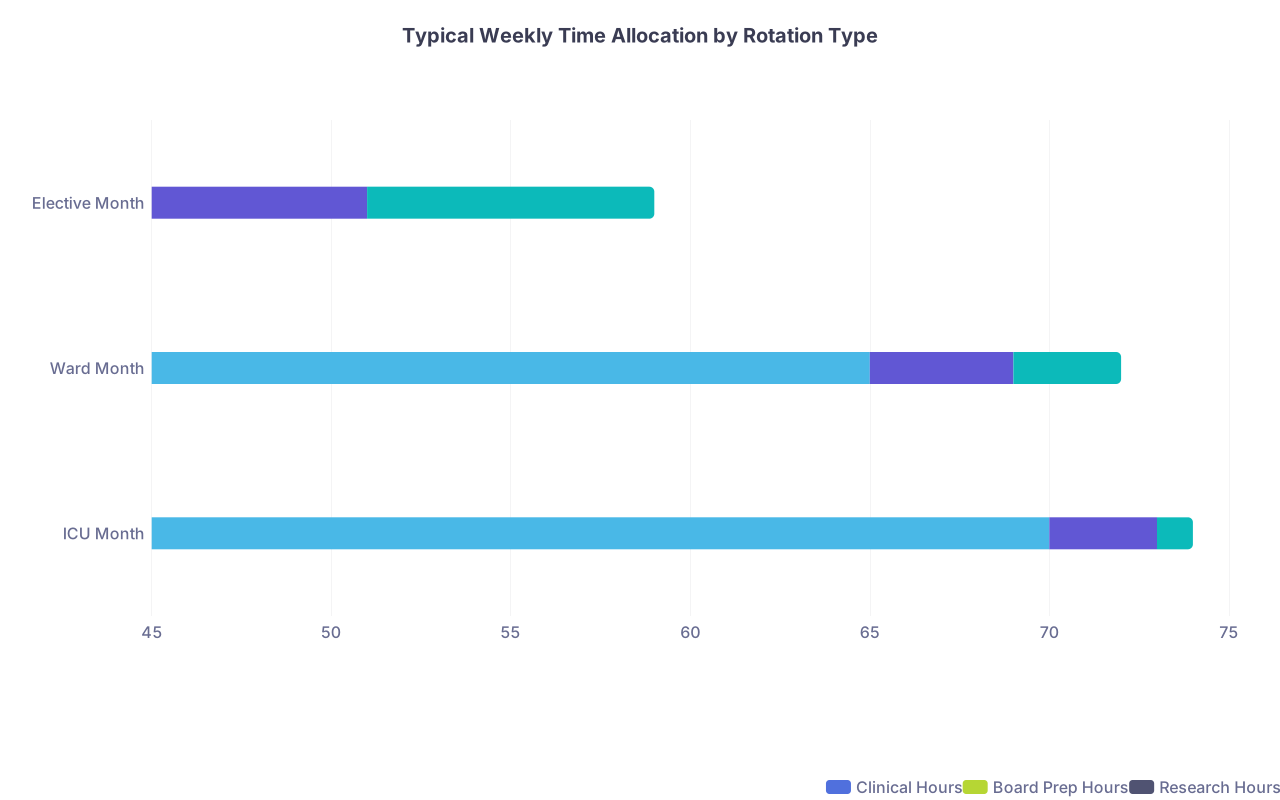
| Category | Clinical Hours | Board Prep Hours | Research Hours |
|---|---|---|---|
| ICU Month | 70 | 3 | 1 |
| Ward Month | 65 | 4 | 3 |
| Elective Month | 45 | 6 | 8 |
A. ICU / Nights (Clinical‑dominant)
- Clinical: 70–80 hours / week.
- Realistic:
- Board prep:
- 4–5 days / week.
- 20–30 min per day, mainly questions.
- Research:
- 0–1 small block per week (≤60 min).
- Only critical tasks with external deadlines.
- Board prep:
Sample day (night float):
- 5:30–6:30 p.m. – arrive, sign‑out, start work.
- Overnight – admits, cross‑cover.
- Post‑shift:
- Get home, sleep.
- 4:30–5:00 p.m. – wake up, eat.
- 5:00–5:30 p.m. – 15–20 questions + quick review.
- Repeat.
If you are trying to write a manuscript in this block, you are lying to yourself.
B. Wards / Busy Consults (Balanced → Clinical tilt)
- Clinical: 60–70 hours / week.
- Realistic goal:
- Board prep:
- 5–6 days / week, 30–45 min.
- Research:
- 2 blocks per week, 45–60 min.
- Board prep:
Sample workday:
- 6:00–7:00 a.m. – arrive, preround.
- 7:00–5:00 p.m. – work.
- 6:00–6:45 p.m. – dinner + decompress.
- 7:00–7:45 p.m. – questions + review.
- One of:
- Tuesday 8:00–9:00 p.m. – research task A.
- Saturday 2:00–3:30 p.m. – research task B.
C. Elective / Research Block (Board‑ or Research‑dominant)
- Clinical: 30–50 hours / week.
- This is where you make real gains.
Example: Research‑dominant, no imminent exam
- Mon–Fri:
- Morning:
- 30–45 min board questions.
- 9:00 a.m.–12:00 p.m. – protected research block.
- Morning:
- Sat:
- 60–90 min board deep dive.
- Sun:
- Off or minimal catch‑up.
Example: Board‑dominant, exam in 4 weeks
- Mon–Fri:
- 60–90 min questions + review in morning.
- 60–90 min targeted reading/videos in afternoon.
- Research: 1–2 hours / week max, small commitments.
- Sat:
- Full‑length blocks (4–6 hours broken into chunks).
- Sun:
- Review of missed questions, weak systems.
7. Protecting Your Brain: Energy Management, Not Just Time
Residents love to plan like robots: “I have 2 free hours; I will work all 120 minutes.” Then they collapse after 40.
You do not have a time problem. You have an energy and attention problem.
Use the “high‑caffeine rule” for boards
Study boards when:
- You are at your highest alertness of the day.
- You can actually focus on parsing explanations, not just clicking through items.
For many residents:
- Before leaving for the hospital (if you are a morning person).
- Or early evening, after a short decompression.
What you do not do:
- Put your highest cognition (board review) at the very end of the day, after scrolling your phone for 45 minutes.
Research needs deep focus blocks
Line up conditions:
- Minimal page load (not when you are primary for every cross‑cover issue).
- Noise‑controlled environment:
- Library, resident lounge, quiet desk at home.
- Clear, bounded task. Not “work on research.”
Match task to brain state
End of a brutal day and your brain is fried?
- Accept it.
- Do:
- Light board questions.
- Audio review or short videos.
- Do not:
- Try to outline a systematic review.
- Learn brand‑new heavy topics.
8. Tracking Without Turning Your Life into a Spreadsheet
You need some feedback loop, but you do not need an MBA dashboard. Two simple tools are enough.
Tool 1: Weekly one‑line log
At the end of the week, jot:
- “ICU week. 4 days qbank, 1 research block, felt overloaded.”
- “Elective. 6 days qbank, 3 research blocks, submitted abstract.”
You will quickly see:
- Which rotations are board‑dead zones.
- Where research actually moves forward.
- How much you overestimate your free time.
Tool 2: Visual progress markers
For boards:
- Track:
- % of question bank completed.
- Average percentage correct (directionally, not obsessively).
For research:
- Track milestones, not hours:
- “Data collected.”
- “Draft complete.”
- “Submitted to journal.”
This matters because humans respond to visible progress. You will work more consistently when you can see you are 43% through UWorld, not “somewhere in the middle.”
9. What to Do When Everything Crashes at Once
Sometimes life ignores your protocol:
- You are on wards.
- Family emergency blows up your weekend.
- PD says you need to show improvement clinically.
- And your board exam is 5 weeks away.
Here is the emergency triage protocol.
Step 1: Shrink your horizon to 72 hours
Stop worrying about the whole month. Look at the next three days.
- What absolutely must get done clinically? (discharges, notes, follow‑ups)
- What is the minimum board work you can realistically complete? (e.g., 15 questions per day)
- What research tasks are you allowed to drop entirely for 72 hours?
Step 2: Declare a “research freeze”
Email collaborators:
“I am currently on a heavy clinical rotation and have a board exam on [date]. For the next week, I will be focusing on those priorities. I will not be able to make substantial progress on [project] until after [date], but I remain committed long term.”
If they do not understand, that is not a mentor you want long‑term.
Step 3: Tighten your board prep, do not expand it
You will be tempted to suddenly push 3‑hour nightly study blocks. You will fail. You are already overloaded clinically.
Instead:
- Hold to:
- 30–60 min per day of high‑quality questions, zero fluff.
- Focus on:
- High‑yield weaknesses.
- Recently missed topics.
Consistency under stress trumps heroic one‑off marathons.
10. Pulling It Together: Your Triage Checklist
Here is the protocol you actually run. No fluff.
Weekly (10–15 minutes):
- Identify this week’s type:
- Clinical‑dominant / Board‑dominant / Research‑dominant / Balanced.
- Place:
- 5 question blocks on the calendar (even if short).
- 2–3 research blocks (or explicitly 0 if ICU / exam crunch).
- List 1–3 concrete tasks only for research:
- “Revise results section.”
- “Extract 20 more patients.”
- “Draft figure 1.”
Daily (2–3 minutes):
- Look at today’s clinical reality:
- Is the original plan still realistic?
- If not:
- Cut research first.
- Preserve a smaller board block (even 15–20 minutes).
- Decide now, not at midnight, whether today is a:
- “Board light” day (10 questions)
- Or a “Board normal” day (30–40 questions)
Monthly (15–20 minutes):
- Check:
- Qbank completion % and trend in scores.
- Research milestones hit / missed.
- Adjust:
- Next month’s rotation expectations (ICU = research freeze; elective = research surge).
- Board plan for upcoming exams.
You do not need a perfect system. You need a ruthless, honest one that matches the reality of residency.
Start with this simple, hard step today:
Tonight, take out your calendar and block five specific 30–45 minute board prep sessions for the next seven days. Then add just two research blocks you can realistically protect on your current rotation—and delete every other vague “I’ll work on research” placeholder.