
Most residents fail at post-call studying because they design routines for fantasy versions of themselves, not for the zombie walking out of the hospital at 10 a.m.
Let me be blunt: if your plan involves “just do 40 questions after call,” you will abandon it within a week. Post-call you are sleep-deprived, cognitively dull, emotionally thin, and often dehydrated. You are not lazy. You are impaired. Any routine that ignores that is garbage.
The fix is not “more discipline.” The fix is a micro-routine built around:
- 5–15 minutes of focused, low-friction work
- Automation and defaults that run even when your brain does not
- Zero decision-making on the day of call
You are not building a heroic habit. You are building a safety net. Something so small and pre-baked that you follow it even when you swear you will do nothing.
Let me show you how.
Step 1: Accept the Real Post-Call Brain You Actually Have
You cannot design a usable system until you stop lying to yourself about post-call capacity.
Post-call you are usually:
- Sleep-deprived – worse executive function, worse memory consolidation
- Emotionally blunted or irritable – low motivation
- Decision-fatigued – every “What should I do now?” feels like a brick wall
- Physically uncomfortable – hungry, dehydrated, sometimes mildly hypoxic if you spent the night in a mask
So the rules for a realistic post-call routine:
No planning on post-call day.
The plan must be decided before the call. Post-call day is execution only.No willpower assumptions.
If it requires you to “psych yourself up,” it will fail.Single clear minimum target.
“If I do just this, today counts.” Everything else is bonus.Easy start, hard stop.
It should be easier to start than to skip. And it must be short enough that you do not dread it.
The right mental model: you are designing your post-call routine for someone mildly intoxicated who still cares about their boards. That is about the level of function we are dealing with.
Step 2: Define Your Post-Call Micro-Goal (Correctly)
You need a micro-goal that is:
- Specific
- Binary (done / not done)
- 5–15 minutes max
- Tied to your actual exam (Step 3, ITE, boards, in-service, etc.)
Bad goals:
- “Review endocrine”
- “Do some reading”
- “Study if I feel up to it”
Good micro-goal examples:
- “Review 3 flashcards I got wrong yesterday about vasopressors.”
- “Do 1 timed 5-question block in UWorld and read only one explanation deeply.”
- “Listen to 8 minutes of a cardiology audio while brushing teeth and getting into bed.”
That is the scale we are working with. Tiny, surgical.
Here is a simple menu of realistic micro-goals for post-call days:
| Type | Micro-Goal Example |
|---|---|
| QBank | 3–5 questions, review 1–2 explanations |
| Flashcards | 10–15 cards, only “due” cards |
| Audio Review | 5–10 min of a board review podcast |
| Visual Cheatsheet | 1 page of your own summary notes |
| Single Topic Drill | Just AKI workup or diabetic emergencies |
Pick one as your default micro-goal. You can rotate weekly, but on any given week, there should be one automatic post-call task.
Step 3: Choose Your Post-Call Window (And Guard It)
The most common error: trying to study after you get home, shower, eat, scroll your phone, lie down “just for a second”. You know how that story ends.
The best time window for a micro-routine is:
- After sign-out
- Before leaving the hospital
- While your brain is still in “work mode” but before it shuts down
Alternative for some rotations: right after you get home before hitting the bed. But that is riskier.
If you are on a rotation where you truly must leave the hospital immediately (occasional programs enforce this), then your micro-routine lives at home and must be:
- Location-fixed: same chair, same device, same setup every time
- Tied to a habit you will not skip, like changing clothes or brushing teeth
Here is the priority list:
- Best: 5–10 minutes in a call room / residents’ lounge before you badge out.
- Second-best: 5–10 minutes at your kitchen table before touching your bed.
- Last resort: 5–10 audio-only minutes while commuting home (but this should be low-stakes recall, not brand new dense content).
Step 4: Build a Zero-Friction Setup
If you have to hunt for logins or think about what to do, you have already lost.
Your job is to remove every possible barrier ahead of time. That means:
- QBank app already logged in on your phone
- Deck already selected in Anki (“Post-call: 10 cards”)
- Specific audio playlist called “Post-Call Micro” pre-downloaded
- Short list of “post-call topics” bookmarked
Your setup should be so simple that once you open your phone or laptop, you see exactly what to tap.
Here is a simple process for pre-loading this:
Pick your tool: UWorld, AMBOSS, Anki, Boards & Beyond audio, etc.
Create a dedicated “Post-Call” preset:
- In Anki: a filtered deck with 10–15 cards tagged “high-yield” or “recent incorrect”
- In UWorld/AMBOSS: a block of 5 mixed questions (timed or tutor) saved as a test preset
- In Spotify/Apple Podcasts: a playlist with 3–4 short, high-yield episodes
Pin it to your home screen:
- Move the app to your phone’s first screen
- Rename the preset to “Post-Call 5” or “Post-Call 10”
- If you study on laptop, keep the tab pinned, auto-login turned on
You want your tired brain to see one giant button that might as well say: “Tap here to feel like you did something for your boards.”
Step 5: Design the Actual Micro-Study Protocol
Now we get specific. You need a repeatable procedure, not a vague habit.
Here is a concrete default protocol that works for most residents:
Default Post-Call Micro-Routine (10 minutes total)
Water and bathroom first (2 minutes)
- Fill water bottle or grab a cup
- Quick bathroom stop
This resets you a bit and buys you enough physiological comfort to study without misery.
Sit in a designated spot (30 seconds)
- Same chair / same table every time (call room desk, residents’ lounge, or your kitchen table).
- Phone on Do Not Disturb except study app.
Open your pre-set study task (30 seconds)
- Tap the one preset you created:
- 5 QBank questions or
- 10 Anki cards or
- 8 minutes of audio
- Tap the one preset you created:
Execute without multitasking (6–7 minutes)
- For QBank: answer 5 questions, quickly flag anything confusing, and pick one explanation to read carefully
- For Anki: go through 10 cards, speaking key points out loud if possible
- For audio: listen and try to actively recall 1 key point every 2–3 minutes
Quick capture (1 minute)
Use your notes app or index card for exactly 1–2 takeaways:- “Post-call takeaway 1: Criteria that define severe pancreatitis.”
- “Post-call takeaway 2: When to start steroids in COPD exacerbation.”
Hard stop (immediately)
- Close the app.
- Say to yourself (yes, out loud if you can): “Today counts.”
- Go home or go to bed.
If you feel good and want to do more, fine. But the routine must end at 10 minutes by default. The goal is consistency, not heroism.
Step 6: Use Automation and “Future You” Tricks
Your current self has to do favors for post-call self, who is unreliable and tired.
Here is how you make that happen:
1. Calendar + labels
Create a repeating event on your calendar on the days after call:
- Title: “Post-Call 10 – Boards”
- Time: 15–30 minutes after your usual sign-out
- Location: “Resident lounge desk 2” or “Kitchen table”
Color it differently from other events. This is not negotiable like “maybe I will study.” It is part of work.
2. Sticky note prompts
Low-tech, high-impact:
- In your white coat or call bag: a bright sticky that says “5 Qs then home”
- On your laptop: “Post-call = 10 cards before sleep”
You are creating an interruption to stop autopilot from sending you straight to your bed or Instagram.
3. Pre-download resources
Nothing kills a micro-routine like “No wifi in the call room” or “App needs to update.”
Before a call month:
- Download QBank blocks for offline use if your platform allows it
- Download a few audio lectures on your phone
- Sync Anki decks so all cards are available offline
Step 7: Align the Content With Your Rotation
Do not fight your brain’s natural context. After an ICU call, your mind is still half in vasopressors and ventilators. Use that.
Your post-call micro-routine should be anchored to what you just saw:
- On wards: sepsis, pneumonia, heart failure, AKI
- In ICU: shock types, ventilator settings, sedation, ARDS
- In ED: chest pain, stroke, trauma, anaphylaxis
- In OB: eclampsia, postpartum hemorrhage, fetal monitoring
Aligning content does two things:
- It makes recall easier because you have actual patients tied to the concept.
- It improves retention because you will see those problems again within days.
If you like structure, give each rotation a default micro-topic:
| Rotation | Post-Call Topic Default |
|---|---|
| Wards | Infections + sepsis |
| ICU | Shock + vasopressors |
| ED | Chest pain + resuscitation |
| OB/GYN | Hypertensive disorders + PPH |
| Peds | Fever in infants + asthma |
Then your rule is simple: post-call, pick one subtopic from the rotation default. That is it.
Step 8: Track Wins in a Ruthlessly Simple Way
You do not need a complex tracking system. But you do need a visible streak or tally, or you will underestimate how much you are actually doing.
Two options that work well:
Option A: Calendar tally
- Put a small checkmark (✓) or a dot on your calendar on any day you complete the micro-routine.
- Use a different color for “post-call micro” than normal-study days.
Option B: Simple habit app
Use a basic habit tracker (Streaks, HabitBull, Loop, etc.) with exactly one habit:
- “Post-Call Micro – 10 minutes”
Hit it once you finish. That is it. No extra tags, categories, or notes.
Your brain responds very well to “I have done this the last 4 post-call days, I do not want to break it.”
Step 9: Build a Pre-Call Checklist That Protects the Routine
Post-call studying starts before the call.
The night before a call, run a very short checklist:
- Is my device charged?
- Is my primary study app logged in?
- Are my offline resources downloaded?
- Do I know where I will sit post-call (specific spot)?
- Did I set or confirm my calendar reminder?
You can even formalize this as a mini-flow:

| Step | Description |
|---|---|
| Step 1 | Evening Before Call |
| Step 2 | Charge devices |
| Step 3 | Open study app and log in |
| Step 4 | Confirm post-call preset |
| Step 5 | Set calendar reminder |
| Step 6 | Call shift |
| Step 7 | Morning sign out |
| Step 8 | Water and bathroom |
| Step 9 | Sit at study spot |
| Step 10 | Run post-call micro-task |
| Step 11 | Mark habit complete |
| Step 12 | Go home and sleep |
This is maybe 5 minutes of prep, but it saves you every post-call morning from the “I’ll just skip today” trap.
Step 10: Protect Sleep First, Then Micro-Study
Let me say this plainly: sacrificing core post-call sleep for studying is dumb and counterproductive.
Priority stack on post-call days should be:
- Safety (you being fit to drive / get home)
- Hydration and basic nutrition
- Core sleep (at least a 3–4 hour chunk)
- Micro-study (if it can be done safely and without displacing #1–3)
The micro-routine I described works best immediately after sign-out, before you leave. If you are truly at the edge of falling asleep standing up, skip to safety and sleep. You are not a machine.
But here is the key: make “skip” a conscious choice, not the default.
If your program bans any post-call hospital stay and you are borderline unsafe to do even 5 minutes at home? Then your micro-routine can be:
- 5 minutes of flashcard review only, half-asleep in bed, after you wake up from the first nap.
- Or 6 minutes of spaced-repetition audio while you lie there with your eyes closed.
That still counts. Lower the bar until you can step over it every post-call day without wrecking your recovery.
Step 11: Calibrate by Month: Call-Heavy vs. Light Rotations
Your post-call routine is not static. On lighter rotations, you can push a bit more. On brutal ICU or trauma months, you scale down to the bare minimum.
Here is a rough calibration:
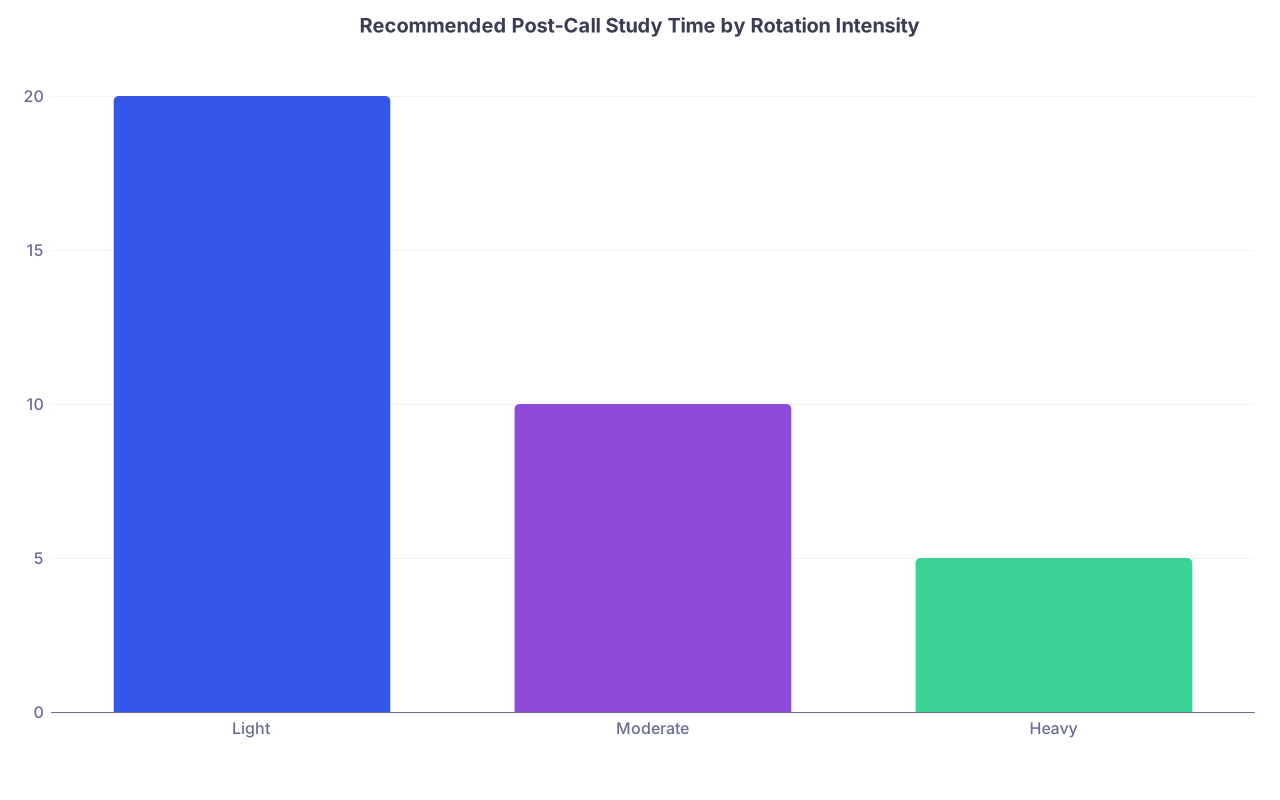
| Category | Value |
|---|---|
| Light | 20 |
| Moderate | 10 |
| Heavy | 5 |
Light rotations (clinic, electives):
- Post-call micro: 15–20 minutes
- Maybe 2 small tasks: 5 questions + 10 cards
Moderate rotations (wards, general ED):
- Post-call micro: 10 minutes (stick to the default routine)
Heavy rotations (ICU, trauma, q3–4 call):
- Post-call micro: 5 minutes or audio-only
- Non-negotiable like brushing teeth, but tiny
Do not use the same expectations for every month. That is how people burn out in January and fail their boards in May.
Step 12: Script Your Self-Talk (Yes, Really)
Tired you is very good at rationalizing:
- “I did a lot of clinical stuff, that counts as studying.”
- “I will double up tomorrow.”
- “One missed day doesn’t matter.”
You need pre-planned counter-scripts.
Two scripts I have seen work:
Script 1: The Minimum Standard
“I am not asking for a full study session. I am asking for 5 questions or 10 cards. Then I am done.”
Script 2: Future You
“Tomorrow me will not magically have free time. But tomorrow me will be happier if I just do the bare minimum now.”
Write one of these on your sticky note or in your habit app description. Sounds silly. Works.
Step 13: Use Simple Metrics to See Real Progress
Residents dramatically underestimate the power of small daily reps. So let’s quantify.
If you do:
- 5 QBank questions post-call
- 2 calls per week
- 48 weeks of residency
That is:
- 5 × 2 × 48 = 480 questions per year
- 960 questions in 2 years
And that is only from post-call micros, not counting any other studying.
Here is roughly what that looks like, visually:
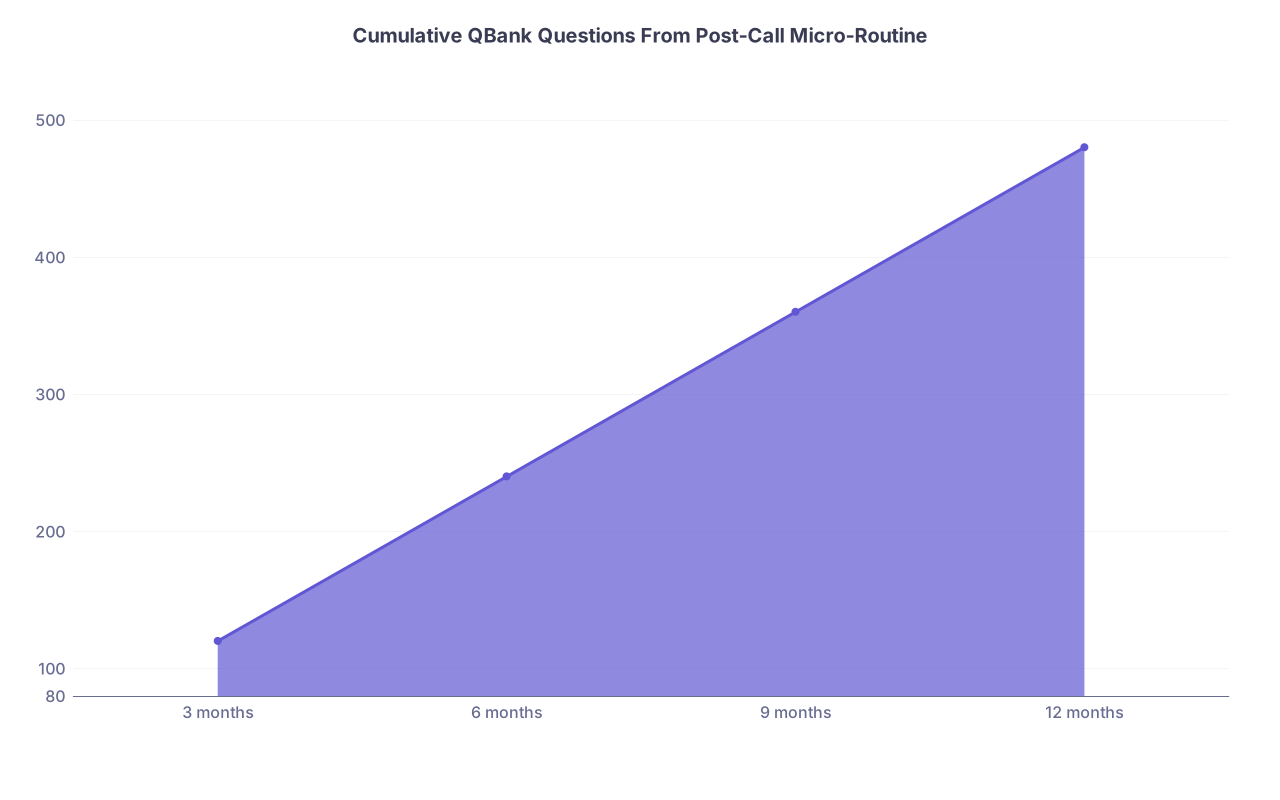
| Category | Value |
|---|---|
| 3 months | 120 |
| 6 months | 240 |
| 9 months | 360 |
| 12 months | 480 |
People do not fail boards because they were 480 questions short. They fail because they stop completely for long stretches. A micro-routine kills those dry spells.
Step 14: Fix Common Failure Patterns (And What To Do Instead)
I have watched people crash the same way over and over. Here are the main failure modes and the fixes.
Failure Pattern 1: “All or nothing” thinking
- “If I cannot do a full hour, why bother?”
Fix: Explicitly define your win as 5–10 minutes. Treat anything more as bonus.
Failure Pattern 2: Randomness
- Every post-call day is a new debate about what to study, where, how.
Fix: Pre-decide one default tool, location, and time window for the entire month.
Failure Pattern 3: Over-ambitious setup
- Lugging textbooks, six different apps, elaborate highlights.
Fix: One device. One app. One micro-task.
Failure Pattern 4: Using micro-routine to procrastinate sleep
- “Just one more block,” turning into 45 minutes, then sleeping less and crashing next day.
Fix: Use timers and hard caps. 10 minutes maximum. No second block allowed on post-call day.
Step 15: Example Micro-Routines You Can Copy-Paste
Here are three ready-to-use post-call systems. Pick one and modify.
Example 1: The “5Q and Go” (for QBank-heavy prep)
- Location: Residents’ workroom desk, same chair
- Default tool: UWorld mixed mode, 5-question preset
- Protocol:
- Bathroom + water
- Sit down, phone on DND
- Run 5-question block (timed)
- Read one explanation carefully (especially if you got it wrong)
- Write down 1 key learning point on a running “Post-Call Pearls” note
- Mark habit complete, leave
Example 2: The “10 Cards in Bed” (for brutal rotations)
- Location: Your bed, after your first 4-hour post-call nap
- Default tool: Anki filtered deck “Post-Call: 10 high-yield cards”
- Protocol:
- Wake up, do not open social media
- Open Anki, run the 10-card deck
- If you cannot sit up, do it lying down with phone brightness low
- Close app immediately afterwards
- Mark habit complete, then either rest or get up
Example 3: The “Commute Audio Drill” (for long drives home)
- Location: Car or bus, driving home post-call
- Default tool: Board review podcast playlist “Post-Call Audio”
- Protocol:
- Start selected 8–10 minute episode before you start driving
- While listening, say out loud (or silently if you prefer) one takeaway every couple of minutes
- Once home, jot down a single key point in your notes app
- That is your study done
Step 16: Make It Adaptive, Not Fragile
Your micro-routine should bend, not break. If one part fails, you pivot rather than quit.
Examples:
- If QBank is down → do 10 flashcards instead.
- If Anki crashes → listen to your “Post-Call Audio” for 5 minutes.
- If you had an absolutely catastrophic call and can barely function → review a single picture or one-page cheatsheet and name 3 facts out loud.
Have a simple backup hierarchy in your head:
- Primary: QBank or flashcards
- Backup: audio
- Emergency: skim a single-page note
- Worst case: mentally rehearse management of a common condition (e.g., sepsis bundle) for 2 minutes in bed
That way “something” always happens, even on terrible days.
Final Takeaways
- Design your post-call study routine for the version of you that is half-asleep and irritable, not for the optimistic version building the calendar.
- Keep the bar brutally low: 5–15 minutes, pre-decided, with one clear binary micro-goal tied to your rotation and exam.
- Protect consistency, not intensity—automation, tiny wins, and a fixed protocol will quietly add up to hundreds of questions and reps by the time your boards arrive.