
A low in‑training exam score is not a judgment on your intelligence. It is an exposure of your system. Or lack of one.
Residents do not fail in‑training exams because they are incapable. They fail because they:
- Study reactively and randomly
- Confuse “being busy” with “training”
- Underestimate how brutal these exams are on unfocused knowledge
You want a turnaround? You need a protocol. Not vibes. Not “I’ll try harder this year.” A clear, stepwise strategy that you can run on autopilot even during 80‑hour weeks.
I am going to walk you through exactly what to do over the next 3–6 months to go from “I hope I do not embarrass myself” to “my score actually reflects how hard I work.”
1. Read Your Score Correctly (Stop Guessing What Went Wrong)
First fix: interpret the score the way your program director does.
Stop obsessing over the raw number. Focus on three things:
- Percentile vs co‑residents and national cohort
- Subscore breakdown by content area
- Trend compared to last year (if applicable)
Most residents never look past the first page. That is like reading only the title of an echo report.
You need to extract the diagnosis from your report.

Do this within 48 hours of getting your score
Get the detailed score report.
Print it. Yes, paper. You are going to mark it up.Highlight your bottom three content areas.
These might look like:- “Cardiovascular” 18th percentile
- “Endocrine” 24th percentile
- “Critical care” 16th percentile
Circle any domain under the 35th percentile.
Those are not “weaknesses.” They are liabilities. If they involve patient‑critical decisions (airway, hemodynamics, OB emergencies, etc.), they become priority one.Note your overall percentile and compare to program norms.
Ask your chief or PD (briefly, like an adult):
“Is there a benchmark percentile where you start to get concerned for board pass rates?”
Most programs have a line. Commonly somewhere around the 30–40th percentile.Check for pattern vs last year (if not PGY‑1).
- Same weak areas two years in a row → systemic gap
- Big drop this year → lifestyle / rotation / burnout effect
- Upward but still low → your method works, just needs scaling and structure
Now put this into a simple table. Keep it in front of your face.
| Content Area | Percentile | Priority Level |
|---|---|---|
| Cardiovascular | 18 | High |
| Endocrine | 24 | High |
| Critical Care | 16 | Very High |
| Infectious Dz | 40 | Medium |
| Renal | 55 | Low |
That page is now your “problem list.” Your entire study plan will revolve around it.
2. Set a Realistic Turnaround Target (Not Fantasy Land)
Vague goals lead to vague studying.
Your target is not “do better next year.” Your target is something like:
- “Move from 22nd to at least 50th percentile next exam.”
- “Eliminate any content area under the 30th percentile.”
- “Be on a passing trajectory for boards based on program benchmarks.”
And you must fit this into reality: call, nights, clinic, family.
Use the “Non‑Negotiable 45–60 Minutes” Rule
You will not magically find 3 free hours a day. Stop pretending you will.
What actually works during residency:
- 45–60 minutes most days on focused, high‑yield work
- Short blocks, done relentlessly
- Embedded into your schedule like pre‑rounds or checking labs
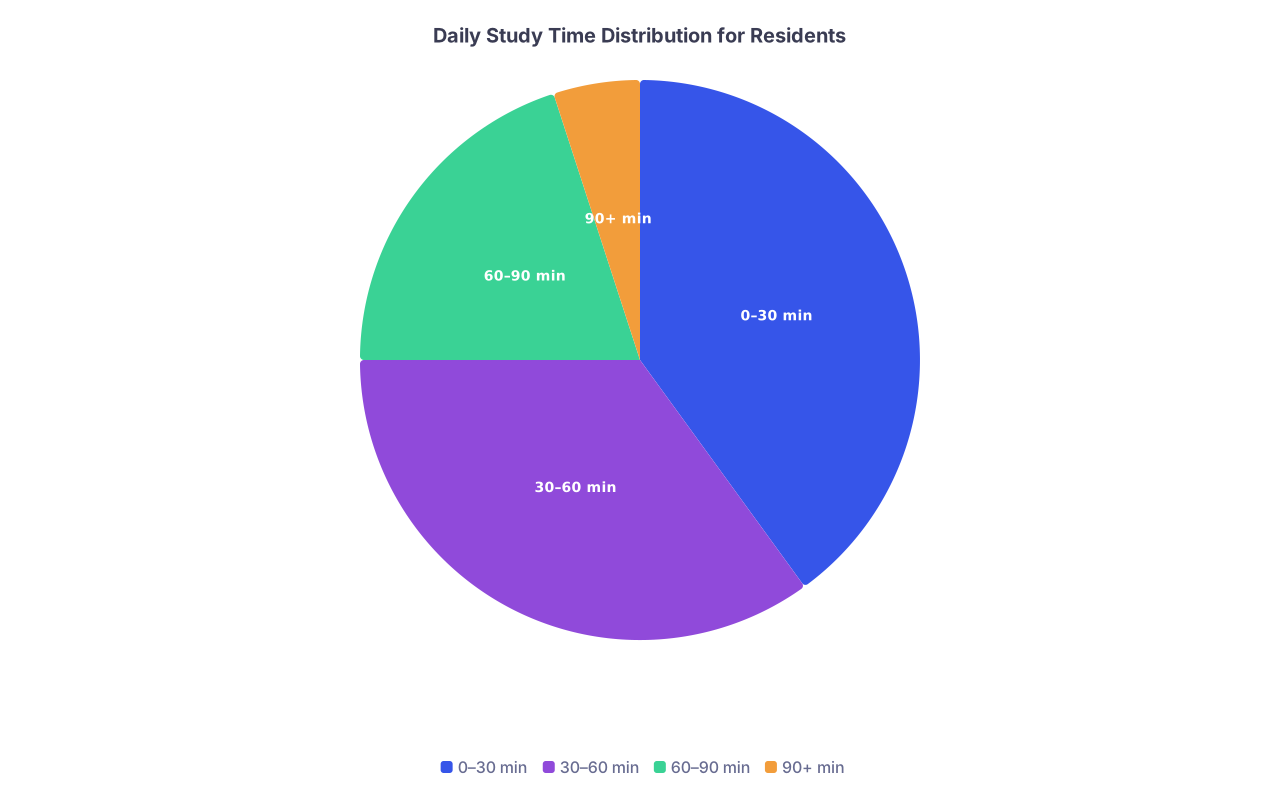
| Category | Value |
|---|---|
| 0–30 min | 40 |
| 30–60 min | 35 |
| 60–90 min | 20 |
| 90+ min | 5 |
You are aiming for the 30–60 min slice, consistently. Miss a day on a brutal call? Fine. Do not miss two.
3. Build a Simple, Ruthless Study System
The problem is not motivation. It is that your system is garbage or nonexistent.
You need three tools. Only three:
- A primary question bank aligned to your specialty (e.g., MKSAP / UWorld / TrueLearn / Rosh).
- A structured resource (text or video) that explains concepts you keep missing.
- A way to capture and review your errors (Anki, simple spreadsheet, notebook – I do not care which, as long as you use it).
Step 1: Question Bank Strategy
Your question bank is not a “when I have time” thing. It is the core of your turnaround.
Protocol:
- Start with your lowest three content areas
Do not grind random questions. That is how you feel “busy” and stay stuck. - Do 10–20 questions per day on workdays, 30–40 on lighter days.
Mixed over your weak domains, or single‑system blocks if the bank allows. - Always tutor mode or timed tutor for now.
You are learning, not just measuring endurance early on.
Your measure of success for the first 4–6 weeks is not “percent correct.” It is:
“Did I learn and record 5–10 things today that I will not forget this time?”
Step 2: Error Log That You Actually Use
Do not skip this. Your errors are your curriculum.
You can use Anki, Notion, Excel, a legal pad. Here is a simple structure that works:
- One line or card per learning point
- Focus on concept not exact question stem
- Include:
- Topic (e.g., “AFib anticoagulation – CHADS‑VASc nuance”)
- What you thought
- Why it was wrong
- The rule / algorithm / association you must remember
Example entry:
- Topic: septic shock – vasopressor sequence
- My wrong idea: started dopamine after fluids
- Correct: norepinephrine first line; dopamine has worse outcomes, more arrhythmias
- Rule: septic shock = NE first; add vasopressin if refractory
If you want structure, do it like this:
| Date | Topic | My Wrong Thinking | Correct Concept | Tag |
|---|---|---|---|---|
| 2026-01-05 | Septic shock pressor | Dopamine as first agent | Norepinephrine first line | Critical |
| 2026-01-06 | DKA management | Bicarb early in treatment | Reserve bicarb for specific cases | Endocrine |
| 2026-01-06 | PE workup | D‑dimer in high-risk pt | Go straight to imaging in high risk | Vascular |
Review this log briefly 2–3 times per week. That is how you raise your floor.
Step 3: One Anchor Resource, Not Ten
Pick one main explanation resource per weak domain.
Examples (not sponsored, just what residents actually use):
- Internal Medicine: MKSAP text, UWorld explanations, OnlineMedEd videos
- General Surgery: SCORE, TrueLearn + selected textbook chapters
- EM: Rosh Review explanations, EM:RAP, CorePendium
- Pediatrics: PREP explanations, Nelson/Pediatrics Board Review
- Anesthesia: TrueLearn, Hall, Baby Miller sections
Whichever you choose, commit.
Protocol:
- For each topic you miss twice, or that feels chronically foggy:
- Read or watch one concise section from your chosen resource
- Add 1–2 key points to your error log or Anki
- Move on
No hour‑long deep dives unless it is a top‑3 high‑risk weakness.
4. Turn the Next 12 Weeks into a Structured “Mini‑Board Season”
You cannot cram this during the last month. You are a resident, not a college student with winter break.
Build a 12‑week block and treat it like a training cycle.
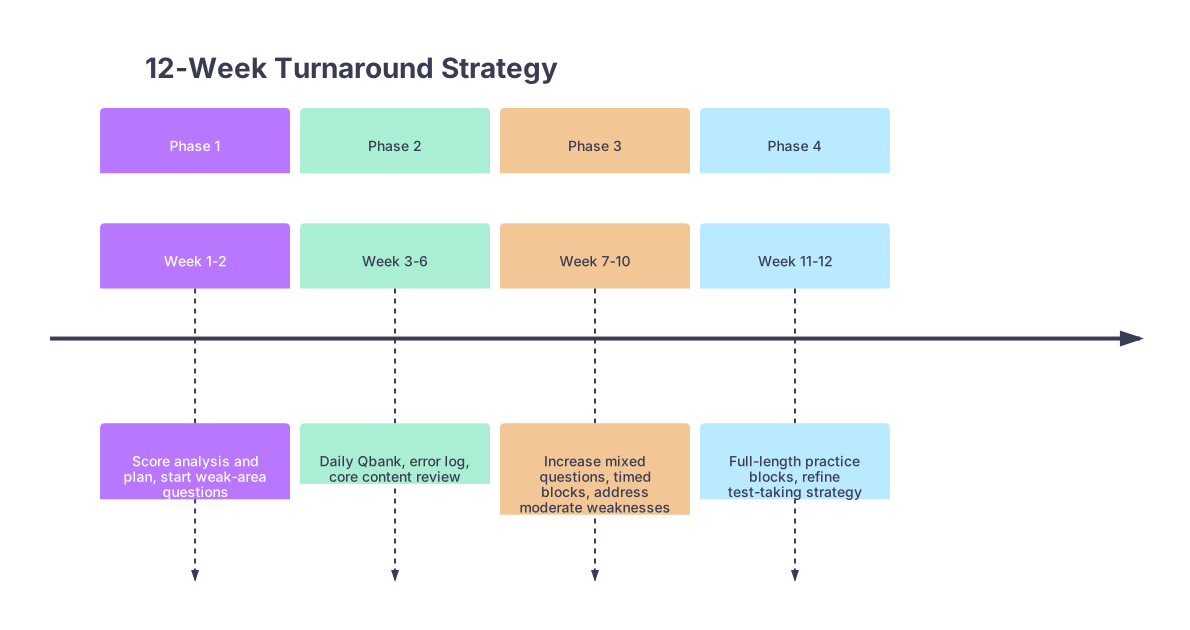
| Period | Event |
|---|---|
| Phase 1 - Week 1-2 | Score analysis and plan, start weak-area questions |
| Phase 2 - Week 3-6 | Daily Qbank, error log, core content review |
| Phase 3 - Week 7-10 | Increase mixed questions, timed blocks, address moderate weaknesses |
| Phase 4 - Week 11-12 | Full-length practice blocks, refine test-taking strategy |
Phase 1 (Weeks 1–2): Stabilize and Aim
Objectives:
- Understand your deficits
- Set daily minimums
- Build the system (Qbank + error log + schedule)
Daily / near‑daily tasks:
- 10–15 questions only from your worst 1–2 domains
- 10–15 minutes cleaning up your error log
- Skim relevant sections of your anchor resource on 1–2 missed topics per day
By the end of Week 2 you should have:
- A living list of your worst topics
100 questions done in weak areas
- 30–50 concrete learning points in your error log
Phase 2 (Weeks 3–6): Heavy Weak‑Area Focus
Objectives:
- Rapidly pull up your worst domains to at least “not terrifying”
- Convert frequently seen topics into near‑automatic wins
Daily minimum:
- Workdays: 15–25 questions
- Lighter days: 30–40 questions
Mix:
- 60–70% questions from your bottom three domains
- 30–40% mixed or from next tier of weaknesses
You should see:
- Your percent‑correct in these areas creeping up
- Less “I have no idea” and more “I narrowed to two and picked wrong”
That latter shift is important. Content problem vs test‑taking problem require different fixes (we will hit that soon).
Phase 3 (Weeks 7–10): Shift to Exam‑Like Conditions
Now that you are less catastrophically weak in specific topics, you train the exam itself.
New elements:
- 1–2 days per week of timed, mixed blocks (20–40 questions)
- Strict time limit (about 1–1.3 minutes per question, depending on your exam)
- Post‑block:
- Tag each miss as:
- Knowledge gap
- Misread question / detail error
- Reasoning / pattern‑recognition issue
- Fatigue / rushing
- Tag each miss as:
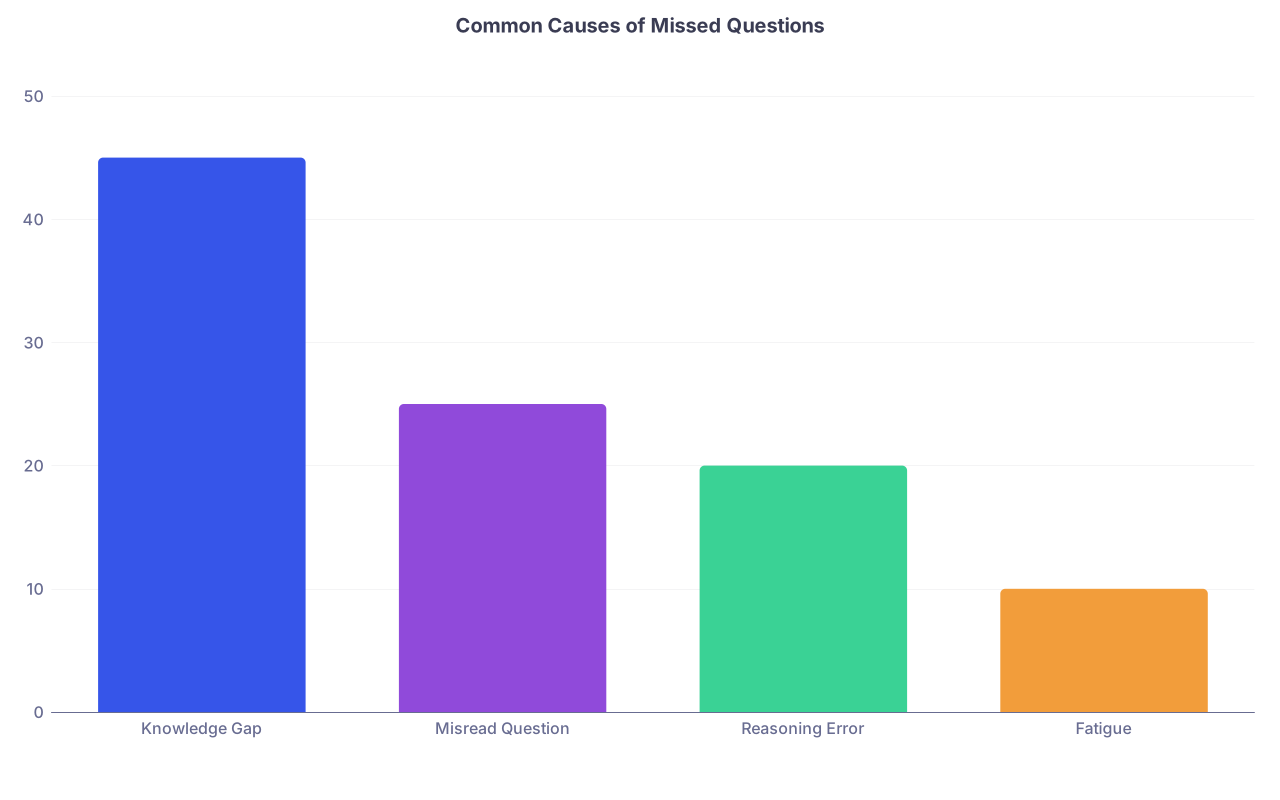
| Category | Value |
|---|---|
| Knowledge Gap | 45 |
| Misread Question | 25 |
| Reasoning Error | 20 |
| Fatigue | 10 |
If “Misread” and “Fatigue” are a big chunk, you fix behaviors. Not by reading another chapter.
Phase 4 (Weeks 11–12): Dress Rehearsal and Polishing
Goals:
- Improve stamina and consistency
- Sharpen guessing strategy and triage skills
Do:
- 2–3 longer timed blocks per week (40–60 questions)
- Strict exam conditions:
- No phone
- No pausing
- Short scheduled breaks only
After each block:
- Write down:
- 3 types of questions you handled well
- 3 situations where you wasted time or panicked
- Choose 1 behavioral rule for the next block (e.g., “if I cannot pick between two by 60 seconds, I choose and mark it – do not sit there for 3 minutes”).
5. Fix Your Test‑Taking Mechanics (They Matter More Than You Think)
Some of you know enough. You just leak points with sloppy execution.
Here are the big mechanical errors I see over and over:
- Reading the stem 3 times before even looking at the answers
- Trying to fully diagnose complex patients instead of answering the actual question asked
- Not using the clock as guardrails
- Changing answers from right to wrong in the last minute flail
You need a simple, repeatable question process.
A 5‑Step Question Protocol
Run this on every question during practice for 2–3 weeks. It will feel slow. It will make you faster and more accurate long term.
Read the last line first.
“What are they asking me?” Treatment? Next test? Most likely diagnosis? Initial step?Skim the stem for high‑yield signals.
Age, chronic conditions, vitals, key lab abnormalities, big red‑flag phrases (“pleuritic chest pain,” “pulsus paradoxus,” etc.).Form a quick hypothesis before looking at choices.
Even if it is rough: “sounds like PE,” “probably septic shock,” “maybe DKA.”Scan answers top to bottom once.
- If your hypothesis answer is there and you are ≥80% sure → pick it, move on.
- If not, systematically eliminate clearly wrong options.
Cap yourself at ~75–90 seconds for hard questions.
If still stuck:- Eliminate 2 choices
- Choose best of remaining
- Mark it only if you have a clear reason you might find later
Practicing this is how you avoid the “I ran out of time and guessed on the last 15 questions” disaster.
6. Integrate Studying Into Real Life, Not Fantasy Life
Pretending you will study for 3 hours after a 28‑hour call is delusional. Design for reality.

| Step | Description |
|---|---|
| Step 1 | Wake up |
| Step 2 | Commute |
| Step 3 | 10-15 questions on phone |
| Step 4 | 20-30 questions pre or post work |
| Step 5 | Quick review of errors |
| Step 6 | Short content review bed time |
| Step 7 | On call day? |
Where to Put the 45–60 Minutes
Common patterns that actually work:
Pre‑rounds slot (20–30 minutes):
Wake up 30 minutes earlier. 10–15 questions with coffee. No phone, no email.Post‑work decompression (15–20 minutes):
Before you open Netflix or doomscroll. Quick block + review 3–5 key points.Commute (audio / flashcards):
- Listen to short board review audio
- Run through Anki on the train (not while driving, obviously)
On brutal call stretches:
- Drop to micro‑sessions:
- 5 questions while eating
- 5 questions before sleep
- Review 5 cards from your error log
The goal is not perfection. The goal is that your average week contains 5–6 contact days with the material, even in chaos.
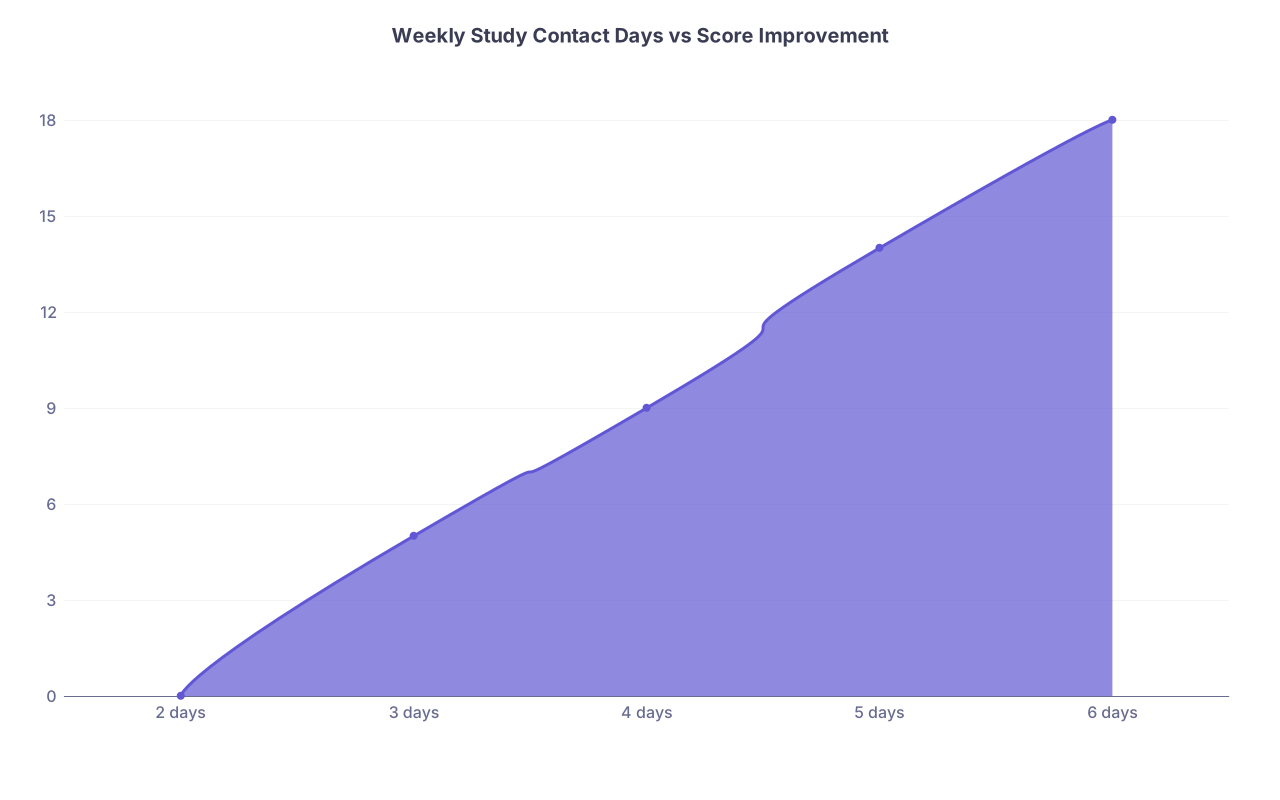
| Category | Value |
|---|---|
| 2 days | 0 |
| 3 days | 5 |
| 4 days | 9 |
| 5 days | 14 |
| 6 days | 18 |
The jump from 2–3 days to 5–6 days of contact is where scores start to move.
7. Use Your Program (Without Making It Their Problem)
Low scores make residents avoid their PD. That is backwards.
You do not need a handout and a pep talk. You need specific support:
Have a 15‑Minute, Grown‑Up Conversation
Script it if you have to. Something like:
“My in‑training exam was in the 22nd percentile, with major weaknesses in cardio, endocrine, and critical care. I have started a daily question regimen and an error log, and I am focusing 12 weeks on these areas. Are there resources the program recommends, and could we briefly review if this plan looks reasonable?”
You will not sound weak. You will sound like someone they do not have to worry about.
Ask directly:
- “Is there a specific percentile that predicts trouble on the boards in this program?”
- “Are there past residents who improved significantly? What did they do differently?”
- “Any faculty particularly strong in my weak areas who might let me run cases by them once a month?”
Then follow through. If they connect you with a mentor and you ghost them, that is on you.
8. Watch for the Non‑Academic Landmines
Sometimes the low score is not about knowledge or strategy. It is about your life quietly falling apart around you.
Red flags I have seen tied to score drops:
- Rotations with chronic 80+ hour weeks and no post‑call protection
- New childcare responsibilities or elder care
- Sleep wrecked by nights + poor recovery habits
- Burnout sliding into depression or anxiety
If, looking at the last 6 months, your first thought is “no wonder I bombed that test,” then your plan must include life adjustments.
- Cap extra shifts if you have any choice
- Fix sleep hygiene aggressively (dark room, no phone in bed, stable wake time on off days)
- Use your institution’s confidential mental health resources if mood, anxiety, or focus are obviously off
You do not “push through” major depression or untreated ADHD by buying another question bank. That is fantasy.
9. How to Know Your Turnaround Is Working
You cannot wait for next year’s exam to see if your plan is garbage.
You need early markers.
Watch these:
-
- Do not obsess over each day. Look at 2–4 week windows.
- If your percentage in targeted weak areas climbs by 10–15 points over 2–3 months, the content work is landing.
Error log patterns:
- Fewer brand‑new “I have never seen this before” issues
- More “I knew this once but forgot details” → memory problem, fixable with spaced review.
Block consistency:
- Standard deviation of your block scores shrinks.
- Less “70% one day, 45% the next.” You want steady, boring 60–70%+ during prep depending on exam norms.
Practice or prior exam simulations (if available):
- Some specialties/programs offer mid‑year assessments. Treat them as data.
- If that score is flat or worse despite 8+ weeks of honest effort, your plan needs overhaul or there is a bigger issue (burnout, sleep, underlying learning difference).
10. Dealing With the Psychological Garbage (Shame, Comparison, Imposter Syndrome)
Low scores carry shame. Residents talk.
You will hear:
- “I barely studied and got 90th percentile.”
- “These exams are stupid, I do fine clinically.”
Ignore this noise. A few points:
- Many people who claim they “barely studied” are lying or forgetting
- Board scores correlate with these exams more than your ego wants to admit
- Being good clinically and being board‑ready are related but not identical skill sets
If you are stuck in shame, do this simple reframing exercise:
Write down:
- One concrete thing you did badly (e.g., “random, last‑minute studying”)
- One concrete thing you did well (e.g., “I showed up and took the exam despite being terrified”)
- Three concrete changes you are implementing (specific, not “try harder”)
Clamp your attention to the third list. That is your identity now.
11. What This Looks Like Day‑to‑Day
Let me put it all together in a sample week for a PGY‑2 with a low score working a busy ward month.
Monday–Friday
- 05:30–06:00 – Wake, coffee, 10–15 Qbank questions (weak domains)
- 18:30–18:45 – After getting home, quick shower and food
- 18:45–19:05 – Review explanations from morning block, add 3–5 items to error log
- 22:00–22:10 – In bed, flip through 10–15 error‑log cards or review a short chapter section
Saturday (post‑call, light)
- 30–40 question mixed block, timed
- 30–45 minutes reviewing missed questions and noting patterns
Sunday
- 20–25 questions (weaker domains)
- 30–45 minutes going through error log and one key content chapter/video in your worst subject
Rinse and repeat for 8–12 weeks. It is not glamorous. It works.
Key Takeaways
- A low in‑training score is a systems problem, not a personal verdict. Diagnose it using your subscores and trend, then target your worst domains first.
- Your turnaround hinges on consistent, structured work: daily questions, a real error log, one anchor resource, and progressive practice under exam‑like conditions.
- Design your plan for the life you actually live as a resident—short, relentless study blocks, early markers of progress, and honest adjustment when sleep, burnout, or life circumstances are the real obstacles.