You walk out of the testing center or finish an in‑service exam, pull up the score report… and your stomach drops.
Email from your program director: “Let’s meet to discuss your performance and next steps.”
This is where plenty of residents panic, shut down, or go into defensive mode. Do that, and you make your life harder.
Handle this correctly, and you can turn a bad exam into a structured, attending-supported plan that actually makes you better and protects your standing in the program.
Let me walk you through how to do the second one.
Step 1: Stabilize and Get the Facts Straight
Before you involve anyone else, you need a clear, unemotional picture of what actually happened.
1.1 Do a 30–60 Minute Decompression — Then Get Objective
You are not making good decisions in the first 15 minutes after seeing a bad score.
Do this:
- Give yourself 30–60 minutes. Walk. Eat something. Vent to one trusted friend or co-resident if you need.
- Then sit down with the score report and answer four concrete questions on paper:
- What was the exam? (In‑training, rotation shelf, Step/Level, board, etc.)
- What was your score and percentile?
- What are the explicit consequences? (Semi-annual eval risk, probation risk, promotion risk, board eligibility.)
- How did your performance compare to:
- Your prior exams?
- Class or national average (if given)?
You are building a “case file” on yourself. No drama, just data.
1.2 Dissect the Score Report
Do not just stare at the overall number. You need section-level failure points.
Grab highlighters or open a simple notes document and categorize:
- Systems or content areas:
- Cardiology, GI, OB, peds, psych, etc.
- Task types:
- Diagnosis, management, next step, interpretation of tests, ethics, statistics.
- Exam behavior:
- Time management: Did you rush the last block? Leave questions blank?
- Guessing patterns: Changing answers often? Running out of time every block?
Make a rough table for yourself:
| Domain | Performance | Notes |
|---|---|---|
| Cardiology | 25th percentile | Slow on guideline questions |
| Infectious Disease | 15th percentile | Missed management questions |
| OB/GYN | 60th percentile | Adequate |
| Time Management | Weak | Last 8–10 Qs rushed each block |
| Test Anxiety | Moderate | Palpitations, racing thoughts |
You will use this later with your attending. This is the backbone of your remediation plan.
Step 2: Decide What You Need From Your Attending
Before you email anyone, be clear on what kind of help you are asking for. “I did badly, help” is not a plan. It is a burden.
You want to walk in sounding like a junior colleague, not a student asking for rescue.
There are usually four buckets of support:
- Content and pattern diagnosis
- You want an attending to tell you: “You consistently miss X type of question; here is how to fix that.”
- Resource curation
- There are 9000 question banks and board resources. You need focused picks, not noise.
- Structured accountability
- Someone who agrees to review progress every 2–4 weeks and sign off on a formal remediation plan.
- Program navigation
- How this affects promotion, board eligibility, semi-annual Milestones, or any formal remediation policies.
Write down what you want in one sentence before you draft an email:
“I’d like your help designing a 10–12 week remediation plan focusing on ID and cardiology content gaps, plus test-taking strategy, with brief check‑ins every 3–4 weeks.”
Now you have a clear ask.
Step 3: Approach the Right Attending the Right Way
3.1 Who Should You Involve?
There are three usual players:
- Program director (PD) / associate PD
- Required if the exam is an official in‑training exam, Step failure, or board failure.
- Faculty mentor or advisor
- Best for ongoing coaching and less formal structure.
- Content-strong attending in your weak area
- Example: ID attending if your ID subscore tanked.
If your PD has already emailed you, you are not choosing whether to involve them. You are choosing whether you show up prepared or not.
3.2 First Contact: Email Script You Can Actually Use
Do not write a novel. Do not be vague.
Here is a template that works:
Subject: Request to develop remediation plan after [Exam Name]
Dear Dr. [Name],
I received my [exam name] score and fell below where I need to be to feel confident about board passage and promotion. I have reviewed my score report and identified weaknesses in [e.g., cardiology, ID, time management].
I would like to meet with you to create a structured, attending-supported remediation plan over the next [X] weeks. My goals are:
– Address the specific content gaps identified on the report
– Improve test-taking strategy and timing
– Track progress with a few objective checkpointsAre you available for a 30‑minute meeting in the next 1–2 weeks? I will bring a brief summary of my score breakdown and a draft of a potential study schedule so we can refine it together.
Thank you for your time and guidance,
[Your name], PGY‑[X]
That email tells your attending: you already started problem-solving. You are not waiting for rescue.
Step 4: Walk Into the Meeting With a Draft Plan (Not Empty Hands)
You are going to co‑create the plan with the attending. But you should not walk in blank.
Bring three things printed or easily shareable:
- Score breakdown with your annotations
- Short written self-assessment (1 page max)
- Rough 8–12 week draft plan
4.1 Your One-Page Self-Assessment
Hit these points. Bullet style is fine.
- What went wrong:
- “I underperformed mainly in ID (15th %ile) and cardiology (25th %ile).”
- “I consistently missed management questions even when diagnosis was correct.”
- Contributing factors (no excuses, just reality):
- Rotation schedule (e.g., heavy nights right before exam).
- Study pattern (e.g., sporadic question practice, minimal review of missed questions).
- Test behavior (e.g., rushing last 10 questions).
- What you think you need:
- “A structured question-based plan.”
- “Dedicated 60–90 minutes per day for 10–12 weeks.”
- “Coaching on management algorithms in ID and cardiology.”
This shows insight. PDs and attendings care almost as much about insight as they do about the score itself.
4.2 Framework for a Draft 8–12 Week Plan
You do not have to reinvent the wheel. Most solid remediation plans share the same skeleton:
- Duration: 8–12 weeks
- Daily time: 1–2 focused hours on most days
- Components:
- Question bank work with active review
- Targeted content review in weak areas
- Periodic assessment exams (NBME-style or in‑training style)
- Timed practice blocks to fix pacing
Here is a simple time allocation snapshot:
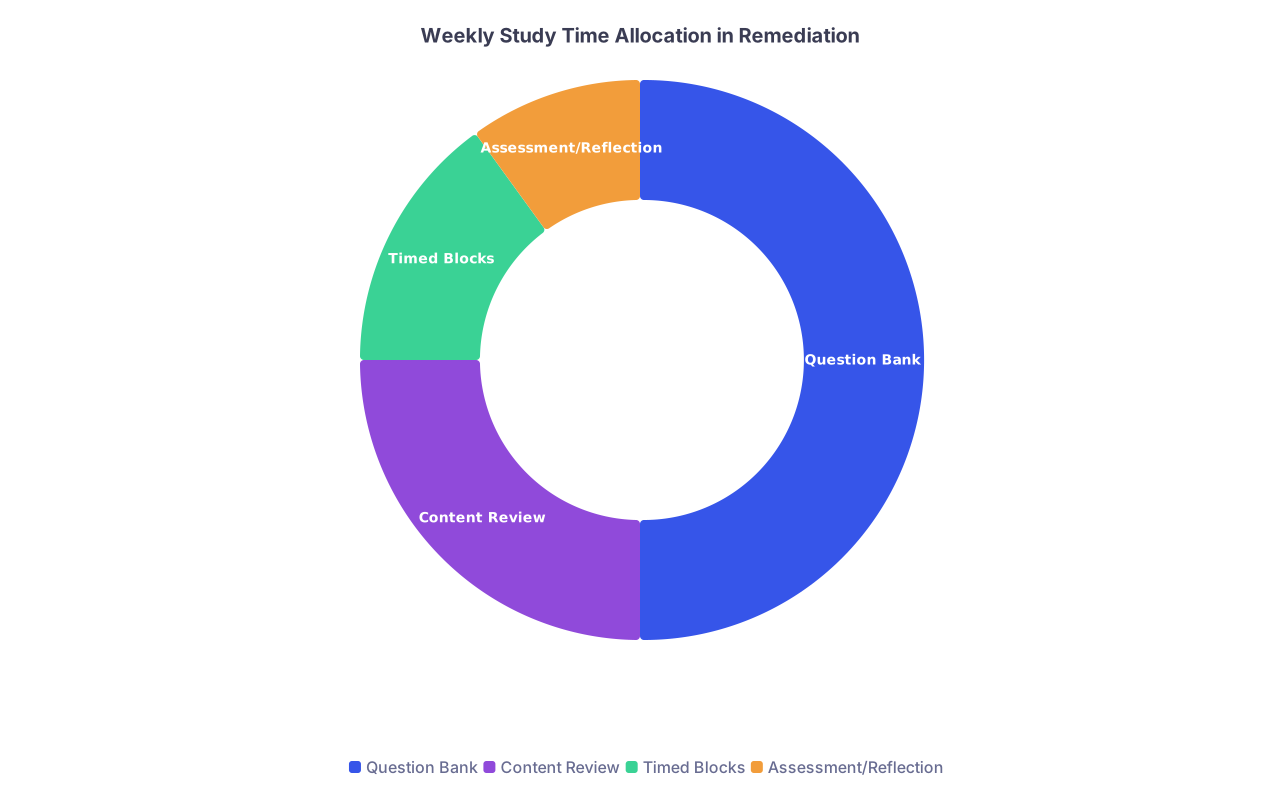
| Category | Value |
|---|---|
| Question Bank | 50 |
| Content Review | 25 |
| Timed Blocks | 15 |
| Assessment/Reflection | 10 |
You will refine these numbers with your attending, but they give you something to start from.
Step 5: Co‑Create a Concrete, Written Remediation Plan
This is where you and the attending turn raw ideas into a plan that can be tracked, supported, and—if needed—shown to the Clinical Competency Committee (CCC).
5.1 Define the Target
Start by writing down the goal. Literally, a sentence at the top:
- “Goal: Improve in‑training exam score from 28th to at least 50th percentile and demonstrate readiness for boards.”
- “Goal: Pass Step 3 on next attempt with a margin of safety.”
If your program uses specific cutoffs or is worried about ACGME Milestones, your PD will tell you the numbers that matter.
5.2 Build the Plan in Four Columns
Create a simple table structure during the meeting and fill it together:
| Component | Specifics | Frequency / Timeline | Attending Role |
|---|---|---|---|
| Question Bank | 30–40 questions/day, mixed, timed | 5 days/week for 10 weeks | Review performance every 3 weeks |
| Weak Content | ID + Cardiology review (guidelines, notes) | 3 focused hours/week | Suggest key articles/guidelines |
| Timed Blocks | 2 blocks of 40 questions under test timing | Every other week | Debrief one block monthly |
| Assessments | 1 practice exam (NBME or equivalent) | At week 4 and week 9 | Help interpret results |
Get as specific as possible:
- Which qbank?
- How many questions per day?
- Which specific texts or resources?
- Exact dates for practice exams.
5.3 Assign Checkpoints and Meetings
Do not leave it at “we will see.” That is how remediation plans die.
Agree on:
- Check‑in schedule:
- Example: short 20‑minute check‑ins at weeks 3, 6, 9.
- What you must bring:
- Progress log (questions done, scores, topics).
- List of persistent weak areas.
- Any concerning trends (e.g., still running out of time).
Create a quick timeline together:
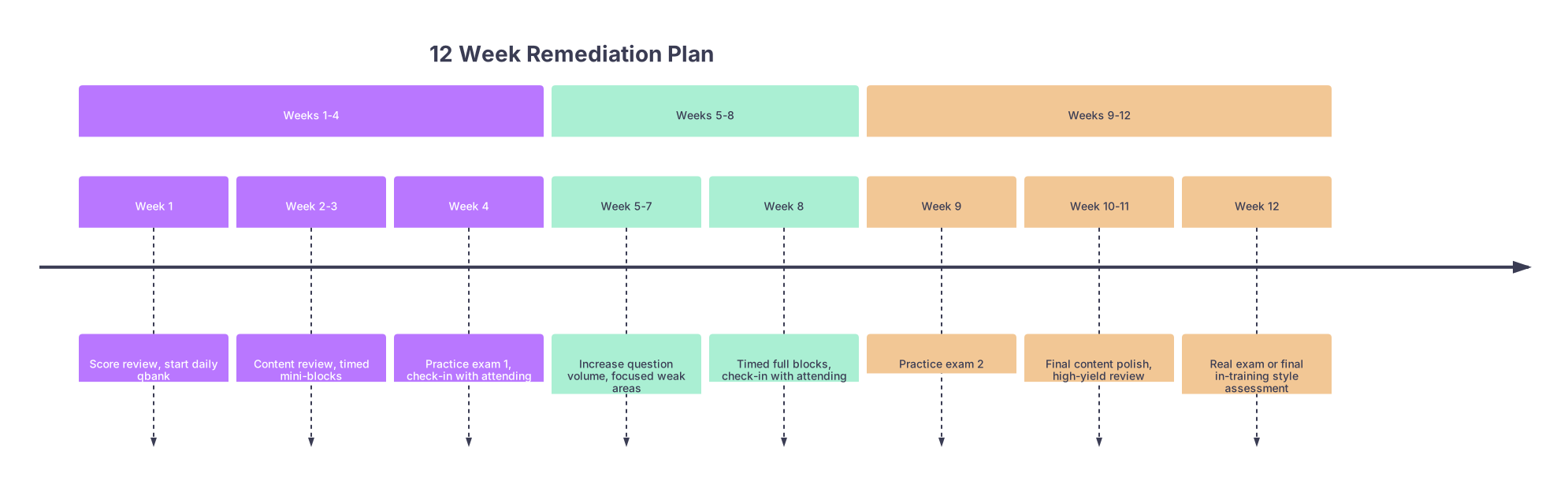
| Period | Event |
|---|---|
| Weeks 1-4 - Week 1 | Score review, start daily qbank |
| Weeks 1-4 - Week 2-3 | Content review, timed mini-blocks |
| Weeks 1-4 - Week 4 | Practice exam 1, check-in with attending |
| Weeks 5-8 - Week 5-7 | Increase question volume, focused weak areas |
| Weeks 5-8 - Week 8 | Timed full blocks, check-in with attending |
| Weeks 9-12 - Week 9 | Practice exam 2 |
| Weeks 9-12 - Week 10-11 | Final content polish, high-yield review |
| Weeks 9-12 - Week 12 | Real exam or final in-training style assessment |
Give the attending permission to hold you accountable:
“If by week 4 my performance is not improving on practice questions, I would like us to adjust the plan.”
Step 6: Lock In Your Daily and Weekly Protocol
Now you have a plan on paper. Next step: make it survivable on a resident schedule.
6.1 Build a Minimum Viable Daily Routine
You are on call. You are post‑call. You are on nights. Waiting for the “perfect” day is how you fail again.
You need a floor, not just an ideal.
Example structure (adjust numbers to your life):
On reasonable days (no call, not post‑call):
- 60–75 minutes: Question bank (timed, mixed)
- 20–30 minutes: Review and annotate missed questions
- 20–30 minutes: Targeted content (guidelines, notes in weak area)
On brutal days (call, post‑call, chaos):
- 15–20 minutes: Review 5–10 previously missed questions or flashcards
- 10–15 minutes: Quick read of a high-yield summary on your weakest topic
The rule:
No zeros. Some days will be ugly. But you keep the connection to the material.
6.2 Weekly Structure
Each week, you should have:
- One designated “long study block” (2–3 hours if possible, day off or lighter day)
- One timed practice block (20–40 questions under exam conditions)
- One 10–15 minute reflection session:
- What improved this week?
- What is still trash?
- What do I change next week?
If you like visuals, map your week roughly like this:
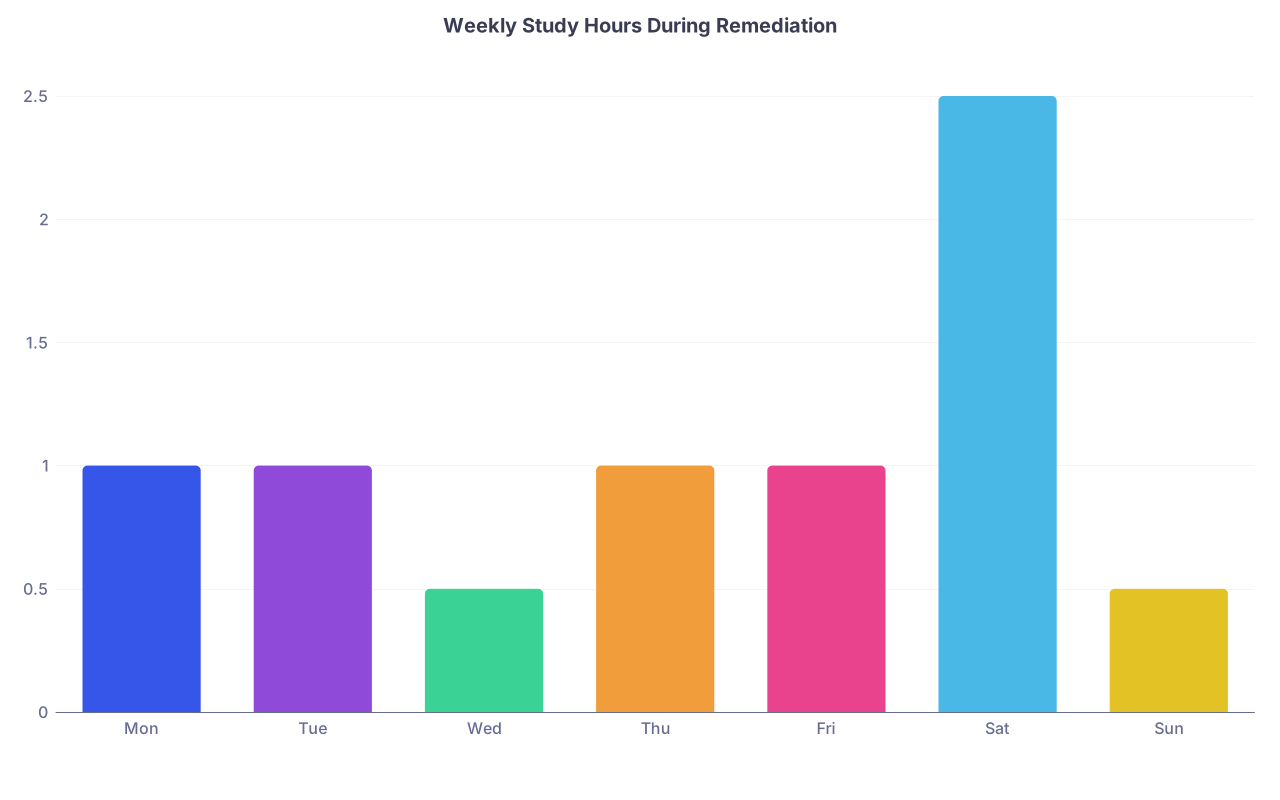
| Category | Value |
|---|---|
| Mon | 1 |
| Tue | 1 |
| Wed | 0.5 |
| Thu | 1 |
| Fri | 1 |
| Sat | 2.5 |
| Sun | 0.5 |
Not perfect. But consistent.
Step 7: Use Your Attending Strategically (Not Just for Moral Support)
Your attending’s time is limited. You get more from them if you bring the right problems to the table.
7.1 What to Bring to Each Check‑In
For each follow‑up meeting, have:
Data snapshot:
- Questions completed (e.g., “720 questions over 4 weeks”).
- Running average score on qbank (trend matters more than absolute).
- Scores on any practice exams.
Pattern summary (bulleted):
- Example: “Still missing management questions when there are multiple ‘acceptable’ options.”
- “ID questions improve, cardiology still weak. ECGs particularly rough.”
Specific cases:
- 3–5 questions or scenarios you got wrong that you want to dissect.
“Here’s where my reasoning broke; how would you think through this?”
- 3–5 questions or scenarios you got wrong that you want to dissect.
Your attending can then do the part only they can do: teach you how an experienced clinician reads and answers that question type.
7.2 Ask for Concrete Feedback and Adjustments
Do not end a meeting with, “Okay, sounds good.” Force some specificity.
Examples of good questions:
- “Given this progress, would you change my study volume or keep it the same?”
- “Do you think I am ready to schedule the real exam in week 10, or should I push to week 12?”
- “What high-yield areas do you still see as gaps based on these questions?”
If you need program help (schedule adjustment, lighter rotation before the real exam), ask the attending or PD directly:
“If my next practice exam shows I am still borderline, would the program support adjusting my schedule before I retake the board for 2 weeks of lighter duty?”
You are not weak for asking this. You are doing risk management—for yourself and your program.
Step 8: Protect Yourself Professionally While You Improve
A bad exam has emotional, academic, and sometimes political consequences. You need to manage all three.
8.1 Document Everything
Keep a simple log of:
- Meeting dates with attendings/PD
- Agreed‑upon plan elements
- Progress markers (practice exam scores, qbank numbers)
This is not about future conflict. It is about showing the CCC and PDs that you responded like a professional. If later anyone questions your effort, you have proof.
8.2 Communicate With the Right People, Not Everyone
People who should know:
- PD / Associate PD
- Official mentor / faculty advisor
- Possibly chief residents if they help with scheduling or support
People who do not need details:
- Random co-residents.
- Gossip hubs in your program.
If asked, keep it simple:
“Score was lower than I wanted. I am on a structured remediation plan with Dr. X and Dr. Y and working through it.”
That is it. You are not obligated to give your medical history to half the hospital.
8.3 Mind Your Clinical Performance
A remediation plan is useless if your clinical work declines.
Common mistake: doubling study time, tanking on the wards, now you have two problems.
Non‑negotiables:
- Show up on time.
- Be prepared on your patients.
- Read on your cases, not just boards.
- Do not visibly study on shift.
Programs tolerate board remediation. They do not tolerate residents who look like they gave up on patient care.
Step 9: Final Preparation and Decision Point
As you approach the next big exam (re-take, next in‑training, or boards), you and your attending should make a clear go/no‑go decision.
9.1 Use Multiple Data Points
Do not rely on “I feel better.” Feelings are unreliable. Use:
- Performance on:
- 2–3 recent practice exams (ideally at or above your target).
- Last 500–800 qbank questions.
- Trend analysis:
- Is your trajectory up, flat, or erratic?
If your practice results are consistently below safe passing range, delaying or adjusting the date is smarter than gambling.
9.2 Simulate the Real Thing
At least once, do:
- Full length or near-full length exam day:
- Multiple blocks back‑to‑back.
- Realistic breaks.
- Same time of day as real exam if possible.
Then review with your attending:
- Did timing hold up?
- Did fatigue crush your last block?
- Are content gaps closing or simply moving?
You want no surprises on test day except the questions themselves.
Step 10: After the Next Score Comes Back
Let us fast‑forward: you took the next exam.
Three scenarios.
10.1 You Improved and Cleared the Bar
Good. You are not done, but the emergency is over.
Debrief briefly with your attending:
- What worked in the plan?
- What habits do you keep long term? (Weekly questions, guideline reading, etc.)
Then document success in a short email for your records:
“As discussed, my [exam] score improved from [X] to [Y]. I will continue with [A, B, C] strategies going forward.”
10.2 You Improved but Still Borderline
Now you and the attending adjust:
- Double down on the highest-yield changes that helped.
- Potentially bring in:
- Another expert attending.
- Institutional resources: learning specialists, counseling for anxiety, formal remediation program.
You are not starting from zero. You are iterating.
10.3 You Did Not Improve Or Got Worse
Hard moment. I have seen residents in this spot. Some recovered. Some did not.
You need brutally honest conversations about:
- Whether there are unaddressed issues:
- Untreated ADHD, depression, anxiety.
- Burnout, sleep, or home crisis.
- Whether the specialty fit is correct.
- Whether a formal, documented remediation or extension year is on the table.
Your attending-supported plan now becomes a program-level remediation plan. Different scale, same principles: clear goals, time frame, resources, and accountability.
FAQs
1. Should I tell my program director immediately after a bad board exam or wait for the official report?
If you clearly failed (e.g., NBME screen shows “Fail”), tell your PD early. Programs hate surprises, especially with high-stakes exams tied to board eligibility. A short email—“I did not pass; I would like to set up a meeting to plan remediation”—signals maturity and gives them time to help you. If your score is just lower than expected but still passing, bring it up at your next scheduled evaluation or sooner if you think it risks promotion.
2. How many hours per week should a resident realistically devote to remediation?
For meaningful improvement, I recommend 7–12 focused hours per week for 8–12 weeks. That usually looks like 60–90 minutes on most weekdays plus a 2–3 hour session on a lighter day. Less than ~5 hours per week rarely moves the needle for a major gap. More than ~15 hours per week on a full clinical load tends to burn people out and damage their clinical work.
3. What if my attending or PD seems dismissive and just says “do more questions”?
Push—politely—for specificity. You can respond with: “I agree more questions will help. Could we identify which domains I should prioritize and how many questions per day are realistic with my schedule? I would also appreciate a follow‑up date to review my progress.” If they still give you nothing, recruit another mentor: a different attending, chief resident, or faculty advisor who actually cares about education. Do not let one disengaged person sink your board chances.
4. How do I handle the shame and anxiety after failing an exam in residency?
You treat it like any other complication. Name it. Analyze it. Build a plan. Most programs have residents every few years who fail an exam—your situation is not unique, even if it feels that way. Limit who you tell to people who help, not people who gossip. If your anxiety is so high that you cannot study or sleep, loop in mental health support (counseling, PCP, or psychiatrist). You cannot remediate effectively if your brain is in constant alarm mode.
Key points to remember:
- Walk into your attending’s office with data, self-awareness, and a draft plan—not just a bad score.
- Co‑create a specific, time‑bound remediation plan with clear checkpoints and documented support.
- Protect your clinical performance and mental health while you grind through remediation; surviving the plan matters as much as passing the next exam.