
The way chiefs spot who’s going to fail boards is not magic. It’s pattern recognition. And you’re giving off more signals than you think.
I’ve sat in those late-night meetings with chiefs, PDs, and faculty where names get quietly circled. Not for remediation yet. Just for “watch this one.” By the time a resident actually fails a board exam, almost nobody in leadership is surprised. The surprise is usually only for the resident.
Let me walk you through how they really identify residents at risk of failing boards—months (sometimes years) before anyone says the words out loud to you.
The First Filter: Your History Follows You
Programs don’t forget your test history. They build you a mental “risk profile” before you ever step on the wards as an intern.
| Signal Type | What Chiefs Actually Notice |
|---|---|
| USMLE/COMLEX | Marginal passes, big score drops |
| In-training exams | Repeated bottom quartile |
| Study behavior | Chronic last-minute cramming |
| Clinical evals | Weak fund of knowledge, basic misses |
| Professionalism | Disorganized, unreliable patterns |
Step scores and those “almost fails”
Nobody cares that you got a 245 vs 255. That’s premed fantasy thinking. But chiefs absolutely care if:
- You barely passed Step 1 or Level 1
- You had a huge drop from Step 1 to Step 2
- You failed any level and needed a retake
There’s a mental list: “one prior failure = higher risk.” They’re not judging your worth. They’re judging the probability that the same patterns will show up again when the pressure hits during residency.
And yes, people talk. A PD will casually mention during a leadership meeting:
“Remember, she failed Level 1 once before passing—keep an eye on her in-training performance.”
That sentence, right there, changes how your scores and behavior will be interpreted for the next three years.
The “soft” academic file you don’t see
You probably think your performance file is your evals and your exam results. That’s the clean, formal version. There’s an informal one too.
Chiefs and APDs build an internal narrative about each resident:
- Strong test-taker but inconsistent on the wards
- Average test-taker, but reliable and steadily improving
- Struggles with all standardized testing; needs structure
Your test history (pre-residency and early in-residency) anchors that narrative. And once that story is set, every new data point either confirms or challenges it.
The Big Red Siren: In‑Training Exam Trajectories
Let me be blunt: ITE performance is the single most powerful early predictor chiefs use. Not the score in isolation—the trajectory.
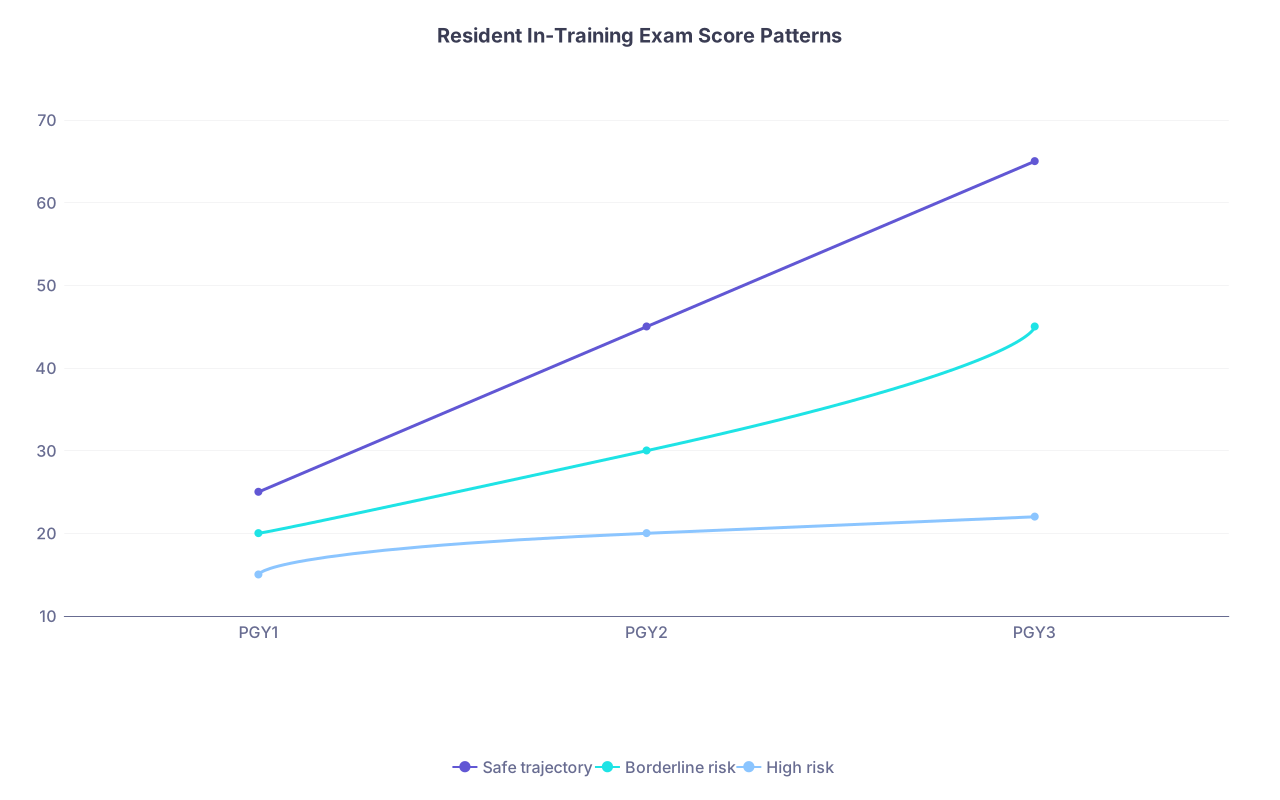
| Category | Safe trajectory | Borderline risk | High risk |
|---|---|---|---|
| PGY1 | 25 | 20 | 15 |
| PGY2 | 45 | 30 | 20 |
| PGY3 | 65 | 45 | 22 |
You see your percentile and move on. Chiefs see patterns.
The three patterns chiefs quietly categorize
Safe trajectory
The intern starts around 25–35th percentile and climbs each year. Nobody worries much. Even if they’re not a “gunner,” the directional arrow is up.Borderline but responsive
They start low (10–20th percentile), but when the program intervenes—assigns a mentor, study schedule, extra board review—the score jumps meaningfully the next year. This resident stays on the radar, but with cautious optimism.High risk, flatline or decline
This is the group that gets highlighted. Literally—on spreadsheets.
We’d sit in a conference room, list of residents up on the screen, and someone would say:
“He went from 18th to 20th to 19th percentile. That’s not random. That’s a pattern.”
Those residents are no longer “might struggle.” They’re “plan as if they’ll fail boards without major intervention.”
The “watch very closely” combo
There’s a specific combo that makes chiefs nervous:
- Below 25th percentile on ITE
- Prior USMLE/COMLEX difficulties
- Plus one of: professionalism concerns, chronic disorganization, or poor clinical prep
One of these alone? Not a crisis. That triad? That’s the “we need a structured board plan for this resident now, not later” conversation.
What Chiefs See on the Wards That You Don’t
Here’s the part nobody tells you: board risk shows up in how you round, present, and think out loud. Chiefs listen for this.
The “thin fund of knowledge” residents
Faculty will say a phrase that’s basically code:
“Good with patients, but thin fund of knowledge.”
That’s not a compliment. That’s a warning label.
It usually means:
- You can’t answer basic bread‑and‑butter questions at your level
- You struggle to integrate pathophysiology with management
- You can’t generalize from one patient to the next similar case
Boards are not random trivia. They’re a stress‑test of your clinical reasoning. If your reasoning looks shaky daily on rounds, chiefs extrapolate that to your exam performance.
Case: the likeable but risky resident
I remember a PGY-2 in IM. Great with patients, always stayed late to help, universally liked. On rounds though, it was like this:
“What’s the outpatient management of this new AFib with RVR?”
Silence. Then: “I’d probably refer to cardiology?”“What’s your differential for this hyponatremia?”
“Um… maybe SIADH?”
That’s it. No structure. No framework.
Her ITE was 15th percentile. The chiefs liked her, but they were blunt internally:
“If she doesn’t get serious about reading and structure, she’s going to fail boards.”
She didn’t. But only because someone sat her down early and said the thing most programs say too late:
“You’re at real risk of failing. Here’s the plan.”
Behavioral Red Flags: How You Study (Or Don’t)
Residency is busy. Everyone’s tired. So chiefs don’t care if you’re not a “board-style super studier” as a PGY‑1. They’re looking for something else: patterned avoidance.
The avoidance profile
There’s a type that makes chiefs anxious:
- Always “intending” to start question banks “soon”
- Talks about being “too busy” to study every single year
- Reacts to bad test results by getting defensive instead of curious
When an intern bombs their first ITE and their response is:
“Yeah, well, that exam was trash and I’m just not good at those,”
that sticks.
The response chiefs trust is:
“That’s bad. I need a structured plan. I’m going to meet with someone and figure this out.”
They’re not grading your soul. They’re grading your traction. Do you engage with feedback and change your behavior? Or do you hide, rationalize, and hope?
The secret: your chiefs watch how you handle bad news
Explicitly. They’ll say things to each other like:
“She got 12th percentile and then asked me for a study schedule and started questions the next week. I’m still worried, but at least she’s engaged.”
vs.
“He got 18th percentile, shrugged, and hasn’t opened UWorld since. That’s how you get a board failure.”
The actual score matters. But your response to that score is a separate data point—and sometimes more predictive than the number itself.
Silent Meetings, Color-Coded Lists, and “The File”
You need to know how often you’re being talked about.

| Step | Description |
|---|---|
| Step 1 | In training exam results |
| Step 2 | Chief review |
| Step 3 | Clinical eval concerns |
| Step 4 | Prior test failures |
| Step 5 | Monitor only |
| Step 6 | Formal plan suggested |
| Step 7 | Meeting with APD or PD |
| Step 8 | Pattern of risk? |
Every year after ITEs, there’s some version of this meeting:
- Chiefs
- Program director
- A couple of core faculty
- Sometimes the associate PD for education
On the screen: a spreadsheet. Names, PGY level, ITE percentiles, sometimes color-coded.
Green: fine
Yellow: borderline / watch
Red: high risk
Nobody pulls this from thin air. There’s a pattern:
- Red two years in a row → near-automatic “we need a documented plan”
- Red plus prior USMLE/COMLEX failure → serious concern
- Yellow with improving trend → cautious but less alarmed
What they do not do (in decent programs) is ignore it. Because a board failure hurts everyone: the resident, the program’s accreditation numbers, the PD’s reputation, future recruitment.
So they start documenting “interventions.” Not just for you. For ACGME.
That’s why you sometimes get pulled into a meeting that sounds strangely formal for “just some test scores.” You’re hearing about study plans and expectations, and you’re thinking, “Wow, this feels like overreaction.”
It isn’t overreaction. It’s risk management—yours and theirs.
The Hidden Factors That Push You From “Watch” to “Worried”
Your exam scores aren’t judged in a vacuum. Context matters. That’s the part most residents don’t see.
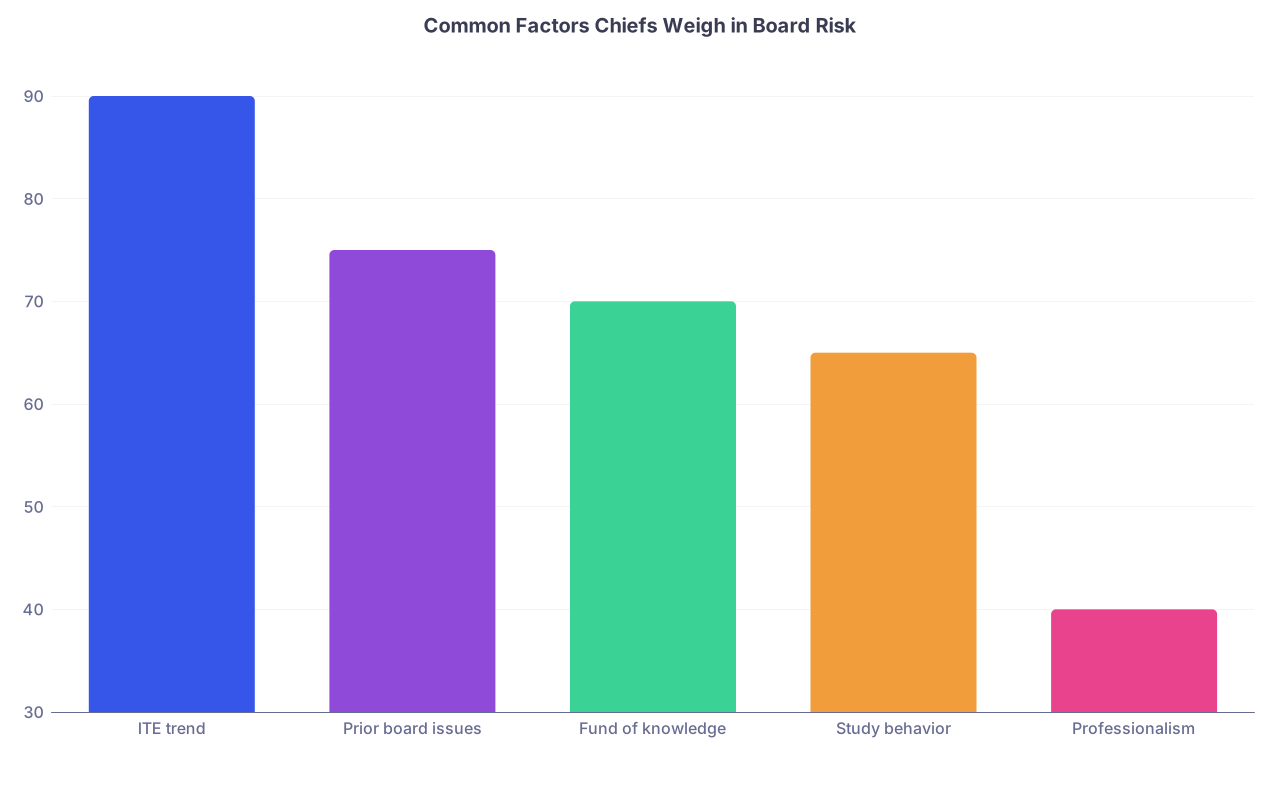
| Category | Value |
|---|---|
| ITE trend | 90 |
| Prior board issues | 75 |
| Fund of knowledge | 70 |
| Study behavior | 65 |
| Professionalism | 40 |
Chronic disorganization
If you’re the resident who’s always late with notes, constantly losing track of tasks, never has an updated list—chiefs start to wonder:
“If they can’t structure their day, are they structuring their studying? Or is everything chaos?”
It’s not that a disorganized person must fail boards. But disorganization + low scores + avoidance? That’s a pattern.
Emotional bandwidth and burnout
Here’s the part leadership talks about quietly: if you’re barely hanging on emotionally—crying in the chief’s office monthly, overwhelmed, no buffer—nobody believes you’re going home and doing 40 board-style questions a day.
They know you’re collapsing on the couch, doom‑scrolling, and trying not to think about how behind you are.
Some chiefs will say it out loud to each other:
“She doesn’t have the bandwidth to catch up at the pace she needs unless something in her schedule or support system changes.”
That’s not an insult. That’s a reality check.
How Residents Accidentally Confirm Chiefs’ Worst Suspicions
Most residents who end up failing boards didn’t have zero warning. They had a bunch of soft warnings they ignored or minimized.
Here’s what seals it in the chiefs’ minds.
“I’ll be fine, I’ve always pulled it off before”
This line. I’ve heard it verbatim from residents years apart.
You might have coasted in undergrad. You might have pulled off last‑minute Step 1 and survived. Residency is different. You’re learning while exhausted, constantly interrupted, juggling real patients.
When a resident with clear risk factors leans on “I always come through,” chiefs mentally downgrade your chances. Because that’s magical thinking, not a plan.
Refusing real help
Programs will offer:
- Dedicated board study mentors
- Extra protected study time
- Paid or recommended review courses
- Structured question bank timelines
When a high-risk resident says some version of, “I don’t really need all that, I just need a bit more time,” chiefs recognize denial.
The residents who scare us the most aren’t the ones with low scores. They’re the low-score residents who won’t engage with help.
If You’re Wondering “Am I One of Them?” — Here’s How Chiefs Would Judge You
Let me be very explicit. This is the unofficial internal rubric.
You’re probably on the “quietly watched” list if:
- You’ve ever failed a board exam before
- Your ITE is consistently below the 25th percentile
- Faculty have written variations of “needs to improve fund of knowledge” more than once
- You have a reputation (fair or not) for being disorganized or always behind
You’re moving into “we’re worried you might fail” territory if:
- Your ITE trajectory is flat or worse over 2+ years
- You respond to feedback with defensiveness or avoidance
- You still don’t have a consistent, structured study approach by mid-PGY‑2 (for a 3-year program)
Notice what’s not on that list: being quiet, not being a gunner, not knowing every obscure zebra. Nobody cares.
They care about whether you’re building a reliable, testable clinical brain over time—or you’re just hoping repetition on the wards will somehow be enough (it usually isn’t).
How to Make Chiefs Quietly Relax About You
Let me flip this into something actionable. Because the point isn’t to scare you. It’s to show you how the game is actually scored.
Chiefs start to breathe easier about a previously “risky” resident when they see three things:
Ownership of the problem
You say, “My ITE was bad. That’s on me. Here’s what I’m doing about it.”
No long speeches about how “those exams don’t reflect real medicine.” That line is dead on arrival.Visible, sustained study behavior
You’re not bragging about grinding questions. The chiefs see it over months: you’re asking better questions, presenting more structured plans, referencing guidelines unprompted.Upward movement—even if it’s modest
If you go from 15th to 25th percentile after a serious plan, most chiefs will say, “OK, this is salvageable. They can probably pass the boards with continued effort.”
If you’re truly worried, the most “insider” move you can make is this: schedule a meeting with a chief or APD and ask them straight:
“Given my scores and performance so far, would you consider me at risk for failing boards? If yes, what would you do in my position, starting this month?”
You’ll see their posture change. Because 90% of residents never ask that. The ones who do? They usually don’t fail.