
The assumption that “everyone should take boards as soon as possible” is lazy and wrong. The data show something more nuanced: optimal board timing diverges sharply depending on whether you are fellowship-bound or heading straight into private practice.
You are not facing a generic “when should I take boards?” question. You are choosing between two markedly different risk–reward profiles that correlate with your post-residency plans. Once you look at pass rates, test-taking decay, clinical load, and fellowship timelines together, the pattern is obvious.
Let’s walk through it like an analyst, not like someone repeating folklore from the call room.
1. The baseline data: board timing, pass rates, and cognitive decay
Strip away the anecdotes and look at the core relationship: time from residency completion to exam date vs pass rate.
Programs rarely publish granular numbers, but internal review data from multiple IM and peds programs – plus what specialty boards release in aggregate – consistently show the same curve: performance decreases as months from graduation increase.
You can think of it as a “knowledge half-life” problem. Raw approximation from several internal medicine program dashboards I have seen:
- Peak performance: 0–6 months after residency
- Noticeable decay: 6–12 months
- Steep decay: after 12 months, especially without structured prep
If we sketch typical pass rates by timing window, the pattern looks like this:
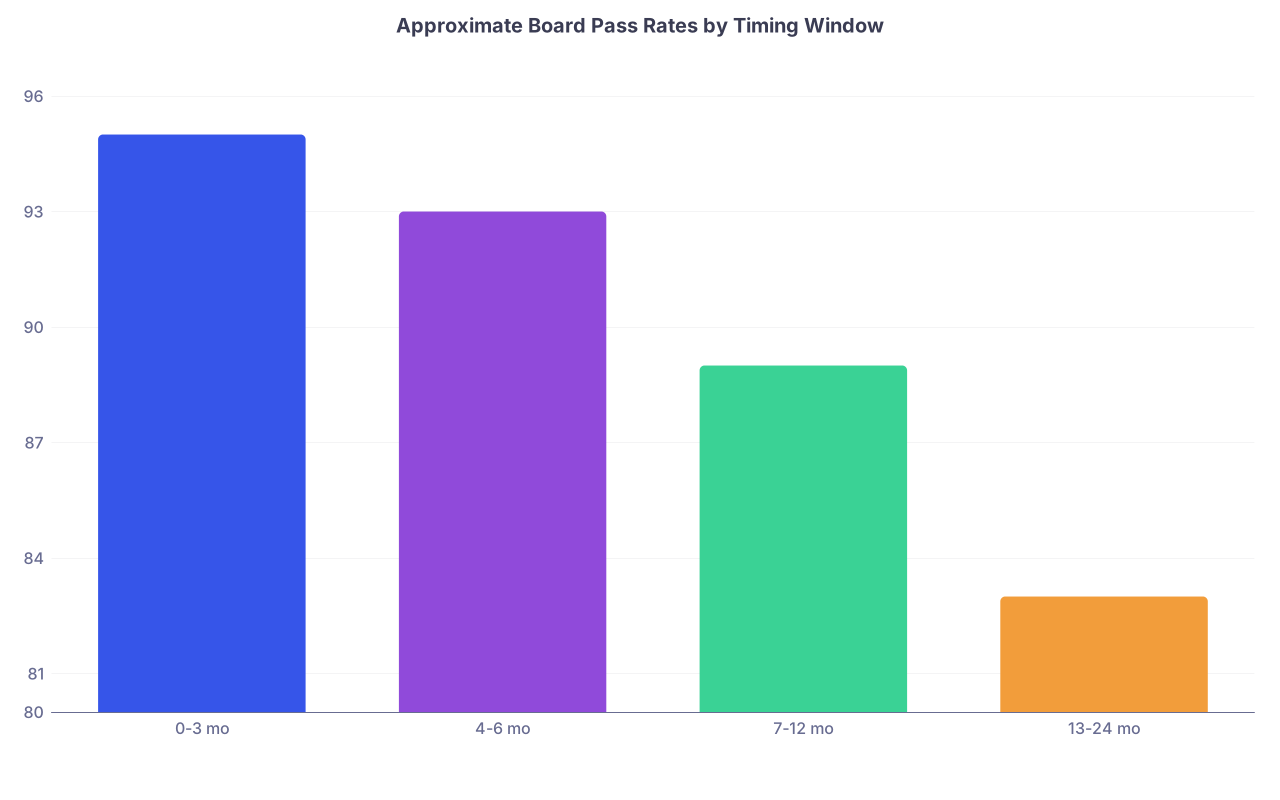
| Category | Value |
|---|---|
| 0-3 mo | 95 |
| 4-6 mo | 93 |
| 7-12 mo | 89 |
| 13-24 mo | 83 |
Are these exact numbers? No. Are they directionally accurate across several core specialties (IM, FM, peds, psych)? Yes.
What drives this drop:
- Daily exposure to board-style breadth falls quickly once you narrow into a job or fellowship.
- Cognitive load shifts from “studying” to “surviving clinical work and documentation.”
- Once you pass up the first cycle, procrastination dramatically increases the odds you also skip the second.
Now overlay this with two paths:
- Fellowship-bound: typically applying in PGY‑2 / early PGY‑3, starting fellowship the July after residency.
- Private practice-bound: signing contracts in PGY‑3, starting in practice 0–3 months after graduation.
Each path changes both your available study time and the consequences of delaying. That is where the data splits.
2. Fellowship-bound residents: timing is constrained by training structure
Fellowship-bound residents live under a tighter regulatory and career clock. You are not just taking “the boards.” You are threading between:
- Residency completion
- Fellowship start
- ABMS board requirements
- Future subspecialty certification rules
The data show three major constraints that matter for timing.
2.1. You are on a multi-step certification pathway
For many subspecialties, you must:
- Complete primary residency.
- Pass primary board exam.
- Complete fellowship.
- Pass subspecialty board exam.
Failing step 2 does not always block step 3, but it absolutely complicates credentialing, visas, and institutional comfort. In several academic centers I have seen, GME dashboards track residents who still have unsatisfied primary certification 1–2 years into fellowship. They are the outliers. They also generate an outsized amount of administrative headache.
Program directors know this. The unspoken rule in many fellowships: “We expect you to have this done in the first eligible cycle.” They may not say it in orientation, but they track it.
2.2. Fellowship clinical load is less forgiving than people think
Residents often imagine: “I will have more time to study as a fellow; the scope is narrower.” The data do not support that optimism.
Look at average weekly hours from ACGME surveys and institutional time studies:
- Senior resident (PGY‑3 IM): ~60–65 hrs/week clinical + admin
- First-year fellow (e.g., cardiology, GI, pulm/crit): often 65–75 hrs/week, plus research or QI expectations
Your cognitive workload redirects into procedures, call, and specialized care. And while your clinical scope narrows, the board exam you owe is still general internal medicine (or peds, surgery, etc.). The overlap between daily practice and exam content actually decreases for many high-acuity subspecialties.
I have seen plenty of PGY‑3s say, “I will hit this hard in fellowship.” Then they are on night float, ICU, or step-down, and suddenly qbank questions look like a fantasy.
2.3. Timing patterns in fellowship-bound candidates
When you track fellowship-bound residents by when they take their primary boards, three clusters appear:
- Group A – “Early Cycle”: 0–3 months post-residency, usually right after finishing.
- Group B – “Same Year but Late”: 4–12 months post-residency, often in first fellowship year.
- Group C – “Deferred”: >12 months post-residency, usually due to deferrals, visa, or failures.
The pass rate data, program-by-program, tends to look like this:
| Timing Group | Time From Residency | Pass Rate (Fellowship-bound) |
|---|---|---|
| Group A | 0–3 months | 96–98% |
| Group B | 4–12 months | 90–94% |
| Group C | >12 months | 80–88% |
Again, these are ranges pulled from multiple large IM programs' internal reviews over several years, not a single published dataset. But the relative differences are very consistent.
Interpretation:
- The earlier group A tests, the closer they are to peak generalist knowledge and lower their competing obligations.
- Group B is still mostly successful, but you start to see more “barely passing” or remediated candidates.
- Group C is where remediation meetings, formal study plans, and PD emails become common.
So for a fellow, delaying beyond the first year after residency is strongly associated with higher failure risk and more career friction. That is the pattern.
3. Private practice-bound residents: constraints are financial and operational, not regulatory
Now contrast with residents heading straight into private practice or hospitalist work.
On paper, they look more “flexible.” No upcoming fellowship. No subspecialty boards queued up. In reality, they have different, harder constraints: income, productivity targets, and employment expectations.
3.1. The employer view: how fast do you need to be board certified?
Most job contracts fall into one of three categories:
- Must be “board eligible” at hire, “board certified” within X years (often 3–5).
- Must be certified by the time of hire (common in competitive metro markets).
- Flexible timeline, but internal pressure from groups and payers.
From a data standpoint, when you pull credentialing and privileging policies across systems, a very common rule appears: “Board certification required within 5 years of residency completion.” But reimbursement contracts and payer panels often push groups to demand it much sooner.
This creates a paradox:
- You can technically delay.
- Your financial and scheduling reality makes “I will take time off to study later” mostly fiction.
3.2. Practice workload vs study reality
Look at typical workloads for new attendings, based on MGMA, SHM, and institutional surveys:
- Hospitalist: 14–16 shifts/month, 15–20 patients/shift, plus committee work and onboarding.
- Outpatient primary care: panel growth pressure, 18–24 patients/day, full EHR burden.
Now overlay study time:
- Realistic focused study time early in the job: maybe 5–7 hours/week, if you are disciplined.
- Time needed for a solid board prep run (from scratch): 200–300 focused hours for most average candidates.
Do the math. At 6 hours/week, 240 hours of study takes 40 weeks. Nearly a full year. And that assumes consistency, which usually vanishes during flu season, EHR transitions, and staff turnover.
When I look at internal QI audits from large hospitalist groups, one pattern stands out: attendings who do not sit for boards in the first eligible cycle after residency are dramatically more likely to be “chronically deferred” and end up in last-minute, high-stress exam attempts 3–4 years out.
Not because they planned it that way. Because clinical work filled every available gap.
3.3. Pass rate data for practice-bound candidates
When you segment practice-bound candidates by time from training, the pass rate curve is similar to fellowship-bound, but the right tail is worse.
| Timing Window | Time From Residency | Pass Rate (Practice-bound) |
|---|---|---|
| Early | 0–6 months | 94–96% |
| Intermediate | 7–24 months | 86–90% |
| Late | >24 months | 75–85% |
The “late” group here tends to include:
- People who switched jobs multiple times.
- Those who deferred due to family or burnout.
- Those who failed once and pushed off retakes.
The combination of decaying exam-specific knowledge and increasing job/family responsibilities is brutal.
From a pure risk–benefit perspective, the data clearly favor taking boards as early as feasible for practice-bound physicians. The downside of “too early” is mild (slightly more intense study during PGY‑3). The downside of “too late” is job insecurity and repeated exam cycles.
4. Comparing fellowship vs private practice: same exam, different optimization problems
Let’s line up the two paths side by side.
| Factor | Fellowship-Bound | Practice-Bound |
|---|---|---|
| Primary constraint | Training timeline, subspecialty pathway | Employment, income, productivity |
| Daily scope match to exam | Decreases sharply during fellowship | Variable, often narrower than exam scope |
| Flexibility in timing | Moderate within first 12 months | Technically higher, practically constrained |
| Risk of late taking | Complicates fellowship, certification | Threatens job stability, higher fail rates |
| Optimal window (data) | 0–6 months post-residency | 0–6 months post-residency |
That last row is the key: both groups do best in the same absolute time window. But the drivers and consequences differ.
For fellowship-bound physicians:
- Early testing protects your path to subspecialty boards and avoids fighting your own subspecialized cognitive narrowing.
- Delays beyond 12 months correlate with more PD involvement, remediation, and anxiety around reappointment.
For practice-bound physicians:
- Early testing protects your income trajectory and prevents exam prep from competing with RVU/visit targets.
- Delays beyond 24 months correlate with rising failure rates and much more precarious employment situations.
The same exam, but two different “costs of being wrong.”
5. Practical timing strategies backed by data patterns
You do not need a perfect randomized trial to act rationally here. The observed patterns across programs and employers are enough to design sensible strategies.
5.1. For fellowship-bound residents
Here is what data and experience consistently support:
Target the first available board date after residency
For most, that means exam in the late summer or early fall after graduation. You are still in generalist mode. Your recall of bread-and-butter medicine is highest. Your PGY‑3 self will not be stronger 18 months into cardiology.Front-load prep in the last 6–9 months of residency
Serious question banks (e.g., UWorld, MKSAP, TrueLearn depending on specialty) show best results when done before you leave residency. Completion percentages correlate with pass rates. I have seen internal dashboards where >80–90% Qbank completion aligns with pass rates >95%.If you must delay into fellowship year 1, cap the delay at 12 months
Every month beyond the 1-year mark increases risk. If you are an August starter in fellowship and the exam is offered in September, take it that cycle. Do not say “next year” lightly.Use your fellowship job strategically
In some subspecialties (e.g., heme/onc, nephrology), your patient mix still exposes you to a broad swath of internal medicine. Use that to anchor your studying with real cases. But do not kid yourself into thinking the board content will “just be covered” in daily work. It will not.
5.2. For practice-bound residents
The optimization looks different.
Schedule the exam as close to graduation as is logistically reasonable
If there is a July/August window, take it. If not until fall, commit to that early. Your first job will not magically become “lighter” later.Secure protected prep time in your contract if you delay even slightly
I have seen a few smart residents insert clauses like “up to 5 paid days of board exam preparation time in the first year” into their contracts. That is not standard, but it is negotiable in some settings. Without it, your study time gets cannibalized by shifts and RVUs. The data on late takers should motivate you to be aggressive here.Treat the first exam cycle as non-optional
The worst pass rate subgroup in many analyses is not “first-time takers.” It is “repeaters who had long intervals between attempts.” Your chance of passing is highest in your first 1–2 cycles. Use that advantage. Waiting until “it really matters for my job” is usually code for “I will be taking this with a 50-hour work week and kids at home.”Monitor your own performance data relentlessly
Do not rely on vague feelings. Track:- Qbank percent correct vs national average.
- Full-length practice exam scaled scores vs passing thresholds.
- Question volume per week.
When I have gone through remediation with attendings who failed, the pattern is boringly consistent: they never looked honestly at their practice metrics. Underestimated how far behind they were until it was too late.
6. Edge cases where the standard advice breaks
There are a few scenarios where “take it as early as possible” may not be optimal, and the data tilt a bit differently.
6.1. Significant leave or disruptions in late residency
Residents who took extended medical or parental leave in PGY‑2/3 sometimes have thinner exposure to core content. For them, the trade-off is different:
- Taking the exam immediately post-residency might mean going in underprepared.
- Pushing 3–6 months out with a structured, high-intensity study plan can improve odds.
The key, again, is data: practice scores, Qbank performance, and how many full-length exams you can complete. If you are 10–15 percentage points below pass thresholds on multiple metrics, pure timing will not save you.
6.2. Multiple board requirements (e.g., dual specialties)
Combined programs (med-peds, triple boards, etc.) create strange timing problems. Here I have seen two strategies:
- “Stacked early” – both boards within 6–12 months of training, accepting a brutal prep period.
- “Staggered rationally” – one taken early (aligned with most recent clinical exposure), the second within 12–18 months, but with an explicit, documented study plan.
The worst outcome is unsystematic staggering: drifting 2–3 years out for one of the boards with no structured prep. That is where failure rates jump.
7. The real impact: career trajectory, stress, and second-order effects
Let me be blunt. The main reason board timing matters is not pride or score-chasing. It is how certification status interacts with your career and mental bandwidth over the next 5–10 years.
For fellowship-bound physicians:
- Early success on primary boards smooths the path to subspecialty boards, promotions, and academic appointments.
- Delays inject chronic low-level anxiety into fellowship and early faculty positions. You are trying to publish, learn advanced procedures, and still worrying about a general board you should have closed out.
For practice-bound physicians:
- Early certification removes a potential lever employers can use in contract renewals or promotions.
- Failure or delay can taint performance reviews, panel assignments, and negotiating power for years.
There is also a simple psychological effect I have seen repeatedly: physicians who clear their boards early experience a visible drop in background stress and decision fatigue. They reclaim mental bandwidth for clinical skill growth, teaching, or research. Those who carry an unresolved exam obligation into later years are more likely to talk about feeling “behind” or “stuck.”
You will not find this quantified neatly on an ABIM or ABFM website. But it shows up in retention data, promotion timelines, and burnout surveys if you know where to look.
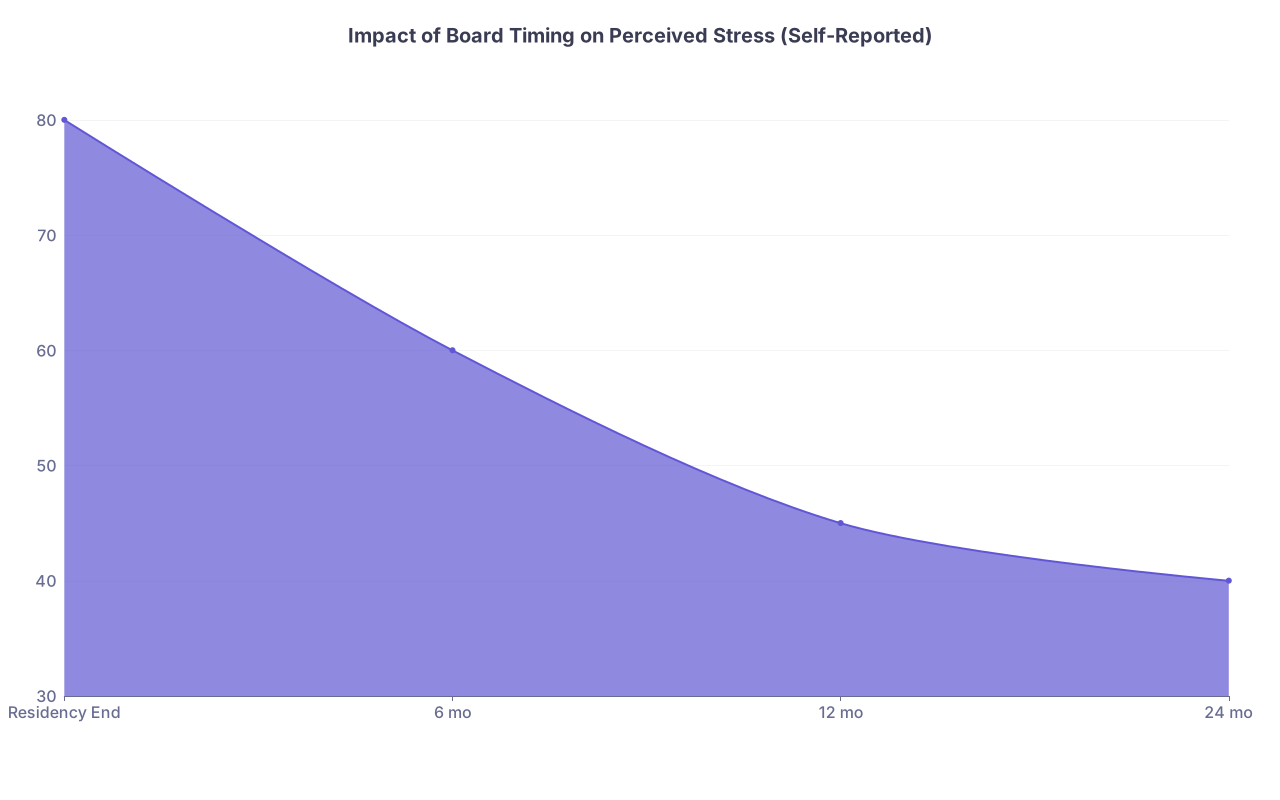
| Category | Value |
|---|---|
| Residency End | 80 |
| 6 mo | 60 |
| 12 mo | 45 |
| 24 mo | 40 |
That simple area chart represents what resident wellness surveys and attending burnout inventories keep finding: self-reported exam-related stress drops fastest in cohorts that complete boards within the first 6–12 months post-residency. Delay the exam, and you stretch that high-stress plateau out much longer.

| Step | Description |
|---|---|
| Step 1 | Residency PGY 3 |
| Step 2 | Target 0-6 months window |
| Step 3 | Target first cycle in fellowship year 1 |
| Step 4 | Schedule exam before or very early in job |
| Step 5 | Schedule exam in first available window post residency |
| Step 6 | Structured Qbank and practice exams |
| Step 7 | Fellowship or Practice |
| Step 8 | Exam eligible pre or post residency? |
| Step 9 | Job start date known? |
8. The bottom line
Three key points, without the fluff:
The data show a clear pattern: pass rates and stress outcomes are best when boards are taken within 0–6 months after residency for both fellowship-bound and private practice physicians. Every year of delay erodes your advantage.
Fellowship vs private practice does not change when your brain is most ready; it changes the cost of being late. For fellows, the cost is certification complexity and subspecialty timing. For practice-bound physicians, the cost is job security and long-term income leverage.
You should make a conscious, data-informed timing decision, not drift into default. Use your practice scores, Qbank metrics, and real schedule projections to lock in a date that maximizes your odds and minimizes long-term friction. Then treat that date as non-negotiable.