Most residents don’t fail boards because they are stupid. They fail because they never learned how the game around board remediation is really played.
Let me tell you what actually happens behind the scenes when a resident is “in trouble” with in‑training exams or fails a board exam. It’s not in the handbook. It’s not in the ACGME requirements. It lives in the quiet conversations in the PD’s office, the side emails to GME, and the whispered advice from that one senior who “magically” got more time and resources than everyone else.
You can survive this. But only if you understand the unofficial channels.
How Programs Really View Board Strugglers
Here’s the part nobody says out loud: programs care less about you passing boards and more about their board pass rate.
That sounds harsh, but it explains almost everything.
Behind closed doors, program directors talk in numbers:
- “We’re at a 92% first-time pass rate.”
- “If we have one more failure this cycle, it drops us below 90%.”
- “The RRC will start asking questions.”
So when you underperform on in‑training or fail Step 3 / specialty boards, the question in the room isn’t “How do we help this poor resident?” It’s: “Are they savable without torpedoing our stats?”
If they think you’re savable, doors open. Quietly. Off the books.
If they think you are high-risk and resistant, doors close. Also quietly.
The trick is signaling—early and clearly—that you’re worth investing in. And then knowing where the real help is hiding.

The “Unofficial” Support Channels Inside Your Program
Every program has formal language: “You will be assigned a remediation plan,” “You must complete X modules,” “You will meet monthly with your advisor.”
That’s the brochure version.
Here’s what actually matters.
1. The PD’s “Quiet Favorites” List
Most PDs won’t admit this, but they mentally divide board-risk residents into three groups:
- The Motivated Saver – works hard, shows insight, asks for help early
- The Unreliable Risk – shows up late, excuses, no insight into weaknesses
- The Hopeless (or Too Time Intensive) – requires more work than the PD or faculty are willing to do
The “Motivated Saver” gets the real help: off‑the‑record accommodations, protected time that’s not on paper, flexibility with rotations.
You get labeled into one of these buckets in about 1–2 meetings.
So when you’re first called in for that “let’s talk about your score” meeting, what you do in that conversation determines whether you’ll get extra support later. Residents blow this constantly by either collapsing (“I’m just bad at tests”) or deflecting (“The exam wasn’t representative”).
What PDs want to hear, and what unlocks the backdoor support, sounds more like:
- “Here’s exactly how I studied before. Here’s what failed. Here’s what I’m going to change.”
- “I’ve already looked into specific board review options and need help rearranging my schedule to make them work.”
- “I’m willing to give up electives, conferences, anything non-essential until I fix this.”
You show insight, a concrete plan, and willingness to sacrifice. They hear: this person is salvageable and won’t embarrass the program.
That’s when they start bending rules for you.
2. Quiet Schedule Engineering (The Real Currency)
The single most powerful support you can get isn’t a book or a course. It’s time.
On paper, everyone has a similar call schedule and rotation requirements. In reality, PDs and chiefs can subtly move mountains for certain residents without anyone noticing.
You’ll never see an email that says: “We are giving Alex 4 weeks of an easy elective to study for boards.” That would be a political nightmare.
Instead you see:
- “Schedule adjustment due to coverage needs.”
- “Resident X needed a shift trade.”
- “We’re rebalancing rotations based on service volume.”
Here’s how the backdoor help with schedule typically looks:
- Shifting you away from brutal services (ICU, night float, ED) in the 2–3 months before your retake
- Loading heavy rotations earlier so the last block(s) before exam become magically lighter
- Creating a “research” or “admin” elective that’s really 60–70% study time
- Reducing call frequency under the guise of “service rebalancing”
Residents who get this didn’t wait for it. They asked for something specific that is easy to justify.
You do not walk in asking, “Can you make my life easier so I can study?”
You walk in saying something like:
“If I’m scheduled on ICU in the month before my exam, my odds of passing are significantly lower. Could we front-load my ICU or swap that month to a colleague and move a less acute rotation closer to my test date? I’m willing to take that same tough block at a less convenient time to help the program’s pass rate and patient care continuity.”
You are tying your request to the program’s numbers, not your comfort.
3. The Real Academic Mentor vs. Your Assigned Advisor
Every resident gets some official advisor. Many of them are useless for remediation. They’ll say things like “just do more questions” and then disappear.
The hidden support is finding the unofficial fixer faculty—usually one or two attendings in the department who have a track record of salvaging struggling test-takers.
You can spot them because:
- Other residents quietly whisper: “Talk to Dr. X, they really helped Y after they failed Step 3.”
- Their evals mention “great at teaching frameworks” or “clarifies complex topics.”
- The PD mentions them repeatedly when talking about board prep.
Once you’ve identified that person, you do not ask: “Can you be my advisor?”
You say:
“I heard you’ve helped prior residents who struggled with boards. I’ve identified X, Y, Z as my weak points. Could I run my plan by you and maybe meet once or twice a month until my exam?”
Most faculty like being the person who “saves” a resident. You’re flattering their expertise and giving them a defined commitment.
That’s how you get real invested coaching, not generic “good luck” nonsense.
4. The Quiet “We’ll Pay for It” Funds
Programs have money. More than they admit. And some of it can be used for your board remediation if they think you’re worth it.
Sources I’ve seen used:
- GME “professional development” funds
- Department education budgets
- Hospital education foundation grants
- Leftover conference travel money when people don’t use it
What gets covered, behind the scenes:
- Commercial board prep courses (like MedStudy, TrueLearn, Rosh, UWorld blocks, specialty-specific courses)
- One-on-one tutoring for high-risk residents
- Extra practice exams or assessment tools (NBME, specialty mock exams)
- Even partial salary support for a focused remediation block during an extra training year
The catch: they won’t advertise this to everyone. They only unlock it when you clearly articulate why a specific resource will materially change your outcome.
You come in saying:
“Here’s my performance breakdown. My biggest deficit is rapid interpretation of X and Y topics. I’ve researched options; this specific course or Qbank directly targets those areas and has structured timelines. If the program can support the cost, I’ll sign a contract with you committing to X number of questions per week and regular check-ins.”
Now you’re not a black hole of spending. You’re a targeted investment.
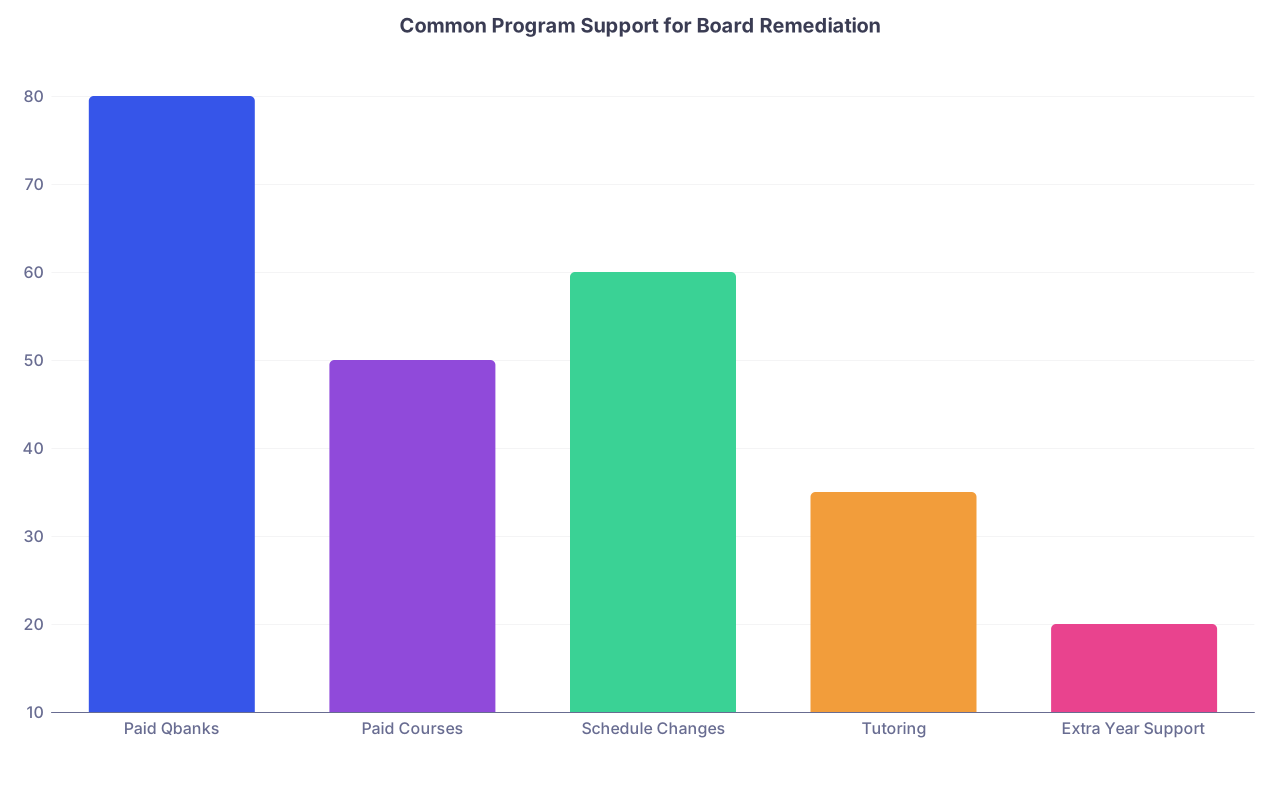
| Category | Value |
|---|---|
| Paid Qbanks | 80 |
| Paid Courses | 50 |
| Schedule Changes | 60 |
| Tutoring | 35 |
| Extra Year Support | 20 |
External Backdoors: Support That Doesn’t Go Through Your PD
Some help comes from outside the chain of command. And frankly, some of it is safer to access that way.
1. The GME Office You Never Talk To
Graduate Medical Education (GME) isn’t just the place that does your HR paperwork. They’re quietly terrified of ACGME citations for poor “board prep and resident support.”
Many institutions now track:
- In‑training exam performance
- Board pass rates by program
- Residents on remediation or probation
That means they also have:
- Institutional deals with board prep vendors
- Centralized tutoring or study skills resources
- Policy levers they can pull if a program is under-supporting a resident at risk
The residents who benefit from this are the ones who bypass the shame and speak directly with GME early—before a second failure, before probation.
You can request a confidential meeting:
“I’m concerned about my exam performance and want to make sure I’m accessing all institutional resources available. I’d like to understand what support exists at the GME level for residents at risk for board failure.”
GME people are often more process-driven and less emotional than your PD. They think in terms of policy and documentation. That can work in your favor.
2. The Disability / Learning Services Route (Legit and Underused)
Here’s a truth that’s rarely said out loud: a non-trivial number of residents with repeated board struggles end up being diagnosed—with documentation—with ADHD, specific learning disorders, or other legitimate issues.
Once that happens, the support landscape changes dramatically.
I’ve watched residents go from:
- Constantly failing practice tests
to - Passing comfortably once they had extra time and a structured remediation plan tied to a formal evaluation.
Common behind-the-scenes pathway:
- Resident struggles with multiple standardized exams.
- Someone (often not the PD, but an honest attending or GME) says, “Have you ever been evaluated for learning differences?”
- They get a proper neuropsych evaluation.
- They get documentation → which unlocks:
- Exam accommodations (extended time, reduced distraction environment, sometimes extra breaks)
- Formal institutional support services
- Legit justification for extended remediation time or schedule changes
I’m not saying “go fake a diagnosis.” That’s stupid and unethical and it will blow up in your face.
I am saying: if your test performance has never matched your actual clinical reasoning, and this has been a pattern for years, you should not dismiss a real evaluation. Programs are much more willing to invest in remediation when there’s explanations beyond “they just can’t test.”
3. Union Leverage and Contract Clauses
In unionized hospitals (think many large urban centers), the resident contract sometimes has gold hidden in the fine print.
I’ve seen clauses like:
- Right to funded remediation after high-stakes exam failure
- Protection from termination prior to an opportunity for remediation
- Limits on consecutive night shifts or duty hours that can indirectly help you study
Most residents never read the thing.
If your program starts pushing you toward resignation after a failure, or is refusing basic reasonable support, a quiet conversation with your union rep can suddenly change their tone.
I’ve seen PDs go from “I don’t think we can offer that” to “We can probably work something out” right after GME or a union rep reminds them what the institutional policy actually says.
The Shadow Side: Politics, Risk, and When to Shut Up
Let’s be honest about something: being labeled a “board risk” can tank your reputation inside a program if you handle it badly.
There are attendings who will quietly write you off. There are co-residents who will gossip (“Did you hear they failed?”). There are PDs who become hyper-suspicious and document every minor issue as “part of a pattern.”
So you have to play this strategically.

Where Residents Shoot Themselves in the Foot
I’ve seen all of these:
- Telling half the program about their failure and then being surprised when everyone knows
- Reacting defensively in remediation meetings, blaming the exam or rotation workload
- Requesting accommodations in a way that sounds like they’re asking for less work, not more targeted support
- Slacking on clinical duties during “study time,” making faculty resent giving them help
Once people start saying “they’re not reliable clinically and they failed boards,” your leverage evaporates.
You must create a completely different narrative:
- Clinically solid
- Takes feedback
- Works harder after setbacks
- Transparent with leadership, but not broadcasting your struggles to everyone
That balance—selective disclosure—is one of the real backdoor moves.
The Nuclear Option: Extra Year, Reappointment, and Delayed Graduation
Nobody wants to talk about this publicly, but it happens every year in multiple programs: someone does an extra year, or a “non-advancement” year, to fix boards.
Officially it’s framed as: “additional training,” “focused remediation,” or “extended residency.” Unofficially, it’s: “we’re trying to protect our board pass rate and give you one last shot.”
Here’s the part that matters: it’s often negotiable.
You can sometimes shape:
- What that extra year looks like (research heavy vs mostly clinical vs hybrid)
- How much study time is protected
- Whether your pay is PGY level appropriate
- Whether they’ll fund courses / exam fees in that year
Residents who approach this as a negotiation instead of a sentence get more out of it.
If you get told, “We’re recommending an additional year,” your response shouldn’t be pure despair. It should be:
“If we’re going to do that, I want to make sure the structure maximizes my chance of passing and becoming the attending you’ll be proud of. Can we sit down and map out rotations, protected study time, and specific funded resources tied to measurable goals?”
Again: you’re framing your ask around their outcome.
| Element | How Programs Quietly Use It |
|---|---|
| Rotation Mix | More electives, fewer high-acuity |
| Protected Study Time | 1–2 half-days weekly or full blocks |
| Funded Resources | Courses, Qbanks, mock exams |
| Evaluation Checkpoints | Monthly or quarterly milestone reviews |
| Exit Criteria | Passing practice exams or boards |
How to Quietly Build Your Own Remediation Structure
Let me be blunt: most formal “remediation plans” from programs are mediocre. They’re written for documentation, not for real learning.
So while you’re extracting whatever support you can from the system, build your own internal structure that doesn’t depend on anyone.
A few patterns from the residents who actually bounce back:
- They treat board prep like a clinical emergency, not an elective side project. Call shifts traded, vacations reallocated, social life temporarily narrowed.
- They don’t just “do more questions.” They do slow questions: deeply reviewing explanations, building weak-topic lists, and revisiting them.
- They use attendings as targeted consultants: “Can I run 10 heme-onc questions by you this Friday? I keep missing X pattern.”
- They make their progress visible to the PD or mentor. Screenshots of Qbank percentages, scheduled practice exams, written reflections on what’s changing.
That visibility is another backdoor technique. When PDs see actual data showing improvement, they relax. Relaxed PDs advocate harder for you with GME, with the CCC (Clinical Competency Committee), and even with your future employers.

| Step | Description |
|---|---|
| Step 1 | Score drops or board failure |
| Step 2 | Meeting with PD |
| Step 3 | Schedule engineered |
| Step 4 | Minimal formal plan |
| Step 5 | Mentor and resources assigned |
| Step 6 | Visible progress data |
| Step 7 | Stronger advocacy to GME and CCC |
| Step 8 | Resident self-structures remediation |
| Step 9 | Labeled Salvageable |
The Real Mindset Shift: From Shame to Strategy
The biggest trap with board remediation isn’t even academic. It’s psychological. Shame makes residents passive. And passive residents don’t get backdoor support.
The people who get the most help:
- Assume they’re still valuable
- Treat failure as a solvable problem, not a label
- Push the system—professionally but firmly—for what they need
I’ve sat in CCC meetings where the entire tone of the room changed because a PD said: “Look, they failed, but you should see the effort they’ve put into turning this around. They’ve met every milestone of their plan. I’m comfortable going to bat to give them more time and resources.”
Those comments don’t come out of nowhere. They’re earned.
You cannot control who gossips or which attending quietly loses faith. You can absolutely control whether your PD sees you as a lost cause or as one of the rare residents who faces failure head-on and refuses to disappear.
That’s who programs will quietly move mountains for.