
You walk out of the in‑training exam a little dazed. You missed a block because of a rapid response. You guessed on more questions than you want to admit. But the chief shrugs and says, “No one studies for that thing anyway. It doesn’t matter.”
Here is the uncomfortable truth: certain patterns on your in‑training exam do not just mean you “had an off day.” They reliably predict who will be scrambling, remediating, or failing their boards later.
I have watched residents brush off these signals, then spend their entire PGY‑3 spring in a panic. You do not want to be that person.
Let’s go through the common in‑training exam mistakes that quietly flag future board trouble—and how to shut them down early.
1. Treating the In‑Training Exam Like a Fake Test
The most dangerous mistake happens before you answer a single question: deciding the in‑training exam “doesn’t count.”
Here is how it usually looks:
- You come off a brutal ICU month and decide, “Whatever, I’ll just see where I’m at.”
- You do not block off post‑call time the day before. You sign out late, scroll your phone in bed, and wake up exhausted.
- You use it as a casual “assessment,” then ignore the score report.
What this mindset really predicts:
- You are building a habit of not taking standardized exams seriously.
- You are rehearsing poor test‑day behaviors you will repeat on the real boards.
- You are teaching yourself that “I can wing it and be fine,” when your knowledge is, in fact, eroding.
Your in‑training score does not live in a vacuum. It trends over years. Program directors absolutely look at:
- PGY‑1 → PGY‑2 → PGY‑3 trajectory
- Your percentile compared with your co‑residents
- Whether you respond to low scores or ignore them
A low PGY‑1 score is common and fixable. A low PGY‑3 score after three years of “Yeah, yeah, I’ll study soon” is a red flag that you may walk into your boards underprepared and overconfident.
Do not make this mistake:
- Treat every in‑training like a dress rehearsal for the boards.
- Protect your sleep the night before like you will for the real thing.
- Use the same test‑day routine you plan for boards (caffeine, meals, timing).
You are either practicing success or practicing failure. There is no neutral.
2. Ignoring the Score Report Details (Especially Weak Domains)
Most residents glance at the overall percentile, decide if they feel ashamed or relieved, then close the PDF forever.
That is exactly how people end up failing boards “unexpectedly.”
The overall score is not what predicts failure. Patterns inside the breakdown do.
| Pattern Type | Why It Predicts Trouble Later |
|---|---|
| Same weak domain each year | Shows no remediation or targeted study |
| Big gap vs co-residents | Suggests systemic knowledge deficit |
| Collapse in basic science | Under-mastery of mechanisms and path |
| Poor performance in bread-and-butter topics | Weak core knowledge |
| Lots of “unclassified” misses | Widespread gaps, not a niche issue |
I have seen residents fail boards while saying, “But my overall percentile wasn’t that bad!” Then you open their reports and see:
- Cardiology below the 10th percentile three years in a row.
- Basic science questions routinely among their worst sections.
- Low performance on high‑frequency board topics (MI, sepsis, COPD, hypertension).
Do not make this mistake:
- Print (yes, print) your score report.
- Circle any domain < 35th percentile.
- Look for repeats from previous years—those are your true risk zones.
- Highlight “core” areas (e.g., for IM: cardiology, pulmonary, GI, renal, infectious disease). Weak here is much more dangerous than weak in a niche area.
If the same section is weak two years in a row, that is no longer “I had a bad day.” That is a pattern. Patterns predict.
3. Writing Off “I Just Ran Out of Time” as Bad Luck
Residents love to blame timing. “I knew the stuff, I just could not finish the block.”
Sometimes that is true for PGY‑1. By PGY‑3, persistent timing problems are not an accident—they reflect thinking style and strategy that will sink you at boards.
Here is what repeated timing problems actually mean:
- You over‑read stems and get stuck in details that do not matter.
- You are doing full differential diagnosis on straightforward questions.
- You do not know enough content cold, so each question turns into an internal review session.
- You change answers constantly, which costs you both time and points.
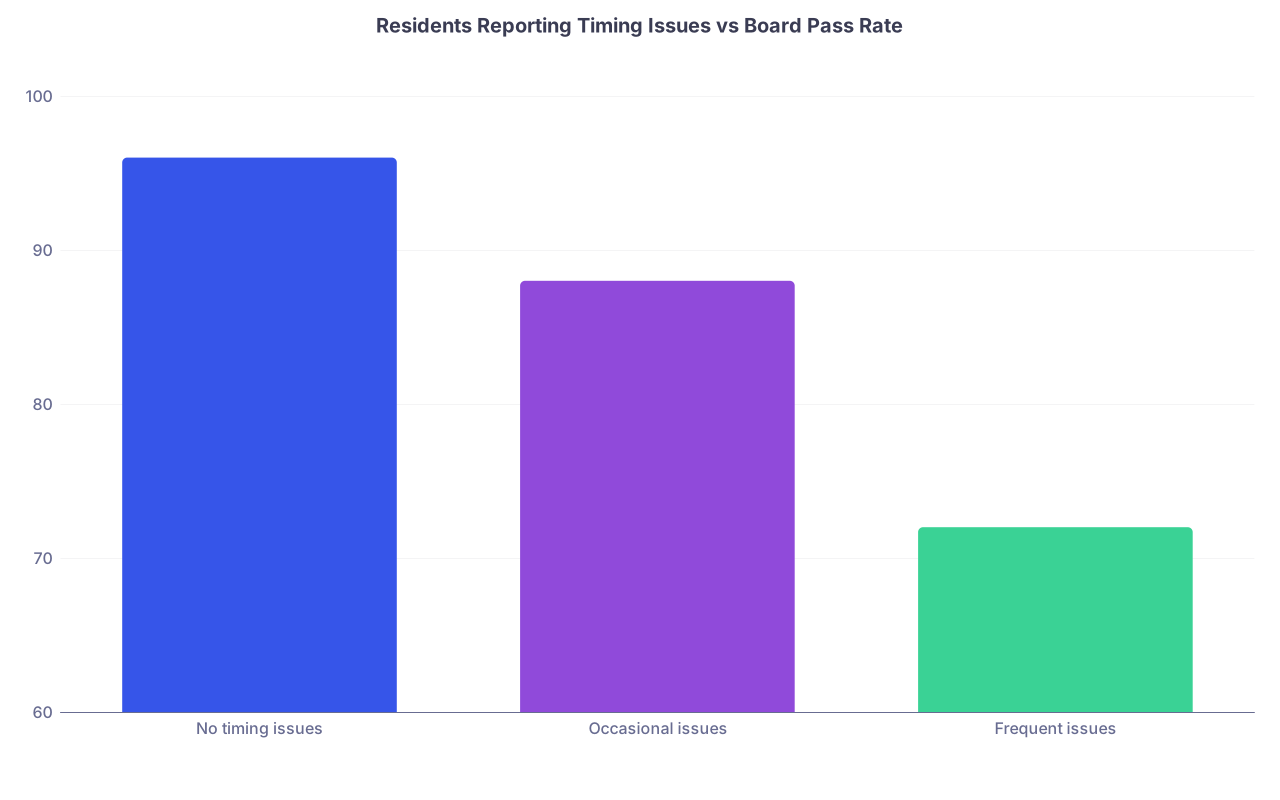
| Category | Value |
|---|---|
| No timing issues | 96 |
| Occasional issues | 88 |
| Frequent issues | 72 |
By the time you are months from boards, the board exam will not magically feel “slower” than in‑training. It will feel the same or worse.
Do not make this mistake:
- If you are consistently leaving >5 questions blank per block, treat it as a board‑threatening problem.
- During question practice, force yourself to move on at 75–80 seconds per question. No exceptions.
- Practice “good enough” answering—identify stem pattern, pick the best answer, move on, instead of trying to be perfect on every question.
Content can be fixed over months. Timing habits take longer. Start early.
4. Treating Each Question as Completely New (No Pattern Recognition)
Another subtle error that predicts future failure: you approach every question like it is the first time you have seen that concept.
Residents who pass boards comfortably do not read a PE question as “a new scenario.” They see:
- “38‑year‑old man, chest pain, pleuritic, tachycardic, post‑op day 2, mildly hypoxic”
and their brain instantly snaps to: “PE probability / Wells / next test vs empiric anticoagulation.”
Residents who fail boards read the same question and think:
- “Okay, chest pain, could be ACS, PE, dissection, maybe pneumonia… What labs do I have… What imaging…”
That style is too slow and too fuzzy. It reflects shallow pattern recognition and weak linking to guidelines.
Signs you are doing this on in‑training:
- You feel like every question is “tricky” or “unfair.”
- You rarely think, “Oh, I have seen this exact setup before.”
- You consistently miss classic, high‑yield patterns (e.g., pericarditis, pancreatitis, preeclampsia).
Do not make this mistake:
- When reviewing missed questions, explicitly name the pattern (“This was a classic pulmonary embolism with high pretest probability and next best step is CT angiography unless contraindicated”).
- Keep a running list—on paper or app—of “bread‑and‑butter patterns” you keep missing.
- Stop telling yourself questions are randomized chaos. They are not. They are heavily weighted toward recurring themes.
If in‑training never starts to feel “predictable,” that is not a test problem. That is a pattern recognition problem. Boards will punish that.
5. Blaming Rotations Instead of Building a Real Study Plan
Every year I hear the same line: “My in‑training score is low because I was on nights / ICU / wards right before it.”
Reality check: everyone is busy. Everyone has bad blocks. Yet some residents steadily improve and pass boards, and some flat‑line for three years then fail.
The real difference is not who had nicer rotations. It is who had a coordinated, boring, unsexy study plan that actually existed.
No plan = very predictable outcome.

| Step | Description |
|---|---|
| Step 1 | Take In-training Exam |
| Step 2 | Get Score Report |
| Step 3 | Feel Bad for 1 Week |
| Step 4 | Promise to Study More |
| Step 5 | Busy Rotations |
| Step 6 | No Consistent Studying |
| Step 7 | Next In-training Exam |
If this loop looks familiar, you are exactly who the boards quietly punish.
Do not make this mistake:
Within 2 weeks of getting your score report, sit down and:
- Pick 1–2 primary resources (e.g., MKSAP + a question bank for IM; TrueLearn + text for Anesthesia).
- Set a weekly question target (e.g., 75–150 per week, every week).
- Assign weak domains to specific months (e.g., March: cardiology; April: pulmonary; May: renal).
Protect 30–45 minutes on most days instead of “cramming on golden weekends.”
Stop swapping resources endlessly. Weak residents constantly restart new books; strong ones finish a modest number of tools thoroughly.
In‑training is not your study plan. It is the feedback on your (actual or nonexistent) plan.
6. Refusing to Ask for Help Early
This one is painful to watch.
PGY‑1: “Yeah my percentile was low, but I was new. I will be fine.”
PGY‑2: “It is a little higher. I just need to find the right question bank.”
PGY‑3, 3 months before boards: “I am below the program’s cutoff, but I am sure I will ramp up soon.”
Post‑graduation: “I failed. Twice.”
The common behavior all along? Never really letting anyone in.
Red flags that you are on this path:
- You are consistently in the bottom quartile of your program for 2 years.
- You do not show your detailed report to your program director or an advisor.
- You hide or minimize your struggles to co‑residents.
- You keep saying “I just have test anxiety” without changing anything concrete about your prep.
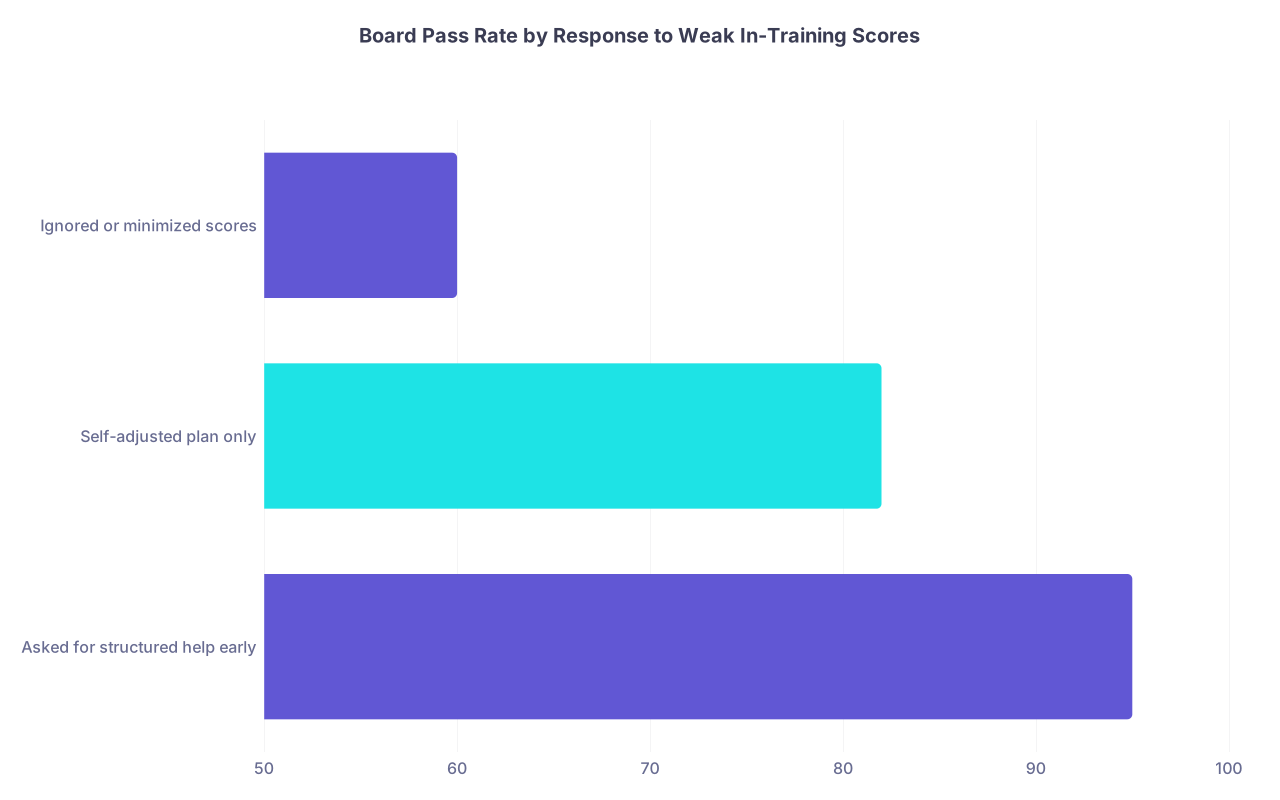
| Category | Value |
|---|---|
| Asked for structured help early | 95 |
| Self-adjusted plan only | 82 |
| Ignored or minimized scores | 60 |
Do not make this mistake:
If you are < 30th percentile two years in a row, set a meeting with:
- Program director or associate PD
- A trusted faculty mentor
- Possibly your institution’s learning specialist if available
Bring your actual reports and an honest description of your current “plan” (even if the plan is “I do questions when I can”).
Request specific help: “I want a structured remediation schedule to be above X score by Y date.”
Embarrassment passes. Failing boards lives on your record and your finances for years.
7. Over‑Focusing on Rare “Interesting” Topics
Residents love zebras. Boards do not.
If your in‑training breakdown shows you are fine in spondyloarthropathies, vasculitis, and rare metabolic disorders but terrible in hypertension, diabetes, and CKD, you are walking straight toward failure.
I see this a lot:
- Residents obsess over “cool” ICU topics, ECMO, obscure infections.
- They binge advanced podcasts and subspecialty Twitter threads.
- Meanwhile, they are missing basic questions on diuretics, anticoagulation, COPD management, colon cancer screening.
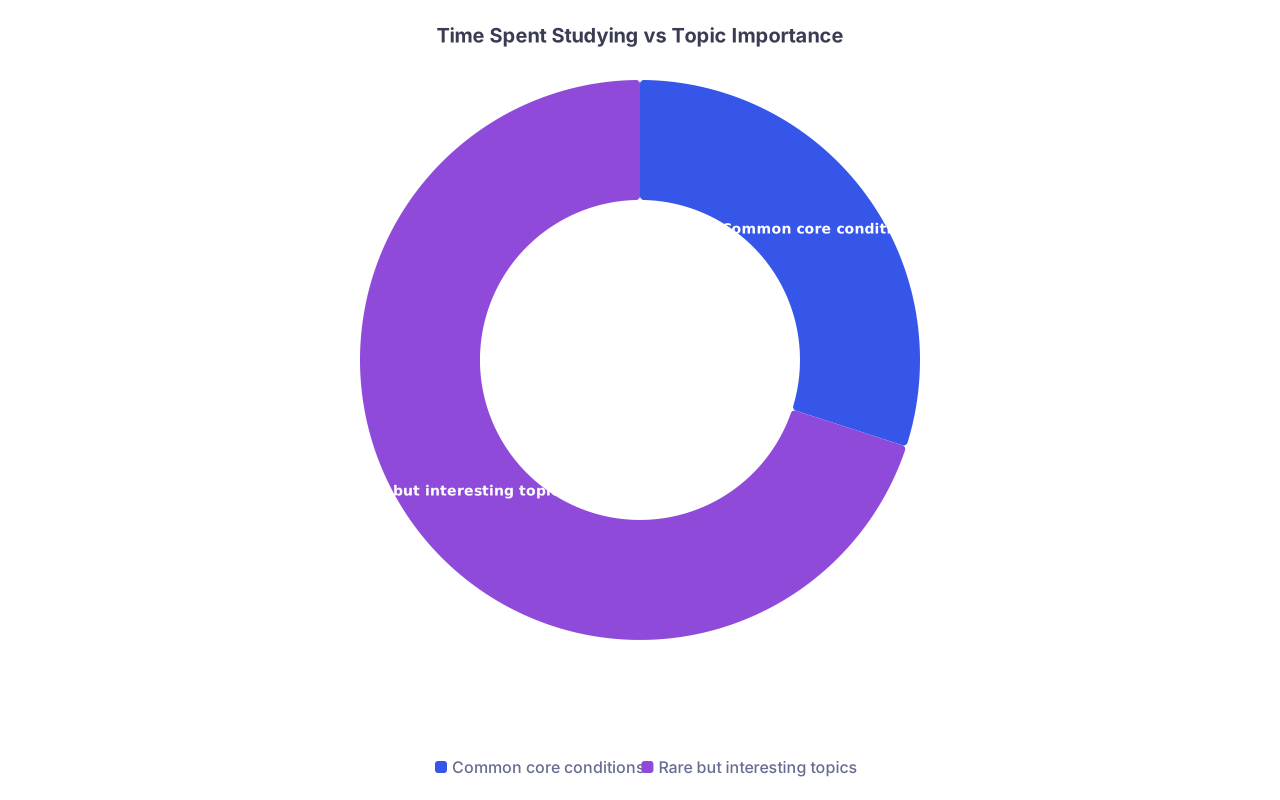
| Category | Value |
|---|---|
| Common core conditions | 30 |
| Rare but interesting topics | 70 |
That 30/70 split is how you fail a very passable exam.
Do not make this mistake:
Use your in‑training domain list as your map. Mark:
- High-frequency, bread‑and‑butter topics in one color
- Rare, niche topics in another
Your study time should look like the inverse of that doughnut chart: 70–80% on core conditions; 20–30% on rare stuff.
When you catch yourself reading something esoteric, ask: “Is this more important than hypertension for my board exam?” The answer is usually no.
Boards are not trying to impress your fellowship director. They are trying to make sure you will not miss a basic, dangerous diagnosis at 3 a.m.
8. Not Learning From How You Missed Questions (Error-Type Blindness)
Most residents review missed questions like this:
- Look at correct answer.
- Skim explanation.
- Think, “Oh yeah, that makes sense.”
- Move on.
That process improves almost nothing because it does not touch the root cause: why you missed it.
There are patterns of error that predict board trouble later:
- Knowledge gap: You had no idea; pure content deficit.
- Misreading: You missed one key word (“worst headache of life,” “sudden,” “postpartum”).
- Misclassification: You knew the disease but picked the wrong severity or stage.
- Wrong “next step”: You identified the condition but failed guideline‑based management.
- Overthinking: You changed from the right answer to a more exotic one.
These patterns repeat. On in‑training. On qbanks. On boards.
If you never categorize them, you never fix them.
Do not make this mistake:
For 50–100 missed questions after a given in‑training (or over a month), tag each with:
- K = knowledge gap
- R = reading / attention error
- S = strategy / test‑taking issue
If >50% are K, you need more systematic content review.
If a huge chunk are R or S, you need to train your test‑taking habit, not just read more.
Residents who fail boards often do not have worse raw knowledge. They have messier thinking and worse process.
9. Assuming “I’ll Turn It On Later” Despite Flat or Falling Trends
Let me be blunt: a flat or falling in‑training trend through residency, with no real change in study behavior, is one of the strongest predictors you will struggle with your boards.
I have heard every rationalization:
- “I just do better when it really matters.”
- “Once I am done with call, I will have more time.”
- “I know more clinically now; standardized tests just do not capture that.”
Boards do not care. The correlation between in‑training percentiles and board pass rates is not perfect, but it is real. And unflattering.
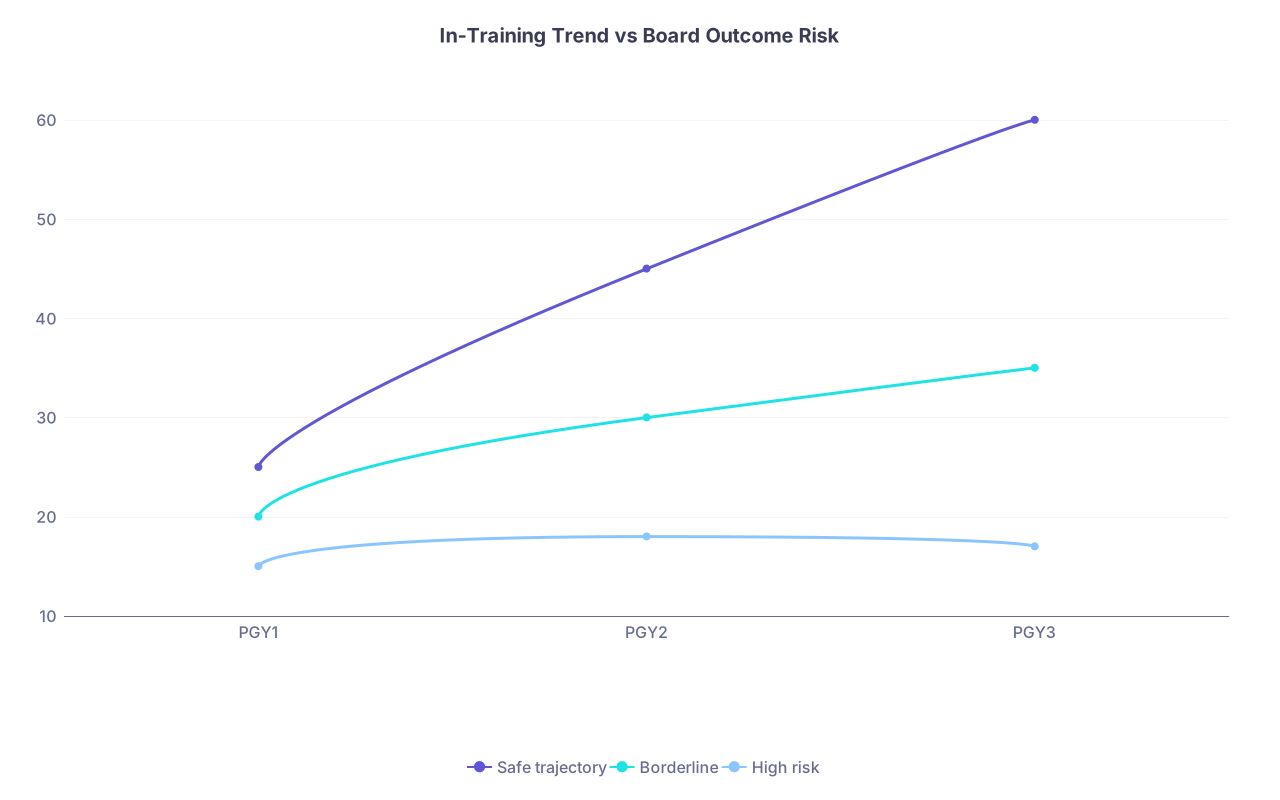
| Category | Safe trajectory | Borderline | High risk |
|---|---|---|---|
| PGY1 | 25 | 20 | 15 |
| PGY2 | 45 | 30 | 18 |
| PGY3 | 60 | 35 | 17 |
Take a hard look at where you are:
- If your PGY‑3 score is under ~35th percentile with no upward trend, you are at real risk.
- If you are hovering near your board pass‑prediction cutoffs used by your specialty, you are at real risk.
Do not make this mistake:
Decide what board percentile you actually need (your program likely has data; ask).
Work backward: if you want to go from 30th to 60th percentile, passive “study harder” is a fantasy. You need:
- A defined qbank target (e.g., 3–4 blocks per week with written review).
- A structured content source to fill in gaps.
- Probably at least one board review course or intensive block, not in the last 2 weeks.
“Turning it on later” without a different process is just procrastination wearing a motivational T‑shirt.
10. Using In‑Training Only for Comparison, Not Calibration
Last error, and it is subtle.
Many residents use in‑training exam results to compare: “I am better than X,” “I am near the middle,” “At least I beat the interns.”
That is useless. Boards are not graded on how you stack up against your co‑residents. They are pass/fail (or score‑threshold) against a national standard.
The smarter way to use in‑training is calibration:
- How many questions can I do in a row before my accuracy collapses?
- Which hour of the exam do I start missing easy questions?
- Does caffeine help or hurt my focus?
- Does my performance tank after a big lunch?
- Am I worse in the morning or afternoon?
You are trying to discover: What does my board test‑taking self look like under realistic conditions?
Do not make this mistake:
- After in‑training, do not just ask, “What was my percentile?”
Also ask, “What did this teach me about how I take long exams?”
Concrete moves based on that:
- If you fade in the last 30 questions, practice longer qbank blocks and adjust your day‑of nutrition.
- If you make more careless errors early, slow your pace in the first 10 questions—give your brain time to settle.
- If your performance drops when you change answers, adopt a strict “change only if you find a clear misread or fact error” policy.
Treat in‑training as high‑fidelity simulation, not an isolated score event.
FAQ (Exactly 5 Questions)
1. My in‑training score dropped this year. Does that automatically mean I will fail the boards?
No. A single drop is a warning, not a verdict. What predicts failure is a pattern: persistently low percentiles, repeated weak domains, no change in your study process. If you respond to a drop with a real, structured plan and targeted remediation, you can absolutely still pass on the first attempt.
2. How low is “dangerous” for an in‑training percentile?
It depends on your specialty and program data, but as a rough rule: consistent scores below the 30th percentile, especially in PGY‑3 for three‑year programs (or later years for longer ones), put you at higher risk. More concerning than a single low number is a flat or declining trend plus repeated deficits in core topics like cardiology, pulmonary, and renal.
3. What is the most common fixable mistake that leads to future board failure?
The biggest fixable mistake is having no real, consistent question‑based study habit. Residents tell themselves they will “study more” but never convert that into a weekly qbank target and content review schedule. Those who commit to steady, year‑round question practice and actually review their errors systematically usually reverse their risk.
4. Should I take time off or light rotations before the in‑training exam?
You do not need a full vacation block, but you should avoid scheduling your most brutal rotation to end the day before the exam if you can control it. More realistic: protect the night before for sleep, avoid a 28‑hour call immediately prior, and treat the day with the same seriousness you would the real boards. Chronic exhaustion will mask your true ability and bake in bad test‑day habits.
5. If I am already PGY‑3 and my last in‑training was weak, is it too late to turn things around?
It is late, not hopeless. You cannot rely on vague intentions. You need an aggressive but realistic plan: high‑yield board review resource, substantial weekly question volume with written error analysis, and possibly a formal board review course or institutional remediation support. The key is to stop hiding the problem, involve your program leadership, and get external structure so you are not improvising alone.
Keep three things in your head:
- Repeated in‑training patterns—not one bad day—are what predict board trouble.
- Timing, pattern recognition, and error type are as dangerous as raw knowledge gaps.
- The worst mistake is pretending it will fix itself later; a boring, consistent plan now is what actually changes your trajectory.