
The worst board exam timing strategy is drifting into it without a decision.
You’re either going to take your boards right after residency, or you’re going to delay. Both can be smart. Both can be disastrous. The difference is whether you match the timing to your actual reality instead of some perfect-world fantasy.
Let’s walk through this like a real decision, not a vibe check.
The Short Answer: Most Should Test ASAP, But Not At Any Cost
For the majority of residents, the best move is:
- Take your specialty boards within 3–6 months of finishing residency
- Only delay a year if one of these is true:
- You’re completely burned out and unsafe to study
- You have a major life event (baby, illness, relocation chaos, visa mess)
- Your new job doesn’t require board eligibility/certification immediately and your financial/life situation makes later clearly smarter
If you’re vaguely thinking “I’ll just do it next year when life is calmer,” that plan fails for most people. Life rarely gets calmer. Your recall of minutiae absolutely gets worse.
But “take it immediately” can also be dumb if you’re falling asleep on rounds, your practice questions are in the 40–50% range, and you’re barely hanging on. That is not “ride the momentum”; that’s “walk into a $2,000 failure you could’ve avoided.”
So the question isn’t “immediately vs year later.” It’s:
Do your knowledge, energy, and life circumstances support a focused 2–3 month sprint right after residency—or not?
What Actually Changes If You Wait a Year?
Strip the emotions out for a second. Here’s what concretely changes when you take boards right away vs a year later.
| Factor | Right After Residency | Waiting ~1 Year |
|---|---|---|
| Knowledge recall | Highest, very fresh | Fades, needs re-learning |
| Study habit momentum | Strong from training | Weaker, harder to restart |
| Clinical load | Transitioning, variable | Often full attending load |
| Life demands | Move/new job, but no kids for some | More family/job obligations |
| Income hit if you fail | Usually lower | Higher – attending-level pay at risk |
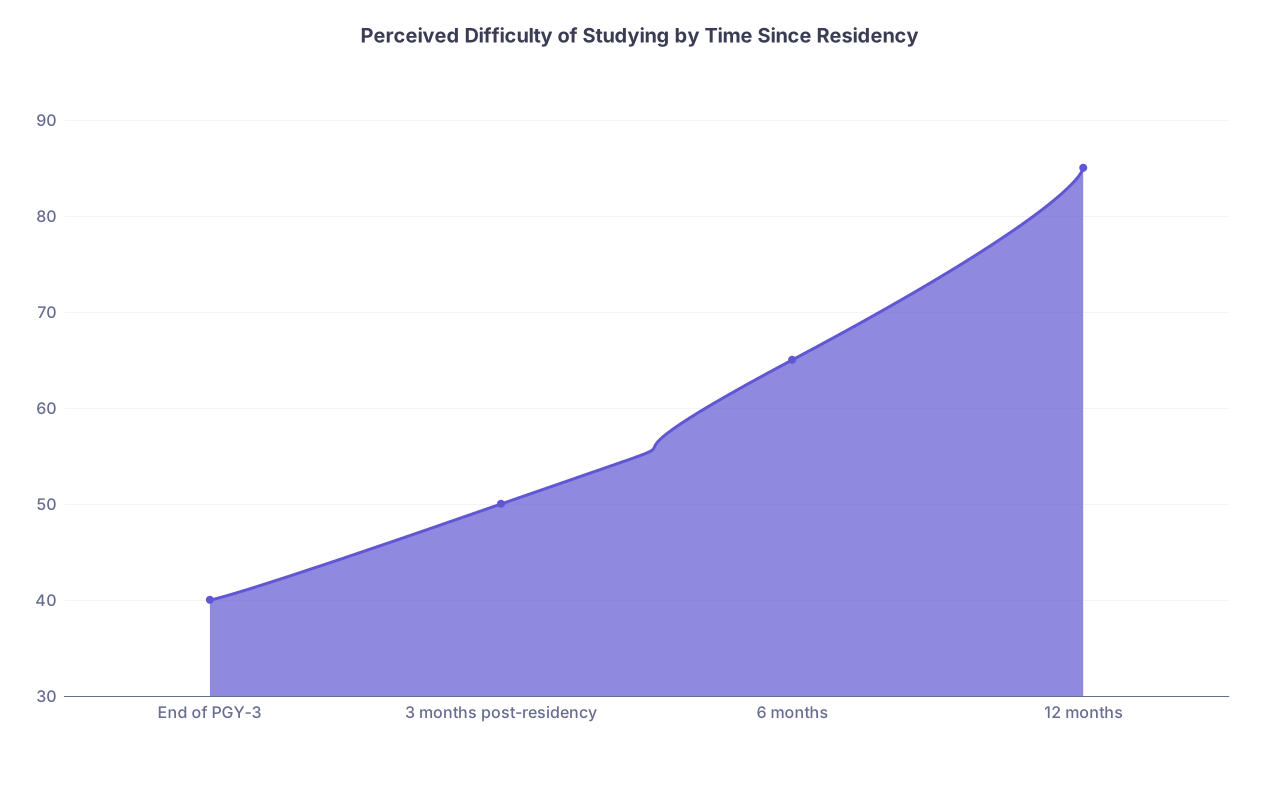
| Category | Value |
|---|---|
| End of PGY-3 | 40 |
| 3 months post-residency | 50 |
| 6 months | 65 |
| 12 months | 85 |
(Scale here is “how hard does studying feel?” — higher is worse. This is what most people report informally.)
Benefits of Taking Boards Immediately After Residency
You’re still in “exam mode.” You’re used to:
- Thinking in guidelines and esoterica
- Doing practice questions
- Getting pimped daily
Your brain is primed for board-style thinking. That matters more than people admit.
Other concrete upsides:
- Content is fresh. You just finished ICU blocks, OB nights, subspecialty clinic. You’ve seen zebra cases recently.
- You have structure. Most programs give you some study time near the end or right after graduation, or at least a predictable rotation schedule.
- You close the loop. You finish training, crush the exam, move on. No giant exam hanging over your head while you’re trying to figure out billing, EMR shortcuts, hospital politics, and how to not miss daycare pickup.
Downsides of Testing Immediately
Let’s be real:
- You may be exhausted or low-key depressed at the end of residency.
- You might be moving, onboarding a new job, or adjusting to a new city.
- Your attention span could be shot from years of fragmented sleep and constant interruptions.
If you’re finishing residency on fumes, “just push through for 2–3 more months” isn’t grit. It’s self-sabotage.
When Waiting a Year Actually Makes Sense
Waiting is not automatically bad. It’s just dangerous if you treat that year like recovery without a plan.
Delaying usually works only if you’re intentional from day one. It can be the right move if:
You’re truly burned out to the point of dysfunction.
I’ve seen residents who couldn’t get through a 10-question block without zoning out. They failed once, then passed easily a year later after taking 2 months to seriously rest, get therapy, and rebuild basic focus.Major life disruption is non-negotiable.
Example:- You’re moving across the country with kids,
- Switching visas,
- Starting attendinghood in a rural hospital with thin backup,
- And your partner is also changing jobs.
Trying to do boards on top of that can risk both your sanity and your exam result.
You have a flexible job that doesn’t require certification immediately.
Some community hospitals or urgent care systems only require you to be “board eligible” initially, as long as you’re committed to taking boards within a set window (often 3–7 years depending on specialty board rules). If they’ll support dedicated time next year and not cut you off if you don’t test right away, you’ve got breathing room.Your practice questions are consistently weak near graduation.
If you’re running at 45–55% on UWorld/board-style Qbank sets after honest effort, you might benefit more from:- Finishing residency
- Stabilizing your life for 2–3 months
- Then doing a true 6–8 week focused study period (even if that’s several months after graduation)
The key thing: waiting only helps if you actually create study time later. If you go into a job that gives you zero slack, you’ll just be more tired, less sharp, and more anxious.
A Simple 5-Step Decision Framework
You want a clear answer? Here’s the framework I’d use if you were sitting across from me.

| Step | Description |
|---|---|
| Step 1 | Finishing Residency in 3-6 months |
| Step 2 | Plan to delay or add prep time |
| Step 3 | Schedule exam within 3-6 months |
| Step 4 | Negotiate time and support, consider modest delay |
| Step 5 | Delay up to 1 year with written study plan |
| Step 6 | Are Qbank scores near passing? |
| Step 7 | Severe burnout or major life event? |
| Step 8 | Job requires early certification? |
Let’s translate that into actual questions.
1. How are your current practice scores?
Be honest and current. Not your best day, not your worst.
- If your board-style Qbank (not just trivia) is ≥ 65–70% consistently under realistic conditions → content foundation is probably adequate.
- If you’re < 60% and have been studying consistently → you’re at risk. You either:
- Need more time right now, or
- Need a later, more focused block of time once you’re not drowning in residency.
2. Rate your burnout: 1–10
Not “I’m tired,” but “I can’t think straight, I dread everything, I zone out reading a single page.” If you’re 8–10 for weeks:
- Trying to cram for boards right after residency may just turn into passive reading and anxiety scrolling.
- That is how people fail despite being “smart enough.”
On the other hand, if your burnout is a 5–7 “I’m tired but functional”, you can likely still perform with:
- 1–2 weeks of real rest post-residency
- A structured 6–10 week plan
- Some boundaries around work/social obligations
3. What does your first job expect?
This part gets ignored until it bites.
| Job Type | Typical Expectation |
|---|---|
| Academic hospital | Certified or eligible within 3–5 years |
| Large hospital system | Board eligible on start, certified within 2–3 attempts |
| Community practice | Flexible, often just board eligible initially |
| Locums | Often require certification or close to it |
Ask them directly:
- Do you require me to be board-certified by a certain date?
- How many attempts are allowed for me to maintain privileges?
- Will I get paid study time or CME support for board prep?
If the answer is “Yes, we need certification soon and we don’t give formal study time,” your best shot might actually be taking boards sooner, while knowledge is fresher.
4. What will your schedule look like a year later?
Here’s where people lie to themselves.
They imagine:
“Next year I’ll be settled, fewer obligations, better sleep.”
Reality for many new attendings:
- Full clinic load or hospitalist census
- Extra shifts to pay off loans
- Administrative onboarding, committees, maybe teaching
- Family expecting you to be “finally done” and more available
So ask:
If you delay, exactly where in your calendar will you put 10–15 focused hours/week of studying for 2–3 months?
If you cannot concretely answer that, delaying is wishful thinking.
If You Take Boards Right After Residency: Make It Work
If you decide to move forward quickly, treat it as a finite sprint.
Rough Timeline That Actually Works
Assume you finish June 30.
- First 1–2 weeks of July: Real rest. Sleep. See humans. Move if needed.
- Mid-July to late August: 6–8 week focused study block
- Exam in late August or early September
You’re not trying to “review everything ever taught in residency.” You’re doing:
- 60–80 Qs/day targeted
- Daily review of missed questions
- Rapid guideline/algorithm review on weak spots
- 2–3 full practice exams
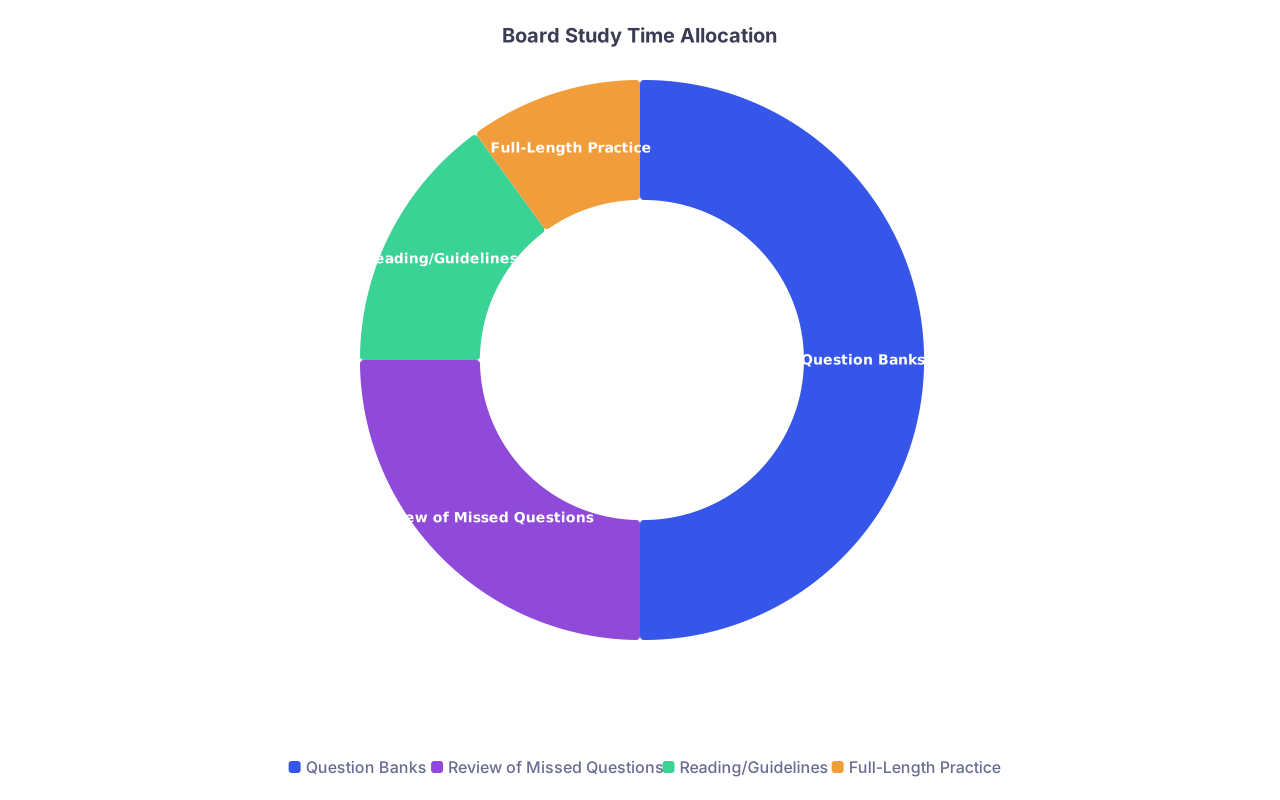
| Category | Value |
|---|---|
| Question Banks | 50 |
| Review of Missed Questions | 25 |
| Reading/Guidelines | 15 |
| Full-Length Practice | 10 |
Tell your family and friends: this is a short, defined period. You are unavailable at certain times. Then you’re truly done.
If You Decide To Wait a Year: Protect Yourself From the Common Failure Pattern
If you’re going to delay, do it intentionally, not by default.
Here’s how to not sabotage yourself:
1. Set the exact test window now
Do not say “sometime next year.” Say:
- “I will test in May–June next year.”
- Or “I will apply for the earliest available date after April 15.”
Put it in your calendar and your family’s.
2. Create a 3-phase plan
You don’t need year-long daily studying. You need clear phases.
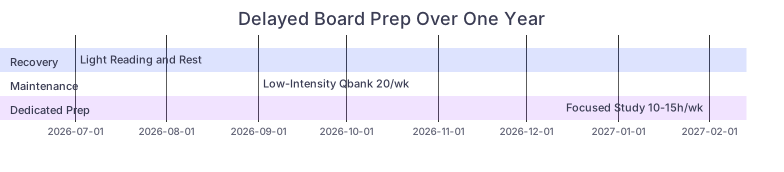
| Task | Details |
|---|---|
| Recovery: Light Reading and Rest | a1, 2026-07, 2m |
| Maintenance: Low-Intensity Qbank 20/wk | a2, 2026-09, 5m |
| Dedicated Prep: Focused Study 10-15h/wk | a3, 2027-02, 2m |
Simple version:
- Months 1–2: Recover, light reading only if you want.
- Months 3–7: Maintenance – 20–40 questions/week, keep the circuits alive.
- Final 6–8 weeks: True dedicated prep, as if you were testing right after residency.
3. Lock in support early
Before you sign a contract or set your schedule:
- Ask for a week of CME/study time around your planned exam.
- Make sure you’re not on nights or heavy call right before test week.
- Tell your partner/family your study window is non-negotiable during that period.
If your future job won’t support any of that, rethink the delay.
How Different Specialties Play Into This
One more layer: your specialty matters a bit.
- IM, FM, Peds, OB/GYN, Psych: Broad content, lots of outpatient and inpatient nuance. Content fades noticeably with time if you narrow your practice as an attending. Freshness helps.
- Surgical specialties: Cases and OR muscle memory continue, but basic science and rare conditions fade. Many surgeons still do best testing within the first year.
- Hospitalist-bound IM grads: If your job is heavy adult inpatient, your inpatient knowledge may stay sharp for a while, but outpatient/ambulatory topics (lipids, preventive care, obscure rheum) will degrade fast.
Translation: it is usually easier to trim down from broad to your niche than to re-expand from a narrow job back to exam-level breadth.
How To Decide Today (Not Someday)
You’re probably looking for a decisive nudge. Here’s the blunt version:
You should lean toward taking your boards within 3–6 months of residency if:
- Your Qbank scores are near or above passing now
- Your burnout is high but not incapacitating
- Your future job expects early certification or won’t give you real study time later
- You can carve out a focused 6–8 week study window post-residency
You should consider delaying up to a year if:
- You are clinically and emotionally wrecked right now
- You have a major life event immediately after residency and no realistic way to protect study time
- Your job is flexible on certification and will support later dedicated prep
- You’re committed enough to block study time 6–8 weeks before your chosen exam date, and you’ve literally put it in writing
Neither choice is “lazy” or “brave.” The only bad choice is drifting, signing up late, and pretending your future self will magically be more disciplined, less tired, and less busy.
FAQ: Boards Timing After Residency (7 Questions)
Is it bad for my career if I wait a year to take my boards?
Usually no—as long as you’re still within your specialty board’s “board eligible” window and your employer is fine with it. Problems start when you either:- Fail multiple times and lose eligibility, or
- Your job requires certification by a certain deadline and you miss it.
As long as you pass within the standard window, most future employers care more that you’re certified than exactly when.
Do programs or employers look down on people who didn’t take boards immediately?
Not automatically. I’ve sat in meetings where the only thing anyone cared about was: “Are they board-certified or eligible right now?” A one-year delay with a pass on first try is usually invisible. What raises eyebrows is repeated failures or loss of eligibility. If you delay, have a clear explanation if asked: “I moved, had a baby, and scheduled dedicated study time the following spring; passed on first attempt.”What if I fail my boards on the first try—do I still keep my job?
Depends entirely on your contract and hospital bylaws. Many places allow multiple attempts as long as you keep scheduling the exam and remain “eligible.” Some are stricter and tie credentialing or promotion to certification. This is why you ask upfront:- How many attempts are allowed?
- Is my employment or credentialing contingent on passing by a certain date?
Do not guess. Get the answer in email or your contract.
How much time should I realistically plan for board studying after residency?
For most people: 6–10 weeks of real studying, 10–20 hours/week. That’s on top of baseline residency memory. If your ITE scores were weak, you took time off for leave, or you’re changing subspecialty focus, you might need more like 12–16 weeks. The trap is pretending you’re “studying” when you’re reading casually on the couch at 11 PM. That doesn’t move the needle.Can I work full-time as an attending and still pass if I take boards right away?
Yes, many do. But they’re disciplined. They:- Protect 1–2 evenings and a weekend block for questions and review
- Say “no” to extra shifts during their study window
- Keep a tight, exam-focused plan instead of randomly reading.
If your attending job is chaos with 14 shifts/month of nights and no predictable off time, realistically either negotiate for a gentler start or consider timing your exam before that schedule fully ramps up.
What’s the biggest mistake residents make about board timing?
Two, actually:- Overestimating how much better “later” will feel without changing anything structurally, and
- Underestimating how fast factual details decay once you narrow your practice.
They tell themselves, “I’ll study more when life calms down,” but never carve out protected time. Then they’re surprised when practice test scores are worse a year out than at the end of residency.
What should I do this week if I’m still unsure when to take boards?
Do three things, fast:- Take a 60–80 question block from a legit board-style Qbank under timed conditions. See where you actually are.
- Ask your future (or current) employer in writing about board timing and expectations.
- Put two possible exam windows on your calendar: one within 3–6 months of graduation, one around 9–12 months.
Based on your scores, burnout level, and the employer’s rules, choose one within the next 2 weeks. Then build a short, concrete study plan around that date.
Now, open your calendar and block off a 6–8 week study window tied to a specific exam month—either right after residency or about a year out. If that block looks impossible in one time frame, that’s your answer.