It’s 7:12 a.m. You just signed out from a brutal night float. You’re stealing five quiet minutes in the resident workroom, scrolling through your email on autopilot. Then you see it: “[ABIM Examination Results]” or “[ABEM Certifying Exam Score Report].”
You click. You scan for the word “pass.”
You don’t see it.
You see “did not pass” or “fail” instead.
Now what?
Let me walk you through what actually happens after a resident fails their specialty boards, not the sanitized version you hear on official webinars. I’m talking about the conversations behind closed doors in the PD office, the emails that get forwarded to the GME office, and the quiet calculations chiefs make about the call schedule when your certification gets delayed.
Because those dynamics are real, and they affect your career more than people like to admit.
First 48 Hours: Chaos, Shame, and Quiet Damage Control
Here’s the sequence I’ve seen over and over.
You find out first. Alone. On your phone or laptop. There’s usually a mix of exhaustion, shame, disbelief, and a very rational fear: “Does this tank my career?”
Most residents don’t tell anyone for a few hours. Sometimes a few days. They run through all the catastrophes in their head:
- Will my program find out?
- Will this affect my ability to be promoted / get a job / moonlight?
- Are they going to think I’m stupid? Lazy? Unsafe?
Reality: your program almost always finds out, and faster than you’d like.
Most specialty boards send aggregate pass/fail data to program directors and sometimes detailed resident-level results through a secure program portal. Some PDs get a spreadsheet with each resident’s result within 24–72 hours. I’ve sat in those meetings where a PD opens that file for the first time.
The PD’s internal monologue is usually something like:
- “Okay, who bombed it?”
- “Is this an isolated issue or a program problem?”
- “Do I need to alert the chair or GME?”
They’re not just thinking about you. They’re thinking about ACGME citations, board pass rate thresholds, and how this looks on their “outcomes” slide for recruitment season.
How the news actually spreads
Here’s the typical chain:
- You silently panic.
- Within a couple of days, your PD downloads the results.
- The PD flags the failures, often in a color-coded spreadsheet.
- They loop in: associate PD, program coordinator, sometimes the department chair.
- Then comes the email to you: “Can you stop by my office when you have a minute?”
No PD writes “come discuss your failure” in email. They’ll be vague. You’ll know exactly what it’s about.
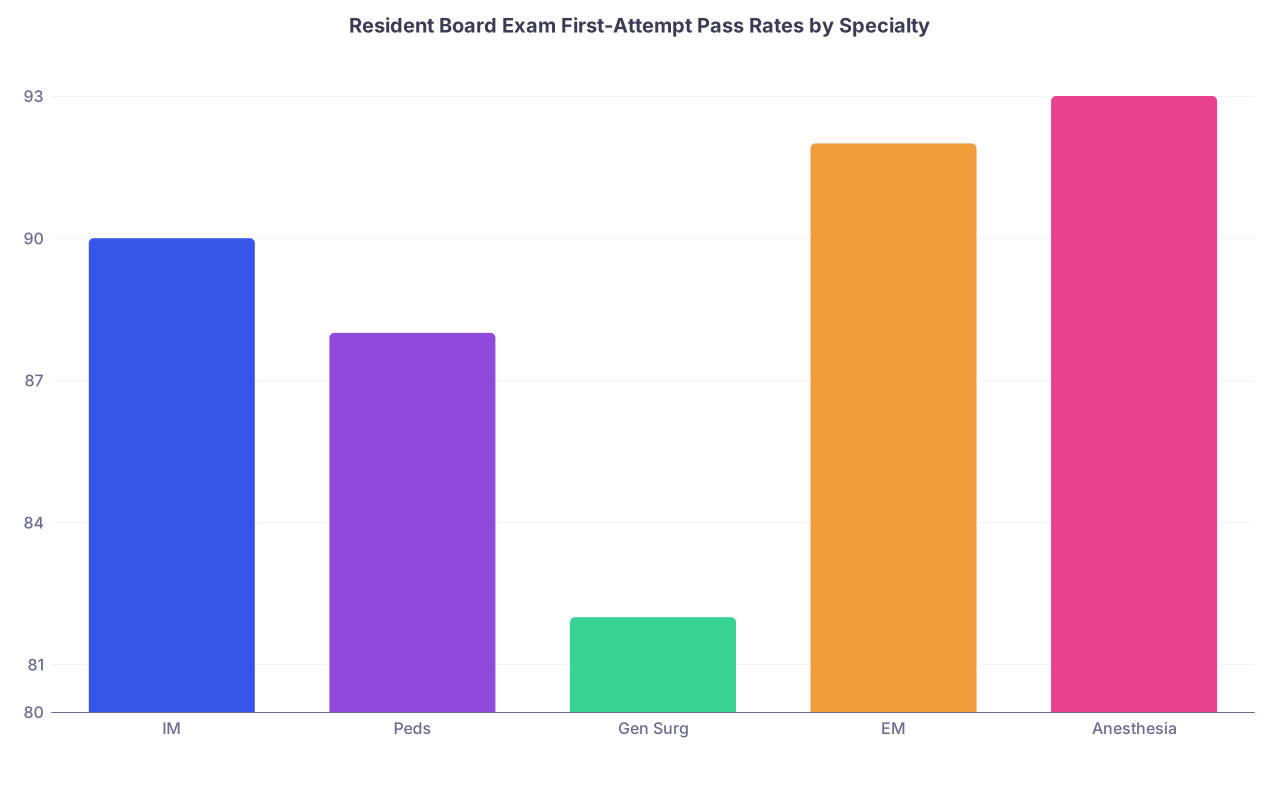
| Category | Value |
|---|---|
| IM | 90 |
| Peds | 88 |
| Gen Surg | 82 |
| EM | 92 |
| Anesthesia | 93 |
Those numbers are approximate, but the point is: failing is not common, but it’s not rare either. Any decent-sized program has a few failures every cycle. That’s why your PD has a script ready.
The Closed-Door Meeting: What’s Really Being Assessed
You walk into the PD’s office. Door closes. PD does the obligatory empathy routine: “I know this is tough,” “These exams don’t define you,” all of that.
Underneath that, they’re trying to answer three questions:
- Are you unsafe clinically?
- Is this a pattern or a one-off?
- How big of a problem is this for the program?
They’re looking at your:
- In-training exam (ITE) scores
- Clinical evaluations
- Any professionalism or remediation history
- Prior board-type exam performances (USMLE/COMLEX, Step 3)
If you were an average or above-average resident clinically, with decent ITE scores, they tend to treat it as a “contained” problem.
If your ITE scores have been in the basement for years and faculty have quietly been saying “nice resident, but weak knowledge base,” the tone shifts. Now it’s not just “you failed the boards,” it’s “we missed something or ignored it.”
How honest you are in that meeting matters
I’ve sat in PD meetings where residents try to spin it:
- “I just had test anxiety.”
- “It was a bad exam.”
- “The questions were weird this year.”
PDs don’t love that. What lands better is something like:
- “I underestimated it. I tried to juggle too much service and studying.”
- “My ITE scores predicted this, and I didn’t fully address it.”
- “I need structure and accountability to fix this.”
Why? Because the PD’s main concern is: are you going to change anything, or are we going to be right back here next year, dragging our pass rate down again?
Program-Level Fallout: Your Failure is Now a Metric
Here’s the part nobody tells you when you’re a resident: your board result is not just about you. It’s a reported outcome metric for the program. It affects accreditation status.
ACGME doesn’t just care that residents sit for boards. They care how many pass. Programs get looked at if their rolling pass rate over several years dips below thresholds.
So a single failure in a small program (say, 6 residents per year) hits harder than one in a giant program with 30 residents per year.
| Program Size (per year) | One Failure Effect | PD Reaction |
|---|---|---|
| 6 residents | Major | High anxiety |
| 12 residents | Moderate | Structured remediation |
| 25 residents | Mild | Quiet individualized plan |
Behind the scenes, PDs and chairs will have conversations like:
- “Is this an advising failure?”
- “Do we need more board review built into didactics?”
- “Are we selecting the wrong applicants?”
But they’re also thinking something more pragmatic: “How do we make sure this person passes next time, because we cannot afford another failure.”
You go from independent adult trainee to “project” very quickly.
What Actually Changes in Your Training and Career Path
This depends heavily on when you fail and what board exam we’re talking about.
Scenario 1: You fail the written qualifying exam as a resident or right after graduation
For most specialties, there’s a written qualifying exam (ABIM, ABEM, ABS QE, etc.). Fail that, and you can’t even sit for the oral or certifying component (where applicable).
Resident-level fallout:
- Your PD will likely put you on an “educational remediation plan.” That’s the polite term.
- This may be formal (paperwork with GME) or informal (more check-ins, structured study plan).
- You may lose some electives to “reading time” or required board review courses.
- Your moonlighting may be “strongly discouraged” or outright blocked until you pass on re-take.
A lot of programs quietly restrict external moonlighting for residents who fail boards or who massively underperform on ITEs, even if they don’t put that in writing. I’ve heard the exact line: “If you’ve got time to moonlight, you’ve got time to study.”
Fellowship / job-level fallout:
If you’ve already matched into fellowship, most programs won’t rescind your spot for a first-time board fail. But they will clock it. And subspecialty boards notice patterns of people who fail primary boards and later struggle with subspecialty ones.
Private practice jobs? They ask about board “eligibility” and “certification.” Here’s the nuance people gloss over:
- If you just graduated and failed once, you’re still “board-eligible.” Many employers accept that.
- If you fail multiple times and start moving from “eligible” toward “chronically not certified,” the tone in job negotiations changes fast.
Scenario 2: You fail after you’re out in practice
Different beast.
You’re hired as “board-eligible,” usually with a clause in your contract that you must achieve board certification within X years or Y attempts.
Fail once: you get a tense but survivable conversation with your chair or medical director. They’ll want a plan, but you usually keep your job.
Fail twice or three times: now you’re in dangerous territory.
I’ve seen:
- Contracts not renewed for hospital-employed physicians who never obtained certification.
- Privileges restricted or conditional at some hospitals.
- Group practices renegotiating partnership tracks.
And yes, some malpractice carriers care. Board certification is one of those quiet checkboxes they like to see.
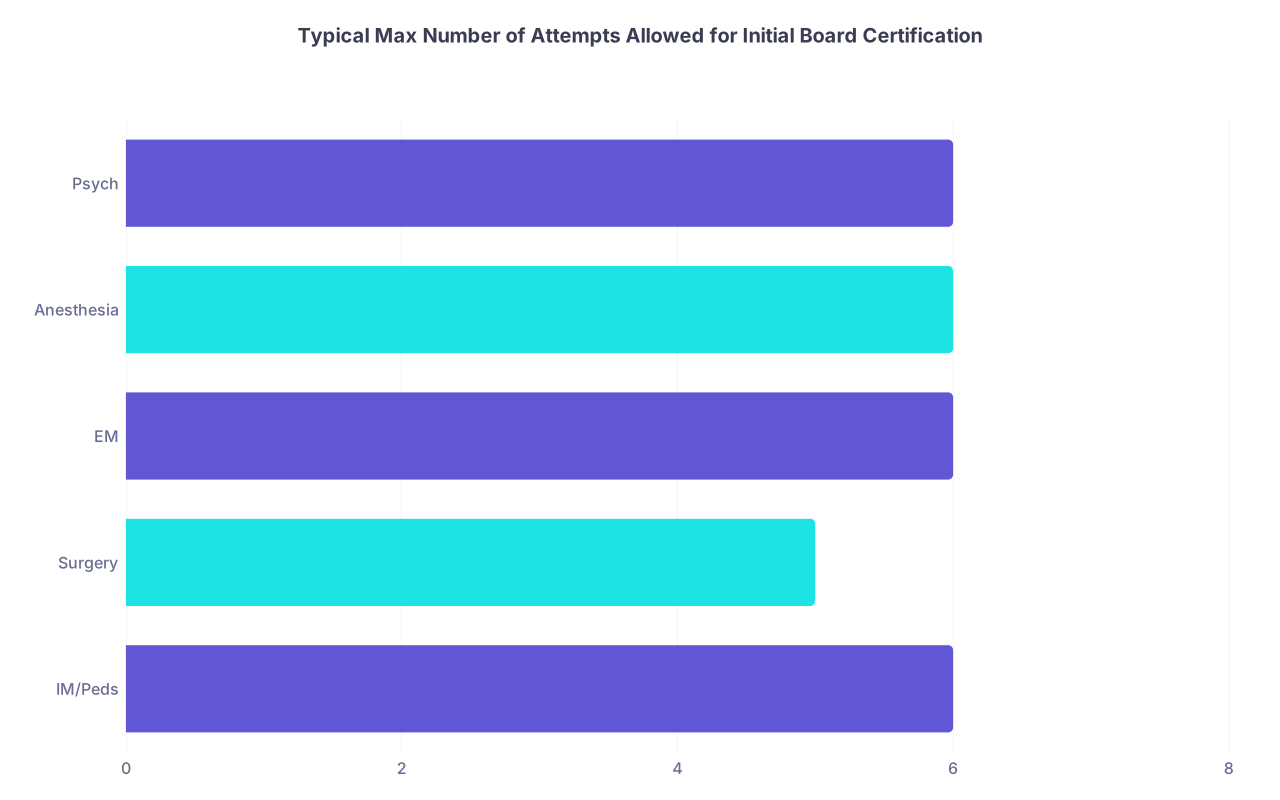
| Category | Value |
|---|---|
| IM/Peds | 6 |
| Surgery | 5 |
| EM | 6 |
| Anesthesia | 6 |
| Psych | 6 |
You don’t get infinite tries. And the number of years you’re allowed to remain “board-eligible” is limited. Blow through that, and now you’re “not certified” permanently in some specialties without special re-entry hoops.
The Emotional Part: How Programs Actually View You After a Fail
Let me be explicit: one failure does not make faculty see you as stupid. That’s not how most attendings think.
What changes is the story people attach to your name.
Residents get labeled informally. “Workhorse but disorganized.” “Brilliant but scattered.” “Average but solid.” After a board fail, your label may acquire a new suffix: “struggles with tests.”
That’s not benign. It influences:
- Who gets backed hard for academic jobs and fellowships.
- Who people assume will succeed in academic medicine vs community practice.
- Who they tap for chief resident (in some programs, repeat test failures quietly take you out of the running).
But here’s the part you need to hear: the way you respond to the failure becomes more important than the fail itself.
I’ve watched two residents fail the same exam at the same time:
Resident A:
- Hid it from peers.
- Kept moonlighting heavily.
- Blamed “test style” and “bad luck.”
- Did not change much in daily work.
Resident B:
- Told their PD directly and honestly.
- Cut moonlighting.
- Built a structured plan with a faculty mentor.
- Used a commercial course, took question blocks daily, asked for coverage on a few shifts to study before the re-take.
Both passed the next attempt. Five years later, nobody sees Resident B as “the one who failed.” In contrast, Resident A’s reputation took a subtle hit that lingered, because attendings remember the denial and lack of insight more than the score itself.
What Remediation Really Looks Like (Not the Brochure Version)
Programs like to say they “support” residents who fail boards. Let me translate what that support usually actually is.
You’ll typically see a mix of:
- Required board-style question blocks weekly with tracking. Some programs literally make you send screenshots or use an institutional account to monitor completion.
- Scheduled meetings with an associate PD or faculty “exam coach” every 2–4 weeks.
- Potentially a required board review course (live or virtual) paid for by the department.
- Targeted leave or elective adjustments to protect study time.
What won’t usually happen:
- They’re not cutting your call schedule to zero for three months.
- They’re not excusing you from core rotations.
- They’re not going to let you blow off conferences to “study on your own.”
You’re still a worker in their service machine. They will do just enough to credibly say, “We intervened.” But do not expect a sabbatical.

| Step | Description |
|---|---|
| Step 1 | Resident fails boards |
| Step 2 | PD reviews results |
| Step 3 | Informal remediation |
| Step 4 | Formal remediation |
| Step 5 | Study plan and check ins |
| Step 6 | Written plan via GME |
| Step 7 | Retake exam |
| Step 8 | Return to baseline |
| Step 9 | Escalation and career impact |
| Step 10 | Performance pattern |
| Step 11 | Pass or fail again |
If you’ve already graduated and you fail as an attending, your “remediation” is often whatever you decide to build. Some hospital systems will offer CME funds for a course, maybe protected time for a few days. But don’t count on a system swooping in to save you. By then, you’re on your own.
How This Affects Your Job Search, Pay, and Future Options
People love to say, “No patient has ever asked if I’m board-certified.” True, but that’s not the right question. The real gatekeepers are:
- Credentialing committees
- Department chairs
- Insurance panels
- Malpractice carriers
Here’s where the failure shows up in the real world.
Credentialing and hospital privileges
Most hospitals have a requirement for either board certification or “board-eligibility within X years of completing training.”
Fail once? Usually not an immediate disaster. But they timestamp you. They now know:
- You’ve used 1 of your allowed attempts.
- The countdown clock to mandatory certification is ticking.
If you stay at the same hospital, they may quietly re-review your file when you re-apply for privileges or reappointment (often every two years). Persistent non-certification starts to look like a risk.
Compensation and contracts
I’ve seen contracts with clauses like:
- “$10,000 bonus upon achieving board certification within three years.”
- “Base salary contingent upon maintaining active board certification.”
Fail and delay certification? You delay or lose that bonus. Fail enough that you never get certified? In some systems, your pay grade and job category are different than fully certified peers.
Fellowship admissions and academic tracks
In competitive fellowships, especially at big-name institutions, first-time board failure raises questions. It doesn’t automatically kill your chances, but it makes committees ask:
- Is this someone who will struggle with subspecialty boards too?
- Is this a signal of poor fund-of-knowledge, or just bad test prep?
Programs are much more likely to gamble on a strong applicant who failed once and then crushed the re-take than on someone with a repeated pattern of barely scraping by on every exam.
What Almost No One Tells You: Secondary Consequences
There are a few ugly downstream effects I’ve seen repeatedly that don’t get mentioned in official statements.
1. Strained peer relationships
You might think, “I’ll just keep this to myself.” But in most residency classes, news leaks.
Someone notices you’re taking a big board review course. Someone overhears a fragment of a conversation with the PD. Eventually one or two co-residents find out, and by the end of the year, most of your class has some idea.
Most peers will be sympathetic. But there’s a subtle shift: when you speak up in teaching conferences or lead code blues, a few people will quietly evaluate your comments through the “failed boards” lens. It’s not fair, but it happens.
The antidote is steady, obvious competence. Show up prepared. Run good lists. Lead clean codes. Be clinically sharp. Over time, performance drowns out the narrative.
2. You become the metric everyone overcorrects for
If your failure drags the program’s three-year rolling pass rate to the threshold where ACGME starts asking questions, the program tends to overcorrect with the next classes:
- Harder stance on ITE cutoffs.
- Aggressive advising on who “should” defer boards.
- More required board-oriented didactics.
You inadvertently become the example PDs mention in private: “We had a resident three years ago who failed the boards and it almost cost us our accreditation threshold. We’re not letting that happen again.”
3. You get typecast
I’ve watched excellent clinicians who just had a bad test year get quietly nudged away from “academic” targets.
Comments like:
- “Maybe private practice is a better fit for you.”
- “Fellowship is very exam-heavy; are you sure that’s the best path?”
Sometimes that’s good advice. Sometimes it’s cowardly steering, based on a single metric.
If you still want the academic route, you have to push back with data: crush the re-take, show strong ITE scores, build a publication or education portfolio. Don’t let one board result silently reroute your whole career without you consciously choosing that.
If You’re In This Situation Right Now
If you’re reading this because you just failed and you’re trying not to throw up in the call room, let me be concrete.
First 24–48 hours:
- Tell one trusted person: senior resident, faculty you trust, or your PD if you’ve got a decent relationship. Isolation makes this fester.
- Do not impulsively sign up for three expensive review courses at once. You’re in shock. Breathe.
- Screenshot or save your score breakdown; boards sometimes give vague subscores that can guide targeted study later.
Next week:
- Meet with your PD or associate PD. Go in with:
- an honest narrative of what actually happened with your prep,
- a rough plan for what you’ll do differently,
- openness to their suggestions, even if their plan isn’t perfect.
- Have a frank conversation about any contractual or credentialing deadlines if you’re about to graduate.
Study-wise:
- You need a different approach, not just “more hours.” If you relied too heavily on passive reading, you need a question-heavy strategy. If you burned through questions mindlessly, you need slow, deep review with spaced repetition and explanation dissection.
- Protect real time on your calendar. If your life structure doesn’t change, your result probably won’t either.
And do not assume your career is over. It isn’t. I’ve seen future fellowship directors, department chiefs, and outstanding community physicians who failed boards once. The common denominator? They took the hit, built insight, and changed behavior.