
The biggest myth new attendings believe about credentialing is that it’s a rubber stamp once you’re board-certified. It isn’t. The hospital is not just checking if you passed your boards; they’re quietly deciding how much risk you represent.
Let me walk you through what actually happens behind closed doors when a newly boarded attending’s application hits a hospital’s credentialing committee. This is the stuff nobody explains to you during residency, but every program director and CMO talks about over coffee.
What Credentialing Really Is (And What It Is Not)
Credentialing is not just “Send your certificates, sign a few forms, done.” It’s a structured risk assessment, with a thick paper trail, in a system designed to protect the hospital—legally, financially, and politically.
On paper, they’re verifying:
- Education and training
- Licensure
- Board certification
- Work history
- References
- Background and malpractice history
But in practice, they’re asking three much blunter questions:
- Are you who you say you are?
- Are you going to embarrass us, cost us money, or create regulatory problems?
- Are you going to be a political problem on the medical staff?
If you think hospitals care most about your Step scores or percentile on your board exam, you’re still thinking like a resident. The credentialing machine barely notices any of that.
The Hidden Hierarchy of What Matters
Let me give you the actual priority stack most hospitals use, whether they openly admit it or not.
| Priority Rank | Factor |
|---|---|
| 1 | Background & malpractice history |
| 2 | Training pedigree & gaps |
| 3 | References & reputation |
| 4 | Board certification status |
| 5 | Behavioral / professionalism |
Board certification is on the list, yes. But it’s not the top of the list. The “hits” that trigger real concern are much more basic and much more political.
Step 1: Background Checks – Where the Alarms Really Go Off
This is where most committees lean forward in their chairs.
They’re not impressed that you’re “boarded.” They assume that. What they’re looking for are landmines.
Malpractice and NPDB Reports
The National Practitioner Data Bank (NPDB) is their friend and your permanent shadow. Every payment, revocation, suspension, and a bunch of “non-disciplinary” actions live there.
Patterns trigger more fear than isolated events. One med staff office director once told me, “One case we can explain. Three cases, and every lawyer on the board starts twitching.”
They’re looking for:
- Multiple malpractice payouts, especially recent ones
- Loss or restriction of privileges at any hospital
- State board actions (even “mild” ones)
- Voluntary resignations “while under investigation”
If something shows up and you didn’t disclose it? That’s worse than the event itself. Dishonesty is a faster way to get delayed or denied than a single malpractice case.
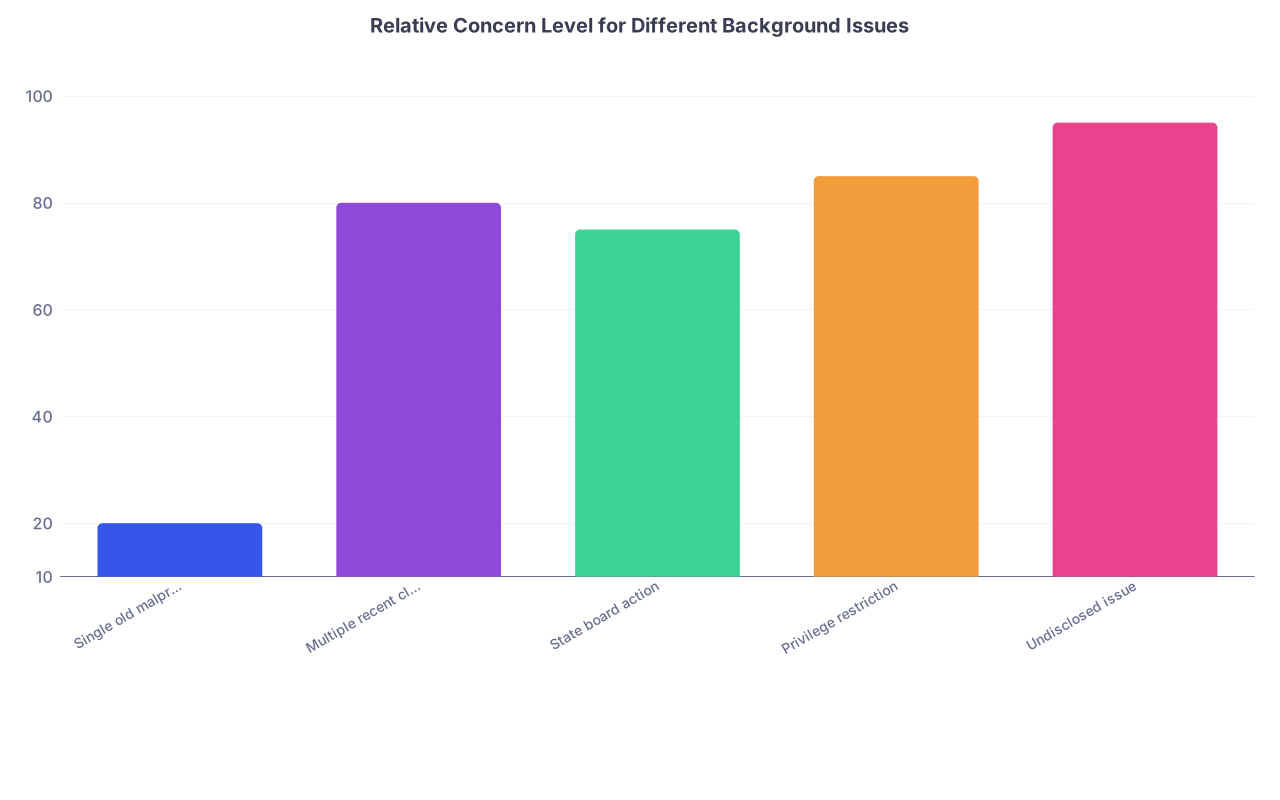
| Category | Value |
|---|---|
| Single old malpractice | 20 |
| Multiple recent claims | 80 |
| State board action | 75 |
| Privilege restriction | 85 |
| Undisclosed issue | 95 |
The committee discussion sounds like this:
“Was this a bad outcome in a high-risk case, or is this someone careless?”
“Was the board action documentation heavy-handed, or is there a real professionalism/impairment issue?”
“Do we want this in our medical staff minutes if something happens here?”
They’re not just judging your past. They’re imagining the future plaintiff’s lawyer putting your history on a projector in a courtroom with the hospital logo behind it.
Step 2: Training Pedigree and Red Flags That Aren’t on Your CV
Most new attendings obsess over where they trained: big-name vs community program. Credentialing committees are more focused on continuity, red flags, and missing context.
Where You Trained – And What That Signals
Here’s the blunt truth:
Well-known programs (Mayo, Hopkins, Mass General, big state flagships) buy you default trust. Not because they think you’re brilliant, but because they know those programs guard their own reputations and do not easily graduate disasters.
Smaller or lesser-known programs are not a problem by default. But they prompt more questions if combined with other issues. I’ve seen stacks like this:
“Moderate program, multiple short stints, and a resignation ‘for personal reasons’ mid-year.”
Now they’re digging.
Gaps and Transitions
Any of these will get discussed:
- Transfers between residencies
- Unexplained time gaps > 3 months
- “Personal leave” or “medical leave” without clarity
- Switching specialties mid-training
- Finishing at a non-ACGME fellowship or sketchy-looking “institute”
None of these are automatic exclusions. But if your record reads like a fragmented story, you’d better give them a coherent, believable narrative. Because they will call your programs.
Step 3: References – What People Actually Say About You
You probably think letters get a cursory glance. Not when they’re credentialing you for independent practice. They look much more closely than they did for residency or fellowship.
And here’s the thing: they don’t just read the letter. They pick up the phone.
The Phone Call That Matters More Than the PDF
Standard process in many hospitals:
- Med staff office receives your references
- A committee member or credentialing staff calls at least one of them
- They ask the questions that never make it into official forms:
“Would you hire this person?”
“Any reservations about their judgment or professionalism?”
“Would you let them operate on your family or see your own child?”
I’ve heard an attending say on a reference call:
“He’s clinically solid, but he was late a lot and had some friction with nursing.”
That sentence will follow you for years. Because it goes straight into the subtext of how much supervision or caution they think you require.

Coded Language Committees Understand Instantly
Credentialing committees are fluent in reference-speak. You may not be… yet.
Phrases that scare them:
- “Best with straightforward cases” → We didn’t trust them with complex ones.
- “Needed more direction than typical” → Questionable independence.
- “Improved over time” → Rough start, possibly professionalism problems.
- “Functioned well as part of the team” with nothing about judgment or skill → Mediocre at best.
They’re not just checking that you have letters. They’re weighing how confident those letters feel.
Step 4: Board Certification – Necessary, But Not the Whole Story
You’re newly boarded. Good. That meets a checkbox. But here’s how committees actually think about it:
Timing and Attempts
They care about:
- Did you pass on your first reasonable attempt?
- How long after training did you become boarded?
- Did you cut it close to the “board eligible” expiration window?
If you took multiple attempts or barely made the deadline, some places won’t care at all. Others will see it as a subtle signal about test-taking, knowledge retention, or… motivation.
No one’s reading your score report. They’re looking at the pattern:
Consistent progress? Fine.
Chaotic, last-minute scramble? Raises eyebrows.
Hospital Requirements vs Reality
Many hospitals have a line in the bylaws: must be board certified within X years of completing training. For new attendings who just passed, that’s satisfied.
The more telling situation is this: someone who never got boarded or let it lapse. That sparks a much more polarized discussion:
“Is this someone who just doesn’t care about standards?”
“Or are we in a desperate-to-fill-coverage situation and willing to bend?”
As a new attending who’s freshly boarded, you’re usually the easy case. Unless your file is messy in other ways, the boards piece just supports everything else.
Step 5: Behavioral and Professionalism Concerns
This is where a surprising number of otherwise competent physicians get slowed down or quietly sidelined.
What Shows Up That You Think Is Invisible
You assume those angry emails to your PD or that one blowup on night float are forgotten. They’re not. Program directors get asked straight up:
“Any concerns about this applicant’s professionalism, communication, or team interactions?”
And PDs—despite the myth—are not always protective. Some are blunt to the point of brutality. I’ve seen comments like:
- “Occasional conflicts with nursing staff, improved after feedback.”
- “Needed remediation for documentation and professionalism.”
- “Technically strong but not always receptive to feedback.”
None of those will guarantee a denial. But they will influence what privileges you get, how closely your cases are reviewed, and how ready they are to act if there’s a complaint.
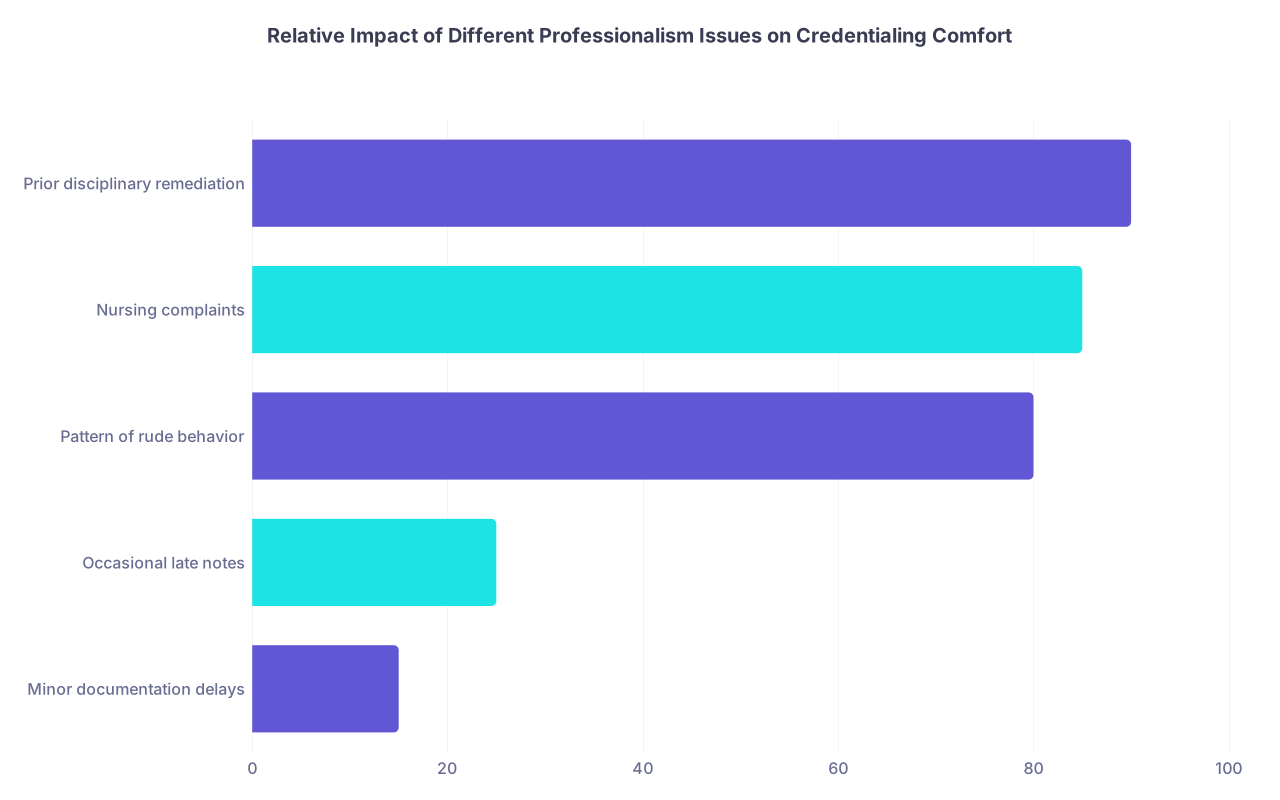
| Category | Value |
|---|---|
| Minor documentation delays | 15 |
| Occasional late notes | 25 |
| Pattern of rude behavior | 80 |
| Nursing complaints | 85 |
| Prior disciplinary remediation | 90 |
The hospital is thinking:
“Technical shortcomings we can monitor and teach. A personality that creates constant conflict? That’s a liability.”
Privileges: The Real Power Play You Aren’t Warned About
You think credentialing is binary: approved or denied. It’s not. The more subtle move is: approve you, then quietly clip your wings with limited privileges.
How They Limit You Without Saying “No”
This is the part people only learn the hard way. The committee can:
- Approve you only for certain procedures, not the full scope you requested
- Require proctoring for specific cases (with a certain number required)
- Tie your privileges to an internal review later (“re-evaluate after 6 months”)
- Deny only the advanced/complex cases but allow bread-and-butter ones
So you’re “on staff,” but you’re not practicing the full version of your specialty you thought you’d signed up for.

What Drives These Limitations
They look at:
- Case logs from residency/fellowship – Do you actually have volume in what you’re asking to do?
- Complexity – Are you requesting robotic, complex reconstructions, advanced procedures with thin logs to back it up?
- Match to hospital needs – Does the hospital even want certain services expanded, or are they risk-averse in that area?
I’ve seen committees say:
“He has 12 of that procedure in training, all supervised. Let’s start with proctored cases and revisit.”
That’s what they will not tell you directly during the recruitment dinner. But it’s absolutely part of the internal discussion.
Politics: Who You Know Still Matters More Than You Want to Believe
Let me be blunt. A mediocre candidate with a strong internal champion will often be credentialed faster than a stellar stranger with no one vouching for them.
Department Chair and Service Chief Influence
Here’s the real chain of power:
- Med staff office gathers the paperwork.
- Department chair/service chief reviews and makes a recommendation.
- Credentials committee and MEC (Medical Executive Committee) follow that recommendation most of the time.
If your future department chair is excited to recruit you, the tone of every meeting changes. People assume:
“If they want this person badly, they probably vetted them.”
Conversely, if the chair seems lukewarm or noncommittal, the committee starts reading every line with suspicion. It becomes a “cover ourselves” exercise.
Behind-the-Scenes Process: From Application to Vote
You should understand roughly how your file travels, because it explains the long silences and odd questions you sometimes get.

| Step | Description |
|---|---|
| Step 1 | Application submitted |
| Step 2 | Med staff office review |
| Step 3 | Primary source verification |
| Step 4 | Department chair review |
| Step 5 | Credentials committee |
| Step 6 | MEC review |
| Step 7 | Board of trustees approval |
| Step 8 | Privileges granted |
At each step, someone can:
- Ask for more information
- Send it back for clarification
- Recommend approval with modifications
- Stall it quietly while they talk behind closed doors
This is why one hire gets through in six weeks and another sits in bureaucratic purgatory for three months.
What Smart Residents and Fellows Do Before They Apply
If you’re still in training, you can absolutely influence what your file will look like when it hits that committee.

A few moves that matter much more than grinding another question bank:
Protect your professionalism record like your life depends on it. Because your career does. Avoid getting your name in any email chains about disruptive behavior, recurrent lateness, or combative communication. Those are the things PDs remember and quietly share.
Build at least two attendings who will go to bat for you on the phone. Not just sign a letter. People who will pick up a credentialing call and say, “Yes, you want this person. I’d hire them again.”
Keep your narrative clean. If you have gaps, leaves, or switches, craft a consistent, honest story and make sure your PD and references are on the same page. Inconsistencies are deadly.
Track your case logs like they’re an asset, not an annoyance. Because they are. When you request privileges later, that data is your ammunition.
FAQs
1. Does failing my board exam once hurt me long-term with hospitals?
Usually not, if you ultimately pass within a reasonable time frame and do not let eligibility lapse. Most credentialing committees look at current status: are you boarded now, yes or no? A single prior failure rarely makes it into the discussion unless your file is already full of other concerns (multiple remediation episodes, gaps, prior discipline). Patterns are what spook them. One stumble followed by clean performance is easy to accept.
2. How bad is it to have one malpractice payout as a new attending?
One payout, especially in a high-risk field (OB, neurosurgery, EM), is not an automatic deal-breaker. Committees will look at timing (recent vs old), amount, and context. If you disclosed it, have a coherent explanation, and your references are strong, many hospitals will credential you without much issue. What causes trouble is multiple payouts in a short window or a payout combined with a board action or privilege restriction at another hospital.
3. Can a hospital refuse to grant me certain privileges even if I’m fellowship trained in that area?
Yes, and it happens more than people admit. Fellowship training doesn’t force a hospital to let you do everything you were trained to do. They may limit you based on your documented case numbers, their internal comfort level with certain procedures, or strategic reasons (they do not want to expand a certain service line). You might be approved as an attending but required to have proctored cases or be denied specific advanced privileges until you prove local competence.
4. How much do soft skills and “being nice” actually matter in credentialing?
A lot more than residents think. Technical skill gets you through training; behavioral reputation determines how comfortable a hospital is taking a risk on you. Recurrent complaints from nursing, documented “disruptive behavior,” or a reputation for being difficult to work with can absolutely slow or complicate credentialing. Committees know clinical issues can be mentored and monitored. Chronic interpersonal problems turn into patient complaints, staff turnover, and legal exposure, which they’d rather avoid.
Key takeaways: Board certification gets you in the door, but hospitals credential you based on risk, not test scores. Your background, malpractice/disciplinary record, references, and professionalism history carry far more weight than your percentile on the boards. And the real power is not just “yes/no” to hiring you, but how broadly—or narrowly—they choose to grant your privileges.