
The residents who get crushed on oral boards usually did not “suddenly forget” how to operate. They built that failure years earlier with sloppy, lazy case logging.
Let me be blunt: your case log habits in residency can either quietly prepare you for oral boards or quietly sabotage them. There is no neutral ground.
You think you are just clicking boxes for ACGME minimums, satisfying some clerk in GME, doing “admin stuff.” You are not. You are building—or failing to build—the mental library you will use when an examiner says:
“Tell me about a recent case where a patient developed post‑op sepsis after a laparotomy. What did you do?”
If your internal reaction to that is, “Uhh… I know I must have had one…” you already see the problem.
Below are the most common mistakes residents make with case logs that come back to bite them hard at oral boards—ABS, ABOG, ABEM, anesthesia, ortho, you name it—and how to avoid being that panicked person in the hotel lobby the night before the exam.
Mistake #1: Treating Case Logs as a Checkbox, Not a Learning Tool
The most dangerous belief: “Case logs exist so the program meets ACGME requirements.”
That is how people sleepwalk into oral boards unprepared.
When you log a case only to hit numbers—“I need more hernias,” “I am short on peds,” “I better log these lap choles”—you miss the real value: the case narrative.
The boards do not care that you did “Lap chole #147.” They care whether you can:
- Reconstruct that case verbally
- Explain your decision making
- Defend your complications without sounding clueless or defensive
Superficial log:
- Lap chole, 40‑year‑old female, ASA 2, routine.
Oral boards reality:
- You will be pressed on “the one where you injured the CBD,” or “the one with conversion to open,” or “the one where you discharged her too early and she came back septic.”
If your logs say nothing meaningful, your brain will not store anything meaningful. You will remember vibes, not details. Vibes do not pass board exams.
Better habit: every time you log a case that deviates even slightly from “boring textbook,” add a very short free‑text note that future‑you could use as a hook:
- “Acute cholecystitis, dense inflammation, 2 clips on cystic, IOC done – critical view challenge.”
- “Hypotension after insufflation – had to decompress, treat presumed gas embolism.”
- “Post‑op bile leak POD 3 – ERCP with stent.”
That extra 20 seconds at logging becomes gold when you need real cases to discuss on exam day. You are building flashcards for your future oral boards whether you realize it or not.
Mistake #2: Incomplete or Vague Details – “I’ll Remember It Later”
No, you will not.
You will not remember whether that hysterectomy patient was 38 or 58. You will not remember if that trauma laparotomy was for a stab vs. blunt. You will not remember which hernia was strangulated vs. elective, or which appy perforated.
I have watched residents scroll their case lists 3 years later, trying to pull examples for a mock oral, saying:
“I know one of these lap appys perforated… not sure which one… maybe this one?”
That is a failure of documentation, not intelligence.
Here is where people go wrong:
- Logging only the CPT code and date
- Leaving all optional fields blank
- Never marking complications or reoperations
- Not indicating urgency (emergent vs elective)
Then they try to reconstruct nuance years later from a spreadsheet of identical lines: “Lap appy – 12‑year‑old – general anesthesia.” Useless.
Build habits now that specifically protect your future self:
Always mark urgency.
If your system allows “elective/urgent/emergent,” use it. Oral boards love to probe how you manage emergent vs elective risk.Flag complications clearly.
If a case had:- conversion to open
- unplanned return to OR
- ICU transfer
- major bleeding
then you should tag it in some consistent way—use the official complication field or your own standardized keyword in the free text: “COMPLICATION – post‑op hemorrhage POD 1.”
Capture key clinical hooks.
One or two words that will jog a complete memory later:- “pregnant”
- “cirrhotic”
- “CKD on dialysis”
- “BMI 52”
- “previous radiation”
Those tags are what let you, four years later, say: “I will use the perforated appy in the pregnant patient,” instead of: “I think there was some complicated appy in 2019?”
You will already be stressed during boards. Do not make yourself also dig through a sea of ambiguity.
Mistake #3: Logging Late and Logging Wrong
This is the silent killer.
The resident who “catches up” on case logs every 2–3 months is building a fantasy dataset. It might meet ACGME numbers. It will not support you in a high‑pressure oral exam where they ask:
“Walk me through a case you did 18 months ago when you were on trauma nights.”
The cognitive science here is not mysterious. Memory decays fast. Even one week later, your recall of specific operative details, hemodynamics, and decision forks is already degraded. Three months later, you are fabricating half of it without realizing.
Signs your logging is too delayed:
- You routinely have to open charts to remember even basic diagnosis or approach
- You log an entire week or month at once
- You say, “I will log that later” more than “I will log that now”
Here is what happens down the line:
On oral boards, you need real, internally consistent stories. If your case logs were built from half‑remembered guesses, your brain will serve you those same distorted narratives. You will contradict yourself under cross‑examination: say the patient was stable when they were not, forget that you used a drain, misrepresent timing.
Examiners notice. They may not say “your case logging habits were poor,” but that is exactly what they are seeing.
Protect yourself with one non‑negotiable rule:
Same day or next day logging. Every time.
Post‑call is messy, I know. But you can still capture:
- The big cases
- Anything unusual
- Anything with a complication, near‑miss, or difficult decision
If you absolutely must delay bulk logging, at least keep a quick, same‑day scratch list—notes app, pocket notebook, whatever—with 1–2 word reminders:
- “ACS – SBO – intraop enterotomy”
- “TKA – intraop fracture”
- “OB – PPH 2L, Bakri, transfused”
Then, when you formally log 2–3 days later, you have accurate anchors.
Mistake #4: Ignoring Complications to “Keep the Log Clean”
This one is both common and dangerous.
The resident thought process usually goes like this:
“If I flag too many complications, my numbers will look bad. Program leadership will wonder if I am unsafe. Better to just… not highlight that bile leak or that post‑op ARDS.”
So they either do not log the case at all, or they log it as routine. Clean. Sterile. Fiction.
Then oral boards arrive, and they panic because they “do not have many complications to discuss.” That is almost never true. What they mean is: “I did not track my complications in a way that I can find them now.”
Examiners are not impressed by a complication‑free career. They are suspicious of it. What they want to see is:
- That you recognize complications
- That you respond appropriately and decisively
- That you understand preventable vs inevitable risk
- That you can analyze your own errors without collapsing
Poor case logging deprives you of legitimate, rich cases to demonstrate exactly that maturity.
Here is where it backfires most:
On exam day, you get a question like:
“Tell me about a case that did not go well. A complication or unexpected outcome.”
You freeze. Not because you never had one. Because:
- You never tagged them in your case log
- You never reviewed them deliberately
- You half‑blocked them from memory because they were painful
So you pull a vague, watered‑down “minor wound infection” case. Examiners push. It becomes obvious that you are avoiding talking about real morbidity. Your credibility drops.
The fix:
Log every significant complication.
Not just deaths and reoperations. Include:- unplanned ICU transfers
- large transfusions
- major infections
- prolonged vents
- readmissions for serious issues
Tag them consistently.
Create your own internal flag: “COMPL,” “MAJOR COMP,” etc. Same pattern every time so you can filter later.Review them annually.
Before in‑service exams or before semiannual meetings, pull your complication cases, reread them, and write 2–3 bullets for each:- What happened
- What I did well
- What I would do differently
You are not just building a log. You are building a bank of mature, credible stories to use when examiners say, “Tell me about a time you made a mistake.”
Mistake #5: Not Linking Logs to Deliberate Board Prep
Here is the big misunderstanding: residents treat case logs and board prep as two separate worlds.
World 1: Case logs = satisfy ACGME.
World 2: Oral boards = study guidelines, read textbooks, do mock orals.
That split thinking is how you end up over‑reading and under‑practicing real case discussion.
Your case logs should be the spine of your oral board prep. If you are not using them that way, you are leaving both memory and performance on the table.
Most residents never do the following—but the ones who pass comfortably usually do:
Pull your own case list and turn it into exam prompts.
- Pick 5 biliary cases with different twists (acute, chronic, CBD stone, duct injury, geriatric)
- Pick 5 OB cases (PPH, shoulder dystocia, preeclampsia, VBAC, twins)
- Pick 5 trauma cases (blunt hollow viscus, solid organ injury, pelvic fracture, penetrating under diaphragm)
For each, practice out loud:
- Pre‑op assessment: what you knew and how you stratified risk
- Intra‑op decisions: why you chose approach A vs B
- Post‑op course: complications, escalation, ICU, imaging
- Outcome and reflection: what you learned, what you would change
If your logs are vague, inconsistent, or incomplete, this structured prep is almost impossible. You keep running into “I… sort of remember… but not quite.”
That is what poor logging costs you: not just clean paperwork, but the single easiest source of oral board practice material—your own cases.
Mistake #6: Letting Someone Else Own Your Case Narrative
Another subtle trap: letting attendings or billing personnel “fix up” your logs so much that they stop reflecting what you really did.
For example:
- The attending changes the primary CPT code after the fact for billing reasons
- A co‑resident adds themselves as first assist on a case you barely scrubbed into
- You log as “primary surgeon” on a case where you only did skin because you are trying to hit numbers
- You routinely log group cases without clarifying your exact role
On paper, it looks great: high volumes, complex cases, impressive spread.
On oral boards, this can destroy you.
Examiners will assume that if you logged it as your case, you can walk them through it in detail. If you cannot:
- Explain why that approach was chosen
- Reconstruct the operative steps in the right order
- Discuss intra‑op decision forks that you never actually saw
- Describe post‑op management that you never actually directed
you will sound fake. And nothing sinks an oral board faster than sounding fake.
Self‑protection rules:
Only log as primary what you could defend in detail.
If you barely saw the case, log your role accurately. There is no shame in “assisted, observed, second assist.” The shame comes later when you try to wing a case you never really owned.Keep a short personal list of “my real cases.”
Out of hundreds of logged cases, 20–30 will be truly yours: you saw them in clinic, admitted them, were there for every key decision, and followed them post‑op. That is your oral board toolbox. You need to know exactly which cases those are.Periodically reconcile with reality.
Once a year, skim your log for obviously inflated or questionable entries. Clean them up. Future‑you does not want to be on an exam hot seat trying to explain a case you barely remember because it was mostly someone else’s.
Mistake #7: Never Practicing Retrieval Under Pressure
Reading your case log is not the same as being able to talk through a case under fire.
Poor habits here are sneaky. Residents will “review” logs before in‑service or before semiannual meetings by skimming. Passive. Comfortable. Worth almost nothing for oral board performance.
On the exam, you will face a different environment:
- Tight time pressure
- Examiner interruption
- Long sequences of “what if” branches
- Zero access to notes, logs, or EMR
If all your experience with your case log is scrolling a spreadsheet on your laptop, you are not training the muscle you will use.
Here is where poor logging practices and poor retrieval practice intersect:
If your logs lack clear hooks, you cannot even generate decent prompts for mock orals. So you default to generic, textbook cases. Which are safe, but weak. Examiners can tell when a case is real vs canned.
Better pattern:
Use your case log as a question generator, not a museum.
Once a month, sit with a senior, fellow, or co‑resident and:
- Pick 3–5 cases from your log at random
- Have them say, “OK, tell me that story as if I am your examiner”
- Let them interrupt: “Stop. Why did you choose that imaging? What were you worried about? What else could you have done?”
If your logging is clear and specific, this is easy. If your logging is vague, this exercise is brutal—which is exactly how it will feel on exam day.
Mistake #8: Failing to Track Breadth and Patterns Early Enough
A final way poor logging haunts you: you discover gaps too late.
You are PGY‑5 or chief. Oral boards are on the horizon. You finally look closely at your log and realize:
- Very few cases in certain core areas (e.g., no real pelvic floors, almost no complex vascular, minimal high‑risk OB)
- Almost no pediatric emergencies
- Very few cases with major complications logged
At that point, there is not much time to fix it.
Worse, your brain’s “repertoire” is now biased. You have done 200 routine lap choles and 6 true catastrophes. Guess which ones you remember more crisply? The common ones. But examiners often probe the edges—rare complications, complex anatomy, unusual comorbidities.
Good logging habits allow earlier pattern recognition. Quarterly, you can look at your log and ask:
- Where am I light on experience?
- What types of complications have I not yet managed personally?
- Do I have at least a few cases of the “classic” oral board scenarios? (massive PPH, septic shock, anastomotic leak, tension pneumothorax, etc.)
Then you can actively seek those experiences while you still have time—join certain cases, follow certain patients more closely, scrub when that high‑risk trauma rolls in.
Here is a simple structure to use your log to monitor breadth:
| Category | What to Check Quarterly |
|---|---|
| Volume | Are key index procedures on track |
| Variety | Emergent vs elective balance |
| Complications | Logged and tagged consistently |
| Patient Factors | Age extremes, comorbidities |
| Ownership | Cases I truly owned end to end |
If you do not do this until the year before boards, you have already limited what you can realistically draw from when under examination.
Visualizing How Habits Accumulate
Here is what different logging habits do to you over time:
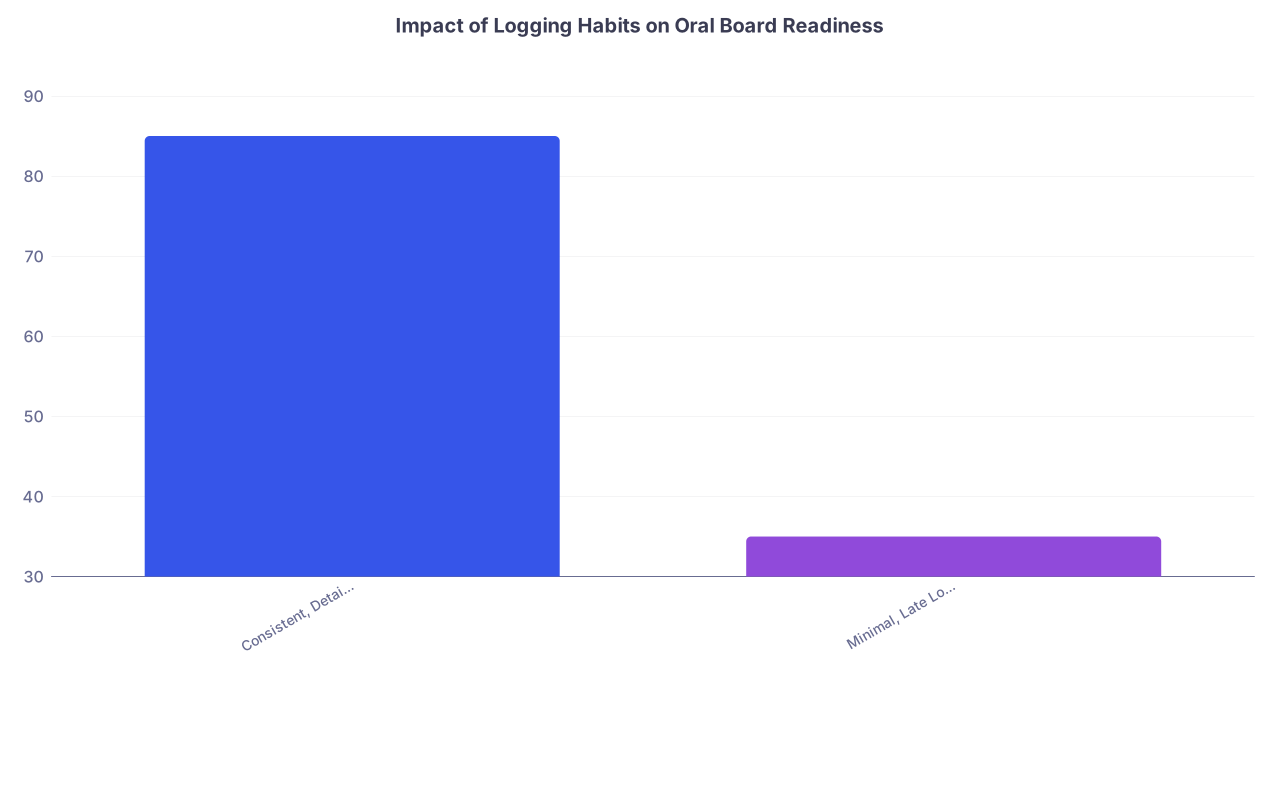
| Category | Value |
|---|---|
| Consistent, Detailed Logging | 85 |
| Minimal, Late Logging | 35 |
Imagine that bar is not some abstract score. It is your ability, under pressure, to recall a case, explain it cleanly, handle pushback, and not contradict yourself.
The gap is built incrementally. Month after month. Click by click.
How to Fix Your Case Log Habits Starting Now
You do not need a five‑page system. You need a few non‑negotiables and the discipline to hold them:
Log daily or every post‑call.
No 3‑month catch‑ups. Ever.For any non‑routine case, add a 1–2 line free‑text memory hook.
Enough that future‑you can pick it out and remember the story.Tag all complications consistently.
Use the official fields plus a personal keyword if needed.Mark actual role honestly.
Only claim primary on cases you can defend under interrogation.Once a quarter, use your log to run 3–5 mock oral cases.
Out loud. With interruption. With pushback.Once a year, review your complication cases deliberately.
Turn them into polished narratives with clear “what I learned” points.
Those habits will do more for your oral boards than another half‑read review book.
One Last Thing You Should Stop Telling Yourself
“I will worry about oral boards later. I just need to survive residency right now.”
That is how future‑you ends up trying to cram 3 years of reflection and case understanding into 3 panicked months, with a sterile, incomplete case log as your only tool. It is miserable. I have watched people go through it. Some pass anyway. Many do not.
Oral boards are not a separate event. They are the final stress test of how you have been thinking, operating, and documenting all along.
If your case logging is lazy, your thinking will be lazy. If your logging is precise, honest, and timely, your narratives will be too. Examiners are extremely good at feeling the difference.

| Step | Description |
|---|---|
| Step 1 | Real Patient Case |
| Step 2 | Same day detailed log |
| Step 3 | Tag urgency and complications |
| Step 4 | Quarterly review and pattern check |
| Step 5 | Select key cases for practice |
| Step 6 | Mock oral with interruption |
| Step 7 | Refined, reliable case stories |
Open your case log system today—whatever your institution uses—and pull the last 10 cases you entered. For each one, ask: “If an examiner picked this and said ‘tell me everything,’ would I be ready?” Then fix at least one of those entries so future‑you is not stuck guessing.