
The evaluation you get is not about the shift you worked. It is about whether you’re someone they’d trust when nobody is watching.
Let me say that plainly: attendings are not writing “what happened.” They’re writing “how safe are you” in board-exam language. And there’s a whole layer of unspoken rules under that which no one explains to residents.
You’re living inside a system you do not fully see. I’ve watched this from the other side of the screen—sitting at the workstation at 9 p.m. clicking through evaluation forms that allegedly “map to the Milestones” but in reality boil down to: would I want you on my service again, and would I be okay if you were alone with a sick patient at 3 a.m.?
Let me walk you through what’s actually happening when attendings write those board-style evaluations.
What Attendings Are Really Scoring (It’s Not Just Knowledge)
The official forms have Milestones, sub-competencies, Likert scales, and all the other alphabet soup the ACGME loves. Attendings don’t think in those terms. They think in patterns that sound like oral boards.
On paper it says:
- “Patient care”
- “Medical knowledge”
- “Systems-based practice”
In their head it’s much more primitive:
- “If the board examiner gave them a crashing patient stem, would they kill the patient or save them?”
- “If left alone, would they miss the thing that kills?”
- “Would I sign my name under their note and sleep at night?”
The unspoken translation: your daily work is being mentally converted into exam-style risk assessments.
So when you think, “I presented clearly and answered most questions,” you’re grading yourself on your performance. Your attending is thinking, “That answer about hyperkalemia? They missed the board-critical ‘give calcium first’ moment. That’s a problem.”
They don’t write: “Resident missed calcium in hyperkalemia.”
They write: “Needs continued development in managing acutely ill patients; should work on prioritization in emergencies.”
That’s code. Board code.
How a Single Shift Turns into a “Board Case” in Their Head
Here’s the part nobody tells you: attendings compress your entire month into 2–4 mental “cases.” Those cases become your written evaluation.
Typical pattern I’ve seen dozens of times:
- First strong impression case – usually your first or second new patient with them.
- One stress test – admission rush, cross-cover, code, or something after midnight.
- One follow-up / longitudinal case – did you remember the plan, follow results, adjust based on data.
- One professionalism or communication moment – handoff, family talk, consultant interaction.
If you were great on 50 other patients but shaky on the one crashing GI bleed at 2 a.m., guess which one stamps itself on their brain? The outlier. The stress test.
They write their evaluation like a board examiner. Here’s what that internal translation looks like:
| Real-Life Event | How Attendings Mentally Code It |
|---|---|
| You forget DVT prophylaxis on a stable patient | “Misses safety checklist items in routine care” |
| You freeze during a rapid response | “Struggles to lead in acute scenarios; knowledge retrieval under pressure needs work” |
| You calmly handle a septic patient and call ICU early | “Recognizes early deterioration; manages sepsis at expected level or above” |
| You argue with a consultant about nothing critical | “Needs improvement in interprofessional communication and collaboration” |
| You call for help early in an airway case | “Appropriate recognition of limits; safe escalation” |
Then they force those impressions into the Milestone grid. That’s why sometimes the narrative and the numerical ratings don’t quite match. The form doesn’t fit the way they actually think.
The Quiet Taxonomy: How Attendings Sort Residents in Their Heads
No attending will admit this out loud at an orientation talk. Over coffee or late-night sign-out? You’ll hear it.
We roughly sort residents into tiers, and the evaluation follows the tier, not the other way around.
The mental categories usually look like this:
“Board-safe, independent soon”
These are your early board-passer vibes. Maybe not perfect, but solid pattern recognition, safe, reliable.“Safe with supervision, still patchy”
Will probably pass boards, but might need a structured review course. Needs more reps, more scaffolding.“Concerning—could fail boards or hurt someone if not watched”
This is where the commentary starts to sound vague and anxious: “needs close supervision,” “benefits from direct guidance in complex patients.”“I’d never want them covering alone”
Rare, but you’ve seen these residents. They may have knowledge on paper, but under pressure they unravel.
The dirty secret: your label in that taxonomy shades every evaluation afterwards. Once an attending decides you’re “board-safe,” small mistakes get framed as growth points. If you’re pegged as “borderline,” the same error becomes proof.
So your job on a rotation is not to be perfect; it’s to move yourself up one tier in their mental board-safety schema.
The Stock Phrases Attendings Use as Codes
Let me decode some phrases you will absolutely see in board-style evaluations. These are not random.
When attendings are worried about your boards but trying not to nuke your career, they write things like:
“Would benefit from further deliberate practice in clinical reasoning.”
Translation: misses key steps in thinking; may struggle with complex board vignettes.“At times has difficulty synthesizing data into a coherent assessment and plan.”
Translation: can list labs and findings but cannot pick the board-relevant diagnosis.“Continued growth expected in managing acutely ill patients.”
Translation: I am not comfortable with them in a code or crashing scenario yet.
When they’re quietly reassured about your board trajectory:
“Demonstrates pattern recognition appropriate for level.”
Translation: sees the board diagnoses when they’re there.“Efficiently identifies sick patients and escalates appropriately.”
Translation: won’t miss the board’s ‘red flag’ patients.“Learns from feedback and does not repeat mistakes.”
Translation: when they blow something, they fix the underlying understanding, not just the fact.
When they are concerned enough to talk about it at CCC (Clinical Competency Committee):
- “Requires more than usual supervision for level.”
- “Benefits from stepwise guidance in developing management plans.”
- “Should focus on consolidating core knowledge before assuming greater autonomy.”
Those are red flags in committee discussions. People notice.
How Boards Shape the Way We Judge Your Daily Decisions
Board-style thinking bleeds into everything. We don’t just ask, “Did they manage the case?” We ask, “Did they think like the exam wants them to think?”
Here’s how that plays out on a random Tuesday.
You have a 65-year-old with chest pain. Normal troponin, non-specific EKG. You think: probably reflux. Let’s give a GI cocktail and observe.
Your attending is thinking three layers:
- Clinical reality – Could be reflux. Could be unstable angina. Did you at least consider the deadly stuff properly?
- Board framing – Did your reasoning clearly identify and rule out the big killers in the correct order?
- Evaluation language – Do I write “solid clinical reasoning” or “premature closure on initial impression”?
Same case, different outcomes:
If you say out loud: “This could be reflux, but we have to assume cardiac until proven otherwise. I want serial troponins, repeat EKG, and consider stress testing,”
you’ve just spoken fluent board-exam language. Your eventual plan can still be conservative, but the way you thought is what they’re judging.If you shrug and say: “Probably GERD. I’ll order Maalox,”
even if the patient is fine, you’ve just tagged yourself as “board-immature” in their head.
We notice your thresholds:
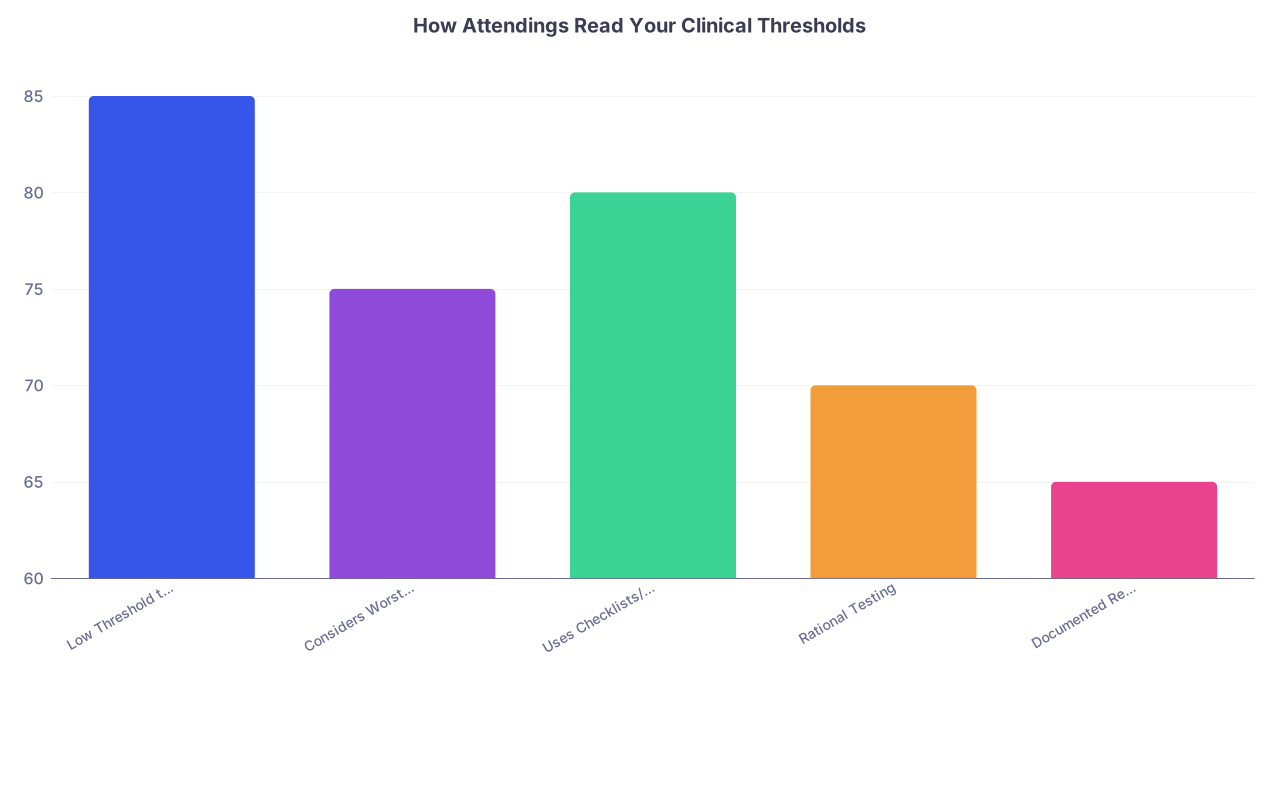
| Category | Value |
|---|---|
| Low Threshold to Call for Help | 85 |
| Considers Worst Case First | 75 |
| Uses Checklists/Safety Nets | 80 |
| Rational Testing | 70 |
| Documented Reasoning | 65 |
That’s how much these elements weigh when someone is mentally converting your behavior to a board-safety score. Numbers here are conceptual, but the relative weights are real.
The “Board Examiner Voice” Attendings Hear When You Present
You think you’re talking to your attending. They’re half-listening to you, half-hearing an imagined board examiner grill you on the same case.
On rounds, when you present:
“This is a 72-year-old male with CHF presenting with shortness of breath…”
The attending’s inner monologue goes:
- Did they define the acuity?
- Did they tell me what they think, not just what the chart says?
- Are they giving me the “most likely diagnosis” and “next best step” the way boards want answers?
The safer you sound in that “board examiner voice,” the more generous the evaluation becomes, even if your knowledge isn’t encyclopedic.
Two residents, same knowledge base:
- Resident A mumbles a list of symptoms, no clear statement of the problem, no prioritized plan.
- Resident B says: “Top concern is decompensated heart failure, NYHA class III symptoms, likely triggered by dietary indiscretion and medication nonadherence. Next step is IV diuresis and checking labs including BNP and renal function, with a low threshold to escalate if he worsens.”
Resident B gets “strong clinical reasoning” on the eval. Resident A gets “needs to continue developing synthesis of data.” Same brain, different framing.
The Role of Milestones, CCC, and How Your Evaluations Actually Get Used
Here’s the structural piece you rarely see:
Your board-style evaluations don’t live in isolation. They get fed into:
- The Clinical Competency Committee (CCC)
- Semi-annual Milestone reports
- Internal discussions about: “Is this resident on track to pass boards and practice safely?”
The CCC does not go case by case. They scan for patterns.

| Step | Description |
|---|---|
| Step 1 | Daily Clinical Performance |
| Step 2 | Attending Mental Impression |
| Step 3 | Written Evaluation Comments |
| Step 4 | Milestone Level Assigned |
| Step 5 | CCC Pattern Review |
| Step 6 | Routine Support |
| Step 7 | Targeted Feedback and Monitoring |
| Step 8 | Formal Remediation or Extension |
| Step 9 | On Track for Boards |
Inside that CCC meeting, people do say the quiet part out loud:
- “I’d be nervous about them alone in the ICU.”
- “Their knowledge is fine but when things get stressful, they shut down.”
- “If boards were tomorrow, I’d be worried.”
Those concerns turn into vague phrases on your semi-annual evaluation. Nobody writes: “I think they might fail boards.” They write: “Should continue to consolidate fund of knowledge in preparation for independent practice.”
You’re reading sanitized language. Behind it, real concerns or real trust.
Behaviors That Quietly Boost Your “Board-Safe” Image
Let me be very concrete. These behaviors disproportionately improve the board-style way attendings evaluate you, even if your raw test scores are just average.
Say the lethal diagnoses first. Every time.
When you present chest pain, start with: “Most concerning for ACS until proven otherwise, though other considerations include…” That simple sentence screams “board-minded.”Narrate your thresholds out loud.
“If the next lactate is up, I’ll call ICU. If her work of breathing increases, I’ll ask for high-flow and step up monitoring.”
Attendings love this. It sounds exactly like the decision forks in a test question.Ask one targeted, board-flavored question per day.
Not “Can we talk about hyponatremia?”
Try: “In a hypotonic hyponatremic patient with seizures, how aggressively do you bolus hypertonic saline, and what’s your go-to correction limit to avoid osmotic demyelination?”
That gets remembered.Close the loop on your misses. Publicly.
If you got something wrong yesterday, show up and say: “I read about it last night; here’s the key algorithm I was missing.”
That instantly flips the narrative from “concerning gap” to “fast learner, boards will be fine.”Own your zone of competence. Don’t fake it.
The fastest way to get a scary board-style comment is to pretend you know more than you do and then flail in a critical moment. Saying “I’m not comfortable managing this independently yet; can we walk through it?” sounds like maturity, not weakness.
The Stuff That Tanks Your Evaluation Faster Than a Bad Test Score
People think a single low in-service exam score dooms them. It does not—if your clinical behavior screams “safe and teachable.” What really destroys board-style evaluations is something else.
Patterns like:
Recurrent overconfidence with shallow understanding.
The “I got a 250 on Step 1” resident who can’t manage sepsis without a prompt. Attendings have a special radar for this.Silence under pressure.
Not wrong answers. Silence. The board analogy is the candidate who stares at the oral board examiner and cannot get words out. If that happens in real life, you will absolutely see reflective language in your evaluations.Blaming the system/others for every miss.
The consultant, the nurse, “the ED didn’t…” Residents who never say “I should have” get tagged as dangerous in our heads.Visible disinterest in improving.
People who shrug at feedback. Who never follow up. That is how you end up with: “Will require above-average supervision in independent practice settings” on paper, which is poison.
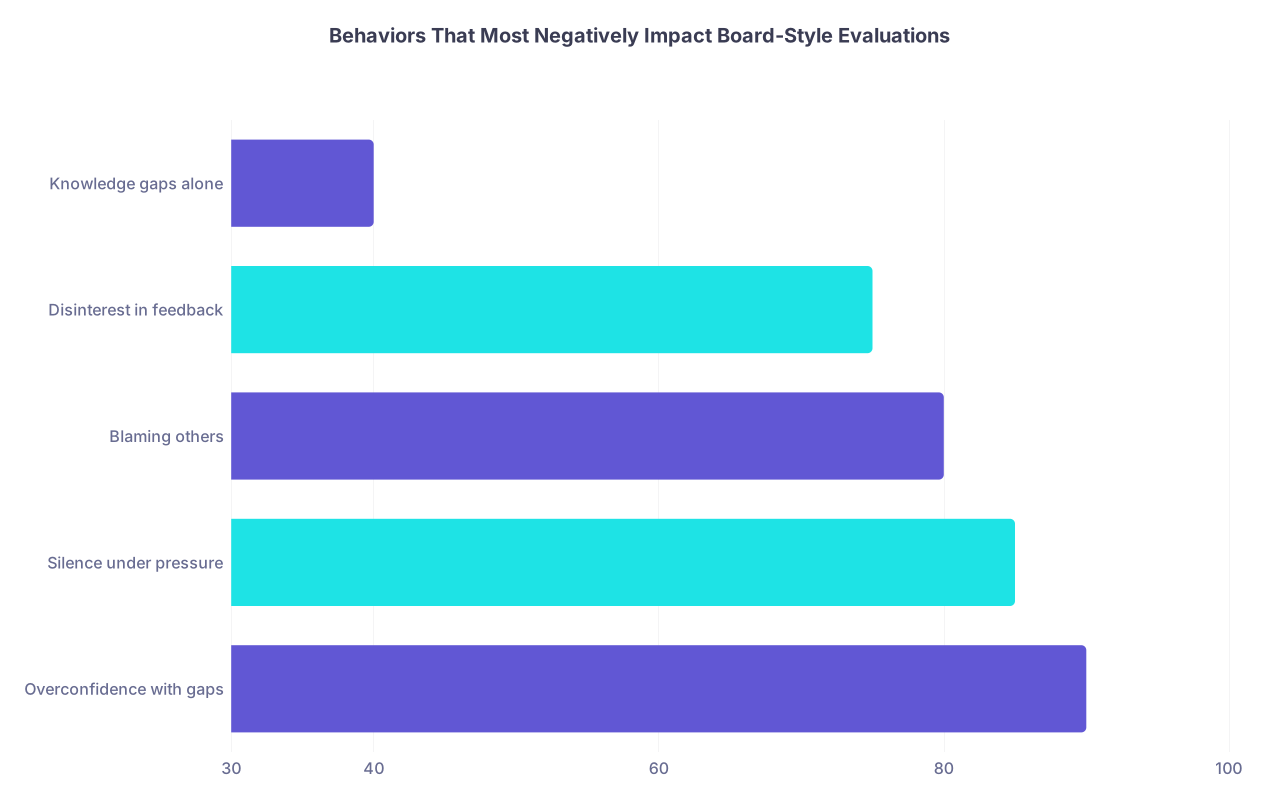
| Category | Value |
|---|---|
| Overconfidence with gaps | 90 |
| Silence under pressure | 85 |
| Blaming others | 80 |
| Disinterest in feedback | 75 |
| Knowledge gaps alone | 40 |
Notice that “knowledge gaps alone” is at the bottom. We can fix knowledge. We are much more rattled by residents who are unsafe in style.
How to Read Your Evaluations Like an Attending Does
You’ve probably read your evaluations like Yelp reviews. “This attending liked me; this one didn’t.”
Stop doing that. Start reading them like an attending on a CCC.
Here’s how:
Ignore the fluff. Track the themes.
Circle every phrase that mentions “clinical reasoning,” “management of acutely ill patients,” “synthesis,” “independent practice,” “safe,” “pattern recognition.” Those are your board-style markers.Check the trajectory, not a single rotation.
Are the comments shifting from “needs help” → “appropriate for level” → “ready for next step”? Or are you stuck in “developing” limbo?Pay attention to the “with supervision” wording.
“With supervision” is expected early. If it lingers into late PGY-2/3 in core areas, that’s a yellow flag.Look for fear or reassurance between the lines.
Do they sound reassured: “I would trust them with…” “I would be comfortable with…”
Or do they sound nervous: “benefits from…” “would benefit from additional…” “at times struggles…”
If you’re seeing worrying patterns, you don’t wait. You pick one attending you trust and ask for a brutally honest, off-the-record read: “If boards were tomorrow, what would worry you about me, and how do I fix it in the next 6 months?”
That’s a grown-up question. The kind that makes attendings invest in you.
A Simple Weekly Practice That Changes How You’re Evaluated
Final insider move. If you want to quietly but powerfully shift how attendings write about you, do this once a week:
- Pick one real patient that made you sweat.
- Write a short board-style stem for them.
- Answer it yourself like an exam: most likely diagnosis, next best step, most important test, worst complication.
- Then find an attending (or senior) and say, “Can I run a board-style case by you and see if my thinking tracks how you’d approach it?”
You are training your brain and their perception at the same time. You’re telling them: “I think in cases; I think in priorities; I’m exam-ready or will be soon.”
Attendings remember the resident who voluntarily thinks like a board candidate. Because boards are, whether anyone says it out loud or not, the hidden curriculum behind most of the “clinical reasoning” language on your evaluations.
FAQs
1. My comments are all “meets expectations” and generic praise. Is that bad for boards?
Not necessarily. Many attendings are lazy or rushed evaluators. Generic “pleasant to work with, solid knowledge” comments with average-to-above-average ratings usually mean: you did fine, no major safety concerns, not the star, not the problem. If your in-service scores and practice exams are okay, you’re probably not setting off alarms. But if you’re worried, ask directly: “What would I need to do to be ‘clearly ready’ for independent practice in your eyes?”
2. I have one rotation with very negative comments. Will that haunt me?
One bad eval does not sink your career, but it will get discussed if it stands out. What CCCs look for is course correction. If after that rotation you start getting “improved,” “responded well to feedback,” “now manages patients effectively,” that single outlier becomes a growth story, not a death sentence. What kills you is repeated similar language across multiple rotations.
3. Do attendings really care about my written notes when evaluating me for boards?
Absolutely. Notes are where we see your unaided reasoning. If your notes read like: “subjective, objective, random plan,” with no prioritization or explicit reasoning, that’s a yellow flag. A clean note that states: “Most likely…; must also consider…; plan because…” shows exactly the kind of thought process boards reward. Many attendings mentally link strong notes with “this person will be okay on written boards.”
4. How honest can I be about not knowing something without hurting my evaluations?
You can be very honest about not knowing as long as you pair it with visible effort and follow-through. “I don’t know, but I’ll look it up and get back to you,” followed by actually coming back with a clear answer, reads as maturity and board-readiness. The dangerous thing is pretending you know, winging it in critical moments, or repeatedly not closing the loop. Attendings will forgive gaps; they will not forgive denial or inertia.
Key points, so you walk away with something sharp:
- Attendings are quietly asking one question in your evaluations: “Are you board-safe?” Everything else is noise.
- Your daily behavior gets mentally translated into board-style “cases” and safety judgments, then sanitized into Milestone language. Learn to speak that language back to them.
- You can tilt those evaluations in your favor by thinking out loud like a board candidate: lead with lethal diagnoses, narrate thresholds, close loops, and show you learn fast from your misses.