
Two chiefs sat in my office at 6:30 p.m., half eaten pizza on the table, USMLE question bank quotes on a printout between us. They thought they were there to “give resident input” on which board review package to buy. In reality, the decision had already been made three weeks earlier in a meeting they were never invited to.
Let me walk you through how it actually works when your program “chooses” board review resources. Because the story you’re told at noon conference is not the story that played out in the conference room at 7 a.m.
The Real Agenda: What Programs Actually Care About
You’re told: “We want to give you the best tools to succeed on boards.”
What’s said behind closed doors is closer to: “We will not let our board pass rate drop below X, and we have Y dollars to prevent that.”
Every resource discussion is a tug-of-war among five pressures:
- Board pass rates
- ACGME and specialty board scrutiny
- Budget and GME politics
- Faculty convenience
- Resident morale (yes, but it’s usually last)
No one says it that bluntly in a town hall. In closed faculty meetings, they do.
Here’s the mental checklist a program director is running while you’re arguing “AMBOSS is just better”:
- Will this move our pass rate needle or not?
- Will the DIO (Designated Institutional Official) approve the cost?
- Will this make our weak test-takers less likely to fail?
- Can we track usage and blame something other than “our teaching” if scores drop?
- Will residents complain loudly if we don’t buy it?
If a resource can’t solve at least two of those problems, it’s dead on arrival, no matter how much you like the interface or the explanations.
How the Meetings Actually Go
The resource decision doesn’t happen once. It happens in waves. Let me show you the real timeline structure.

| Step | Description |
|---|---|
| Step 1 | Board Scores Arrive |
| Step 2 | PD Reviews Failures |
| Step 3 | Faculty Meeting |
| Step 4 | Maintain or Cut Resources |
| Step 5 | Search For New Resource |
| Step 6 | Vendor Presentations |
| Step 7 | Budget Negotiation |
| Step 8 | Token Resident Input |
| Step 9 | Finalize Contract |
| Step 10 | Scores Good or Bad |
Stage 1: The Panic or the Shrug
When board scores come out, there’s always a closed-door debrief.
If the three-year rolling pass rate is safely above the national threshold, the tone is:
“Let’s not overspend. We’re fine.”
If it’s dropped, or if two or three residents failed, the tone shifts fast:
“What are we doing about test prep? What interventions are in place? What can we document?”
Nobody wants their program on the specialty board’s “at risk” list. That flag quietly shapes resource decisions far more than your preference for question stem length.
Stage 2: Vendor Courtship (AKA: The Sales Show)
You see the result. You don’t see the courting.
Vendors know exactly how vulnerable programs are to pass-rate fear. I’ve sat in on the pitches. They show:
- Shiny dashboards of “predictive scoring”
- Testimonials from big-name academic programs
- “Exclusive institutional discounts” that expire in two weeks (they don’t)
What does the PD ask about?
- “Can we see institutional usage metrics?”
- “What early warning flags do you provide for at-risk residents?”
- “Can we get a report that I can drop into my Clinical Competency Committee packet?”
They’re not primarily asking, “Is this the best learning tool?” They’re asking, “Can this protect us politically and on paper?”
Stage 3: Internal Fight – Faculty vs Budget
The actual fight is rarely “UWorld vs AMBOSS vs BoardVitals.”
It’s: “Do we pay for one big resource or a mix of cheaper ones?”
You’ll hear phrases like:
- “We’re already paying for MedStudy; do we really need a Qbank too?”
- “The hospital just cut CME funding. Where is this going to come from?”
- “If we buy this, we have to cut back on live board review sessions or conference food.”
There’s almost always a GME-level cap per resident per year. I’ve seen numbers like $500–$1,200/resident/year, depending on institution and specialty. Everything has to fit under that ceiling.
| Institution Type | Typical Range (USD) |
|---|---|
| Community Hospital Program | $300–$700 |
| Mid-sized University Program | $500–$1,000 |
| Big Name Academic Center | $800–$1,500 |
If you’re in a smaller or financially stressed program, your PD is trying to cover:
- Question bank(s)
- Video lectures or review course
- In-training exam fees
- Maybe a book stipend
- Maybe a live review course or board prep day
All inside that number. That’s why you don’t “get everything.”
Why Programs Pick the Resources They Do (The Uncomfortable Truths)
Let’s break down the major categories and what actually tilts the decision.
Question Banks: Why You Get What You Get
Everybody wants “the best Qbank.” But programs don’t choose them the way you think.
What matters behind the scenes:
Benchmarking and Analytics
If a Qbank offers institutional dashboards that can correlate performance with board outcomes, they immediately move up the list.
Why? Because then the PD can walk into a CCC meeting and say:
“We identified this resident as high risk based on sub-40% performance on these domains and implemented remediation.”
That sentence is gold during an ACGME site visit.Licensing Flexibility
Programs love:- Institutional logins rather than juggling 50 individual codes
- The ability to start subscriptions on staggered dates (for off-cycle residents)
- Multi-year commitments with discounts
Those unsexy logistical details often beat “which explanations are better.”
Board-Style Alignment
If the in-training exam (ITE) questions feel similar to a particular vendor, that vendor will get chosen even if residents swear another bank is “better.”Faculty will literally say, “The ITE feels like X, we should stick with X.” Residents lose that argument 9 out of 10 times.
Cost Per Seat vs. Per Cohort
A vendor offering a flat institutional fee instead of per-resident licensing often wins at larger programs. The PD would rather buy “unlimited seats” and know the cost upfront.
So if your program insists on a Qbank you think is second-tier, there’s probably a data or contract reason, not ignorance.
Video and Review Courses: Why You Get Stuck with Certain Ones
Here’s a harsh truth: most faculty are not watching the videos they’re buying for you. They are relying on reputation, other PDs’ opinions, and board pass-rate graphs from vendor slides.
What drives these picks?
- “What are other big-name programs using?”
- “Is there a curriculum we can align our didactics to?”
- “Will this give residents structure if they’re struggling?”
Sometimes, one or two influential faculty members have had a good experience with a product and push it hard. I’ve watched a single senior faculty member’s loyalty to a certain internal medicine board review course keep that contract alive for years after residents stopped liking it.
The Political Layer: GME, Hospital, and Optics
You’re not just fighting the vendor and the PD. You’re fighting the entire internal politics of the institution.
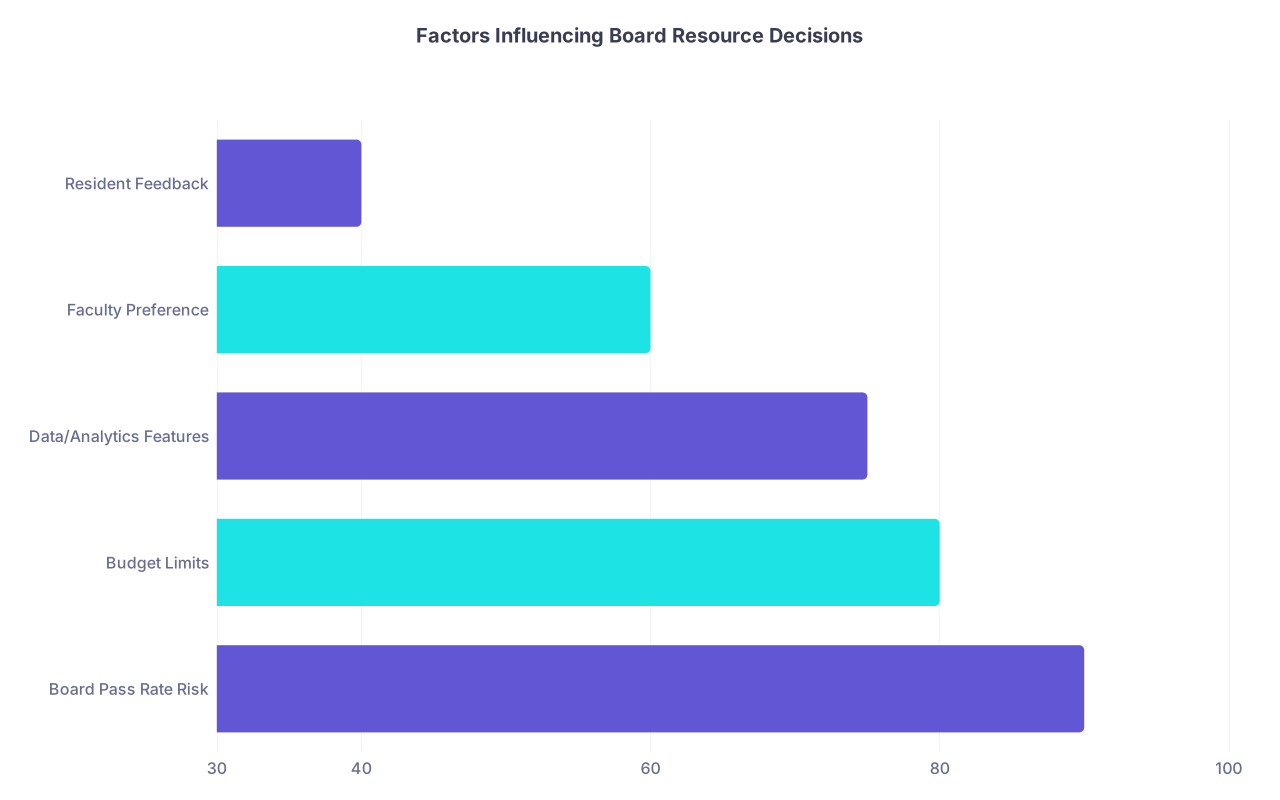
| Category | Value |
|---|---|
| Board Pass Rate Risk | 90 |
| Budget Limits | 80 |
| Data/Analytics Features | 75 |
| Faculty Preference | 60 |
| Resident Feedback | 40 |
Let me decode those for you.
Board Pass Rate Risk (Non-Negotiable)
If your program has had failures or is near the minimum acceptable pass rate, the conversation changes dramatically.
You’ll hear:
- “We need to be able to show a structured intervention.”
- “Can we mandate X resource usage for residents below the 30th percentile on ITE?”
That’s when big comprehensive packages get greenlit. Not because they’re perfect. Because they’re defensible.
Budget Limits and the GME Gatekeepers
The DIO and GME office often set institution-wide rules:
- “We’ll pay for one primary board prep resource per resident per year.”
- “No, you cannot buy UWorld and AMBOSS for everyone. Pick one.”
- “Use departmental CME if you want extras.”
Your PD is sometimes arguing on your behalf and losing, then coming back to you with a spin version:
“We felt this mix was the best balance of cost and quality.”
Translations: “This is what Finance would approve.”
Optics: Looking Good on Paper
Programs hate looking unstructured or ad hoc. So even if many residents already pay out of pocket for the “better” resource, the program will still buy something else if it allows them to say:
- “All residents get access to a designated board resource starting PGY-1.”
- “We track progress longitudinally across training.”
Looks great in the annual program evaluation document. Less great if you’re stuck with a mediocre platform.
Your “Input”: How Much It Really Matters
Let’s be blunt: most resident “input” is post-hoc justification. The decision is rarely built from the ground up based on your survey responses.
Here’s the actual pattern at a lot of places:
- PD and core faculty narrow to 1–2 finalists based on cost, contracts, and analytics.
- Chief residents are “asked” to weigh in. But they’re shown only those finalists.
- A quick resident survey goes out: “Rank how helpful you find Resource X and Resource Y.”
- Leadership announces: “Based on resident feedback, we chose…”
Resident feedback is primarily used to:
- Break a tie between similar options
- Provide cover for a decision already leaning a certain way
- Prove “resident involvement” in program evaluations
Brutal, but true.
Now, that doesn’t mean you’re powerless. It means you need to understand where your voice actually does carry weight.
Where You Can Actually Move the Needle
If you want to influence what your program buys, stop arguing like a customer and start talking like a program director.
You’ll get further if you frame things the way leadership thinks:
- “This resource has strong data showing correlation with board performance”
- “It gives you dashboards for early identification of at-risk residents”
- “We can structure our didactic block around its curriculum map”
- “Their contract includes faculty access and question-writing tools”
You also need to be realistic about timing. The worst time to push for a new resource is two months before board scores come out and budgets are already set. The best time is:
- Right after a shaky board cycle, when leadership is looking for “solutions”
- Right before fiscal year budgeting, when they’re open to new line items
- Right after multiple programs in your institution adopt a resource (leverage herd mentality)
And if your program is chronically under-resourced? You may need a hybrid strategy:
- Use the institutional resource enough to generate decent usage data (so they don’t blame you if scores drop)
- Quietly invest your own money in the resource you know you need for your actual score
Is that fair? No. Is that common? Very.
The Hidden Remediation Economy
You know who really drives some of these contracts? The handful of residents who fail.
When someone fails boards, there’s suddenly a paper trail and a flurry of CYA activity:
- “What resources were they provided?”
- “Did we have a formal remediation plan?”
- “Can we document that we offered X, Y, and Z?”
Programs will pay good money for institutional access to board review resources that come with:
- Formal remediation tracks
- Study plans that can be “prescribed”
- Progress reports that can be shown to the CCC and, if needed, to the board
If a vendor pitches a product explicitly as a remediation tool (“We increased second-attempt pass rates from 60% to 90% in struggling residents”), programs listen hard. That may be what gets funded while your preferred, slicker interface gets passed over.
Why Programs Stick with Mediocre Resources for Too Long
You rotate, you talk to friends at other programs, you realize there are much better resources out there. Why does your program cling to a tired, outdated platform?
Because changing vendors costs more than you think:
- Contract termination penalties
- Faculty time to re-align didactics and reading lists
- Re-training residents and faculty on a new dashboard
- Institutional IT headache for single sign-on and access issues
Plus, leadership hates admitting they backed the wrong horse. It’s easier to tell you:
“We’ve been very happy with X and our pass rates remain strong.”
Translation: “We’re locked in for another year and nobody has the energy to blow it up right now.”
What This Means for You, Practically
From your side of the table, here’s how to play in this less-than-ideal reality:
Figure out what your program actually values.
Look at what they emphasize:- Constant talk about board scores? They’ll buy analytics-heavy stuff.
- Emphasis on “wellness” and “not overburdening residents”? They’ll avoid platforms with mandatory usage tracking.
- Heavy academic/research culture? They’re more likely to follow whatever the big-name university programs are using.
Use the provided resource strategically, not religiously.
Sometimes the institutional Qbank is great. Sometimes it’s “fine.” Either way, you need to:- Do enough questions to satisfy program expectations
- Extract whatever is uniquely helpful (analytics, weak area identification)
- Supplement with what you know is actually high-yield, if you can afford it
Be smart about what you complain about.
Programs are more responsive when you say:- “This platform’s questions are poorly written and don’t resemble the ITE. Here are three examples.”
than - “We just like UWorld better.”
Specific, test-linked, and data-framed complaints get traction. Vague annoyance doesn’t.
- “This platform’s questions are poorly written and don’t resemble the ITE. Here are three examples.”
Quick Comparison: Program Priorities vs Resident Priorities
This mismatch is the source of most frustration.
| Priority | Program Directors Care | Residents Care |
|---|---|---|
| Pass rate impact | Very High | High |
| Analytics & tracking | Very High | Low–Medium |
| Cost per resident | Very High | Low |
| Question/explanation quality | Medium–High | Very High |
| Interface & usability | Medium | Very High |
| Reputation among trainees | Medium | High |
| Contract/IT simplicity | High | Almost None |
Understanding that table is half the battle. You’re talking about explanation quality; they’re thinking about pass-rate graphs and budget lines.
The Part No One Says Out Loud
There’s one more layer here that’s uncomfortable but true:
Some programs rely on the fact that high-caliber residents will buy the “right” resources on their own. They quietly let the motivated, anxious, and better-off residents upgrade themselves, and then they use the board pass rate numbers that those residents produce to justify keeping cheaper institutional resources.
I’ve heard the exact sentence in closed meetings:
“Our residents seem to be doing fine with what we provide and whatever they choose to use on their own.”
Whenever you see a program with excellent pass rates but bare-minimum provided resources, that dynamic is probably in play.
It’s not necessarily malicious. But it’s reality.
FAQ: What Residents Always Ask About Board Resources
1. Should I buy my own Qbank if my program already provides one?
If the provided Qbank is one of the major, reputable ones and your program uses it heavily (in didactics, quizzes, remediation), you can often get away with just that plus the ITE. If the provided resource is clearly second-tier, scores poorly on realism, and senior residents quietly tell you “everyone buys X on top,” believe them. In competitive specialties or if you’re a marginal test-taker, I would not rely solely on a weak institutional resource.
2. How do I push my program to switch to a better resource without pissing them off?
Bring specifics, not vibes. Talk to chiefs and a few respected seniors first, collect examples where the current resource misaligns with ITE or boards, and present alternatives framed around outcomes and analytics rather than “we like it.” Aim to raise it at a resident-faculty retreat or annual program evaluation time, not in a random noon conference rant.
3. My program tracks Qbank usage and threatens remediation if we don’t hit numbers. Is that normal?
It’s increasingly common, especially in programs that have had board failures. It’s not always educationally ideal, but from the PD’s perspective, it gives them something objective to point to. If you’re stuck in that system, hit the minimums with the institutional bank, then do your “real” studying with whatever works best for you.
4. Does using the same Qbank as the in-training exam actually matter?
A bit, but not as much as people like to think. Familiarity with question style can help, especially with timing and reading patterns, but your content mastery and volume of high-quality questions matter more. Programs overweight this factor because it feels concrete and safe: “ITE looks like X, so we’ll buy X.”
5. How early should I start using my program’s board resources?
If your program gives access PGY-1, you don’t need to go full board mode from day one, but you should dip in early. A slow, steady trickle of questions throughout residency beats the classic PGY-3 cram. Also, early use generates the usage and performance data that protects you if your scores wobble later—you can show you engaged consistently rather than “doing nothing” until panic season.
You’re going to keep hearing polished lines about “supporting your board success” at town halls and recruitment dinners. Now you know what those same people are saying in the meetings you are not invited to.
The resource your program buys will not be perfect. It rarely is. Your job is to understand why it was chosen, how it’s being used to judge you, and where you need to quietly go beyond it for your own score. Once you can see that clearly, you can start planning the part that actually matters: how you’re going to turn whatever you’re given—plus whatever you choose to add—into a passing board score and options for your future.
And after you survive that, we can talk about how your program really decides who gets the “good” letters and fellowship slots. But that’s another conversation.