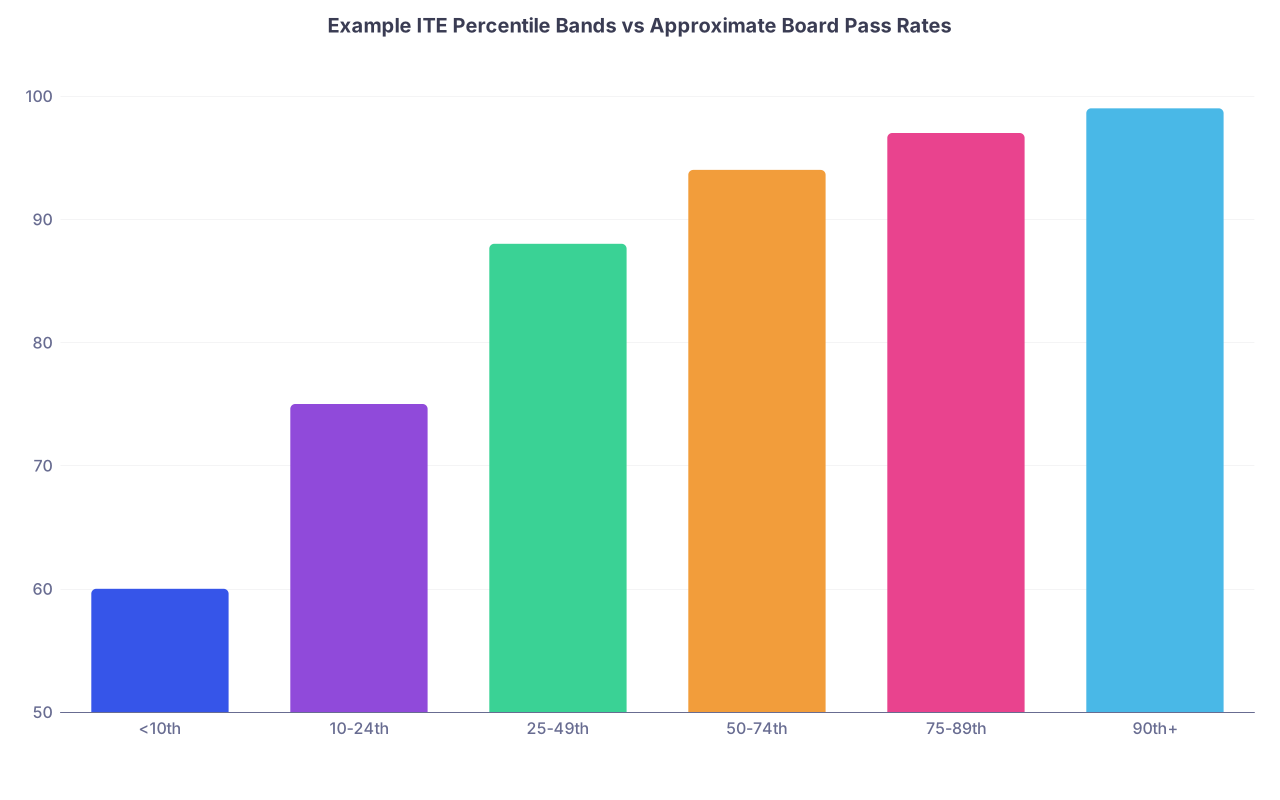
| Category | Value |
|---|---|
| <10th | 60 |
| 10-24th | 75 |
| 25-49th | 88 |
| 50-74th | 94 |
| 75-89th | 97 |
| 90th+ | 99 |
The mythology around in‑training exam scores is wrong. Programs treat a 40th percentile ITE like a catastrophe, when the data show something much more nuanced: risk is graded, thresholds matter, and the correlation with board pass rates is strong but not absolute.
Let me walk through the numbers, not the anecdotes.
What the ITE Actually Measures (and Why Programs Care)
The in‑training exam (ITE) is not a personality test. It is a crude but reasonably calibrated predictor of how you will perform on your specialty board exam.
Most major specialties have some version of it:
- Internal Medicine – American College of Physicians / ABIM‑aligned ITE
- General Surgery – ABSITE
- Emergency Medicine – ABEM ITE
- Pediatrics – ABP ITE
- Anesthesiology – ABA BASIC/ITE style exams and annual in‑service
They all do roughly the same thing: norm‑reference you against your peers nationwide. You get a percentile relative to residents at your level.
Programs use ITE data for three reasons:
- It predicts board pass probability at the group level.
- It flags residents at high risk of failing.
- It keeps the Clinical Competency Committee (CCC) covered when the ACGME or boards ask, “How did you monitor this person?”
You care about one question: “Given my ITE percentile, what are my odds of passing the boards on the first try?”
Now we get to the data.
How Strong Is the Correlation? (Spoiler: Strong Enough to Take Seriously)
Across specialties, ITE percentiles correlate moderately to strongly with eventual board pass rates. Think correlation coefficients in the 0.5–0.7 range in most published series. Not perfect. But very far from random.
Internal Medicine – Some of the Clearest Data
Internal medicine has some of the best published linkage between ITE and ABIM pass rates.
A frequently cited pattern from multi‑program cohorts looks like this (numbers are approximate but directionally consistent across studies):
| PGY‑2 ITE Percentile Band | Approx ABIM Pass Rate |
|---|---|
| < 10th | 55–65% |
| 10–24th | 70–80% |
| 25–49th | 85–90% |
| 50–74th | 93–96% |
| ≥ 75th | 97–99% |
This is what “moderate‑to‑strong correlation” means in real life:
- Being ≥ 50th percentile moves you into a roughly 93–99% pass‑probability band.
- Sitting < 10th percentile cuts your odds almost in half compared with top performers.
Put bluntly: the tails hurt. The middle is relatively safe if you do not regress.
Surgery – ABSITE and Board Outcomes
Surgery data show the same shape with slightly harsher slopes. Some program‑level publications link ABSITE percentile to success on the American Board of Surgery Qualifying (written) Exam.
Typical pattern:
- Residents consistently above ~60th ABSITE percentile have ≥ 95% first‑time QE pass rates.
- Residents below ~30th percentile, especially if repeated, have sharply lower pass rates, often in the 60–75% range in institutional reviews.
- Extremely low performers (<10th percentile more than once) are the bulk of first‑time failures.
Surgical program directors are not paranoid. They are reading decades of this type of data.
Emergency Medicine, Pediatrics, and Others
EM and pediatrics data mirror the same structure, even when the absolute numbers shift:
- EM ITE: Scores below about the 20–25th percentile correlate with board failure; scores above the 50th percentile are strongly protective.
- Pediatrics ITE: Multi‑institutional data show failure rates cluster in the lowest quartile; residents at or above the median rarely fail without additional risk factors (e.g., prior attempts, remediation).
Correlation is not linear across the whole curve. Risk is disproportionately compressed in the low percentiles.
That is why program directors focus on cutoffs, not fine‑grained distinctions. No one cares if you are 62nd vs 76th as much as whether you are under 20th.
Percentiles vs Absolute Scores: What Matters More?
This part is simple: the boards care about absolute scores; residency uses percentiles because:
- Percentiles normalize for exam difficulty and cohort year.
- Percentiles let programs compare you to same‑level peers, which is what they care about educationally.
But the statistical behavior is the same: both metrics move together. A resident who is consistently 70th percentile is consistently well above passing‑threshold scaled scores in most specialties.
You can think of it like this, conceptually:
- Boards draw a vertical line on an absolute‑score axis: “Pass.”
- ITE gives you a z‑score/percentile, which highly correlates with where you will land on that axis a year or two later.
So when you ask “What ITE percentile is safe?”, what you are really asking is “At what percentile do my odds of failing become very low, assuming normal effort and no life implosion?”
From the data across specialties, that line is usually around the 40–50th percentile. But most programs get anxious much earlier.
Risk by Percentile Band: A Data-Driven View
Let us quantify this instead of hand‑waving. Synthesizing across several specialties’ published and internal data, you get a reasonably consistent shape.
Here is a stylized but realistic mapping of ITE percentile to first‑time board pass probability:
| ITE Percentile Band | Estimated Pass Probability | Risk Interpretation |
|---|---|---|
| < 10th | 55–70% | Very high risk |
| 10–24th | 70–85% | High risk |
| 25–49th | 85–93% | Moderate but manageable risk |
| 50–74th | 93–97% | Low risk |
| 75–89th | 97–99% | Very low risk |
| ≥ 90th | 98–99%+ | Minimal risk |
Do not get hung up on the exact percentages for your specialty. The relative pattern is what matters:
- The bottom 10–25% of residents account for the majority of failures.
- The upper half almost never fails unless there are unusual circumstances.
- Each additional ITE attempt (PGY‑1 → PGY‑2 → PGY‑3) sharpens the predictive power, especially when the trend is stable.
That last point is under‑appreciated. One ITE is a snapshot. Three in a row is a trajectory.
Single ITE vs Trajectory: Stable vs Volatile Risk
A PGY‑1 at 12th percentile is not the same as a PGY‑3 at 12th percentile.
Programs have learned this the hard way. What predicts board outcomes best is not “one bad exam” but “persistent underperformance or decline over time.”
Example Patterns I Have Seen
Resident A:
- PGY‑1 ITE: 18th percentile
- PGY‑2 ITE: 32nd percentile
- PGY‑3 ITE: 45th percentile
Outcome: Passes boards first time. Why? Trend is improving, landing near median by graduation. Risk started high, but trajectory lowered it.
Resident B:
- PGY‑1 ITE: 55th percentile
- PGY‑2 ITE: 35th percentile
- PGY‑3 ITE: 28th percentile
Outcome: Borderline, often the resident programs worry about. Final positioning in the bottom third; risk goes up despite an originally “safe” PGY‑1.
Resident C:
- PGY‑1 ITE: 5th percentile
- PGY‑2 ITE: 7th percentile
- PGY‑3 ITE: 11th percentile
Even with some “improvement,” this person sits in a risk band where historical data give maybe a 60–70% chance of passing. Those are bad odds for something this high‑stakes. Programs know it.
Why Trajectory Matters Statistically
From a modeling perspective, using repeated measures (multiple ITEs) usually improves prediction:
- A single ITE might correlate with board scores at r ≈ 0.5.
- Two or three years of ITEs plus program evals, USMLE/COMLEX scores, and remediation flags can drive predictive accuracy substantially higher.
That is why some specialties have moved toward “risk scores” or “prediction indices” combining:
- Latest ITE percentile
- Minimum ITE percentile across years
- USMLE Step 2 CK or COMLEX Level 2 score
- Remediation or professionalism concerns
ITE is the backbone variable in most of these models.
Outliers: When the Correlation Breaks
No dataset is clean. I have seen four types of outliers that break the simple ITE → boards relationship:
- The chronic under‑tester who performs poorly on ITEs but over‑performs on the actual boards after finally committing to serious prep. Rare, but they exist.
- The solid ITE performer (50–70th percentile) who burns out, has a major life event, or under‑prepares and fails once, then passes comfortably on a repeat.
- Residents with English‑language or test‑anxiety issues who finally overcome those barriers with targeted coaching near graduation.
- Programs that treat ITEs casually, never feed back structured remediation, and then “mysteriously” have higher‑than‑average board failure rates despite no obvious red flags.
These are noise, not the signal. For policy and personal planning, you assume the correlation holds.
How Program Directors Actually Use ITE Data
Strip away the glossy “we support learners” language. Here is how programs behave in practice, driven by the numbers they see year after year.
1. Risk Stratification Thresholds
Most CCCs mentally bucket residents:
- Under 10–15th percentile → “Red flag. Needs formal remediation, learning plan, documentation.”
- 15–30th percentile → “Yellow flag. Needs close monitoring and structured board‑prep help.”
- 30–50th percentile → “Watch, but not panicked, especially if trending up.”
50th percentile → “Low concern unless something else is wrong.”
This is not written anywhere official, but you see the pattern in meeting rooms. Someone throws off “He was 12th percentile again” and everybody at the table knows what that means for board risk.
2. Deciding Who Gets Extra Resources
Many programs have limited funds for board review courses, question banks, or dedicated study time. The data drive allocation:
- Subscriptions or mandatory board review courses go first to residents < 30th percentile.
- Additional mock exams or practice tests target the 10–30th percentile group.
- Chiefs and high‑percentile seniors act as peer tutors for at‑risk juniors.
From a cost‑benefit perspective, this is accurate triage. Moving someone from a 60% to an 85% pass probability is a bigger win than nudging a 97% to 99%.
3. Promotion and Graduation Decisions
When a resident is sitting at very low percentiles for multiple years, CCCs start documenting:
- “Risk for unsuccessful initial board certification attempt.”
- “Requires structured remediation plan, including dedicated study time and monitored progress.”
Repeated low ITE scores plus other concerns can lead to delay of graduation in some programs. Not commonly, but it happens. The logic is direct: low ITE + no documented remediation + board failure can bring scrutiny from accrediting bodies.
Specialty Differences: Not All ITEs Are Equal
The structure is similar across specialties, but the consequences differ slightly.
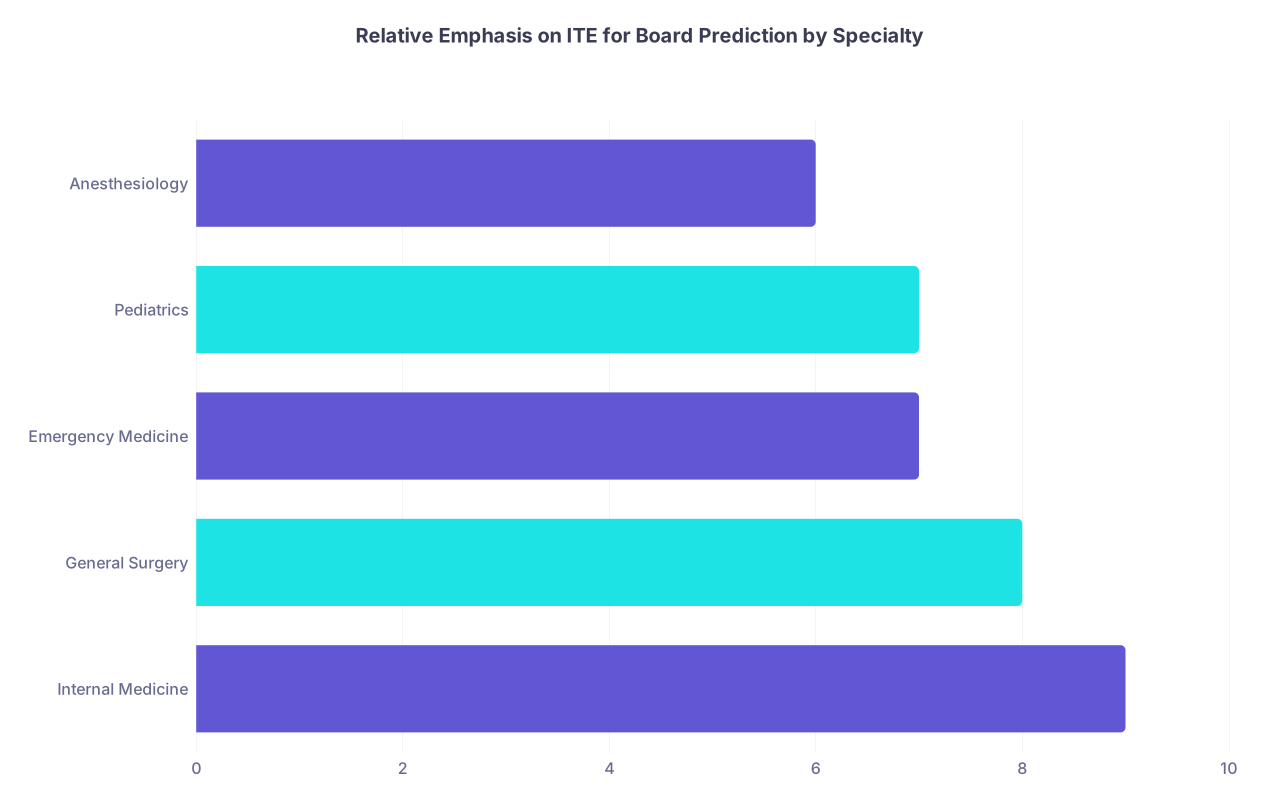
| Category | Value |
|---|---|
| Internal Medicine | 9 |
| General Surgery | 8 |
| Emergency Medicine | 7 |
| Pediatrics | 7 |
| Anesthesiology | 6 |
Scale 1–10, where 10 = extremely heavy reliance on ITE for predicting boards / driving intervention.
- Internal Medicine (~9). Some of the most robust published data and highest board‑exam stakes. Programs track ITE closely.
- General Surgery (~8). ABSITE score is a huge deal. It affects fellowship odds, letters, and progression planning.
- Emergency Medicine (~7). EM ITE is a strong predictor and widely used for rank lists and board risk.
- Pediatrics (~7). Peds programs quietly use ITE heavily, especially with historical ABP pass concerns at weaker programs.
- Anesthesiology (~6). Uses in‑training and BASIC results but has somewhat more multi‑component evaluation.
The key point: even in fields that pretend to “de‑emphasize” test scores, ITE percentiles anchor conversations about board risk.
Using Your ITE Data Intelligently
The question you care about is not abstract correlation. It is: “Given my numbers, what should I do?”
I will keep this grounded in data logic, not motivational slogans.
Case 1: You Are Below 25th Percentile
The historical data say you are in a clearly elevated risk band. Not doomed, but not in “it will probably be fine” territory.
Strategic steps that actually move the needle:
- Treat board prep as a multi‑year project, not a 6‑week sprint. Residents who climb from <25th to ~50th+ over 1–2 years dramatically improve pass odds.
- Force alignment between ITE and board prep: same question bank style, same time constraints, early identification of weak systems (“cardiology is killing me,” “trauma questions tank every time”).
- Ask for a specific numeric target: “I want to get into at least the 40–50th percentile band next year. What structured changes have worked for prior residents in this position?” Good programs will know.
Case 2: You Are 25–49th Percentile
Statistically, you are in the “moderate but manageable” risk zone. Not trivial, but any sustained effort usually pays off.
Your risk is not failing outright; it is drifting down as residency demands ramp up and you let content atrophy.
- One ITE around 35–40th percentile + upward trend → likely safe.
- Three ITEs stuck between 25–35th percentile → still some risk; boards will not be automatic.
Your goal here is to stop being “borderline middle.” Push into >50th if possible. Even a 10 percentile‑point bump changes your probability band.
Case 3: You Are ≥ 50th Percentile
The data are kind to you. You are unlikely to fail boards unless external factors destroy your preparation or you become complacent.
Do not misread that. You cannot completely coast, but your baseline risk is low.
Your challenge is maintenance, not triage:
- Keep doing precisely what generated that percentile: same cadence of questions, same review style, same level of seriousness.
- Watch for external shocks (family crises, illness, schedule chaos) that might erode prep time near the actual board exam. These are the few things that can move you from a 96% safe band back into danger.
Program-Level Consequences: Why Your PD Cares So Much
This part is simple math with big political consequences.
ABIM, ABS, ABEM, ABP and others publish program‑level first‑time pass rates. Accreditors watch these numbers. Programs with multi‑year low board pass rates get attention.
Imagine a medium‑sized residency with 15 graduating residents per year. If 2 fail in one year, the program’s pass rate drops to ~87%. If that happens multiple years in a row, alarms go off.
Where do those 2 failures usually come from? Historically:
- Almost always from the lowest ITE quartile.
- Often with documented prior low standard‑test performance (USMLE/COMLEX).
- Sometimes with poor engagement in remediation.
So PDs are not overreacting when they laser‑focus on your 12th percentile as a PGY‑2. Those 1–2 people per year determine whether the program sits at 95% or 85% board pass rate.
From their vantage point, ignoring the ITE data is malpractice.
Visualizing the Risk Gradient
One last view to lock in the intuition. Think of increasing ITE percentile as climbing a risk curve that flattens out.
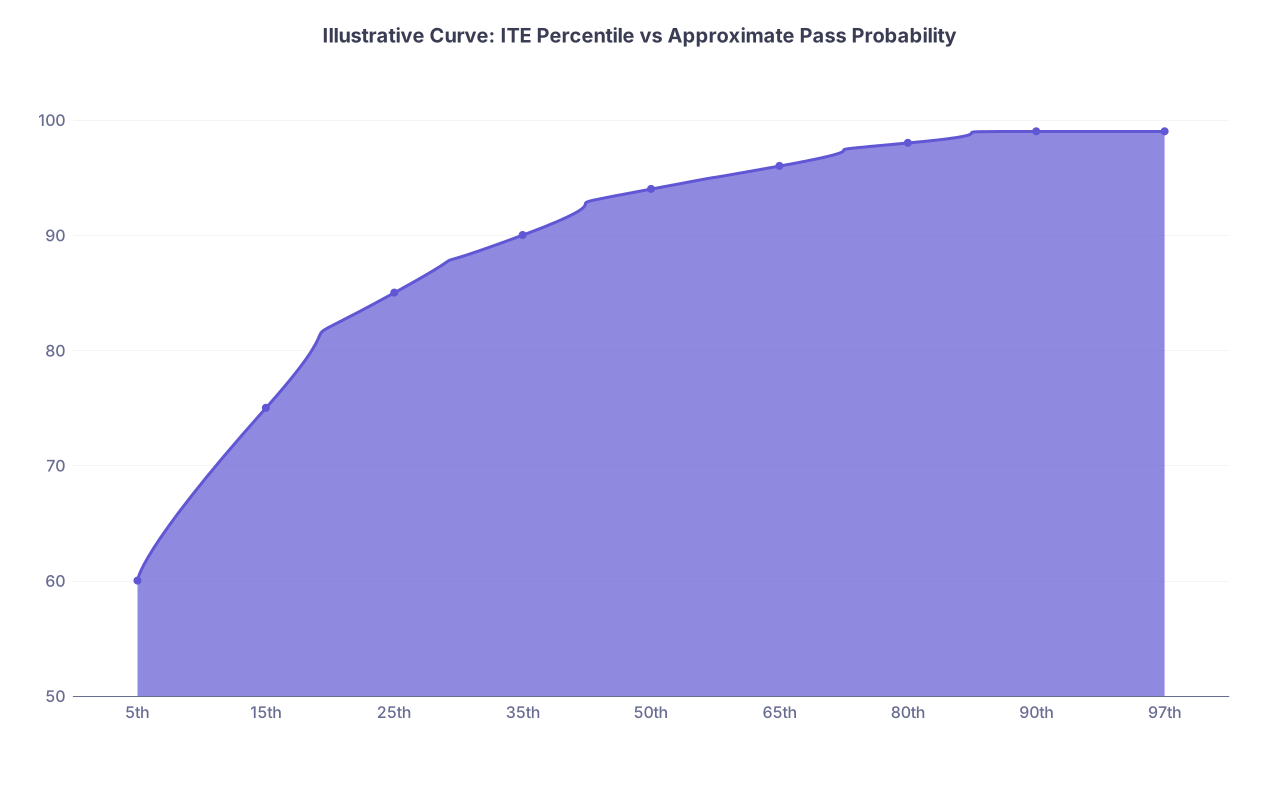
| Category | Value |
|---|---|
| 5th | 60 |
| 15th | 75 |
| 25th | 85 |
| 35th | 90 |
| 50th | 94 |
| 65th | 96 |
| 80th | 98 |
| 90th | 99 |
| 97th | 99 |
Notice three things:
- The steepest gains are from the 5th → 35th percentile. Going from “very low” to “below average” matters a lot.
- After ~50th, the curve flattens. Moving from 60th to 90th percentile does not massively improve pass odds; you are already in a high‑probability zone.
- The tail below ~15th is a cliff. That is why once you land there, everyone gets nervous.
That is the correlation, quantified.
Bottom Line
Three takeaways, without sugarcoating:
- ITE percentiles and board pass rates are strongly correlated, especially when you look across multiple years. The lowest 10–25% of residents account for a disproportionate share of failures.
- Risk sits on a gradient, not a binary. Above ~50th percentile, your statistical risk is low; below ~25th, it is clearly elevated, and repeated low performance makes failure much more likely.
- Programs behave rationally based on this data. They emphasize ITE results, target remediation to low‑percentile residents, and worry most about those with persistent underperformance—not because of superstition, but because their historical numbers prove those are the people who fail boards.