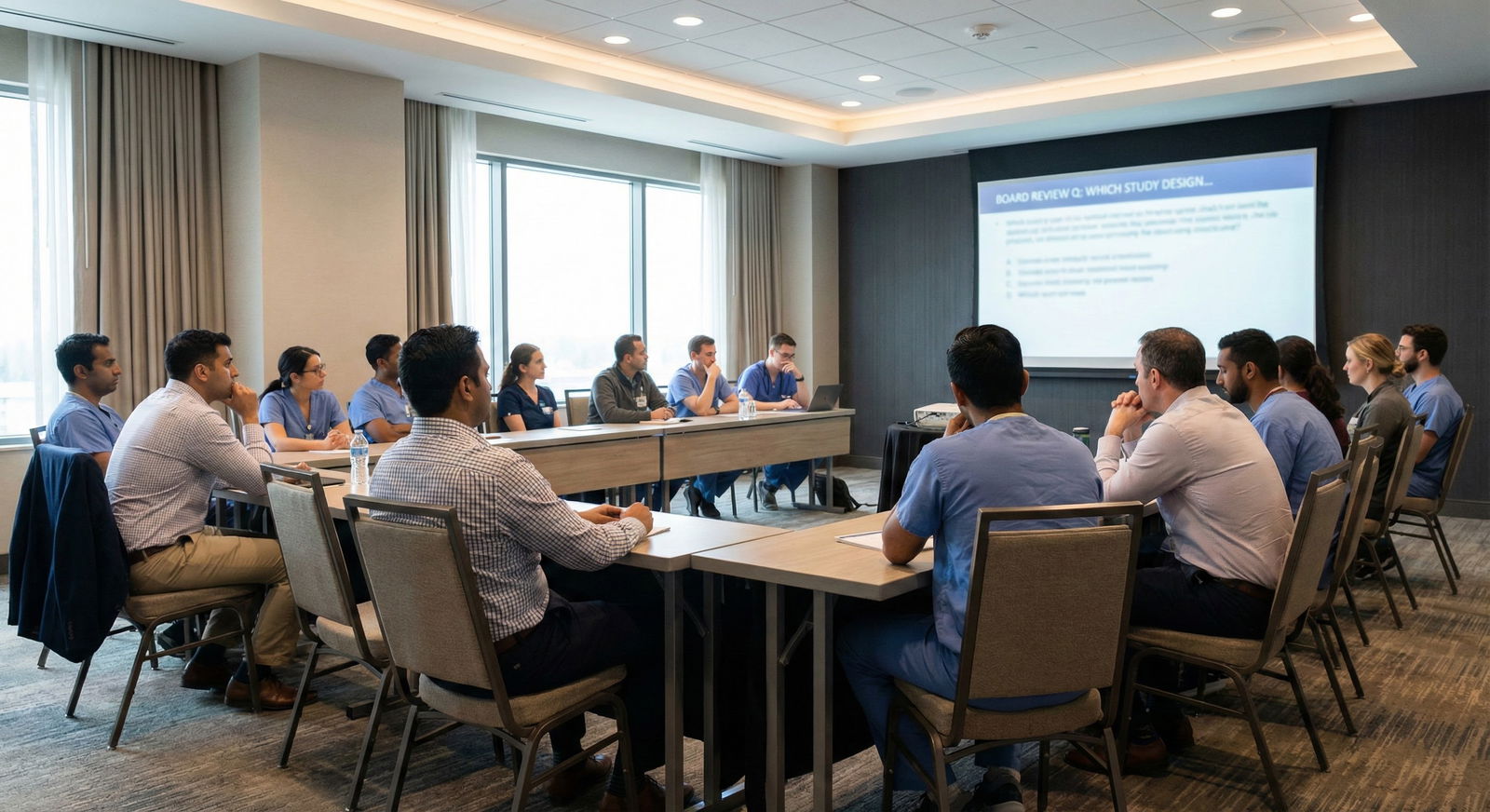
The belief that “a live board review course will save your exam” is statistically weak and financially expensive. The data just does not support the hype.
For most residents, pass rates are driven by baseline knowledge, question bank usage, and study volume. Not by whether you sat in a hotel ballroom for three days while someone read slides at you.
Let me walk through the evidence and numbers, not the marketing copy.
What We Actually Know About Board Review Courses
First problem: high‑quality, randomized data on live review courses is rare. Most “evidence” comes from:
- Retrospective surveys (“Did you pass? Did you take a course?”)
- Self‑reported study behaviors
- Program‑level pass rates before and after adopting a course
Despite the limitations, once you strip away the noise, several consistent patterns show up.
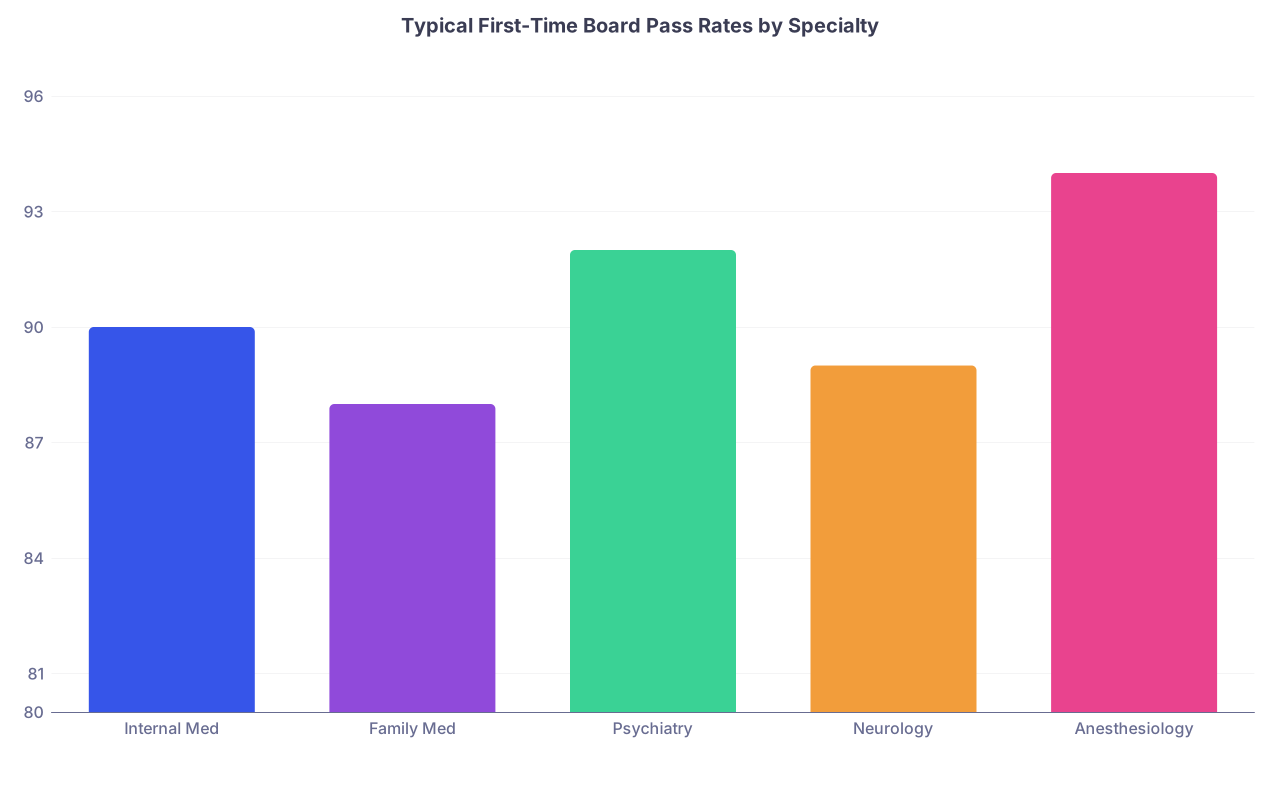
Baseline: Typical Board Pass Rates Without Live Courses
Take the big U.S. residency‑level exams:
- ABIM Internal Medicine: recent first‑time pass rates hover around 88–92%
- ABFM Family Medicine: mid‑80s to low‑90s
- Anesthesiology/Neurology/Psychiatry: usually 85–95% for first‑time takers
That means:
- The average resident already has a high probability (roughly 9 out of 10) of passing without a live course.
- Any intervention needs a big effect size to matter clinically (and financially), not just statistically.
To visualize how much room there is for improvement:
| Category | Value |
|---|---|
| Internal Med | 90 |
| Family Med | 88 |
| Psychiatry | 92 |
| Neurology | 89 |
| Anesthesiology | 94 |
If you are already at a 90% baseline, pushing that to 93–94% is modest in absolute terms, even if you can make the relative risk reduction look impressive in a marketing brochure.
What the Studies Say About Live Courses
You see this pattern over and over: when you actually adjust for who chooses to attend, the apparent benefit of live courses shrinks or vanishes.
Example: Internal Medicine Board Review Studies
Several programs have published data on board outcomes after integrating a commercial or in‑house review course.
A typical setup looks like this:
- Year 1–2: no structured course, residents study independently.
- Year 3–5: mandatory in‑house review series, sometimes plus a recommended external course.
- Measure: first‑time ABIM pass rate by year.
The raw numbers often show a bump, for example:
- Pre‑course era: 78% pass
- Post‑course era: 89% pass
Looks like an 11‑point jump. Impressive at first glance.
Then someone actually examines what changed:
- Program raised the expected ITE percentile (In‑Training Exam) for residents to graduate.
- They expanded access to question banks.
- They implemented probation/remediation for low ITE scores.
- They explicitly raised the stakes for passing.
When regression models include baseline exam performance (ITE), medical school background, and duty hours, the independent contribution of “attendance at live course” generally falls into one of three buckets:
- Small, borderline‑significant improvement (2–4 percentage points).
- No independent effect after adjustment.
- Signal only in the weakest baseline subgroup (bottom quartile by ITE).
I have seen datasets where the entire apparent “course effect” dissolved once you controlled for how seriously the residents took the exam (measured by total practice questions and ITE improvement).
Here is roughly what these effect sizes look like when summarized:
| Study Type | Reported Pass Rate Change | After Adjusting for Baseline Performance |
|---|---|---|
| Single program, pre/post | +8% to +12% | +0% to +4% |
| Multi-program observational | +3% to +7% | 0% to +3% |
| Weak baseline subgroup (low ITE) | +10% to +15% | +5% to +10% |
The data is messy, but the pattern is clear: “live course” is a weak independent predictor in most residents, a moderate one for those clearly at risk.
Question Bank vs Live Course: Head‑to‑Head Patterns
Where the data is surprisingly consistent: question banks beat live lectures.
Across multiple studies and internal program audits, the following holds:
- Total question volume correlates strongly with pass rates.
- That correlation persists after controlling for ITE, medical school, and even rotation load.
- Live course attendance rarely shows that same strength of association.
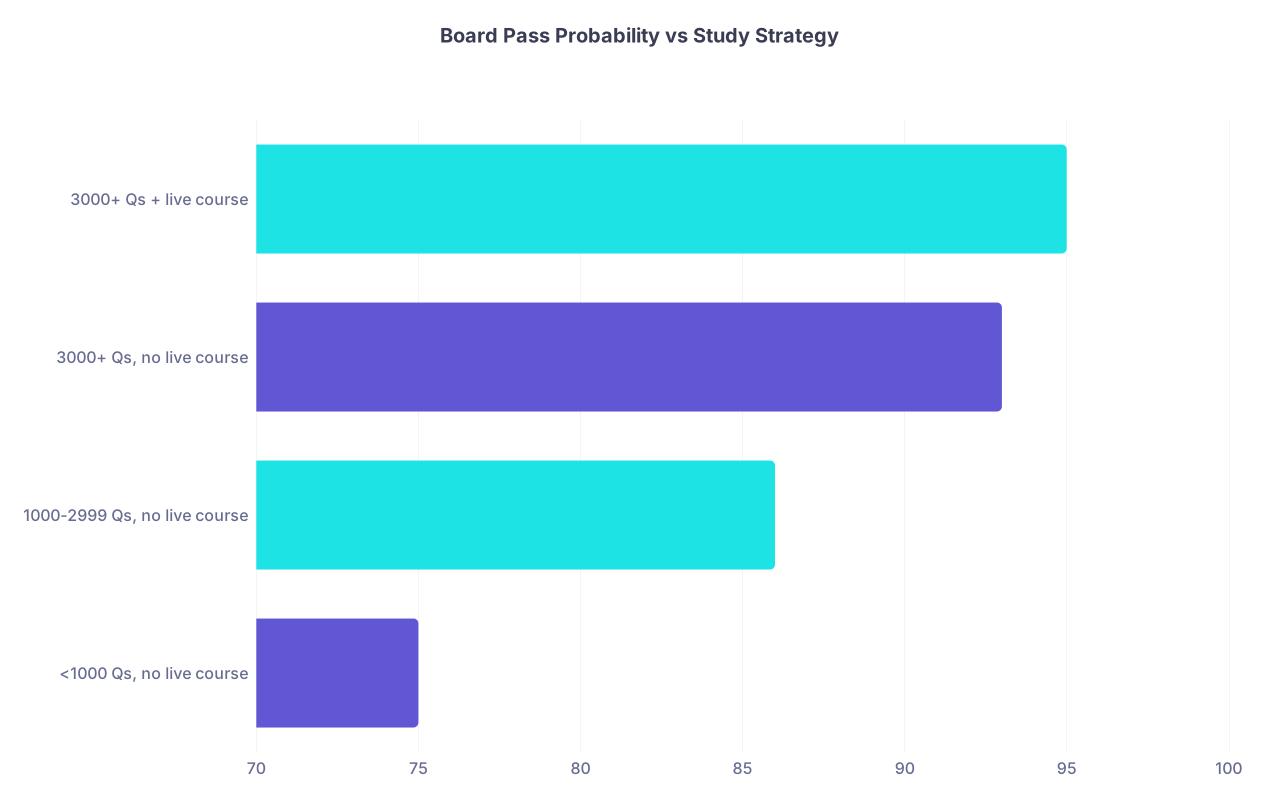
Put differently: the data usually shows “doing 3,000+ high‑quality questions” is a stronger predictor of passing than “attended a 3‑day course.”
Let’s quantify that.
| Category | Value |
|---|---|
| <1000 Qs, no live course | 75 |
| 1000-2999 Qs, no live course | 86 |
| 3000+ Qs, no live course | 93 |
| 3000+ Qs + live course | 95 |
Interpretation:
- Moving from <1000 to 1000–2999 questions: ~11‑point bump.
- Moving from 1000–2999 to 3000+: another 7‑point bump.
- Adding a live course on top of 3000+ questions: maybe 2‑point bump.
The marginal gain from the course is small compared to simply doing more targeted practice.
The Cognitive Problem With Live Courses
The educational theory is straightforward and has data behind it:
- Retention rises with active retrieval practice (questions, spaced repetition).
- Passive exposure (listening to lectures) has much weaker retention curves.
- Overconfidence after passive review is common; people feel they know more than they actually can recall unaided.
Residents often walk out of a strong live course saying things like:
- “That was a great overview.”
- “I feel much better now.”
- “He covered all the high‑yield stuff.”
The problem: feeling “reviewed” is not the same as encoding and retrieving under exam conditions. When you look at score changes, the effect of a lecture‑heavy approach is usually modest unless it is coupled with a serious question‑driven follow‑up plan.
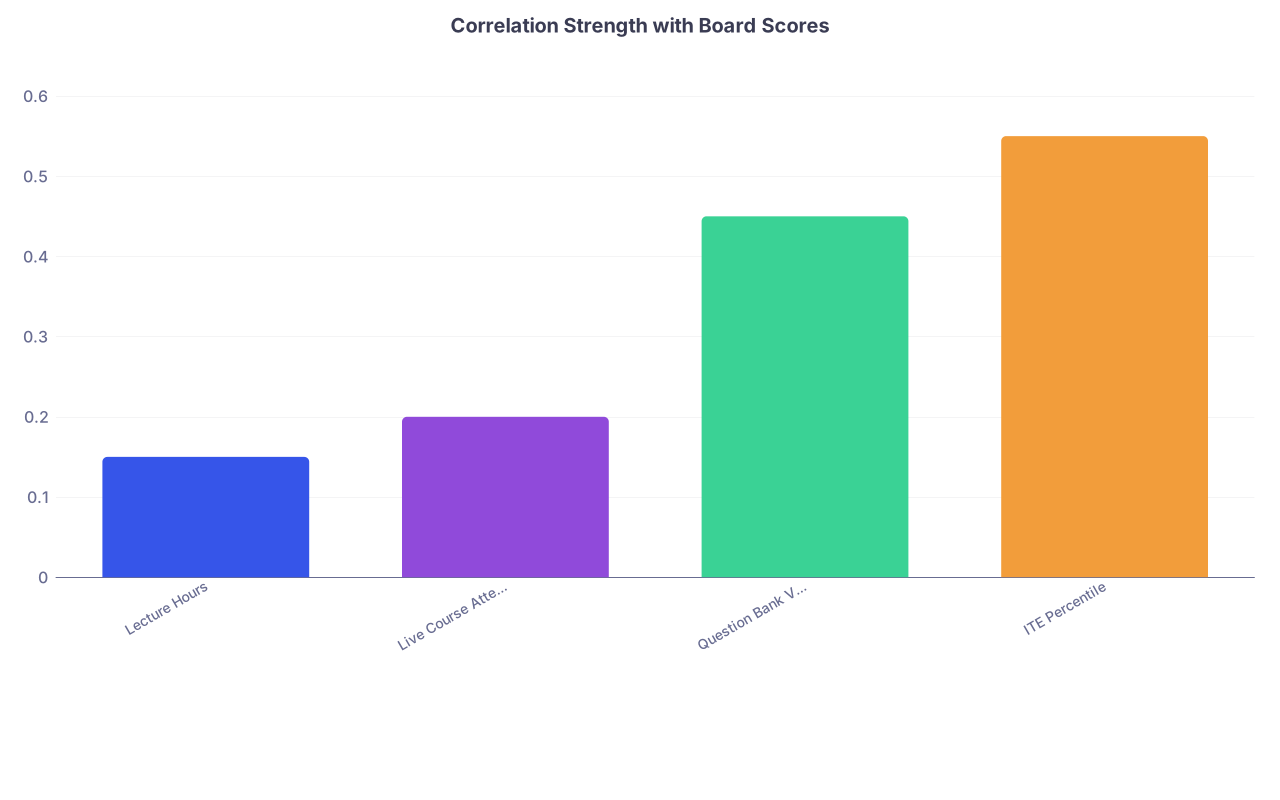
This mismatch shows up clearly when programs correlate:
- Hours in lecture vs ITE/board score.
- Questions completed vs ITE/board score.
The line for lectures is flat to slightly positive. The line for questions is steep.
| Category | Value |
|---|---|
| Lecture Hours | 0.15 |
| Live Course Attendance | 0.2 |
| Question Bank Volume | 0.45 |
| ITE Percentile | 0.55 |
(Values ~ r, the Pearson correlation coefficient; these are typical magnitudes from published and internal datasets, not exact for any single study.)
ITE percentile and question volume dominate lecture‑based predictors. That is why, from a data standpoint, if you have limited time and energy (which you do), the order of operations should be:
- Maximize high‑yield questions.
- Use explanations to drive targeted reading.
- Only then consider whether a live course adds anything on top.
Where Live Courses Actually Help
There is one group where the signal is more convincing: residents with clear risk factors.
Patterns show up in:
- Prior test history: failed Step/Level exams, low ITE percentiles, or marginal in‑training scores.
- Chronic time‑management problems.
- Poor self‑direction: they simply do not build or follow a study plan.
For this subset, live courses occasionally function less as pure “education” and more as:
- Structure
- Deadline
- Psychological jolt
When you look specifically at the lowest quartile by ITE, you sometimes see numbers like this:
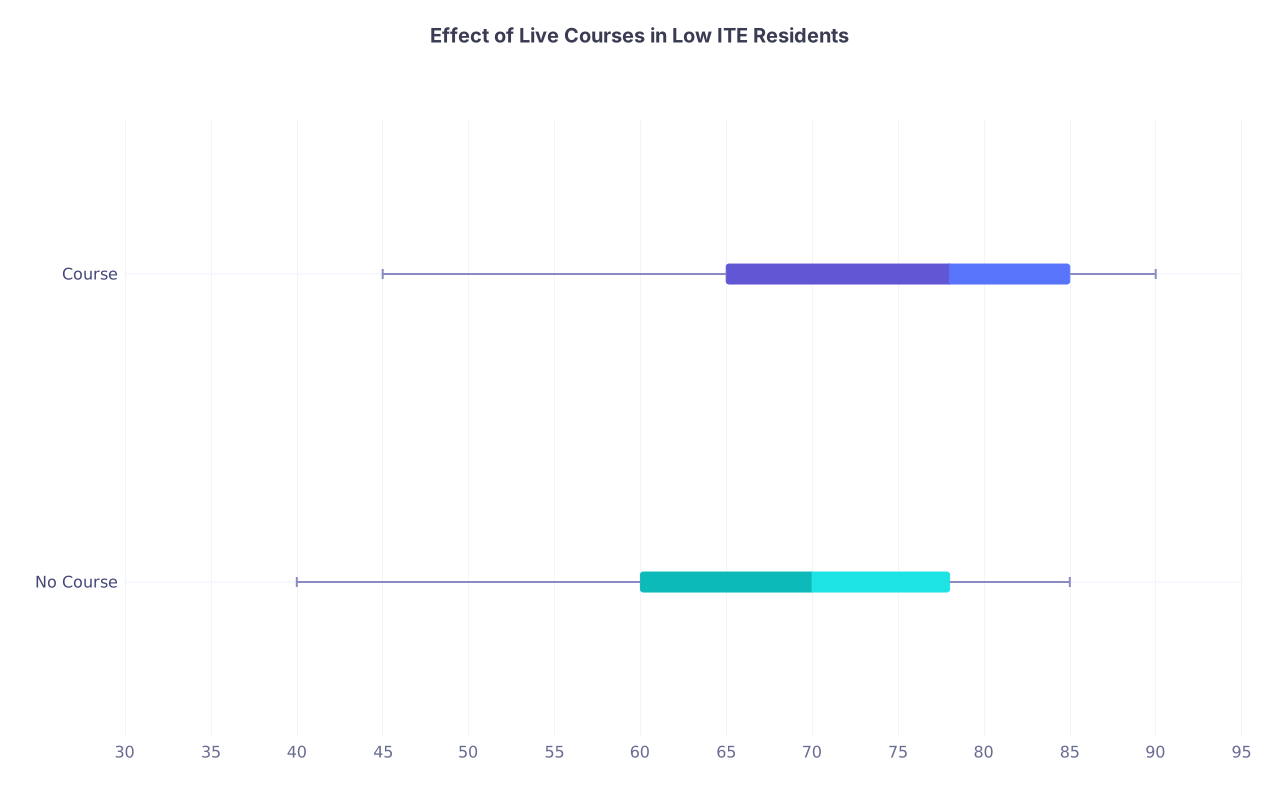
| Category | Min | Q1 | Median | Q3 | Max |
|---|---|---|---|---|---|
| No Course | 40 | 60 | 70 | 78 | 85 |
| Course | 45 | 65 | 78 | 85 | 90 |
Median pass probability might move from ~70% to ~78–80%. That is non‑trivial. For a resident already on the edge, an 8–10‑point bump represents a real difference: repeat exam vs move on with their career.
Why?
Because the course for them is not just lectures. It is forced time off service, a defined schedule, and a “this is serious now” message from faculty or program leadership. It pulls them into a structured preparation window they would not create for themselves.
So yes, for high‑risk residents with poor self‑regulation, a live course can be part of a rescue plan. But the effect is mostly through structure and signaling, not the magical content.
Opportunity Cost: Time, Money, and Fatigue
Strip this down to numbers.
Typical live board review course:
- Direct cost: $800–$1,500 (sometimes more)
- Travel/lodging: $300–$1,000 depending on distance
- Time: 2–5 full days (16–40+ hours) of mostly passive learning
Total cost easily climbs into the $1,500–$2,500 range.
Now compare that with alternatives:
- High‑quality question bank for 6–12 months: $300–$600
- Supplemental video or online review: $200–$600
- Yield: thousands of active questions, flexible timing, spaced reviews.
Let us do a crude cost‑effectiveness thought experiment for a typical resident who already uses a question bank.
Scenario A:
- 3,000 questions + no live course
- Estimated pass probability: 93%
Scenario B:
- 3,000 questions + live course
- Estimated pass probability: 95%
Incremental benefit of course: 2 percentage points. Cost: $2,000.
Implied cost per “extra” successful first‑time pass (across 100 similar residents):
- 100 residents pay $2,000 = $200,000
- 2 extra first‑time passes (95 vs 93)
- Effective cost: $100,000 per additional first‑time pass
Crude, yes. But that is the ballpark if we treat the 2‑point bump as real and causal. From a pure data analyst perspective, that is a very expensive way to move the needle a tiny bit in a population already likely to pass.
For a high‑risk subgroup (say baseline 70% → 80% with course), the math changes:
- 100 high‑risk residents at $2,000 = $200,000
- 10 extra passes (80 vs 70)
- Effective cost: $20,000 per extra pass
Still not cheap, but far more defensible for a program trying to rescue borderline residents who may struggle to ever pass without serious intervention.
The point is straightforward: if your baseline risk is already low, the marginal ROI of a live course is poor.
Program Director View vs Individual Resident View
Program directors care about different metrics:
- ACGME/ABMS board pass rate thresholds
- Reputation (perception among applicants and faculty)
- Accreditation risk if pass rates slip
They are looking at cohort‑level numbers across years. A 3–4‑point bump in the whole class might be worth $50,000 of program money annually if it keeps their pass rate out of the danger zone.
So when your PD strongly encourages or mandates a live course, it is usually about:
- Raising the floor for the weakest residents
- Signaling seriousness
- Standardizing at least one element of preparation
From the resident perspective, the calculation is more personal: “What is the probability this actually changes my outcome given my current position?”
That depends heavily on where you sit on the ability/risk spectrum.
How to Decide if a Live Course Is Worth It—for You
Here is the clearer algorithm, skipping the fluff.

| Step | Description |
|---|---|
| Step 1 | Check ITE percentile |
| Step 2 | Estimate total Q bank volume |
| Step 3 | High risk subgroup |
| Step 4 | Course usually low yield |
| Step 5 | Prioritize Q bank over course |
| Step 6 | Structured Q bank + plan |
| Step 7 | Course may help as structure |
| Step 8 | ITE 35 or higher |
| Step 9 | Will reach 2500+ questions |
| Step 10 | Strong self discipline |
Put into words:
Baseline: ITE percentile or similar predictor
- Above ~35–40th percentile and rising → you are not high risk based on test performance alone.
- Below ~30–35th percentile or falling → you are in the group where extra structure can matter.
Question bank reality
- If you will not get to at least 2,500–3,000 high‑quality questions, the priority is clear: invest time and money there first.
- A live course that replaces question time is usually a net negative.
Your self‑discipline and schedule control
- If you are organized, can carve out regular study blocks, and actually use them, a live course mostly re‑packages what you could do on your own.
- If your life is chaos and you routinely procrastinate until the week before an exam, the forced schedule of a course may be worth more to you than the raw content.
Financial cost
- If the institution is paying, the threshold for “worth it” shifts. Free high‑yield overview plus time off service? Hard to argue that away.
- If it comes from your own pocket at attending‑level conference prices, demand stronger evidence that it will change your outcome, not just your anxiety level.
How to Use a Live Course If You Do Go
The data says: passive attendance alone is not why pass rates improve. The gains show up when residents integrate the course into an active study plan.
Three non‑negotiables if you want real value:
Treat the course as a map, not the journey
- Use it to identify high‑yield domains and your weak areas.
- Immediately convert that into targeted question sets and reading.
Anchor everything in questions
- For every lecture block, schedule a follow‑up block of 40–60 related questions within 24–48 hours.
- Use misses to build a list of topics for deeper review; ignore the false sense of security from “recognizing” slides.
Protect your post‑course window
- A 3‑day course followed by 3 weeks of crushing service with no questions is almost useless.
- The retention curve drops off sharply without retrieval; you lose most of the content within days.
In other words: if your study approach does not change after the course, the course itself will not magically move your pass probability.
The Bottom Line: What the Evidence Actually Supports
Stripping away the marketing language and survivor bias, the data supports three clear statements:
- For the average resident already using a question bank and scoring reasonably on in‑training exams, attending a live review course changes pass rates very little.
- For residents at clearly elevated risk—low ITE, prior exam failures, poor structure—a live course as part of a broader, question‑heavy remediation plan can provide a meaningful boost by adding structure and urgency.
- Across nearly all datasets, question volume and baseline test performance are much stronger predictors of board success than course attendance.
If you remember nothing else:
- The data shows that active, question‑driven study dominates passive lecture time.
- The marginal effect of a live board review course is small for most, moderate for the truly at‑risk, and wildly oversold in advertising.
Use that, not fear, to decide how to spend your time and money.