
The comforting belief that “I’ll just cram during PGY-3 for boards” is not a plan. It’s a trap that quietly wrecks careers.
Let me be blunt: I’ve watched smart, capable residents fail their specialty boards because they clung to this myth. They thought they’d be different. They weren’t. Odds are, you won’t be either if you keep that mindset.
You are in residency, not college. The volume, the complexity, and the fatigue profile are in a different universe. Board exams during residency are not a final you can hero your way through in two weeks of all-nighters.
You might think you’re saving time and mental energy by “waiting until it really counts.” What you’re actually doing is making five high‑risk mistakes at once:
- You’re overestimating future time and energy you absolutely will not have.
- You’re underestimating how much your day‑to‑day learning leaks without spaced reinforcement.
- You’re ignoring the politics: program directors, ACGME, and your future job all care if you pass on the first try.
- You’re planning around the best‑case scenario in a field built on worst‑case thinking.
- You’re putting your entire training investment on a 6–8 week gamble when you’re the most burnt out you’ve ever been.
Let’s dismantle this fantasy properly.
The PGY-3 Cram Fantasy vs. Reality
The PGY‑3 cram fantasy usually sounds like this:
“I’ll focus on surviving intern year.”
“I’ll learn on the job during PGY‑2.”
“Then I’ll lock in for boards PGY‑3 and crush it.”
I hear this verbatim at least once a year, usually from a tired PGY‑2 who just bombed an in‑training exam and is still trying to bargain with reality.
The problem isn’t that PGY‑3 studying is bad. You do need a serious push then. The mistake is assuming you can start then. As if everything before that is optional.
Here’s the ugly truth: PGY‑3 is usually the worst time to start from scratch.
You’re juggling:
- Senior-level responsibility for patients and juniors
- Possibly a job search or fellowship interviews
- Administrative nonsense (evaluations, CCC meetings, procedures logs)
- Life events you can’t just postpone: partners, kids, aging parents, your own health
- Call, nights, weekends, and the creeping burnout you’ve been ignoring since PGY‑1
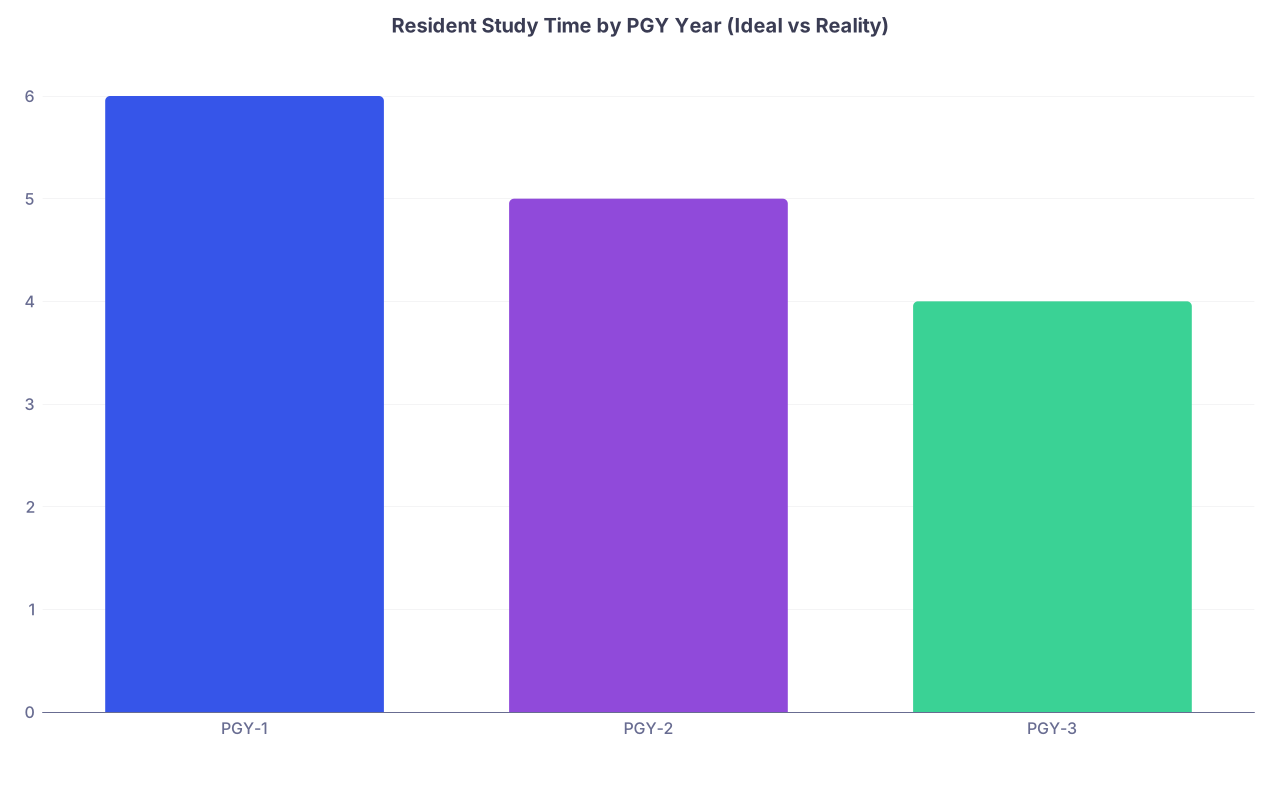
You think you’ll get “a clear 6–8 weeks.” Reality: those weeks will be shredded with random clinic days, “just two calls this month,” mandatory conferences, and the thousand tiny interruptions that destroy deep focus.
| Category | Value |
|---|---|
| PGY-1 | 6 |
| PGY-2 | 5 |
| PGY-3 | 4 |
That chart is the uncomfortable pattern: residents think their study time will increase with seniority; in practice, it often shrinks.
You are not going to suddenly transform into a fresh, well‑rested studying machine in PGY‑3. You’ll be a tired senior trying to plug three years of gaps under a deadline.
The Silent Killers: In-Training Exam Neglect and False Reassurance
One of the most common pathways to board failure starts with blowing off in‑training exams (ITEs). “They don’t count,” people say. That’s the mistake.
ITE performance is one of the clearest predictors of board performance. Not perfect, but very predictive. Most specialties have data showing stepwise increased failure risk at lower ITE percentiles.
Here’s how people sabotage themselves:
- PGY‑1: “I didn’t study, so this doesn’t mean anything.”
- PGY‑2: “I improved a bit, I’ll really focus next year.”
- PGY‑3: “Now it matters—time to get serious.”
The problem? Each year you’re demonstrating your baseline under real-world conditions. If your PGY‑2 ITE is weak, that’s your warning shot. Ignoring it is like ignoring a rising creatinine because “the patient feels fine.”
Let me spell out the red flags I’ve seen repeatedly in residents who later struggle with boards:
- ITE consistently below ~30–40th percentile
- Big gaps in certain domains (e.g., OB in FM, ECGs in IM, derm in peds) that never get structured remediation
- “Bare minimum” exposure to question banks—doing random blocks when you feel guilty, not as part of a plan
- Magical thinking: “I always pull it out when it counts” based on undergrad or med school patterns
| ITE Percentile Trend | Board Pass Risk Level | Common Resident Mindset |
|---|---|---|
| 60–80+ each year | Low | "I’m probably fine but should still study" |
| 40–60 fluctuating | Moderate | "I’ll ramp up later; I’m average" |
| 20–40, no improvement | High | "I’ll fix this PGY‑3 when I really try" |
| <20 any year + no plan | Very High | "Those exams don’t reflect how I really practice" |
Do not make the mistake of treating ITEs as fake boards. They’re dry runs that expose where your “on the job learning” is not cutting it.
Ignoring repeated low performance and betting everything on a last‑minute surge is how strong clinicians end up with “Board Eligible” on their credentials three years longer than they expected.
Cognitive Load: Why ‘I’ll Learn From the Wards’ Is Only Half-True
Residents love to say, “I learn best by doing.” Fine. But that line is also used as an excuse to never sit with a book or question bank.
Here’s the problem: what you learn on the wards is heavily skewed by:
- The patients who actually show up
- The attendings you happen to work with
- What’s urgent enough to trigger a consult or admission
- Your own blind spots—you pay attention to what you already kind of understand
Board exams don’t care what your hospital’s case mix looks like. They care what the specialty expects as a baseline.
A few cognitive traps that wreck the “I’ll just learn clinically” approach:
- Recency bias – You over‑rate what you saw last week and forget the rare conditions that still get tested.
- Survival-mode learning – On call, you learn just enough to not screw up tonight, not enough to master the whole topic.
- Fragmentation – Knowledge comes in choppy stories, not in comprehensive frameworks that exams demand.
The purpose of longitudinal studying during PGY‑1 and PGY‑2 isn’t to turn you into a test robot. It’s to:
- Fill in the cases you don’t see
- Solidify pathophysiology behind the pattern recognition you’re building
- Convert “I sort of know this” into “I consistently get this right under time pressure”
The huge mistake is assuming clinical learning automatically generalizes to exam performance. It doesn’t. Without deliberate, repeated, test‑style exposure, your knowledge stays fragile.
The Real-World Consequences of Failing Boards (That People Underplay)
Residents sometimes talk about board failure like it’s an annoying speed bump. It’s not. It can be a multi‑year detour with real financial, emotional, and professional damage.
Here’s what I’ve actually seen:
Job offers contingent on passing boards
People sign contracts “pending board certification within X years.” Fail once, and the clock suddenly feels very real. Fail twice, and some employers start backing away.Credentialing nightmares
Hospitals and insurers may limit privileges or panel participation if you’re not board certified within a set timeframe.Program director fallout
Your PD now has to explain to the CCC, ACGME, and future applicants why their graduate failed. Trust me, they notice. Programs with repeated board failures get flagged.Lost income and delayed progression
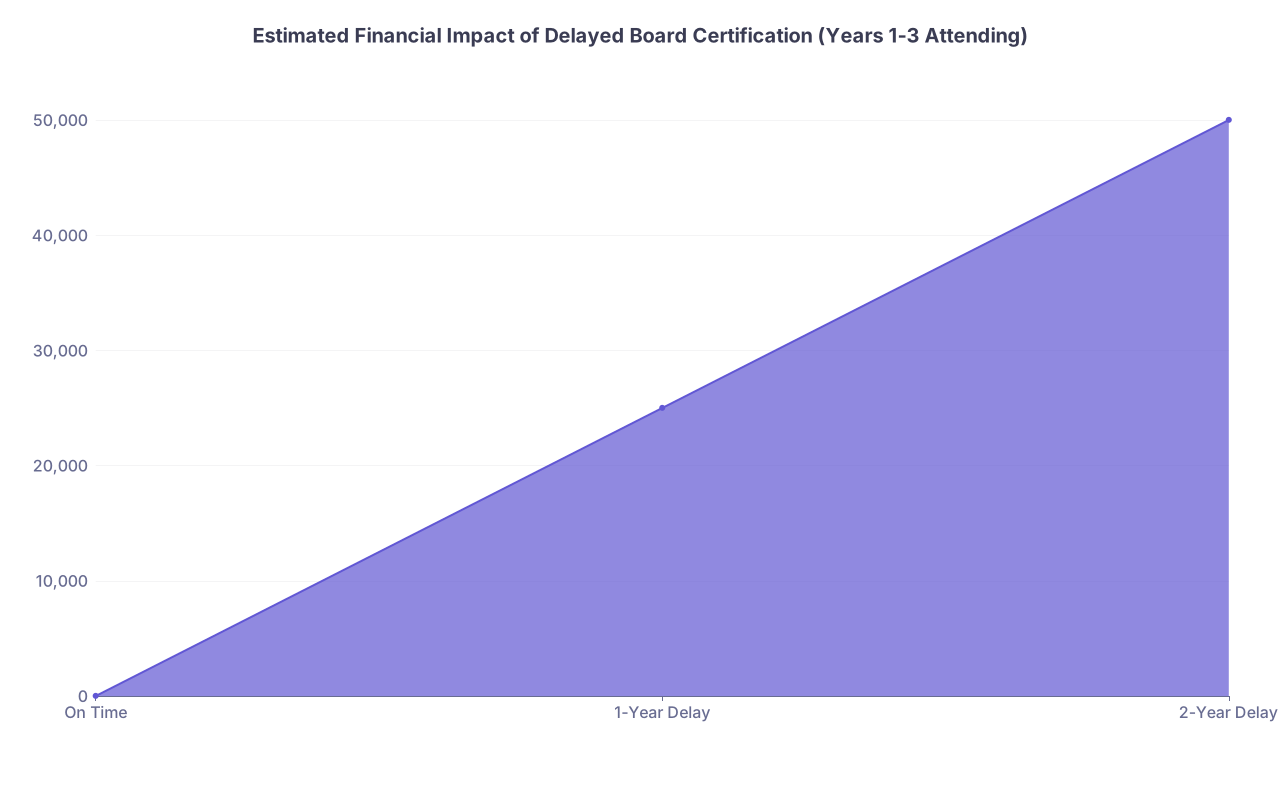
Some jobs bump your salary once you’re board certified. Delay that by 1–2 years and you’re forfeiting tens of thousands of dollars—on top of exam fees, review courses, and potential retake costs.Psychological hit
Residents who fail often spiral quietly. Imposter syndrome increases, confidence on rounds drops, willingness to ask for help decreases because they feel exposed. The shame alone can derail early‑career growth.
| Category | Value |
|---|---|
| On Time | 0 |
| 1-Year Delay | 25000 |
| 2-Year Delay | 50000 |
That’s a conservative curve. It doesn’t even count lost opportunities, fellowship spots, or positions at more competitive institutions.
Do not make the mistake of treating board failure as a minor inconvenience. Sometimes people recover easily. Often, they don’t.
Why the ‘I’ll Turn It On Later’ Strategy Dies in Residency
A lot of residents are former procrastination champions. High school, college, even parts of med school: you coast until late, then flip the switch and overperform.
You are probably one of them. That strategy is almost part of the culture.
Residency is where that identity goes to die.
Reasons the “I always come through” narrative fails here:
Your margin is gone
In college, you had days you could devote 12–14 hours to nothing but studying. In residency, you get off a 12‑hour shift and still have laundry, notes, maybe a crying infant or a neglected partner. You don’t get big clean blocks of time.Your brain is cooked
Working nights, switching between rotations, sleeping 4–6 interrupted hours, and then asking your brain to sustain intense study? That’s not grit. It’s self‑delusion.The content is layered
Boards are not about brute‑forcing disconnected facts in a short window. Questions assume years of layered exposure. Without that foundation, cram attempts turn into frantic memorization without retention.The exam stakes distort your mental game
You can’t treat a high‑stakes certifying exam like an orgo midterm. Anxiety alone will eat a chunk of your performance. People who haven’t built confidence through repeated, spaced practice feel that the hardest.
If your plan relies on becoming a different person “when the time comes,” you don’t have a plan. You have hope. And hope has a terrible pass rate.
A Safer Model: Low-Grade, Long-Term, Boring Consistency
You don’t need a heroic plan. You need a boring, realistic one that respects your future bandwidth instead of lying about it.
Here’s the structure that works and avoids the PGY‑3 panic trap:
1. PGY‑1: Learn the Game and Build the Floor
- Pick one primary resource (text + questions or just a strong Qbank). Not five.
- Commit to a tiny, non‑negotiable baseline: for example, 10–15 questions per day on non‑call days, 10 on weekend days, 0 on post‑call.
- Track your weak areas by domain. Not obsessively—just enough to notice patterns.
- Take your ITE seriously. Review missed questions. Actually learn from them.
This year is about getting used to the rhythm of regular, low‑dose studying. You’re not “crushing” anything yet. You’re building the habit that future you will absolutely need.
2. PGY‑2: Purposeful Reinforcement and Gap Hunting
Now you know your weak spots from PGY‑1 ITE and early Qbank runs.
- Focus study blocks on the domains you chronically miss, not what you like.
- Start doing some timed blocks to build test stamina.
- Keep the daily or near‑daily question habit. If you can’t do daily, do 5 days/week but protect those days like you protect post‑call sleep.
- Treat your second ITE like a diagnostic exam: after results, create a 3–6 month micro‑plan.
If your PGY‑2 ITE is still weak, this is the last safe time to sound the alarm with your PD and get structured support. Waiting until PGY‑3 for a miracle is how people end up in last‑minute panic review courses with too little runway.
3. PGY‑3 (or Final Year): Consolidation and Simulation, Not Rescue
By now, if you’ve kept even a modest consistent effort, PGY‑3 is about leveling up, not starting from scratch.
- Do full‑length mock exams under real conditions on lighter rotations.
- Target remaining weak categories with focused review.
- Refine test‑taking strategy: time management, question triage, avoiding second‑guess overcorrection.
- Use vacation strategically if needed—but as a final polish, not the only study block you get.
You still work hard here. But it’s a fight you can win because you didn’t walk into it unarmed.
Red Flags: When ‘I’ll Cram PGY-3’ Is Already Failing You
If you recognize yourself in any of these, your PGY‑3 cram plan is already broken. You just haven’t hit the wall yet:
- You “mean to study” but weeks go by with fewer than 50 total questions done.
- You haven’t opened an actual board-style resource in over a month.
- You rationalize with lines like, “Real life patients are better than questions anyway.”
- You’re avoiding looking at your ITE percentiles because they stress you out.
- You keep saying, “Once this rotation is over, I’ll start.” And it’s never the right rotation.
I’m not saying this to shame you. I’m saying it so you don’t wake up a year from now with the same habits and less time.
If you’re PGY‑1 or early PGY‑2, you still have enormous leverage. If you’re late PGY‑2 or early PGY‑3 and behind, you need an emergency—but still structured—plan now, not “after this block.”
How to Course-Correct Without Burning Out
The fear when I say “you need to study consistently” is: “I’m already dying. I can’t add more.”
Fair. So don’t add more in a stupid way.
Avoid these mistakes:
- Do not try to go from 0 questions/week to 300/week overnight. You’ll flame out in 10 days.
- Do not stack heavy content review on top of a brutal rotation and nights and family chaos and expect to last.
- Do not copy the study plan of a co-resident in a totally different life situation and pretend it’s sustainable.
Instead:
- Scale up gradually: from 50 questions/week to 80, then 100–120, etc., over a month or two.
- Pick “anchor times” that are as protected as possible (e.g., 30 minutes after pre‑rounding but before sign‑out, or first thing at home before you touch your phone).
- Use weekends smartly: one longer study block and one true rest block. Both matter.
Your goal is not to become a monk. It’s to stop pretending that “Future Me during PGY‑3” will suddenly have infinite willpower, time, and energy. They won’t. And you know it.
Key Takeaways: Stop Believing the PGY-3 Myth
Let me condense this without sugarcoating.
- “I’ll cram during PGY‑3” is not a study plan. It’s an excuse to avoid facing your weaknesses now.
- Residents who ignore ITEs and lean on clinical learning alone are regularly surprised by board failure—and the fallout is uglier than they were told.
- The only reliable protection is boring, low‑grade, long‑term studying starting PGY‑1 or PGY‑2. Small, consistent effort beats heroic last‑minute surges every time.
You’ve worked too hard to gamble your entire career on a fantasy version of yourself that only exists in your head. Do not make that mistake.