
It’s 11:47 p.m. You’re post‑call, sitting in front of your laptop with a Qbank open. Timer running. Same question you’ve been staring at for three minutes.
Your brain feels like oatmeal. You scroll Twitter. You tell yourself, “I’m just being lazy. I need more discipline.” You force another block. You get crushed. And the self‑talk gets nastier:
“Everyone else is hustling. I’m just weak.”
Here’s the problem: a lot of residents in this exact spot are not lazy at all. They’re burned out. And mislabeling burnout as laziness is one of the fastest ways to destroy your board prep, your confidence, and sometimes your career.
I’ve watched sharp residents talk themselves into a hole with this mistake. Some failed boards they could have passed. Others passed but ended up hating medicine. The common thread: they kept calling burnout “laziness” and tried to fix it with more grind instead of the right intervention.
Let’s make sure you do not repeat that.
The Most Dangerous Mistake: Calling Burnout “Laziness”
Burnout and laziness can look the same from the outside: not studying, procrastinating, “wasting time.” But the engine underneath is completely different. If you treat the wrong problem, you make it worse.
Here’s the core danger:
If you mislabel burnout as laziness, you prescribe yourself discipline when you actually need recovery, structure, or help. That’s like treating septic shock with more fluids and ignoring the source.
What typically happens:
- You’re exhausted, emotionally flat, and sleep‑deprived.
- Your focus is shot, memory is trash, and every question feels like climbing stairs with ankle weights.
- Instead of pausing and asking, “What’s wrong with the system I’m in and my capacity right now?” you default to: “I’m lazy. I just need to push harder.”
So you:
- Add more Qbank blocks.
- Cut more sleep.
- Stop seeing friends.
- Drink more coffee.
- Move the test date earlier “so I’m forced to focus.”
And then—shock—you get more exhausted, your scores plateau or drop, and your self‑talk turns toxic. I’ve seen residents spiral from “I’m lazy” to “Maybe I’m not cut out for this field” in a month.
You’re not protecting yourself if you insist on viewing everything through a moral lens of laziness vs virtue. You’re just beating up the only resource you have: your brain.
Burnout vs Laziness: What It Really Looks Like
You do not want to wing this distinction. If you get it wrong, your whole board plan can collapse.
Let’s draw the line clearly.
| Feature | Burnout | Laziness |
|---|---|---|
| Energy level | Chronically drained, even after rest | Normal or variable |
| Emotions | Numb, cynical, detached | Mostly intact, maybe mildly bored |
| Guilt | High, constant self‑blame | Situational, mild or absent |
| Motivation | You *want* to improve but feel stuck | You just don't care much about the goal |
| Functioning at work | Often declining, more errors, short fuse | Usually okay when stakes feel real |
Now let’s go deeper with real‑world board prep scenarios.
Signs you’re likely burned out (not lazy)
These patterns should make you stop blaming “work ethic” and start thinking “system overload.”
You actually care about the exam—genuinely—but feel emotionally flat. You’re worried about failing, you know it matters, yet when you open a book you feel nothing. No urgency. No spark. Just gray.
You used to be disciplined. You got through Step 1, Step 2, medical school. Something changed in residency—more call, worse attendings, toxic culture—and since then your studying tanked.
You sit down to study and can’t absorb anything. You read a paragraph three times and retain nothing. It’s not that you won’t; you literally can’t.
You’re more irritable or cynical at work. Rolling your eyes at patients. Detached on rounds. Thinking, “I don’t care” when you know you should.
Sleep is garbage. Either you can’t fall asleep, or you sleep 10 hours post‑call and still feel dead. Coffee just makes you anxious, not sharper.
Your body is shouting at you: headaches, GI issues, chest tightness, constant fatigue. But you keep ignoring it because “everyone is tired.”
Performance is slipping everywhere: clinical work, relationships, paperwork, not just boards. Notes are late. People ask, “You ok?” more than usual.
That cluster? That’s burnout. Not laziness. If you call that “laziness,” you’ll double down on self‑criticism and overwork and push yourself closer to the edge.
Signs you’re leaning more toward actual laziness / avoidance
Let’s be honest: sometimes it really is procrastination, not pathology. But you still need to treat it strategically, not with vague shame.
Patterns more consistent with simple laziness/avoidance:
You’re high‑functioning at work. You crush rounds, stay late to help, present flawlessly. But you consistently choose Netflix instead of questions on your days off, even when you’re rested.
You feel basically fine physically. No chronic exhaustion, no major emotional blunting. You just don’t want to do the unfun thing (studying).
You only feel guilty when confronted. Someone asks, “How’s studying?” and you wince—but otherwise you’re not ruminating on it.
You’re still getting enjoyment from normal hobbies and social stuff. You’re not numb. You’re just not prioritizing boards.
When you do sit and study, you can focus decently. You just don’t sit down often enough.
This is a motivation, habit, and structure issue. Not a complete burnout picture.
Both patterns are fixable. But they require opposite approaches. And here’s where people blow it.
The Classic Self‑Destructive Responses (Don’t Do These)
This is where residents reliably hurt themselves.
Mistake #1: Treating burnout like a “discipline problem”
The internal script goes like this:
- “I’m behind.”
- “Other residents are doing 40 questions a day.”
- “I’m just weak.”
- “Solution: do more. Sleep less. No excuses.”
So you take a brain that is already depleted and smash it harder. Short term, you might squeeze out a few days of productivity. Medium term, your scores stall or drop and your capacity shrinks.
The ugly part? Then you “prove” to yourself that you’re lazy or dumb because the extra grind didn’t fix it.
You’re not lazy. You’re running on fumes.
Mistake #2: Calling actual laziness “burnout” as an excuse
There’s a flip side. I’ve heard this too many times:
“I think I’m burned out,” from someone who sleeps 8 hours, has light rotations, says yes to every brunch, but does 20 questions a week.
Sometimes that’s not burnout. That’s avoidance dressed up in psych language.
You don’t want to over‑pathologize normal human resistance to boring, stressful tasks. If everything else in your life is humming along and ONLY studying is neglected—this is probably a structure and priority issue, not full burnout.
Why this matters:
If you call laziness “burnout,” you give yourself permission to do nothing and feel virtuous about it. Then exam day shows up and mercy won’t.
Mistake #3: Using shame as a motivator
The resident brain loves this move:
- “You’re pathetic.”
- “Other people with kids and worse schedules manage it.”
- “If you fail, you deserve it.”
People think this is “tough love.” It’s not. It’s just self‑abuse. Shame might kick you into gear for a day. But long term, it erodes the very confidence you need to learn.
The brain does not learn well in a constant stress bath of “I’m trash.” It learns in the zone of challenged but safe. You keep dragging yourself below that threshold, and then wonder why nothing sticks.
Practical Ways to Tell Which One You’re Dealing With
You need a quick mental triage. Here’s a simple framework that actually works.
1. The 7‑day experiment
For one week, commit to this controlled test:
- Sleep: Protect at least one stable sleep block ≥ 6.5–7 hours on non‑call nights.
- Alcohol: Minimal, ideally none.
- Study: 30–60 minutes per day, no more. Even if you “feel good,” cap it.
- Phone: Park it in another room or on Do Not Disturb during study blocks.
- Debrief: After each block, briefly rate:
- Focus (0–10)
- Mental exhaustion (0–10)
- Retention (0–10—can you recall main points 10 minutes later?)
Then look at the pattern:
- If, even with that light structure and real sleep, your focus is terrible, exhaustion is high, and you feel emotionally flat the whole week—burnout is likely a major player.
- If your focus is decent when you actually sit, but you keep “forgetting” or skipping the block entirely—this is more avoidance / habit / priority.
2. The “work vs study” gap
Ask yourself honestly:
- On busy service, do you still show up, present well, handle tasks, and get decent evals?
If yes, but your boards prep is nonexistent, you’re probably not systemically burned out. You may be stressed, sure, but your core functioning is intact. You’re just not allocating energy to studying.
If no—if both work performance and studying are sliding—that’s a red flag for real burnout, depression, or both.
3. The “joy test”
Think about something you used to enjoy that has nothing to do with medicine:
- Lifting
- Baking
- Watching dumb comedies
- Playing with your dog
If you do that thing now, does it feel like anything? If everything feels gray and pointless, that’s not laziness. That’s your brain waving a white flag.
Fixing Burnout Without Blowing Up Your Board Plan
If your self‑assessment screams burnout, the answer is not “Well I guess I’ll just fail.” The answer is: treat the problem like an attending would—systematically.
Step 1: Drop the moral judgment
You’re not allowed to keep calling yourself lazy if the pattern is clearly burnout. It’s inaccurate and harmful.
Trade “I’m lazy” for:
“My system is overloaded. Capacity is down. I need to recover and then rebuild intelligently.”
Corny? Maybe. But way more accurate.
Step 2: Shrink the study ask to something survivable
One of the biggest mistakes burned‑out residents make is setting heroic study expectations:
- 80+ questions/day
- 2 hours of review
- Daily video lectures
You cannot go from zero to marathon when you’re already limping. You need a minimum viable plan.
For a truly burned‑out resident on most rotations, early phase:
- 20–30 questions/day, max.
- Strict 45–60 minutes, then done.
- No guilt allowed after that block. Study is checked off.
Your goal the first 2–3 weeks is not “crush the Qbank.” It’s “rebuild the habit and show your brain it won’t be tortured.”
Step 3: Take a real shot at modifying your schedule
Residents underestimate how much they can ask for. Program leadership would rather help you before you fail boards.
Concrete asks I’ve seen granted:
- Switching one ICU month to a lighter elective during your last 2–3 months before boards.
- Moving from 24‑hour call to night float temporarily.
- Tacking on a vacation week before the exam instead of after.
- Adjusting the exam date if you have a legitimate case of burnout and a clear study plan.
Yes, some programs are rigid. Some are toxic. But many aren’t, and residents just never ask. Do not make that mistake.
Step 4: Involve professionals early
This is where people hesitate and pay the price.
If you’re seeing:
- Persistent anhedonia
- Passive suicidal thoughts
- Major sleep disturbance
- Panic attacks about work or boards
You need to talk to someone—occupational health, a therapist, your PCP, or your program’s wellness person (not the fluff session; the real help).
I’ve watched residents try to white‑knuckle this for months. By the time they ask for help, their exam is 4 weeks away and their baseline capacity never really returns.
You don’t get extra credit for “toughing it out.” No one is going to pin a medal on that decision. All you get is a higher chance of failing an exam that locks in your career options.
Fixing Laziness / Avoidance Without Lying to Yourself
Now let’s say you’re on the other side: not burned out, just not doing the work. You don’t need therapy for that. You need structure, honesty, and some friction.
Step 1: Strip away the “burnout” shield if it doesn’t fit
If you’re:
- Enjoying life
- Functioning well at work
- Not constantly exhausted
…then you need to stop hiding behind burnout language. Call it what it is: “I don’t feel like studying and I keep choosing short‑term comfort.” That’s fixable, but not if you refuse to name it.
Step 2: Make studying the default, not the exception
Classic lazy pattern is: “I’ll study if I have time tonight.” Translation: you won’t.
Better pattern:
- Decide the when in advance: “Every non‑call day, 6:30–7:30 p.m.”
- Decide the what in advance: “One 20‑question block + review.”
Protect that block like sign‑out. Someone asks you to hang out then? You say, “I’m busy until 7:30, can we do 8?” That’s not draconian. That’s normal adult prioritization.
Step 3: Add friction to avoidance
If you keep losing an hour to your phone before you start, don’t trust “willpower.”
Do objectively annoying things that make it harder to bail:
- Put your phone in another room. Not in your pocket. Not face‑down. Gone.
- Use website blockers during your study hour.
- Tell a co‑resident you’ll text them “DONE” after your block. If they don’t hear from you, they check in. Not as your parent, as your colleague.
You’re not weak for needing external constraints. You’re realistic.
Why This Mislabeling Wrecks Board Performance Specifically
You’re not just risking a bad week. You’re messing with a long game.
Board prep during residency is already stacked against you:
- Irregular shifts
- Night float
- Inconsistent energy
- Emotional load from clinical work
Add a misdiagnosis on top—calling burnout laziness or laziness burnout—and you sabotage the only part you can control.
Two common disaster arcs:
Burned‑out resident, labeled as lazy
- Pushes harder
- Sleep craters
- Retention plummets
- Starts missing obvious questions
- Confidence nosedives
- On exam day, panics because this test feels like all those miserable Qbank sessions: overwhelming and hopeless
Avoidant resident, labeled as burned out
- Feels justified in avoiding studying
- Tells themselves, “I need rest to treat my burnout”
- Six weeks pass with minimal studying
- Real burnout starts when the test is too close and there’s no runway left
Both end in the same pain: walking into a career‑defining exam underprepared and over‑stressed.
A Quick Reality Check About “Everyone Else”
One more trap you need to avoid: using imaginary others as a weapon against yourself.
Residents constantly say things like:
- “Everyone else on my program does 80 questions a day.”
- “My co‑residents study every night after call.”
- “I’m the only one struggling.”
No, you’re not. You’re just the only one whose internal monologue you can hear.
I’ve sat with residents who looked flawless from the outside—perfect notes, big smiles—who were quietly falling apart and barely studying. The ones loudly bragging about their study grind are often the least consistent.
Stop using fantasy colleagues as the benchmark and then diagnosing yourself as lazy or broken when you can’t match them.
Your job is simple and much harder: be honest about your capacity, your patterns, and your next right step.
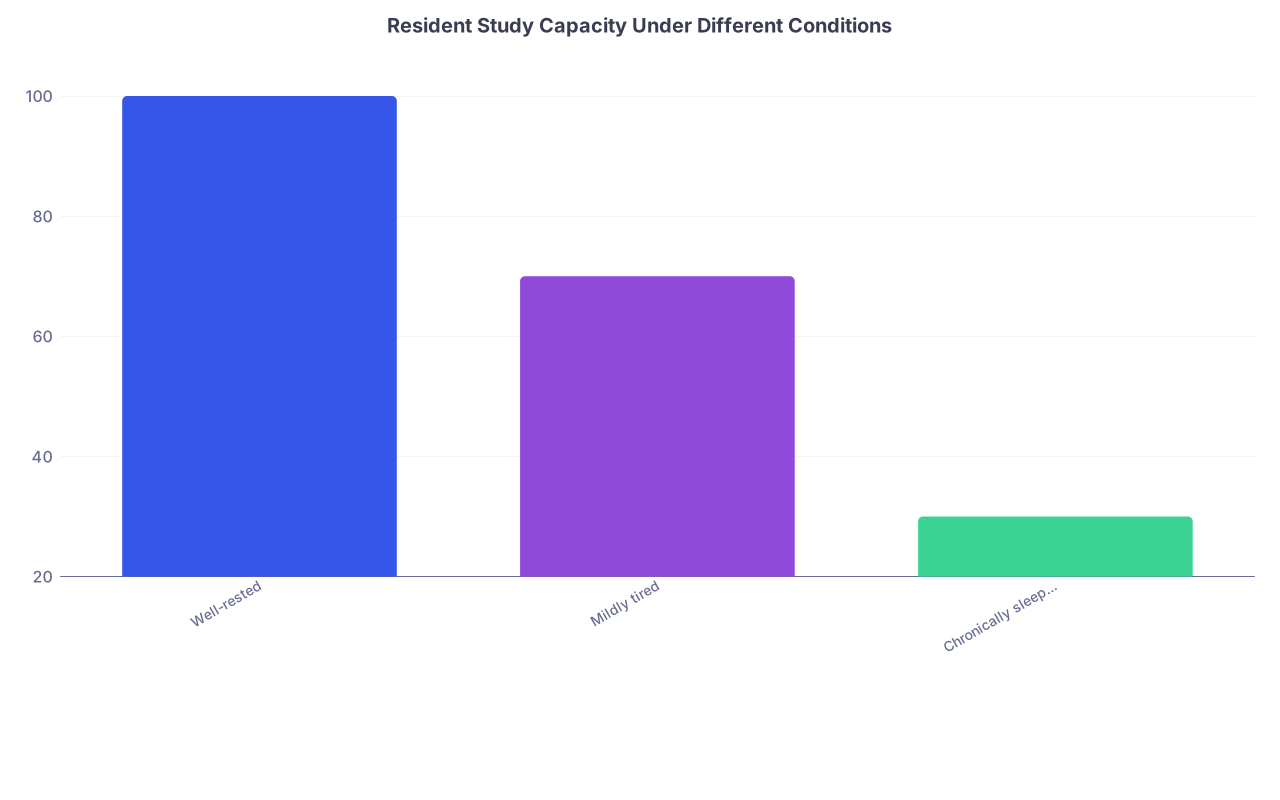
| Category | Value |
|---|---|
| Well-rested | 100 |
| Mildly tired | 70 |
| Chronically sleep deprived | 30 |

| Step | Description |
|---|---|
| Step 1 | Struggling to study |
| Step 2 | Likely burnout - seek support and reduce load |
| Step 3 | Assess for early burnout or other issues |
| Step 4 | Likely avoidance - build structure |
| Step 5 | Screen for mood or anxiety disorders |
| Step 6 | Energy and mood low most days |
| Step 7 | Work performance also falling |
| Step 8 | Enjoying life and work overall |
If You Remember Only Three Things
Don’t call burnout “laziness.” If your energy, mood, and functioning are crashing in multiple areas, you’re not weak—you’re burned out, and more grind will break you, not save you.
Don’t call laziness “burnout.” If you’re fine at work and in life but simply never sit down to study, that’s an honesty and structure problem, not a psychiatric emergency.
Your boards are too important to wing this. Do the uncomfortable self‑assessment, adjust your plan to match reality, and ask for help early—before your mislabeling turns a tough season into a preventable failure.