
The mythology around in-training exam scores is almost as dangerous as the exams themselves. Most residents have no idea how program directors actually look at those numbers—and a lot of attendings are guessing too.
Let me tell you what really happens behind that closed-door Clinical Competency Committee (CCC) meeting when your in-training exam report is on the screen.
How Program Directors Actually Use In‑Training Exams
First truth: the in-training exam is not about your ego or your pride. It is a risk management tool.
On paper, we all say the same polite line: “The in-training exam is for formative assessment, to guide your studying and help us support your learning.” That’s the brochure version. The real version is more blunt: program directors use those scores to predict who’s going to embarrass the program on the board pass rate report.
Because that report hits two things PDs care about deeply: ACGME accreditation and the program’s reputation with applicants and the department chair.
When I sat in CCC meetings, we did not scroll line by line reading every resident’s percentile. We did two things:
- We looked at the bottom.
- We looked at trajectories.
If you’re anywhere above the danger zone and not trending downward, you’re background noise. Nobody is obsessing over whether you’re 62nd vs 74th percentile. But if you’re in that bottom chunk—or you’ve dropped hard year-to-year—you become a “discussion item.”
Here’s the uncomfortable part: different programs draw that danger line at different places. Some get nervous below 30th percentile. Some only start to twitch below 20th. A few harsh ones start flagging anyone below 50th if the board pass rate has been bad lately.
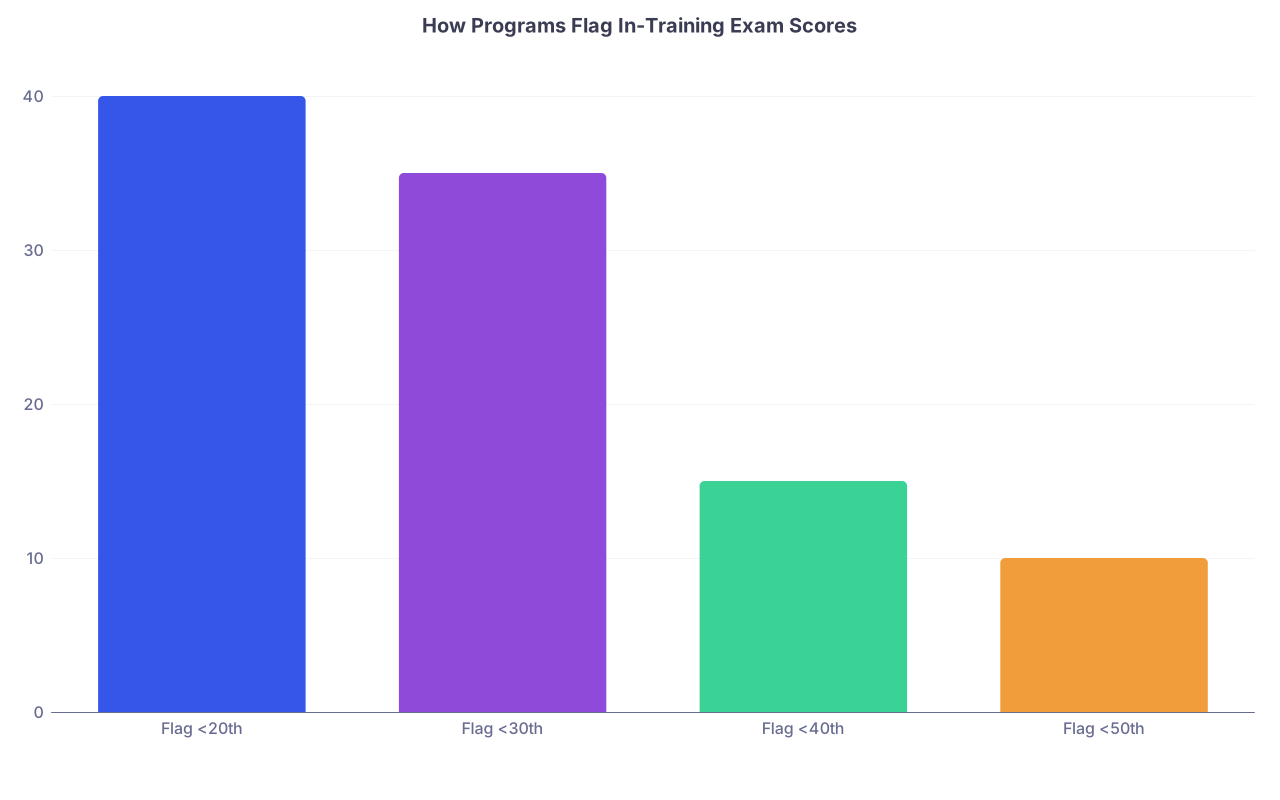
| Category | Value |
|---|---|
| Flag <20th | 40 |
| Flag <30th | 35 |
| Flag <40th | 15 |
| Flag <50th | 10 |
Those are not official statistics, but they’re close to what PDs will tell each other at national meetings and over drinks. The pattern is consistent: the worse their recent board pass rate, the more they overreact to your score.
So yes, your exam is officially “formative.” But to your PD, it’s also a weather forecast: storm or clear skies on next year’s board report.
What Different Percentile Ranges Really Signal
Residents love to trade numbers like stock tickers.
“Heard R3s averaged 70th this year.”
“I’m only 45th, am I in trouble?”
“He’s 99th, he’s gonna crush boards.”
You’re asking the wrong question. The better question is: What does my number trigger in my program director’s head?
The No‑One‑Cares Zone (roughly ≥50th percentile)
If you’re at or above the program average, most PDs do not give you a second thought unless:
- You’re borderline in other areas (professionalism, clinical performance, attendance).
- You’ve had a big drop from a prior year.
I’ve literally heard a PD say in a CCC:
“Anyone at or above the mean who isn’t causing trouble clinically—move on. Time is limited.”
In other words: you’re fine. You may not feel fine, but administratively, you’re not a problem. You’re not a project.
The Yellow Light Zone (roughly 30th–49th percentile)
This is where it starts to matter. Not panic, but awareness.
The inner monologue in a PD’s head sounds like:
- “If they’re clinically strong and hardworking, I’m not worried, but I want a plan for Step 3 / boards.”
- “If they’re also struggling on rotation, now I’m concerned about global performance.”
- “If they were 70th last year and now 35th, that drop matters more than the raw number.”
You might end up with:
- A “strong recommendation” to do a board review course.
- A requirement to meet with faculty to map out a study plan.
- Your name remembered when the next exam cycle comes around.
You’re not on probation. But you’re on the radar.
The Red Flag Zone (below ~30th percentile)
This is where things turn from “we should help” to “we must protect the program.”
Here’s the conversation you never hear:
- “We can’t afford another board failure this year.”
- “Anyone below 20th needs a written remediation plan.”
- “If they don’t improve on next year’s ITE, we need to think about promotion decisions.”
You may get:
- Mandatory remediation or tutoring.
- Required use of question banks with documented progress.
- Written warning tied to promotion.
- In some programs, conditional promotion (“advance to PGY-3 if… exam performance improves”).
And if you’re in your final year with those scores, some PDs will quietly push your graduation date or slow-roll your sign-off because a board failure in a new grad crushes their stats.
What PDs Talk About in CCC Meetings (That You Never Hear)
Let me give you a rough script of a real CCC conversation about a resident’s low in‑training exam score. I’ve seen versions of this dozens of times.
“Alright, next—PGY-2. In-training exam 18th percentile, down from 28th last year.”
“Clinical evals?”
“Mostly solid. A couple comments about needing more independence, but no big professionalism issues.”
“Any concerns on service?”
“Slow on notes, but patients are fine. Knows limits, asks for help.”
“Okay. This is a board risk, not a safety risk. We need a formal plan.”
Translation:
You’re not being labeled a bad doctor. You’re being labeled a future test failure.
Then comes the checkbox exercise:
- Require meeting with PD or APD?
- Assign faculty mentor for board prep?
- Recommend or require commercial review course?
- Re-test (internal exam) in six months?
The goal isn’t personal. It’s statistical. They’re trying to shift your odds.
What almost never gets said to your face is the phrase, “You’re a liability to our board pass rate.” Instead you hear: “We want to support you.” Which, to be fair, many sincerely mean. But the motive is double-sided.
How In‑Training Scores Affect Promotion and Fellowship
Now the important piece everyone quietly worries about: do these scores affect your career? Yes. But not always how you think.
Promotion within residency
For most programs:
- One low score will not stop your promotion.
- Two low scores, especially with a bad trend, can.
Programs are much more willing to delay or conditionally promote someone than they were a decade ago because the ACGME is watching outcomes, and institutional risk tolerance is lower.
You’ll rarely see this written explicitly in the handbook, but here’s the real bar in many places:
- Bottom 10–15% once: conversation, plan, no big deal.
- Bottom 10–15% twice: documented remediation, potential conditions for promotion.
- Bottom 10–15% in your final year: PD sweating before signing your graduation letter.
Fellowship applications
Here’s the dirty little secret: most fellowship programs do not care about the raw in‑training numbers as much as they care about what your PD writes about you.
But. When a PD is on the fence writing your letter, those numbers creep into their subtext. I’ve seen it a hundred times.
Letter versions:
- Strong resident, I have no concerns about their ability to pass boards. (Translation: scores at least average, no worries.)
- Has made significant progress in medical knowledge. (Translation: was low once, is trending up.)
- With continued focused study, I believe they’ll be successful. (Translation: borderline. Not a guaranteed pass.)
Do fellowship selection committees actually see your in‑training exam score report? Sometimes, but not always. Many never request it. But they do see how your own PD feels about your risk of passing boards. And that opinion is usually anchored to your in‑training performance.
Why Some Brilliant Clinicians Underperform on In‑Training Exams
There’s a story every year: Senior resident, excellent on the floor, patients love them, faculty trust them. Then the ITE scores drop a bomb—25th percentile.
In CCC, the tension is obvious:
- Faculty: “But they’re great clinically.”
- PD: “I don’t doubt that. I’m worried about boards.”
The uncomfortable truth is that in-training exams are board-proxy tests, not clinical reality measures. And some patterns nearly always show up among underperformers:
- Chronic over-reliance on “learning by doing” with no protected review time.
- Too much time in the EMR, not enough time consolidating knowledge.
- Constant fatigue leading to “I’ll study when this rotation is over” (it never ends).
- High anxiety, which tanks standardized test performance.
The PD’s internal calculus looks like this:
“Is this a knowledge gap we can fix with structure and time, or is this a pattern that will replicate on boards?”
The more they think it’s the latter, the more aggressive they’ll get. That’s why you’ll see some residents pushed into commercial review courses, mandatory question logging, or weekly meetings they didn’t ask for.
Specialty Differences: Not All In‑Training Exams Are Treated Equally
A neurology PD and an emergency medicine PD are not looking at these scores the same way. Neither is a small community internal medicine program vs a massive academic one.
| Program Type | Typical Reaction to <30th Percentile | Emphasis on Trend |
|---|---|---|
| Big Academic IM | Formal plan, track yearly | Very High |
| Small Community IM | Ad hoc concern, informal coaching | Moderate |
| Competitive Surgical | Serious red flag, threatens promotion | Extremely High |
| EM with Strong Board Rate | Watchful waiting + light support | High |
| Program with Low Pass Rate | Aggressive remediation, documentation | Extremely High |
A few patterns I’ve seen consistently:
- Competitive surgical specialties are ruthless about test performance. A low in-training score plus rough ABSITE trend can absolutely tank promotion or fellowship hopes.
- Internal medicine and pediatrics tend to be more “developmental” on the surface, but they track trends obsessively because ABIM/ABP public data is front-and-center.
- Smaller community programs sometimes react late. They don’t always have robust remediation structures, but when multiple residents fail boards, suddenly every in-training score gets hyper-scrutinized.
The key for you: understand your program’s culture. The same 32nd percentile can be a blip in one place and a fire alarm in another.
How PDs Separate “Board Risk” From “Bad Resident”
Here’s where most residents over-interpret the meaning of their score.
Low in-training exam ≠ bad resident.
CCC rooms are full of nuanced discussions like:
“He’s 22nd percentile, but patients love him, never unsafe, just not a strong standardized tester.”
or
“She’s 75th percentile, but we continue to get feedback about dismissive communication with nurses.”
Guess which one is more likely to sail through boards? The second. Guess which one is easier for the PD to “fix”? The first.
Many PDs will honestly prefer a solid, respectful, clinically reliable resident with mediocre test scores over a star test-taker who is toxic on the team. Because the first is a coaching project. The second is a liability in real life.
But they still cannot ignore the board risk. So you’ll see this split:
- You might get glowing comments on professionalism and patient care while simultaneously getting a written study plan and nagging emails about question banks.
- You might feel “punished” for a low score even though everything else is fine.
What’s really happening: they’re trying to salvage a resident they actually like and respect from a system that punishes board failures ruthlessly.
If Your In‑Training Score Is Bad: What Smart Residents Do
I’ve watched residents handle low scores in ways that help them—and ways that absolutely poison their relationship with leadership.
The worst thing you can do is get defensive or avoidant.
“I just don’t test well.”
“The exam doesn’t reflect how good a doctor I am.”
“I was on nights, I didn’t have time to study.”
PD thought bubble:
“I know all that may be true. And none of it helps when the ABMS sends me a failure report.”
The residents who turned it around did a few things differently.
They showed up to the meeting already owning the problem:
- “This was lower than I wanted and it worries me too.”
- “Here’s what I think went wrong and what I’ve already started changing.”
- “I’d like some help structuring a realistic plan that fits my rotations.”
They didn’t grovel. They didn’t over-apologize. They treated it like a shared quality-improvement project: “You want your board pass rate up, I want to pass. Let’s fix this.”
And PDs respond very well to that energy.
How In‑Training Scores Predict Board Performance (The Conversation PDs Have With Themselves)
Officially, every exam vendor will tell you their in‑training exam is “correlated” with board performance. Behind closed doors, PDs talk about “cut points” and “panic scores.”
They’ll say things like:
- “Our experience is anyone below 20th is a coin flip for boards.”
- “If you’re 50th+ repeatedly, I’m not worrying.”
- “I watch more for multi-year trends than single-year dips.”
Some programs even build crude internal models:
- Year 1: below X percentile → early support.
- Year 2: if still below X → written plan, conditional promotion.
- Year 3+: strong concern if no upward trend.
They’re not always scientific, but they’re not random either. Years of watching who passes and fails boards have given PDs pretty sharp instincts.
If you’re repeatedly in the bottom quartile without clear improvement, do not let anyone tell you “It’s just a formative exam.” You are on a collision course with the same result on the real thing unless you change something big.
That’s the unvarnished version.
The One Thing Residents Consistently Misunderstand
Residents think PDs are obsessed with the exact number. The truth: PDs are obsessed with trajectory and pattern.
Your CV snapshot:
- PGY-1: 35th percentile
- PGY-2: 48th percentile
- PGY-3: 55th percentile
You may feel mediocre. The PD sees: “Safe. Hardworking. Trending up. Likely to pass.”
Now compare:
- PGY-1: 65th percentile
- PGY-2: 40th percentile
- PGY-3: 27th percentile
You may blame “bad rotations” or life stress (which might be absolutely real). The PD sees: “This is becoming a board risk we can’t ignore.”
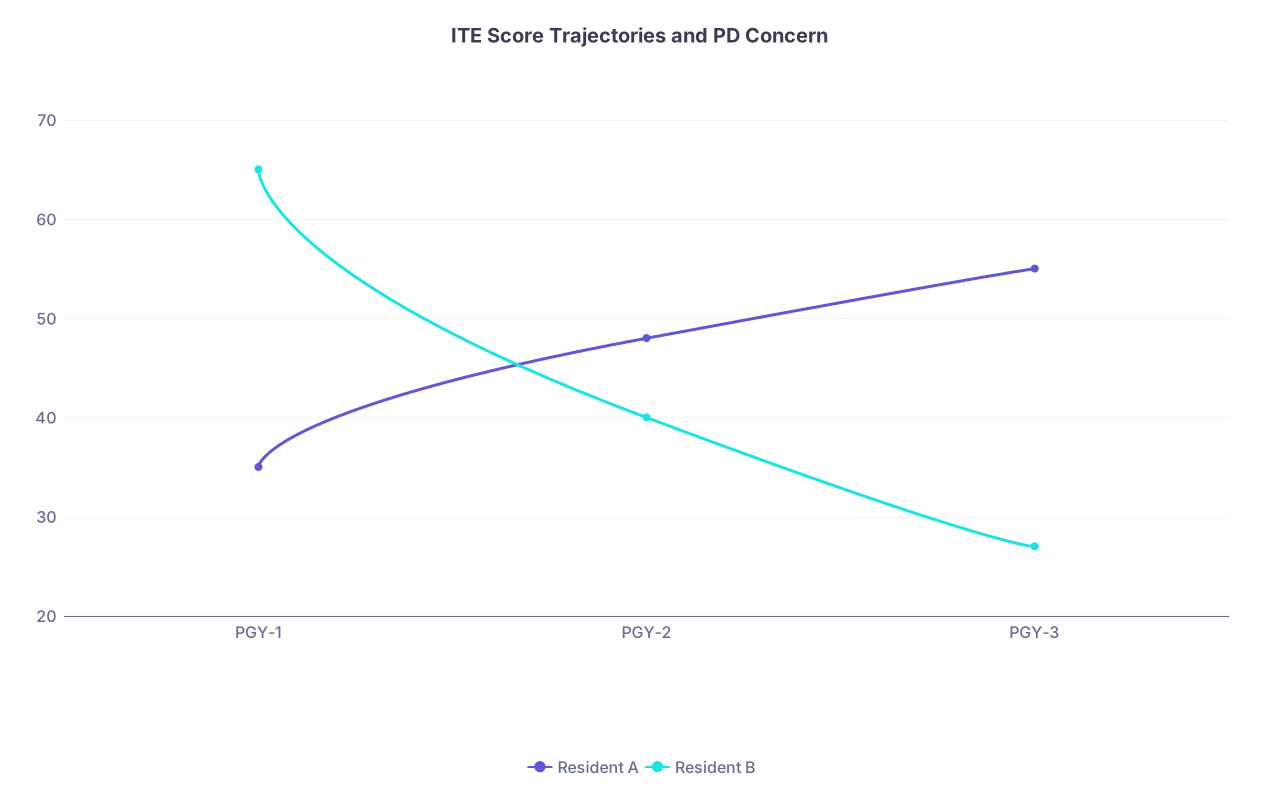
| Category | Resident A | Resident B |
|---|---|---|
| PGY-1 | 35 | 65 |
| PGY-2 | 48 | 40 |
| PGY-3 | 55 | 27 |
That graph is basically what they’re drawing mentally. Not in exact numbers, but in overall slope. Upward → reassurance. Downward → alarm.
If you remember nothing else from this entire breakdown, remember this: a mediocre-but-rising pattern is far safer than a high-then-falling pattern. PDs trust trends more than isolated peaks.
FAQ: What Residents Quietly Ask About In‑Training Exams
1. Can a single bad in‑training exam get me kicked out of residency?
By itself, almost never. Programs know life happens—illness, family crises, brutal rotations. What shifts things from “bad year” to “problem resident” is either repetition (multiple low years) or low scores combined with other concerns (poor clinical performance, professionalism issues). A one-off low score usually leads to a meeting and a plan, not a dismissal.
2. Do fellowship directors actually see my in‑training exam scores?
Often they don’t see the raw report, but they feel the ripple effect through your PD’s letter. If your PD has watched you sit in the bottom 20–30th percentile for years, they’re rarely going to write “no concerns about board passage” with a straight face. On the flip side, if you climbed from low to solid, they’ll usually highlight that improvement—and fellowship directors care a lot about that trajectory.
3. Is it true that being top percentile on in‑training exams guarantees I’ll pass boards and get any fellowship I want?
No. High in‑training scores strongly predict board success, but they do not override bad behavior, poor teamwork, or weak clinical skills. I’ve seen 90th percentile test-takers who made everyone miserable and had trouble getting strong letters. Fellowship directors want board-safe and functional colleagues. Crushing the exam is an asset, not a free pass.
4. If my score is low, should I tell my PD I just “don’t test well”?
You can mention test anxiety or past struggles, but if that’s your main narrative, it lands poorly. PDs hear that line constantly. A better move is: “I know standardized tests are a weaker area for me. Here’s what I’m already doing to change that, and I’d value your help structuring a plan.” They want to see ownership and action, not just explanation.
Core truths to walk away with:
In‑training exams are board-risk radars, not moral judgments; PDs care more about your trend than your exact percentile; and if you’re in the danger zone, the smartest move is to treat your PD as an ally in a shared problem—because your board pass is their report card too.