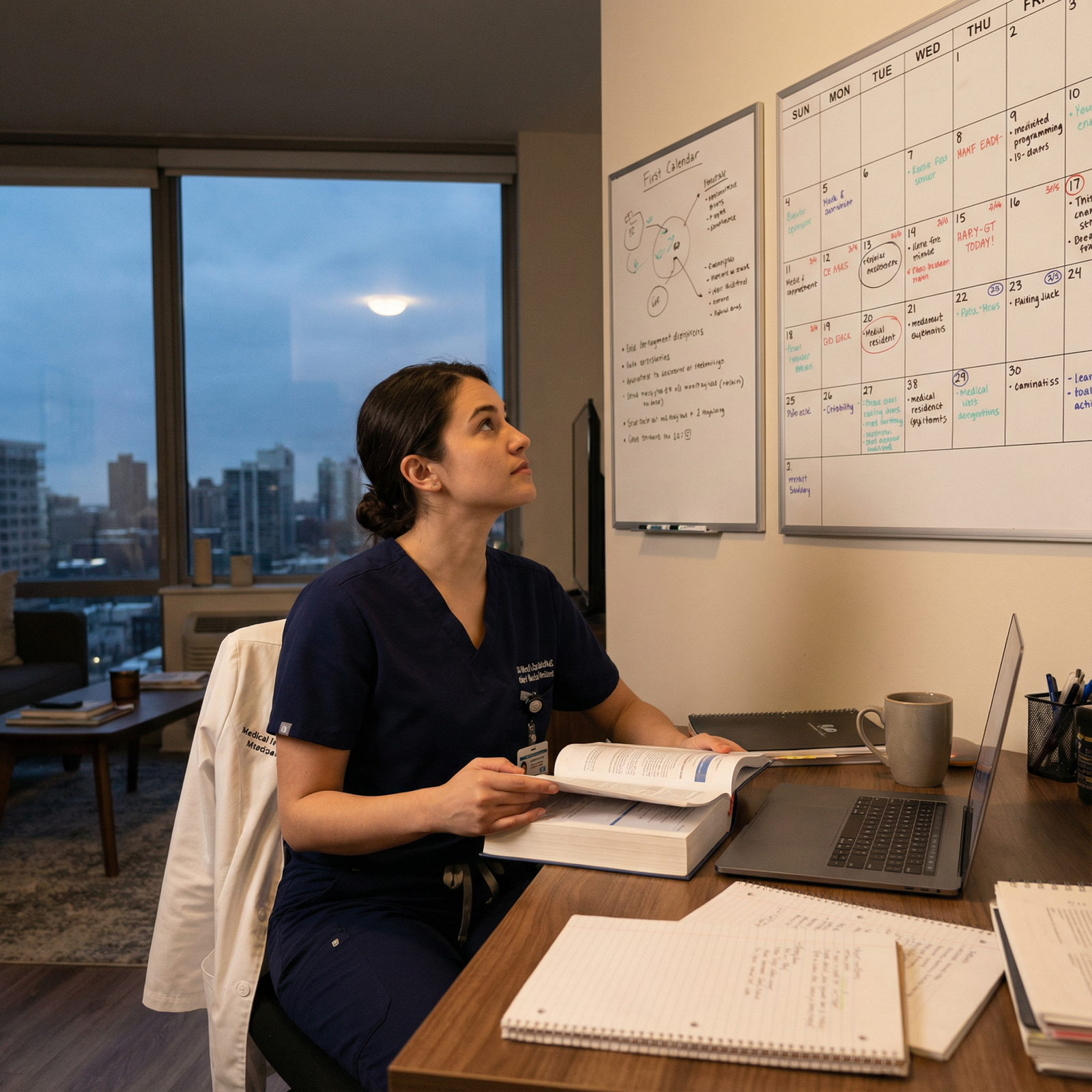
It is your PGY-3 spring. You are between nights, answering MyChart messages half-asleep, and someone casually mentions, “Yeah, I booked my oral boards slot already. Getting on a mock circuit next month.”
You freeze for a second. Oral boards? Already?
You have a vague memory of your program director saying, “You should start thinking about the certifying exam timeline early,” during orientation. You nodded, filed it away somewhere between “update N-95 fit test” and “sign up for hospital parking,” and never thought about it again.
Here is the problem: the certifying oral exam is not a thing you “deal with later.” The residents who treat it that way are the same ones you see silently panicking when dates are released, or worse, explaining to a future employer why they are “board-eligible” for the third year in a row.
I am going to walk you through the biggest planning mistakes I see residents make with their oral boards. The goal is simple: you do not become the cautionary tale.
Mistake #1: Treating the Oral Exam Like a Formality After You “Pass Written”
Most residents implicitly assume the sequence is:
- Survive residency
- Pass written boards
- Coast into a “rubber-stamp” oral exam
That is wrong. The certifying oral exam is not a courtesy checkpoint. It is a high-stakes, highly structured assessment that has very different failure patterns than the written.
Common faulty assumptions:
- “Everyone passes oral boards eventually.”
- “It is just talking through cases, I do that all day.”
- “I will worry about it once I pass the written – one thing at a time.”
Here is the reality:
- Pass rates are high only for those who actually prepare. Every cycle, smart, clinically strong residents fail because they assumed their day-to-day work automatically translates to exam performance.
- The exam is an artificial environment with time pressure, cold-start cases, and examiners trained to probe your weak points. Your usual workflow does not fully prepare you for that.
- The time gap between completing residency and actually taking the oral exam can stretch if you do not plan. The longer you wait, the more your “training voice” fades, and the harder it is to recall guidelines, phrasing, and structured reasoning.
The planning error is simple: you treat the certifying exam as a postscript to the written, instead of as its own multi-year project with logistics, prerequisites, and a learning curve.
Mistake #2: Not Mapping the Certification Timeline Early
Most boards (ABIM, ABS, ABA, ABOG, etc.) have a rigid timeline and “windows” for when you can sit for the oral exam after you complete training. Residents routinely ignore the timeline until they are backed into a corner.
Here is what gets people:
- Misunderstanding when you become eligible for the oral exam
- Missing early registration deadlines
- Failing to complete all documentation / case logs in time
- Underestimating how long it takes to get case lists approved or training verified
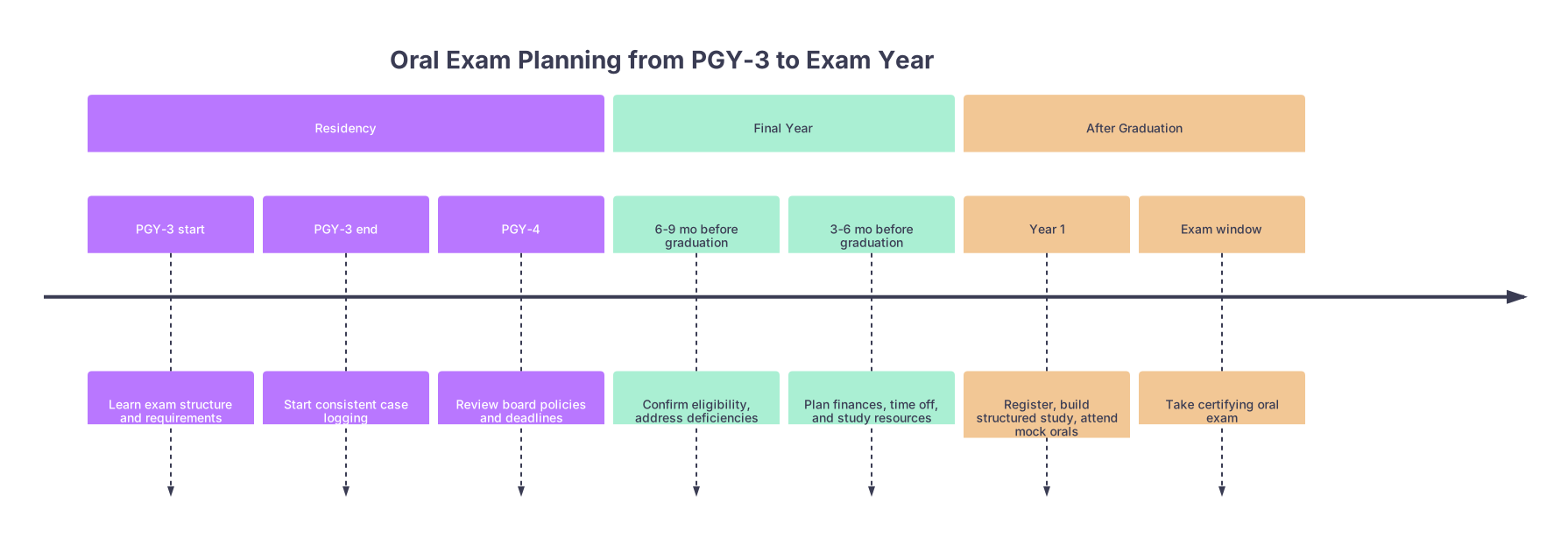
You need an actual timeline, not vibes.
| Period | Event |
|---|---|
| Residency - PGY-3 start | Learn exam structure and requirements |
| Residency - PGY-3 end | Start consistent case logging |
| Residency - PGY-4 | Review board policies and deadlines |
| Final Year - 6-9 mo before graduation | Confirm eligibility, address deficiencies |
| Final Year - 3-6 mo before graduation | Plan finances, time off, and study resources |
| After Graduation - Year 1 | Register, build structured study, attend mock orals |
| After Graduation - Exam window | Take certifying oral exam |
What I recommend you do (and almost no one actually does early enough):
In PGY-2 or early PGY-3, go to your board’s website and download the official certification brochure or candidate handbook. Yes, the boring PDF. Actually read:
- Eligibility criteria
- Required sequence (written first, then oral)
- Time limits between finishing residency and passing the oral
- How many attempts you have within that window
- Case log requirements (volume, types, formats)
- Policies about leaves of absence, fellowship, part-time work
Put the critical deadlines into a calendar you actually use, not a sticky note on your locker. Color one: eligibility; color two: registration; color three: exam windows.
Residents often assume their program coordinator will “handle all that.” They do not. They might remind you. They will not rescue you from poor long-range planning.
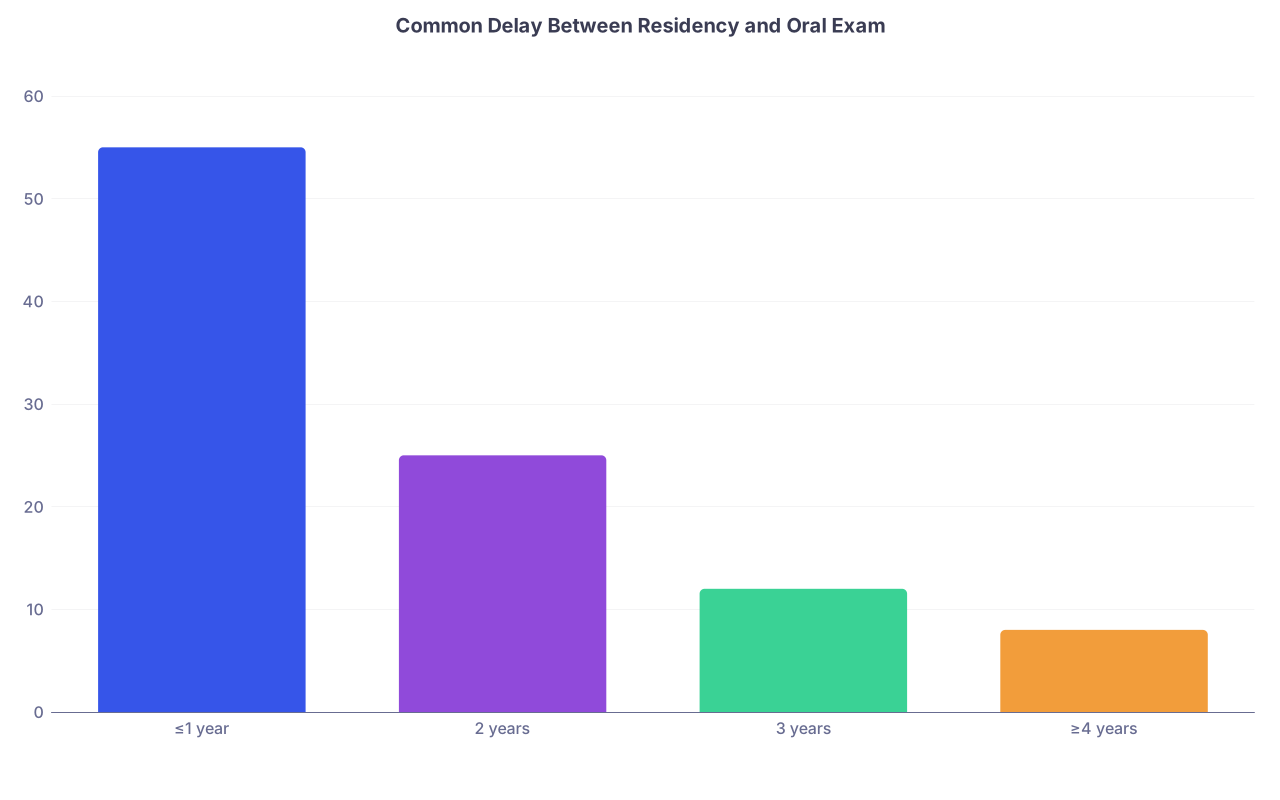
The biggest trap: letting years slip.
| Category | Value |
|---|---|
| ≤1 year | 55 |
| 2 years | 25 |
| 3 years | 12 |
| ≥4 years | 8 |
Every extra year you delay:
- You lose daily exposure to structured teaching
- You forget exam-style language and key guidelines
- Your life gets more complicated (jobs, kids, mortgage, admin roles)
- Your motivation erodes
The time to map your certification timeline is during residency, not after your first job contract.
Mistake #3: Ignoring Case Logs Until It Is Too Late
This one burns people badly, especially in procedural specialties and OB/GYN, surgery, anesthesia, and some subspecialties.
Pattern I have seen repeatedly:
- PGY-1 to PGY-3: “Yeah, I log cases… when I remember.”
- PGY-4 to PGY-5: “I will clean everything up before graduation.”
- Post-graduation: “Wait, my case list is missing months. And this format is wrong. And I do not meet the category requirements.”
The boards are not casual about this. If your case documentation is incomplete or does not meet criteria, you may not be permitted to sit for the exam when you want. That can push you back an entire year.
Common mistakes with case logging:
- Logging inconsistently, based on memory, instead of daily or weekly
- Not categorizing cases correctly per board definitions
- Failing to include required fields (outcomes, complications, etc.)
- Losing access to hospital systems or EMRs after graduation, then being unable to reconstruct details
- Assuming your program auto-exports a board-ready list (often they do not)
You avoid this by treating case logs like a non-negotiable clinical task.
- Set a weekly block (even 15 minutes) to update log entries.
- Cross-check your running counts against board minimums and distributions every 6–12 months.
- Before your final year ends, do a full review with a faculty mentor who has recently gone through the process.
Leaving case logs to your final months of residency is how you end up piecing your career together from memory at 2 a.m. with partial EMR access. Do not do that to yourself.
Mistake #4: Not Budgeting Time and Money for the Oral Exam
You already know board exams are expensive, but many residents still get blindsided by the combination of:
- Exam fees
- Travel (if in-person) or tech / environment prep (if virtual)
- Prep course fees or mock orals
- Lost income from days off
- Childcare, coverage swaps, and associated stress
The subtle error is not just “forgetting it costs money.” It is failing to budget emotionally and logistically for that cost so you are not forced into dumb choices.
I have watched people do these:
- Schedule the exam during the busiest stretch of their new attending job because they “could not afford” more time off.
- Skip any mock orals or structured prep because “I am broke from moving and loans,” then pay for a retake plus an extra year of being non-certified.
- Treat exam needs as a last-minute emergency, begging colleagues to cover shifts while they try to cram.
Build a rough budget by your final year of residency. At least get an order-of-magnitude estimate:
| Expense Type | Typical Range (USD) |
|---|---|
| Exam Registration | 1,500–3,500 |
| Prep Course/Mocks | 500–2,000 |
| Travel/Lodging | 500–1,500 |
| Time Off / Lost Pay | Varies by contract |
Then build space into your financial plan. That might mean:
- Reserving some moonlighting income
- Using CME funds from a first job (if allowed)
- Negotiating exam-related leave or CME time in your employment contract
If you do not deliberately reserve the time and resources, everything else in life will consume them.
Mistake #5: Assuming “Clinical Experience” Equals “Oral Exam Ready”
This is the arrogant trap. Especially for high-performing residents.
You do good work. Patients like you. Attendings trust you. You handle complicated cases. So you assume you will be fine in an exam that is “just talking through management.”
Then you sit down for your first serious mock oral and you realize:
- Your explanations are verbose and poorly structured.
- You rely heavily on “I would” statements with no justification hierarchy.
- You get flustered when the examiner pushes against your plan.
- You miss key safety phrases that examiners expect.
- You waffle on decisions instead of committing and defending.
Oral boards are about:
- Structure
- Prioritization
- Safety and risk framing
- Clear articulation under pressure
Not just “being good in the hospital.”
If you are not practicing exam-style responses, you are training the wrong skill. That is like showing up to a standardized patient OSCE after only doing night shift handoffs and assuming they are identical.
The residents who pass comfortably are the ones who:
- Learn a specific framework for answering questions (assessment → prioritized differential → immediate safety steps → definitive plan → contingencies).
- Train their mouths and brains to deliver 60–90 second structured answers without spiraling.
- Practice being interrupted, challenged, and redirected without losing composure.
You will not magically develop that on exam day. You have to rehearse it.
Mistake #6: Starting “Serious” Preparation Way Too Late
There is a predictable pattern:
- Six months out: “I have time. Let me just finish orientation at my first job.”
- Three months out: “I should probably schedule some mocks.”
- One month out: full-blown panic, binge courses, answer banks, late-night sessions.
Your brain is a terrible tool for compressing complex, orally tested reasoning into four weeks. People think they can brute-force it because they got away with that in med school. Oral exams punish that habit.
A sane prep arc looks more like:
- 9–12 months before exam window: Light exposure. Learn exam format, watch videos, sit in on someone else’s mock if you can.
- 6 months before: Weekly or biweekly focused sessions. Join a small group or partner, do timed cases, review key guidelines.
- 2–3 months before: Increase frequency. Mocks with faculty, formal prep course if you are going to do one, refine style and timing.
- Final 2–3 weeks: Short, high-yield review; simulated full exam scenarios; protect sleep.
Cramming in the final month is how you:
- Burn out on prep and resent the process
- Over-focus on trivia instead of structure
- Show up tired, brittle, and over-caffeinated
Remember: the certifying oral exam is not testing whether you can regurgitate factoids. It is testing your day-to-day reasoning. That is built gradually, not in one desperate sprint.
Mistake #7: Studying in Isolation and Skipping Mock Orals
This one is almost universal among residents who are introverted, anxious, or “self-sufficient.” You prefer to read, watch lectures, and take in content passively. You avoid early mock orals because:
- “I am not ready yet.”
- “I do not want to embarrass myself in front of faculty.”
- “I perform better when the stakes are real.”
So you delay. And delay. And then you walk into the actual exam having never truly stress-tested your communication style under exam-like pressure.
Bad idea.
You will not know your blind spots until someone stops you mid-answer and asks, “Why are you doing that instead of X?” You need external pressure to expose:
- Where you ramble
- Where you hedge excessively
- Where you overlook safety issues
- Where your knowledge is thin in common scenarios
And you cannot simulate that alone in your living room.
At minimum:
- Do multiple mock orals with faculty who have examined, or at least have taken the exam recently.
- Do peer-to-peer sessions where you take turns playing “examiner” with old cases or published stems.
- Record at least some sessions (audio is enough) and listen to yourself. Cringe, then fix.
Residents often treat mock orals like a final check. They should be a core part of your learning environment for months.
Mistake #8: Ignoring the Psychological Load and Burnout Factor
Here is the part almost nobody talks about honestly.
By the time you are eligible for the certifying oral exam, you are usually:
- Freshly in a demanding attending role or deep in fellowship
- Carrying real malpractice risk for your decisions
- Managing personal life milestones (partners, kids, housing, loans)
- Recovering from years of chronic exhaustion
You are not a wide-eyed MS2 with boundless test-taking energy. You are tired. And the exam will feel like an extra anvil on your neck if you do not respect the psychological load.
Common mental mistakes:
- Minimizing your anxiety until it shows up as avoidance and procrastination
- Refusing to scale work temporarily before the exam (“I do not want to be seen as weak”)
- Telling yourself you “always pull it off at the end,” letting that excuse chronic under-preparation
- Internalizing a failure (or a delay) as a character flaw instead of a logistical or planning problem
You need to plan around your mental bandwidth as much as your schedule.
That may mean:
- Taking a slightly lighter schedule the month before the exam if your contract allows
- Being frank with your partner or family: “For two months, I need X hours a week protected for this. Then it is done.”
- Working with a mentor or coach if you have paralyzing exam anxiety
- Practicing short mindfulness or breathing routines before and during mocks so they are baked in for test day
Burnout and oral boards do not mix. You cannot fake bandwidth.
Mistake #9: Letting “Board Eligible” Status Drift Indefinitely
There is a dangerous complacency in the phrase “board eligible.”
Employers tolerate it for a short window. Malpractice carriers sometimes do too. But over time, that eligibility without certification starts looking less like “in progress” and more like “stuck.”
Here is how the drift happens:
- You postpone your first oral exam window because “I just started my new job.”
- You postpone the second because you changed cities, or had a baby, or took on new responsibilities.
- You fail once and decide to “take a break” and recover before you try again. The break becomes 18 months.
- Suddenly, you are nearing or past the time limit the board allows for initial certification, trying to petition or scramble.
Each delay feels reasonable in isolation. Added together, they jeopardize your entire certification timeline.
If you are already in that drift, you need to be honest with yourself:
- Pick the next available feasible exam window.
- Build a realistic, structured plan and get help.
- Treat this as a non-negotiable professional priority, the way you would treat licensure.
Do not let “board-eligible” become your permanent title.
Frequently Asked Questions
1. When should I start planning for the certifying oral exam during residency?
By PGY-2 to early PGY-3, you should at least understand your board’s requirements, eligibility timeline, and case log expectations. That does not mean hardcore studying yet, but it does mean reading the candidate handbook, setting calendar reminders for key deadlines, and making sure your case logging is clean and consistent. Serious content preparation usually ramps up during your final year of residency or early in your first post-training job, depending on the specialty’s exam schedule.
2. Do I really need a formal prep course, or can I just study with peers and faculty?
Plenty of people pass without a commercial course, especially if they have strong local support and committed faculty willing to run multiple mock orals. The mistake is not the lack of a course; it is the lack of structured practice. If your program is weak on mock orals, a good course or organized coaching can be worth it. If your department has a robust internal prep system, you may not gain much from paying thousands more. What you cannot skip is live, repeated, exam-style practice.
3. How many mock oral exams should I aim to do before the real thing?
As a rule of thumb, at least 8–12 full-length or near-full-length sessions with different examiners is a reasonable target. Mix formats: some focused on specific topics (e.g., obstetric emergencies, vascular complications), some run as full exam simulations with timing and pressure. Spread these over 2–3 months so you have time to correct patterns, not just rack up reps. Doing one or two mocks in the final week only tells you you are in trouble; it does not fix anything.
4. What if I fail the oral exam once? How should I change my approach?
Treat a failure as a diagnostic event, not a personal indictment. Get detailed feedback if your board allows it, or ask mock examiners to reconstruct your performance based on typical failure patterns. Identify whether your main issues were knowledge gaps, structure and communication, case types, or anxiety and composure. For the next attempt, over-correct on structure and practice volume: more mocks, more recorded sessions, and earlier start. Also, compress the time to your next try as much as your circumstances allow; long delays usually make things worse, not better.
Bottom line:
- The certifying oral exam is a separate, serious project, not an afterthought once you “pass the written.”
- The biggest failures are planning failures—timeline, case logs, time, money, and mental bandwidth—not raw intelligence.
- If you treat preparation as a structured, long-range part of residency and early practice, you will not be the one explaining a multi-year “board-eligible” limbo on every job application.