It’s 7:58 AM. You’re sitting in an over-air-conditioned hotel conference room that smells faintly of burnt coffee and anxiety. Two older physicians walk in with identical black binders. They do not introduce themselves beyond last names. They sit. One clicks a pen, the other presses “start” on a small timer.
You’re staring at them, trying to remember every management algorithm you ever read.
They’re staring at you, but they are not doing what you think they are doing.
Let me walk you behind their eyes for a minute.
Because if you do not understand what’s happening on their side of the table, you’re going to misinterpret half their behaviors, overreact to the wrong things, and underprepare for what actually matters on oral boards and in-training orals.
What Examiners Are Actually Scoring (It’s Not What You Think)
You think they’re testing: “Do you know the perfect, guideline-concordant answer to every step of this case?”
They aren’t.
They’re testing three questions:
- Are you safe?
- Are you systematic?
- Are you someone I’d trust alone at 2 AM?
Everything else—buzzwords, perfect drug doses, citing trials by name—is secondary.
Here’s the mental checklist almost every experienced examiner is running in the background, even if the board handbook doesn’t spell it out:
- Do you recognize sick vs not sick instantly?
- Do you anchor critical actions early? (Airway, hemodynamics, disposition)
- Do you have an organized way of thinking, or are you just throwing random facts at the wall?
- Do you correct yourself appropriately when nudged?
- Do you get weirdly defensive or flustered when pressed?
If the answer to the first three is yes and the last two are acceptable, you’re in solid territory.
Think of it this way: they’re not grading you as a trivia champion. They’re grading you as a future colleague they might have to cover a call schedule with.
The unspoken truth: almost every examiner I know would rather pass a safe, slightly clunky candidate than a brilliant chaos machine who sounds impressive but misses obvious red flags.
Inside the Examiner’s Morning: How Cases Are Built and Used
Let me tell you what their morning looked like before you walked in.
They got assigned a standardized case set—a script. They didn’t write it. The national board (or your department exam committee for in-service orals) did. That script includes:
- A stem with key details
- Mandatory “must mention” items
- Branching prompts depending on how the candidate answers
- Scoring anchors: what counts as clearly unsatisfactory, borderline, or clearly acceptable
They are not making it up as they go along. They may improvise some follow-ups, but they’re leashed to that script more than you realize.
So when you see an examiner’s face shift slightly after you answer something, it’s not always “You’re wrong.” Sometimes it’s:
- “Okay, I have to go down branch B for this answer.”
- “I need to read the next hint because you missed the required item.”
- “We’re now in the ‘salvage this candidate’ pathway.”
I’ve watched faculty train as examiners. The message they get is blunt: “You are not here to play ‘stump the chump.’ You’re here to determine if the candidate meets the standard. Period.”
Do some examiners ignore that and show off? Yes. Usually the ones who brag in the workroom about “destroying” candidates. Those people exist. But the structure of the exam ties their hands more than you think.
The Real Scoring Rubric: What’s In Their Head While You Talk
No one shows you how examiners are taught to think. So I will.
Strip away the formal language and this is the mental model:
| Category | What Examiner Is Really Asking |
|---|---|
| Initial response | Do you recognize how sick this is and act appropriately? |
| Differential diagnosis | Does your thinking cover dangerous and common causes? |
| Workup plan | Is your testing targeted, safe, and timely? |
| Management | Are you initiating correct, time-sensitive treatments? |
| Communication & safety | Would nurses, consultants, and patients trust you? |
They’re not tallying, “Did they name 7 causes of XYZ?” They’re listening for patterns.
1. Pattern: “Safe vs Dangerous”
First pass in their head is always: “Would this kill the patient if I left them alone?”
Example: ACS case. If you never give aspirin, heparin or equivalent, nitro when appropriate, and don’t call cardiology in a timely way, that’s a problem. They don’t care if you can recite the TIMI risk score. They care that you treat the MI.
They’re watching for:
- Do you prioritize airway/breathing/circulation without being prompted when needed?
- Do you escalate care (ICU, OR, cath lab, transfer) at the right moment?
- Do you recognize “this isn’t stable” fast enough?
People fail oral exams not because they forgot a lab, but because they calmly plan a CT on a crashing patient before stabilizing them.
2. Pattern: “Organized vs Scattered”
Every examiner has sat through that one candidate who knows a lot but sounds like an exploding bibliography.
They jump from one organ system to another, mention four obscure causes, then forget to do the one obvious test that actually changes management.
Examiners are scoring:
- Do you present your thinking in a structure? (ABC, then problem list, then plan by problem)
- Do you close the loop? (Confirm follow-up, disposition, informed consent, return precautions)
- Do you seem in control of the narrative?
A candidate who says, “First I’d assess ABCs; the patient is stable, so then I’d focus on…” sounds competent even if they forget some micro-detail. A candidate who just rattles labs and drugs in no order sounds lost, even if technically they mention the right things.
3. Pattern: “Coachable vs Dangerous Ego”
This one’s huge and no one talks about it.
Examiners will push you. They’ll give a slightly ambiguous lab. They’ll ask, “Are you sure about that?” They’re not always trying to trip you—they’re looking for how you react to friction.
The candidates who worry examiners the most:
- Double down on clearly wrong answers when gently given a chance to rethink
- Argue, deflect, or get snappy (“Well, I mean, it depends…,” said with attitude)
- Blame the case write-up (“I guess if the history had been clearer…”)
Compare that with:
“I’d initially think X, but given that finding, I’d reconsider and lean toward Y. I’d also do Z to clarify.”
That’s gold. That’s what a safe attending sounds like when called at 3 AM and given new data. Examiners pass those people. Even if they’re not perfect.
Why They Keep a Poker Face (and What They’re Thinking Behind It)
You say something. Both examiners sit stone-faced, no nodding, no smile. You assume: “I must be bombing.”
Not necessarily.
Examiners are taught to deaden their affect. There are specific reasons:
- To avoid unintentionally coaching (“Mm-hmm” when you’re close, frown when you’re off)
- To control implicit bias (“I like this person” raises scores if they’re not careful)
- To keep uniformity across candidates
So what are they actually thinking when you’re talking?
Let me pull the curtain:
- “Okay, they hit the key action. That check box is done.”
- “They’re dancing around the must-mention diagnosis, I’ll give them one more question to see if they get there.”
- “We’re at time; I need to move this along to reach all scoring domains.”
- “They’re nervous but safe; I’m not going to tank them over style.”
I’ve sat in debriefs. Most examiners are actively rooting for you to do well. They know this format is artificial. They know nerves make you sound dumber than you are.
The few who enjoy being intimidating? Everyone on the committee knows who they are. The system usually pairs them with a calmer co-examiner to balance things out.
How Examiners React to Common “Mistakes”
Let’s dissect a few typical patterns candidates obsess over—and how it really lands on the examiner side.
Forgetting a specific drug dose
Candidate fear: “I didn’t know the exact mg/kg, I’m done.”
Examiner reality: They don’t care, unless the dose you gave would obviously harm the patient.
If you say, “I’d start norepinephrine at a standard weight-based starting dose and titrate to MAP >65,” that’s fine. You don’t need to rattle off micrograms.
What worries them is something like, “I’d give 200 mg of IV morphine for chest pain.” That’s not a knowledge gap. That’s unsafe.
Saying “I don’t know”
Candidate fear: “If I say I don’t know, I fail.”
Examiner reality: “I don’t know, but here’s how I’d find out or reason through it,” is completely acceptable. In fact, it can increase their confidence in you.
What does hurt you:
- “I don’t know,” followed by silence.
- Making something up confidently and being spectacularly wrong on something core.
A seasoned examiner hears, “That’s not something I know offhand. I’d check a reliable resource or call pharmacy, but the principle here is…” and thinks, “That’s what a safe attending does. Good.”
Needing prompts
Candidate fear: “They had to lead me, I must be borderline.”
Examiner reality: The case script literally tells them when to prompt. Prompts aren’t always a sign you’re failing. Sometimes they’re just advancing the scenario to reach another scoring item.
There are “rescue prompts” where they’re basically trying to see if any hint will salvage a key concept. But even then, if you recover well, they often credit that.
I’ve seen multiple candidates pass strongly despite needing a nudge. What kills you is not recovering even after obvious prompting.
What Examiners Remember After a Session (And What They Don’t)
Walk out of an oral exam and your brain will obsessively replay that one clumsy sentence for days.
Meanwhile, the examiner at lunch is saying, “That 3rd candidate? The one who didn’t intubate the COPD patient rolling in with pH 7.05? Yeah, that was rough.”
They remember:
- Big safety misses.
- Candidates with glaring judgment problems.
- Candidates who were a pleasure to examine—calm, organized, honest.
They do not remember:
- The exact number of items in your differential.
- Whether you said “ceftriaxone” or “a third-generation cephalosporin.”
- If you mixed up the name of a rare syndrome but correctly handled the main management.
The important unspoken rule: you’re being judged on global performance, not on a single awkward line. They score domains, not stray sentences.
How Examiners Talk About Candidates in the Hallway
This is where the real truth leaks out.
After a half-day of cases, faculty gather to turn in scores, grab coffee, gossip. You hear things like:
- “She started a massive GI bleeder on a heparin drip. I couldn’t rescue that.”
- “He was nervous, but his priorities were solid. I passed him.”
- “She knew every fact but didn’t start antibiotics for septic shock until 20 minutes into the case. All facts, no instincts.”
No one says, “Did you hear he forgot to mention troponin the first time?” Because that’s not what sticks. What sticks is your clinical judgment profile.
This is why your prep should be built around: Can I safely and systematically run these core scenarios? Not: Can I regurgitate an UpToDate article under pressure?
How to Align Your Performance With Their Brain
You wanted inside their mind. Now use it.
Open Every Case Like a Safe Attending
The first 60–90 seconds set the examiner’s entire impression of you.
You want to sound like this:
“First I want to assess the patient’s airway, breathing, and circulation. Are they stable? Depending on that, I’ll either call for immediate resuscitation and higher level of care or proceed with a more detailed history and exam.”
That tells them: You understand priorities. You’re not going to calmly order CRP while the patient is in extremis.
Then you move into:
- Concise differential, with clear mention of life-threatening causes.
- Targeted workup that matches the stability of the patient.
- Early critical therapies.
Examiners start making up their mind about “pass vs trouble” extremely early. They’ll still let you finish; they’ll still score you. But you want that early gut impression in your favor.
Think Out Loud. But Not Like a Maniac.
You’re not there to narrate everything in your head. But you are there to show the structure of your thinking.
What they want to hear:
“I’m considering X, Y, and Z. Of those, X is most dangerous, so I want to rule that out first by doing A and B.”
What they don’t need:
“I could also consider 17 different zebra diagnoses that have nothing to do with the case, but I’ll list them because I’m panicking and silence scares me.”
Fill the silence with useful structure, not panic data.
Own Errors Gracefully
You will say something dumb. Everyone does. The examiners know this.
The difference between “pass” and “fail” is your repair.
Examiner: “Would you like to revise that plan, given the patient’s blood pressure is 60/30?”
Bad: “Oh yeah, sure, I guess I’d probably do fluids.”
Good: “You’re right; hypotension changes my priorities. I’d immediately start resuscitation with fluids and pressors as needed, support airway and breathing, and shift focus to stabilizing first before additional diagnostics.”
They’re not punishing you for the first misstep as much as they’re evaluating your second move.
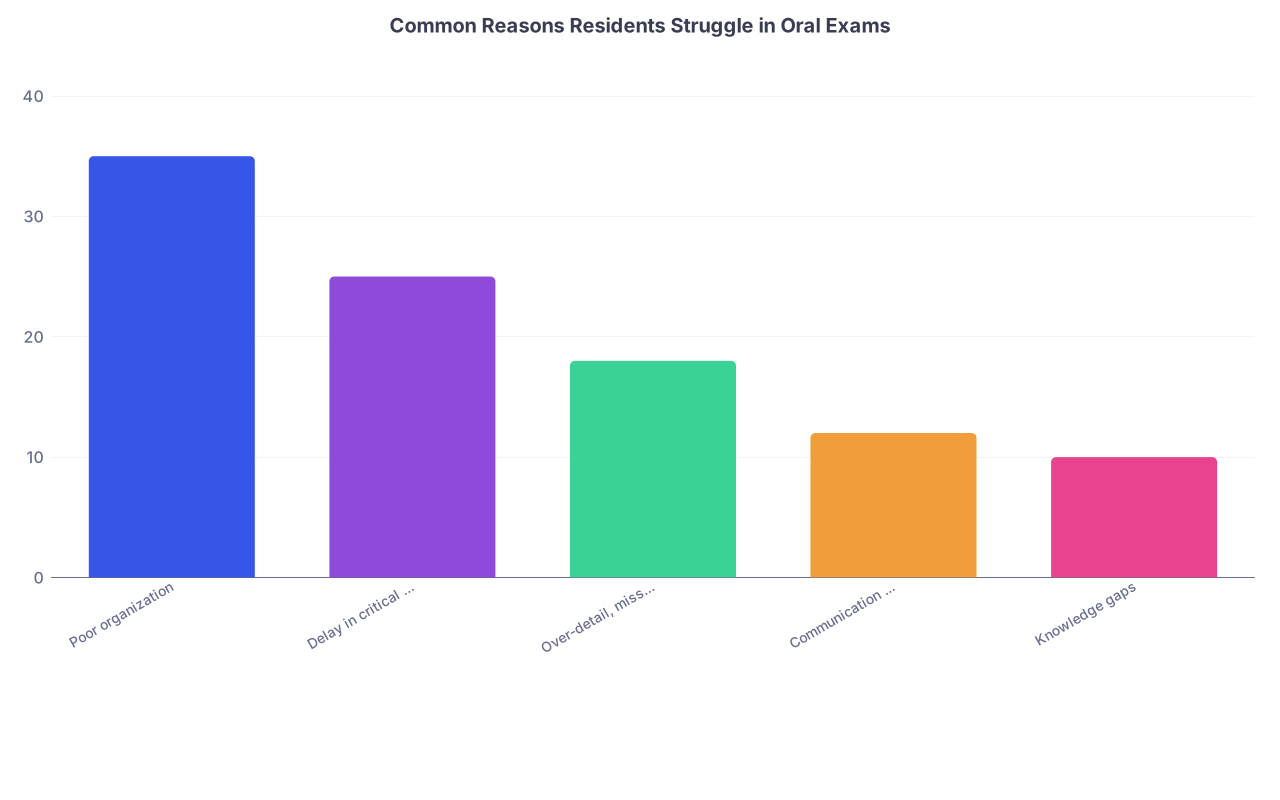
What Data Shows About Common Trouble Spots
Let’s be concrete for a second.
| Category | Value |
|---|---|
| Poor organization | 35 |
| Delay in critical action | 25 |
| Over-detail, miss big picture | 18 |
| Communication style | 12 |
| Knowledge gaps | 10 |
When I’ve sat on local boards or mock exams, the top reasons residents look bad are:
- They’re disorganized and wander.
- They delay a critical action while being “busy” doing low-value steps.
- They talk impressively but do not move the patient forward.
“Knowledge gaps” is actually the least frequent primary issue. You don’t usually fail because you never read about HSP. You fail because, in a sepsis case, you don’t give antibiotics until 15 minutes into your monologue.
How To Practice The Way Examiners Think
Your prep is probably backwards. Most residents “study” for orals by re-reading management summaries. High-yield content. That’s fine, but it’s not sufficient.
You need to rehearse in the format examiners are scoring.
Here’s a structure I’ve seen work when programs prep their residents:

| Step | Description |
|---|---|
| Step 1 | Pick core scenario |
| Step 2 | Resident presents approach out loud |
| Step 3 | Peer acts as examiner with prompts |
| Step 4 | Peer scores - safety, organization, judgment |
| Step 5 | Immediate feedback on 2-3 key behaviors |
| Step 6 | Resident repeats case applying changes |
The key is this: your friends should be listening like examiners, not like co-residents trying to win at trivia. Feedback should be:
- “You didn’t stabilize before ordering tests.”
- “Your organization improved when you used ABC/then problem-based plan.”
- “You missed the moment to escalate care.”
Not: “You forgot to mention D-dimer.”
Run 20–30 reps of common scenarios—chest pain, SOB, abdo pain, sepsis, trauma, perioperative complications—out loud, with time pressure, and you’ll start sounding like someone who belongs across the table, not under it.
How Style and Personality Actually Land
This part is uncomfortable, but you deserve the truth.
Examiners are human. They respond to demeanor.
They unconsciously like:
- Calm but not robotic.
- Confident but not arrogant.
- Collaborative tone (“I’d discuss with the patient,” “I’d coordinate with ICU”).
They unconsciously dislike:
- Defensive answers.
- Sarcasm or jokes to hide uncertainty.
- Overconfident patter without clear safety.
Will they admit that in the training manual? No. In the debrief room, they talk about it all the time.
Your job is not to fake a personality, but to lean into your professional self. The version of you that signs notes, calls consults, explains things to families. Talk like that person, not like a nervous test-taker.
One More Thing Nobody Tells You: They Know This Is Artificial
Examiners—at least the good ones—are not confused. They know this isn’t real life. They know you don’t usually care for a crashing patient with your hands in your lap describing what you would do.
The better ones mentally discount some of the awkwardness.
What they’re trying to see through the artificial setting is your clinical silhouette:
- Are you the kind of doctor who sees the cliff before driving off it?
- Do you triage correctly under uncertainty?
- Do you organize chaos into an action plan?
If the answer to those is yes, they’ll overlook the fact you called cefepime “cefotaxime” once or forgot to mention one lab that didn’t change management.

Rapid Calibration Checklist: Are You Speaking Their Language?
Here’s a simple mental checklist you can run after each practice case to see if you’re aligned with how examiners think. Not perfect, but close.
Ask yourself:
- Did I identify sick vs not sick early?
- Did I verbalize a structure (ABC, then problems and plan)?
- Did I clearly name and address the life-threatening possibilities?
- Did I escalate appropriately—ICU, OR, consults—when indicated?
- Did I correct myself reasonably when new data came or when pushed?
If those are consistently yes, you’re performing above the threshold most examiners are looking for.
If you’re missing multiple of those, it doesn’t matter how many fancy facts you know. You’ll sound risky.

FAQs
1. Do examiners see my full application or training background?
Usually no. For national boards, they typically don’t know where you trained, your CV, or your file. They may see your name and exam ID, maybe your specialty track. That’s it. The structure is designed so they judge what’s in front of them that day, not your pedigree.
2. If I bomb one case, am I guaranteed to fail?
Not automatically. Most oral exams use multiple cases and domain-based scoring. A weak performance on one case can be offset by stronger performance on others, if your global safety and judgment profile is acceptable. What reliably sinks people is repeated unsafe thinking, not one ugly miss.
3. Should I be super formal in my language, or talk like on rounds?
Aim for your “professional rounds” voice. Clear, organized, not slangy, but also not robotic. Saying “I’d call cardiology urgently” is fine. You don’t need to recite, “I will initiate a multidisciplinary care conference with…” unless you actually talk like that in real life (you don’t).
4. How much do guidelines and latest trials matter to examiners?
They care about principles, not brand-new minutiae. If you manage sepsis with early antibiotics, appropriate fluids, and vasopressors when needed, you’re fine even if you don’t quote the latest trial by name. Where guidelines matter is when your plan is clearly behind modern standard of care in a dangerous way.
5. What’s the best single way to practice for oral exams?
Run timed, out-loud cases with a colleague acting as examiner, using real case scripts if possible. After each case, get feedback only on safety, organization, and big judgment calls. Fix those. Repetition of that pattern is what makes you sound like the kind of physician examiners are trying to pass.
Two things to keep in your head when you sit down across from them:
- They’re not looking for a genius. They’re looking for someone they’d trust alone with a crashing patient at 2 AM.
- You pass oral exams by being systematically safe, not theatrically impressive.
If you build your prep around those truths, you’ll sound like exactly what they’re hoping to see when you walk into that cold conference room with the ticking timer.