
It’s 2:17 a.m. You’re in the workroom, half-finished note on the screen, pager on your hip, and you suddenly realize: in less than a year, your name might be on a board-eligible certificate.
And you know damn well your program director isn’t just looking at your in‑training exam percentile.
Let me tell you what actually gets said behind that closed-door Clinical Competency Committee (CCC) room when they decide if you’re “ready for the boards” versus “we’re a little nervous about this one.”
It’s not the official milestones language. It’s a dozen small signals that every attending in the room has quietly picked up on for months.
You want to know what they are. Because this is the stuff nobody writes in the handbook.
What “Ready for Boards” Really Means to a PD
Forget the brochure language for a second. When a PD says, “I feel good about them taking boards,” what they’re actually saying is:
“I trust them not to embarrass this program with a first-time fail.”
Harsh? Yes. True? Also yes.
Program directors are judged on board pass rates. Not just publicly, but in those ACGME surveys, in recruitment meetings, on hospital credentialing committees. A run of bad board outcomes and suddenly everyone is looking at their leadership.
So when they’re deciding if you’re “board ready,” they’re silently running through questions like:
- Do they show patterns of closing knowledge gaps or just living with them?
- When they say, “I’ll read about that tonight,” does anything actually change?
- Are they safe when tired, stressed, or behind?
- If they barely passed the ITE, did they react appropriately—or shrug?
Board readiness to PDs is a composite: cognitive, behavioral, reliability, and reputation. And some of the strongest signals aren’t in your test scores at all.
Signal #1: How You Handle Being Obviously Wrong
Here’s something I’ve heard verbatim in a CCC meeting:
“Look, her fund of knowledge isn’t stellar, but when she’s wrong, she actually updates. She comes back the next day having read about it. I can work with that.”
That’s huge.
Attendings are constantly running informal experiments on you. They ask a question they know you don’t fully understand. They watch what you do next.
Two very different residents:
Resident A: gets a question wrong on rounds, nods, says “OK,” never brings it up again.
Resident B: gets the same question wrong, next morning says, “I read about X last night—here’s what I missed yesterday.”
Guess who everyone trusts to grind through UWorld / MKSAP / TrueLearn and fix their weak areas before boards? The one who proves they can close feedback loops.
Because the boards are basically that same dynamic in extreme form: thousands of questions where you’ll be wrong during prep and have to adapt.
If your pattern in residency is:
- Defensiveness when corrected
- Avoiding topics you’re bad at
- Superficial “Yup, got it” without change
…then your PD’s gut will quietly say, “This one might be a risk for a first-time fail.”
On the other hand, if people see you using being wrong as a trigger for real improvement, your ITE score suddenly becomes less scary. You’ve already shown you’re coachable and iterative.
Signal #2: Your ITE Trend Line vs Your Absolute Score
Everyone obsesses over the raw PGY‑3/4 ITE percentile. That’s not actually how PDs think.
They care about the trajectory and the story behind that trajectory.
I’ve sat in meetings where a PD said:
“He started at like the 15th percentile intern year. Last exam he was at 45th, studying consistently, using questions. I’m not worried. He’ll be fine.”
Then in the same hour:
“She’s been hovering around 35–40th percentile for three years. Never changes her approach. That worries me more.”
The hidden truth: PDs know a lot of people with mediocre ITEs pass the boards. They’ve seen it every year. So they’re not hung up on a magic cutoff so much as:
Are you demonstrating adult learning behavior?
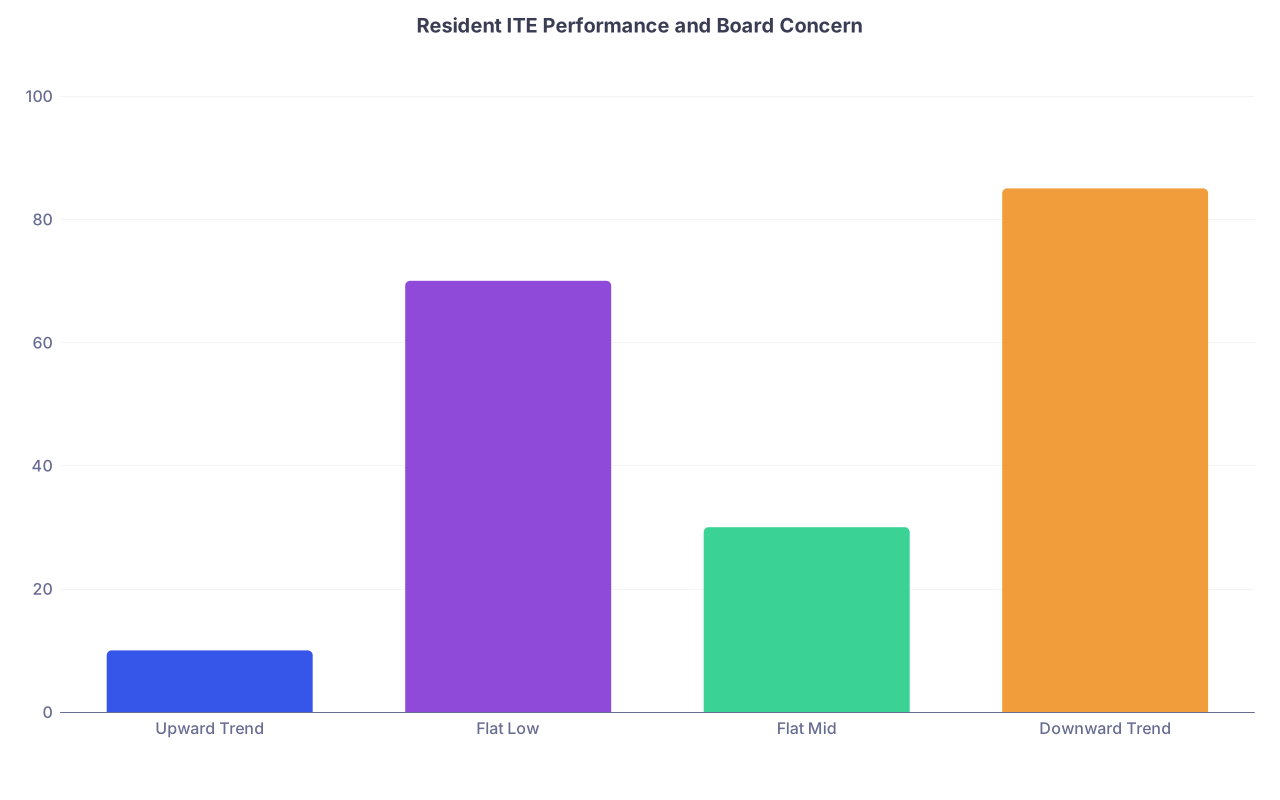
| Category | Value |
|---|---|
| Upward Trend | 10 |
| Flat Low | 70 |
| Flat Mid | 30 |
| Downward Trend | 85 |
That chart is roughly how concerned PDs feel, not actual pass rates. But it’s emotionally accurate.
- Upward trend from low: low concern. You figured something out.
- Flat low without change in strategy: very high concern.
- Flat mid with no effort: mild concern. You’ll probably pass, but they still wish you’d prove it.
- Downward trend: massive red flag, especially if your life is otherwise “fine.”
When residents bomb the ITE then don’t change anything, PDs flag that. When you bomb it and then ask specifically:
“I’ve been using just UWorld casually. What do your residents who passed after a low ITE usually do differently?”
That’s a different signal entirely. That says: I’m not in denial; I’m in problem-solving mode.
Signal #3: How You Think Out Loud on Rounds and at the Board
You want a secret? Attendings often care more about your thought process than your final answer.
On rounds, especially later in residency, they’re listening for whether you:
- Generate a coherent, prioritized differential
- Tie decisions to physiology and evidence, not vibes
- Recognize what you do not know and where the holes are
- Know when to escalate or ask for help
That’s board prep in disguise. The ABIM, ABFM, ABS, whoever—those exams punish pattern recognition without understanding. A vague, “It looks like sepsis so hang vanc and zosyn” posture, with no reasoning, sets off alarm bells.
An attending who consistently hears you reason like:
“Given X and Y, I’m worried about Z because of A and B. I’m less convinced about C because D is missing. So I’d start with…”
…will say in the CCC meeting:
“Even when she doesn’t know the exact guideline, her reasoning is sound. Boards are going to be easier for her than real life.”
Whereas the “memorized buzzwords, shallow rationale” resident makes everyone uneasy. Boards are written by people who hate superficial thinking. Your attendings know that. They had to live it.
Signal #4: Your Relationship with Independence and Supervision
Board certification implies a certain level of autonomous decision-making. PDs are constantly testing how you handle independence—long before you realize it.
This isn’t written anywhere, but here’s how they mentally sort seniors:
- Resident who asks for help too late and minimizes problems → unsafe.
- Resident who never asks for help and hides uncertainty → scary.
- Resident who asks for help strategically with a clear question → ready.
Example from a real case review:
“He called me at 2 a.m. about that borderline unstable patient, and honestly, he didn’t need to. But his assessment was thorough, his plan was reasonable, and he just wanted confirmation. That’s exactly how I want a new grad to behave.”
What your PD extracts from that: this person won’t do something catastrophically stupid alone at 3 a.m. That’s a prerequisite for them to feel okay signing off on your readiness for boards. Even though boards are written, they are a proxy for judgment.
On the flip side, if your pattern is:
- Avoiding calling the attending even when things are going sideways
- “I got this” energy that isn’t backed up by competence
- Defensive attitude when someone says, “You should’ve called me”
…then your PD may technically let you sit for boards, but they’ll silently hope the exam catches what they haven’t been able to remediate.
And yes, that happens. I’ve heard: “If this person fails, it’s honestly not the worst thing. They need the wake-up call.”
Brutal. But real.
Signal #5: The Comments Attendings Write That You Never See
You see the summative summary in MedHub/New Innovations. PDs and CCC members see everything.
Let me translate some common euphemisms you’ll never be explicitly told.
“Requires more direct supervision than peers at current level”
→ We don’t trust their judgment yet.“Fund of knowledge adequate but not robust for level”
→ Bare minimum. Might pass boards, might not.“When gaps identified, responds with appropriate reading and behavior change”
→ We believe they can ramp for boards if they choose to.“Defensive when given feedback, limited insight into performance”
→ High risk. Boards may be a problem.“Pleasure to work with, dependable, patients love them” with no mention of knowledge or clinical reasoning
→ Lovely human. We’re still nervous about the exam.
And then there’s the line every PD loves:
“I’d be comfortable with them as my family’s doctor / my surgeon tomorrow.”
That sentence outweighs a single mediocre ITE score by a mile. Because it says: this person functions at an attending level where it counts. Boards will catch up.
Signal #6: What You Do in the Last 6–9 Months Before Boards
This is where PDs see your true colors. Once they know roughly when you’ll sit for boards, they watch what you do with that runway.
Here’s the unsanitized truth:
Residents who treat boards like a background annoyance tend to look exactly like that on exam day.
Residents who treat it like a constrained, time-limited project—those are the ones PDs mentally check off as “safe.”
What they notice:
- Do you proactively ask for a lighter elective to study, or do you wait until someone suggests it?
- Do you show up with a study plan and concrete resources, or just say, “Yeah, I’ll do some questions”?
- On rotations with known board-nerd attendings (every program has them), do you engage or avoid them?
I’ve seen PDs literally say:
“She’s got a plan, she’s doing 40 questions a day, mapped out her weak areas from ITE… I’m not worried.”
Versus:
“He keeps saying he’ll ‘get serious’ after this next rotation. He’s said that three rotations in a row. I’m very worried.”
Residents underestimate how much of this is visible. PDs talk to the seniors’ clinic preceptors: “How are they doing? Do they seem engaged? Mention boards at all?” They watch your vacation pattern. They notice if your documentation suddenly improves (that often tracks with more structured thinking, which ironically tracks with better exam performance).
Signal #7: Your Pattern of Reliability Under Stress
Boards are a stress test. Program directors look for evidence you’ve passed other stress tests without disintegrating.
Think about the last six months. Have you had:
- A brutal string of nights
- A bad outcome or M&M case
- Personal issues (family illness, relationship breakup)
- A schedule nightmare (back-to-back ICU and busy wards)
Every PD knows your life is not stable during residency. They’re not grading you on being unbreakable. They’re grading you on pattern.
Do you disappear academically whenever life gets hard? Or do you flex your workload, ask for help, and still chip away at growth?
A PD’s inner monologue:
“If they barely read at all during residency, only logging onto a Qbank when life is perfect, how will they handle studying for boards as an attending with a full panel and kids at home?”
Because here’s another thing they know but rarely say: your first recertification is coming faster than you think. If you can’t self-regulate study under stress now, you won’t then either.
Residents who keep some minimal but visible engagement with learning even during tough rotations generate a lot of trust. It’s not about crushing 100 questions a day; it’s about never fully disengaging from being a learner.
Signal #8: How You Talk About the Exam Itself
PDs listen very closely to how you frame the boards.
Two seniors, same ITE percentile:
Resident 1: “The boards are such a joke. Total hoop to jump through. No one practices like that anyway.”
Resident 2: “Some of it is dumb, but I know it’s high stakes for the program and me. I just need a focused plan.”
Guess which one a PD will go to bat for if something goes sideways?
You can think the exam is silly; most faculty agree parts of it are. What matters is whether you show basic respect for the process and the impact your performance has on others.
I’ve heard PDs react badly to casual comments like:
- “Honestly if I failed, I’d just take it again, who cares.”
- “Our program’s pass rate is good enough, my score won’t matter.”
They care. A lot. And those throwaway lines, especially if repeated, can get stuck in their heads.
The resident who says, “Look, standardized tests aren’t my strength, so I’m starting early and I might need some help optimizing,” is miles ahead. Same score, totally different signal.
What You Can Quietly Start Doing Now
You cannot change your Step scores. You may not be able to fix two years of lukewarm comments. But you can absolutely change what PDs see from you starting this month.
This is how people have turned around PD perception in a single year:
- They start closing the loop after being wrong. Brief, humble, specific. “I read about X last night; here’s what I learned.”
- They request concrete guidance after a low ITE and then visibly act on it.
- They let at least one respected attending see their real, structured study plan—and stick to it enough that it’s obvious.
- They become more transparent about when they’re out of their depth, and more deliberate about when they don’t call for help (with appropriate backup plans).
- They treat boards like a shared project with the program, not a private burden or a joke.
The beauty is, you don’t have to announce, “I’m trying to look board ready now.” The signals I’ve described are behavioral. Subtle. They show up on rounds, in notes, in the way you show up at conference, and in the emails your attendings quietly send your PD.

PDs’ Quiet Calculus: Who They Worry About
Let me be blunt: there are three psychological categories PDs put residents into as boards approach.
| Category | PD Worry Level | Typical ITE Trend |
|---|---|---|
| Rock Solid | Low | Stable or rising |
| Manageable Risk | Moderate | Low but improving |
| High Risk | High | Flat or falling |
They almost never say this to your face. But they absolutely think it.
- Rock Solid: May not be the smartest, but consistent, reflective, engaged. If they failed, PDs would be shocked.
- Manageable Risk: They’re behind, but they’re trying correctly. PDs feel nervous but hopeful.
- High Risk: They either don’t get it or don’t care enough. PDs start documenting interventions to cover themselves if/when you fail.
You want to stay out of that third bucket. Even if your ITE is trash right now, your behavior this year can push you into “manageable risk” instead of “high risk” in their minds. That’s a very different way they’ll approach supporting you.

| Step | Description |
|---|---|
| Step 1 | Current Performance |
| Step 2 | Low Concern |
| Step 3 | Review Behavior |
| Step 4 | Manageable Risk |
| Step 5 | High Risk |
| Step 6 | PD Support and Trust |
| Step 7 | ITE Trend |
| Step 8 | Adaptive Response |

The One Thing Residents Consistently Misjudge
They think PDs only see outcomes: ITE scores, rotation grades, pass/fail.
Insider truth: PDs obsess over patterns and direction, not snapshots. A below-average but clearly improving resident with mature insight gets far more trust than a naturally gifted but arrogant flat-liner.
I’ve watched a PD fight hard for a struggling resident in a CCC:
“Yes, her scores are low. I know. But her work ethic and insight are excellent now. Give her the structure and I genuinely believe she will pass.”
That kind of defense doesn’t come from liking you. It comes from seeing the right hidden signals—growth, responsiveness, reliable follow-through.
So if you take nothing else from this: how you respond to being behind matters more than the fact that you’re behind.