
The most expensive mistake PGY‑1s make is waiting until “board season” to learn their specialty’s exam blueprint.
By the time you hear co-residents say, “We should probably start thinking about boards,” a lot of the damage is already done.
You are in residency now. You’re no longer studying for a generic “big exam.” You are training toward a very specific board exam with a very specific blueprint that quietly dictates what matters, what gets tested, and what gets ignored. Pretending that blueprint does not exist for the first 18 months of your training is how smart people fail.
Let me show you where PGY‑1s go wrong—and how to avoid being one of them.
The Core Mistake: Treating PGY‑1 as “Pre‑Board” Time
Most PGY‑1s act like this:
“I just need to survive intern year. Boards are a PGY‑2/3 problem.”
That sentence has killed more board scores than any obscure guideline ever will.
Here’s the reality no one emphasizes enough:
- Your specialty board blueprint already exists.
- It’s public.
- Program directors quietly expect you to know it.
- Your day-to-day training is supposed to be filtered through it.
When you do not know the blueprint, you:
- Study the wrong way on rotations
- Ignore high-yield topics your boards will hammer
- Over-focus on things that almost never appear on your exam
- Miss chances to “learn it once, remember it forever”
So you end up cramming in a panic later, trying to reconstruct 3 years of scattered clinical exposure into a coherent framework… in 10–12 weeks. It’s a losing game.

Why Waiting to Learn the Blueprint Wrecks You
Let me be blunt: the board blueprint is not “extra.” It’s the skeleton your entire residency education is supposed to hang on.
Ignoring it early causes cascading problems.
1. You Collect Random Facts Instead of Building a Framework
On wards you learn:
- This antibiotic goes with that bug
- This chemo regimen goes with that cancer
- This test is usually ordered in this situation
Without the blueprint, you never see the pattern. You just stockpile tiny Lego pieces with no picture on the box.
Blueprint-aware residents do the opposite. They constantly ask, “Where does this fit on the exam outline?” So the same clinical exposure produces a different outcome: an integrated framework instead of disjointed trivia.
By PGY‑3:
- Framework folks are refining and applying.
- Random-fact folks are re-learning what they already “saw” 200 times.
2. You Misjudge What’s “High-Yield” in Real Time
You think you can fix it later with UWorld or another Qbank. You can’t. Because you already skipped the best learning opportunities: when the patient is right in front of you.
Boards do not test all of medicine. They test:
- Over-represented: common, dangerous, guideline-driven problems
- Under-represented: obscure edge cases you love to talk about on rounds
If you haven’t read the blueprint, you don’t know:
- That benign cardiac murmurs show up way less than valvular management in specific scenarios
- That ICUs feed your exam questions in some specialties, while for others clinic and ambulatory are king
- That certain procedures are heavily tested in some boards and almost symbolic in others
So you end up going deep on rare zebras and shrugging at bread-and-butter management that will be 40% of your exam.
3. You Turn Your In‑Training Exam Into a Wake-Up Call Instead of a Weapon
The In‑Training Exam (ITE) is basically a practice board exam with a score report that screams:
“Here’s exactly where you’re weak—according to the same categories the actual board will use.”
But if you haven’t internalized the blueprint before PGY‑1 ITE, you make two classic mistakes:
- Treat the ITE as an annoying hoop, not a diagnostic tool
- Look at the raw score, ignore the category breakdown
So your PGY‑1 ITE becomes a scare, not a steering wheel. That’s backwards.
Residents who know the blueprint go into the PGY‑1 ITE with a strategy: “I want to know which blueprint domains I’m bleeding in early, when I still have 2+ years to fix it.”
Blueprint Basics: What You Should Have Done in Month 1 (But Can Start Now)
If you’re in PGY‑1 and haven’t done this yet, fine. Just don’t keep pretending you have time. Do it this month.
At a minimum, you should know:
- Where your board blueprint lives
- How the content is broken down
- Rough weight of each section
- How your ITE maps onto that blueprint
- What your program’s curriculum is supposed to cover relative to it
| Specialty | Board Org | Blueprint Name/Section |
|---|---|---|
| Internal Med | ABIM | Exam Content Outline |
| Pediatrics | ABP | General Pediatrics Content |
| General Surgery | ABS | Qualifying Exam Content Areas |
| EM | ABEM | Qualifying Exam Blueprint |
| Anesthesiology | ABA | BASIC/ADV Exam Content Outline |
Search “[Your Board Name] content outline” or “exam blueprint.” Download it. Print it if you have to. That document should not be a stranger.
The Real Cost of Waiting: You Waste Rotations
The most dangerous part of delaying blueprint awareness isn’t test day. It’s how you burn rotations you’ll never get back.
Imagine two PGY‑1s, both on the same cardiology month.
Resident A (No Blueprint)
- Skims UpToDate for each patient
- Learns a bunch of scattered facts about “what we did”
- Tries to impress with rare complications during rounds
- Goes home too tired to connect any of it to exam prep
- Tells themselves they’ll “do cards again before boards”
Resident B (Blueprint-Aware)
Before the rotation, they spend 30 minutes:
- Checking which cardiology topics are listed on their board blueprint
- Flagging: heart failure, valvular disease, ACS, arrhythmias, preventive cardiology
- Writing a short list: “If I leave this month and can’t answer questions on these, I wasted it.”
Same rotation. Completely different ROI.
Resident B:
- Asks attendings targeted questions that overlap real life and exam structure
- Screens each patient: “Which blueprint bucket is this case teaching me?”
- Saves key pearls into a running note organized by blueprint category
- Uses downtime to do a handful of topic-specific questions from their Qbank
By the time boards loom, they don’t “study” cardiology from zero. They’re just tightening screws.
How to Integrate the Blueprint Into PGY‑1 Without Burning Out
You’re already tired, overworked, and short on attention. Fair. I’m not telling you to start a full board prep schedule as an intern.
I’m telling you to stop flying blind.
Here’s a realistic, non-masochistic way to bring the blueprint into your PGY‑1 life.
Step 1: Do a One-Hour Deep Dive on the Blueprint
One solid hour. Not on call. Not post-call. Sit down with:
- The official blueprint PDF
- A pen and one piece of paper
Your job:
- List the major content domains (e.g., for IM: cardiology, pulm, renal, etc.)
- Jot the approximate weight if they give percentages
- Circle 3–4 “monster” sections that will dominate your score
- Star 1–2 small but traditionally tricky/weaker sections for you personally
That single page becomes your compass for the next three years.
Step 2: Map Your Current Rotations to Blueprint Sections
On day 1 of a new rotation, ask yourself: Which blueprint categories does this month feed?
For example, as an IM resident:
- MICU: pulmonary, infectious disease, sepsis, shock, ventilator/ABG topics
- Nephrology: renal, acid-base, electrolytes, hypertension
- Ambulatory: preventive medicine, chronic disease management, screening guidelines
Do not overcomplicate it. Just write:
“MICU feeds: Pulm, ID, Critical Care, Acid-Base”
That one sentence changes how you see every patient.

| Step | Description |
|---|---|
| Step 1 | Download Blueprint |
| Step 2 | Identify Major Domains |
| Step 3 | Map Rotations to Domains |
| Step 4 | Capture Pearls by Domain |
| Step 5 | Use ITE Score to Adjust Focus |
| Step 6 | Refine During PGY2 and PGY3 |
Step 3: Capture Learning by Blueprint Category (Not by Rotation)
This is where most residents fail. They take notes like:
- “MICU notes”
- “Renal month notes”
- “Cards elective notes”
Then when boards arrive, good luck digging pearls out of those random piles.
Instead, keep a single digital notebook (OneNote, Notion, Google Doc, whatever) organized by blueprint sections:
- Cardiology
- Pulmonology
- Renal
- Endocrine
- …etc.
Every time you see a memorable case or get a clean explanation from an attending, drop a bullet under the right section. Doesn’t have to be pretty. It just has to be findable.
By PGY‑3, you’ll have a custom, real-world, blueprint-organized mini-textbook that no question bank can replace.
How the In‑Training Exam Fits Into This (And How Interns Botch It)
The ITE isn’t “boards practice” in some vague way. It’s your first hard data on how you’re performing within the actual exam blueprint.
Here is the mistake: PGY‑1s wait for the score, feel vaguely good or bad about the percentile, then move on. Useless.
Do this instead:
- Look at the category breakdown. Line it up against the blueprint.
- Mark the sections where you underperformed relative to weight.
- Ask: “If I stay on this trajectory for 2 more years, will I be safe on that domain?”
- Adjust how you plan to use upcoming rotations.
You may discover:
- You’re weak in ambulatory-preventive topics because you mentally write off clinic days
- Your endocrine knowledge is soft because you treated it like a Step 1 afterthought
- You’re over-indexed on ICU medicine and underdeveloped on bread-and-butter outpatient
That’s fixable—if you discover it early. Waiting until PGY‑3 to have that realization? That’s how people end up on remediation plans after failing first attempt.
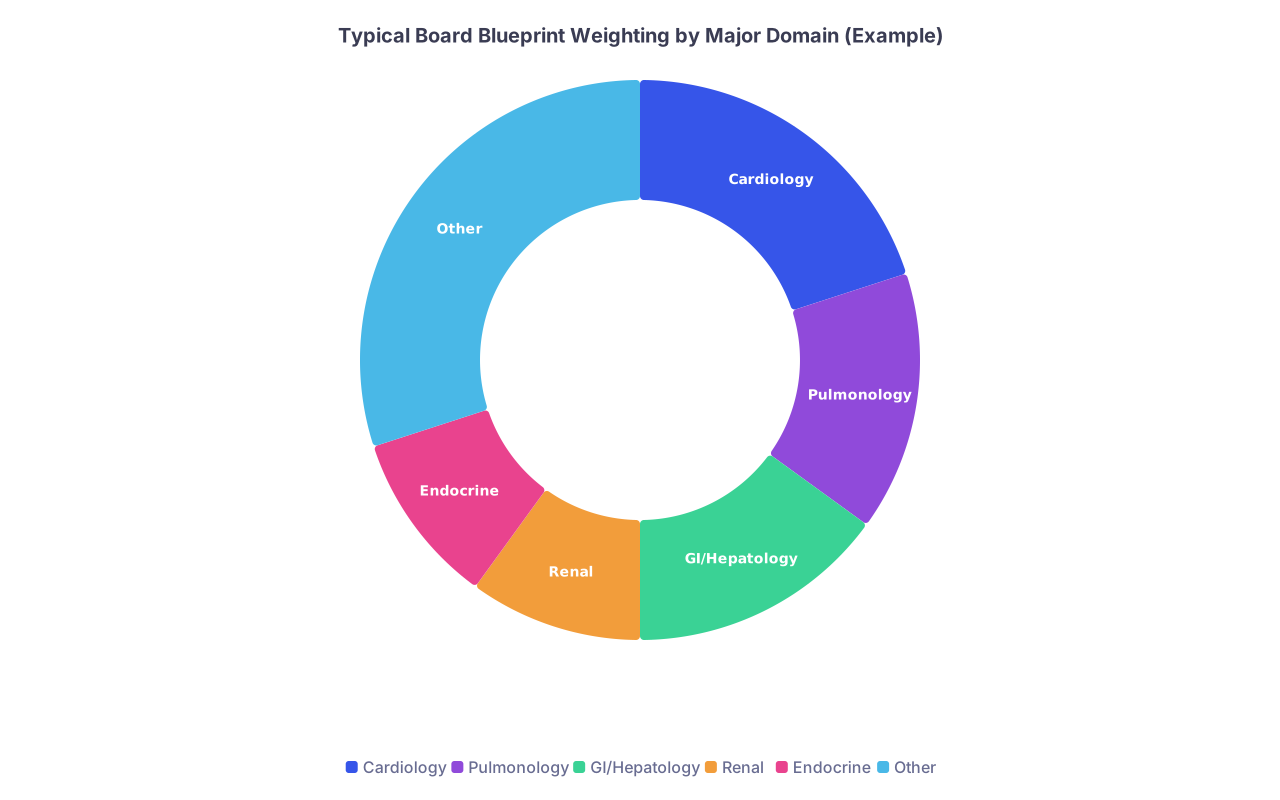
| Category | Value |
|---|---|
| Cardiology | 20 |
| Pulmonology | 15 |
| GI/Hepatology | 15 |
| Renal | 10 |
| Endocrine | 10 |
| Other | 30 |
Specialty-Specific Traps When You Ignore the Blueprint
Every specialty has its own “gotcha” if you don’t read the blueprint early.
Internal Medicine
Trap: Over-focusing on fascinating zebras from consult services and ICU, under-learning:
- Preventive care
- Outpatient chronic disease management
- Common endocrine and rheum basics
Result: Strong on dramatic cases, mediocre on the 60–70% of exam questions about the boring stuff you see every clinic day.
Pediatrics
Trap: Living in the hospital and inattentive during well-child checks and vaccination visits.
Blueprint reality: Immunizations, growth and development, preventive pediatrics are heavily tested. You can’t fix that two months before boards if you never took those encounters seriously.
Emergency Medicine
Trap: Believing every shift is “studying” so you never look at the blueprint.
Reality: The exam punishes:
- Weakness in bread-and-butter chief complaints
- Poor EKG interpretation
- Dispo decisions and risk stratification frameworks
Your boards don’t care how cool your resuscitation story was if you can’t pass their structured scenarios.
Surgery
Trap: Spending 90% of your cognitive energy on intra-op technique gossip and none on perioperative management.
Boards care deeply about:
- Pre-op risk assessment
- Post-op complications
- Critical care and trauma fundamentals
If you do not see how your SICU month lines up with blueprint topics from day 1, you’ll end up “studying ICU” later without the benefit of real patients still fresh in your mind.
Anesthesiology
Trap: Thinking daily cases are enough and ignoring the pharmacology/physiology-heavy blueprint sections until CA‑2.
Those are not “crammable” domains. If you don’t build them steadily with the blueprint in mind, your last-minute efforts become pure memorization.
Simple Weekly Habit: 30 Blueprint-Linked Questions
You don’t need to do 40 Qbank questions a day as an intern to win later. But you do need some regular contact with exam-style thinking, aligned with the blueprint.
Do this:
Once a week, on a non-call day, do 20–30 questions from your specialty Qbank. But not randomly. Choose a block that matches your current or recent rotation’s blueprint domain.
- On nephrology? Do renal/electrolyte questions.
- On heme/onc? Do malignant/benign hematology questions.
- On pedi clinic? Do preventive and developmental pedi questions.
This does three things:
- Shows you what the exam cares about in that domain
- Highlights gaps you can still ask attendings about the next day
- Starts wiring your brain to see patients how the exam will present them
It’s not about high volume. It’s about informed exposure.
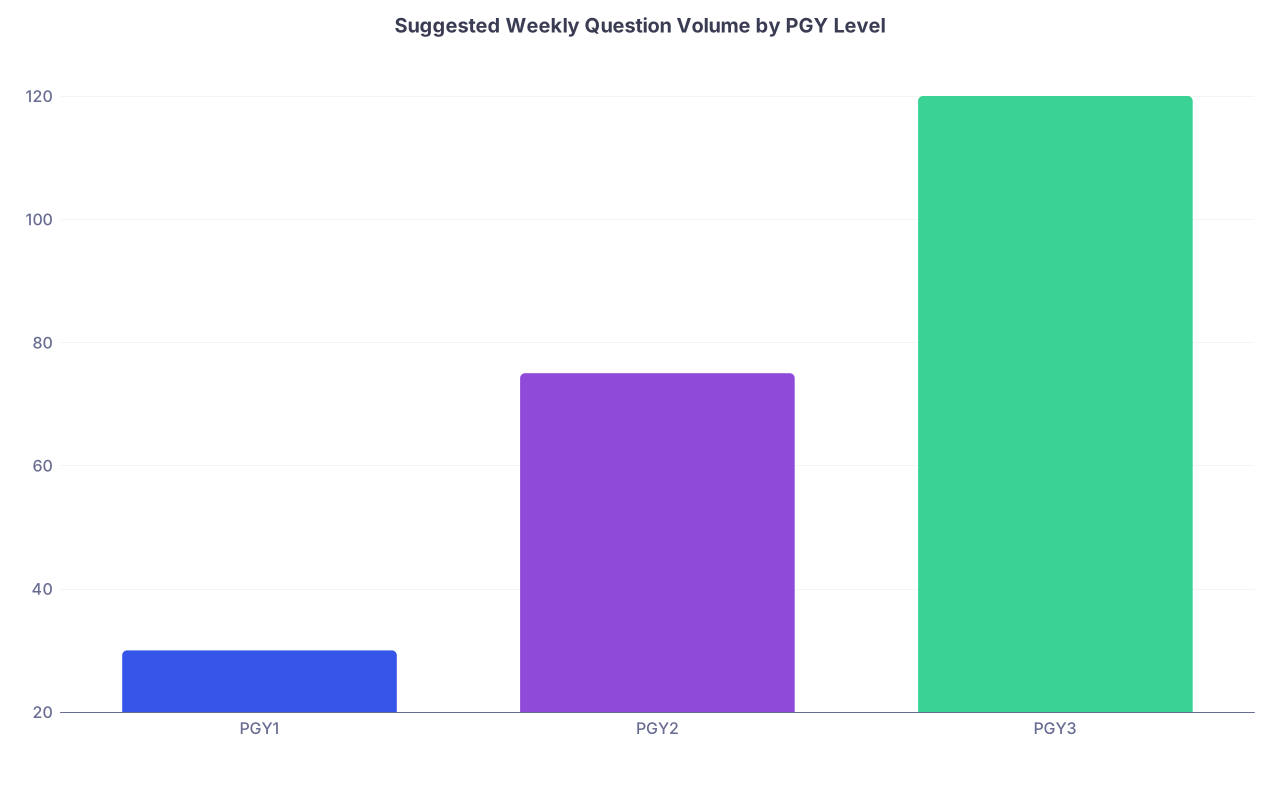
| Category | Value |
|---|---|
| PGY1 | 30 |
| PGY2 | 75 |
| PGY3 | 120 |
Red Flags: Signs You’re Making the PGY‑1 Blueprint Mistake
If any of these feel like you, you’re on the wrong path:
- You don’t know where your board blueprint is hosted
- You can’t say which 2–3 content domains will be the heaviest on your boards
- Your notes are all by rotation, not by topic category
- You’ve never aligned a rotation with specific blueprint sections
- You rely 100% on your program’s didactics and assume “they’ll cover what’s needed”
- You talk about “starting boards studying PGY‑2” like flipping a switch will fix a whole year of misaligned learning
You can fix this now. Not with heroics. With clarity.
What To Do This Week (Concrete Steps)
If you want the shortest, most practical “do not screw this up” checklist, here it is:
- Download your specialty’s official board blueprint/content outline.
- Spend one hour parsing major domains and rough weights.
- Write a one-page summary: big domains, heaviest sections, personal likely weak spots.
- For your current rotation, write one line: “This month feeds [X, Y, Z] blueprint areas.”
- Create or reorganize a single note file by blueprint category, not rotation.
- Do one 20–30 question Qbank block this week tied to your current rotation’s blueprint area.
- Put your next ITE date on the calendar and mark it mentally as “free detailed diagnostic,” not “annoying exam.”
Do that, and you’ve already separated yourself from the majority of your class.