
The way most residents handle content they keep getting wrong is broken. You do more questions, skim the explanation, promise yourself you will “remember it this time,” and then miss the same concept two days later in a different disguise.
You do not have a knowledge problem. You have a system problem.
Here is the framework I used and now force on my own residents: a stepwise, ruthless process for dealing with content that will not stick. Not “study harder.” Not “do more UWorld.” Actual procedures you can follow when you see the same topic beat you three, four, five times.
Step 1: Stop Treating Every Wrong Question the Same
Most residents lump all missed questions together. That is why nothing changes.
You need to separate one-time misses from recurrent failure modes. Different problems. Different fixes.
Build a simple “frequent flyer” tracking system
You need a way to see what keeps coming back. Not in theory. In writing.
Do this today:
- Open a fresh note in Notion, OneNote, Google Docs, or a paper notebook. Title it “Recurring Misses – [Your Specialty] Boards”.
- Add three columns:
- Topic / Concept
- Pattern of Error
- Fix / Anchor / Action
- For the next 7–10 days of qbank or practice exams:
- Every time you miss the same concept twice, it gets promoted to this list.
- Do not put every miss. Only repeats.
After a week of honest use, you will see the same 10–30 items over and over. That is your real curriculum. Not the glossy review book.
To make this visual:
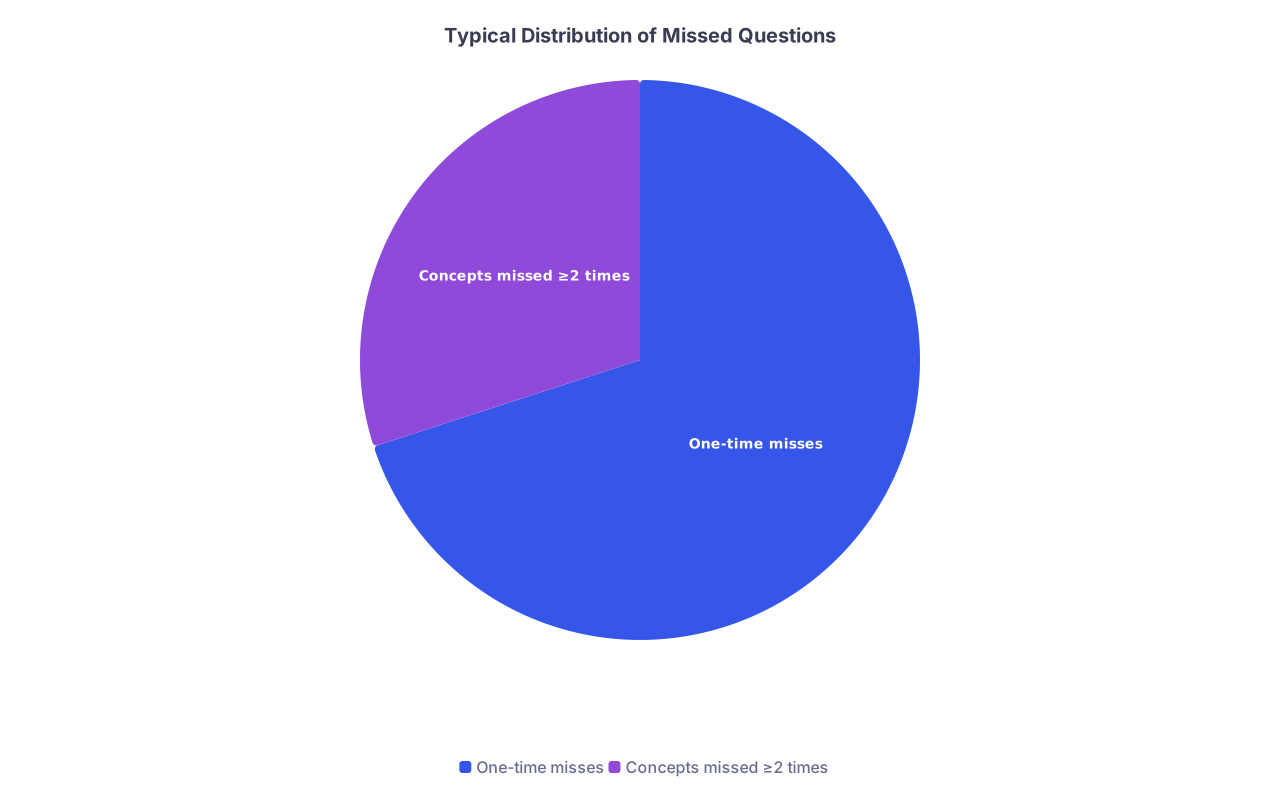
| Category | Value |
|---|---|
| One-time misses | 70 |
| Concepts missed ≥2 times | 30 |
Most residents waste time obsessing over the 70% of one-off misses that will never reappear in that exact way. The leverage is in the 30% that repeat.
Step 2: Diagnose Why You Are Missing It (The Error Taxonomy)
“Got it wrong” is useless feedback. You need to label the type of failure.
I use a simple error taxonomy for residents:
- Knowledge gap – You genuinely do not know the fact / mechanism.
- Recognition gap – You know the fact, but did not recognize this as that.
- Framework gap – You do not have a clear mental model (everything blurs together).
- Process error – You rushed, misread, did not use elimination, or ignored key data.
- Bias / over-correction – “Last time I chose X and it was wrong, so I picked Y.”
For each recurrent miss, tag it with 1–2 of these. No more.
You can even sketch your own quick flow in your head. If you want it visual:

| Step | Description |
|---|---|
| Step 1 | Missed Question |
| Step 2 | Knowledge gap |
| Step 3 | Recognition gap |
| Step 4 | Framework gap |
| Step 5 | Process error |
| Step 6 | Bias or over-correction |
| Step 7 | Seen this topic before |
| Step 8 | Recognized the pattern |
| Step 9 | Mixed with similar topics |
| Step 10 | Rushed or misread |
Example: Real PGY-2 scenarios
IM resident keeps missing hypercalcemia questions:
- Sometimes picks malignancy when it is primary hyperpara.
- Sometimes misses milk-alkali.
- Tag: Framework gap (no stable approach) + Recognition gap.
EM resident misses pediatric rashes:
- Knows the facts when quizzed.
- On questions, cannot distinguish between Kawasaki, MIS-C, and scarlet fever under time pressure.
- Tag: Recognition gap + Framework gap.
Surgery resident misses perioperative anticoagulation:
- Reads about it repeatedly, still messes bridging decisions.
- Tag: Framework gap (no algorithm) + Process error (not identifying risk category).
Once you label the failure type, the fix is obvious. Knowledge gap needs content. Framework gap needs structure. Process error needs a change in how you run questions.
Step 3: Build “Hard Stops” for Your Repeat Offenders
You cannot trust willpower at 11:30 p.m. post-call. You need hard stops—rules that force you to pause when you see a frequent flyer topic.
Here is the protocol:
On your “Recurring Misses” list, star the top 10 topics that:
- You miss frequently
- Are high-yield
- Make you feel that cold “I hope this is not on the exam” dread
For each of those, write a one-line hard stop rule.
Examples:
- “Any time I see hypercalcemia → I must write out PTH vs non-PTH causes before looking at options.”
- “Any pediatric fever + rash → I must list 3 most likely diagnoses and 1 killer I must rule out.”
- “Any question with anticoag in the stem → I must classify VTE risk (low / mod / high) before anything else.”
- Before your qbank session, glance at your hard stop list. Remind your brain these are special cases.
This slows you down. On purpose. Which is what you want for topics that have burned you three times already.
Over 1–2 weeks, you will feel your brain switch from “panic and guess” to “I have a protocol for this”.
Step 4: Convert Vague Topics into Crisp Frameworks
If you keep getting something wrong, odds are you do not have a clean mental model. Everything feels like a blob:
- Sepsis vs SIRS vs shock
- Nephrotic vs nephritic vs AKI on CKD
- Steroid side effects vs Cushing vs pseudo-Cushing
You do not fix this by rereading the same paragraph in a review book. You fix it by building a compact framework that separates:
- Definitions
- Key discriminators
- Triggers (what makes you think of it)
- First step management
How to build a 1-page framework that actually works
Take one frequent offender. For 20 minutes, do this on paper or tablet:
Write the central concept in a circle in the middle (e.g., “Hypercalcemia”).
Around it, create 4–6 branches:
- Causes / categories
- Key lab patterns
- Clinical clues
- First step management
- Exam traps (what they will use to mislead you)
Force yourself to compare it explicitly to its common mimics.
For example, for hypercalcemia:
- One branch: “PTH-mediated” vs “PTH-independent”
- Under each: 2–3 classic causes + lab clues (PTH, PTHrP, vitamin D, phosphate)
- Separate branch: “Exam traps” – thiazides, immobilization, milk-alkali, granulomatous disease.
This is rough work, not art. When you can sketch it from memory in 2–3 minutes, you own the topic.
You can formalize this visually later if you want, but do not waste time making it pretty. Ugly, fast, and memorable beats pretty and forgotten.
Step 5: Create Micro-Anchors, Not Novel-Length Notes
Most residents overcorrect. They go from “I keep missing HUS vs TTP” to writing a full UpToDate summary that they never look at again.
You need micro-anchors:
- 1–3 lines
- A sharp comparison
- A story, image, or phrase that sticks
Examples:
- HUS vs TTP: “HUS = kid + kidneys; TTP = neuro + adult + ADAMTS13. Both MAHA, both low platelets. Shiga toxin for HUS.”
- Kawasaki: “5 days fever + 4 of 5: conjunctivitis, rash, nodes, mucous, extremities. Treat with IVIG + aspirin to save coronaries.”
- MEN syndromes: “2 = parathyroid + pancreas + pituitary. 3 = medullary thyroid + pheo + mucosal neuromas + marfanoid.”
These micro-anchors go into:
- The “Fix / Anchor / Action” column of your recurring misses doc.
- Flashcards (Anki) if you actually review them.
- Margin notes in your qbank or board review book.
You are not building a second textbook. You are building tripwires. Little phrases that fire when you see a certain pattern.
Step 6: Turn Repeat Misses into Active Retrieval Drills
Reading your own notes is glorified comfort. It does nothing for long-term retention during six straight 12-hour shifts.
You need retrieval.
Take each recurrent topic and create 2–5 active prompts. Then cycle them fast.
Options:
- Anki or other spaced repetition
- Your own “rapid fire” doc you quiz yourself from between cases
- Voice memos you record and play in your car
For each topic, use a mix of:
- Trigger prompt – “A 7-year-old with acute kidney injury and thrombocytopenia after bloody diarrhea. Diagnosis and mechanism?”
- Compare-contrast – “Differences between pre-renal and intrinsic AKI on urine sodium, FeNa, and BUN:Cr.”
- First step / management – “First step in hemodynamically stable wide-complex tachycardia in known WPW?”
You do not need fancy structure. Just consistency.
If you like numbers, think of it this way:
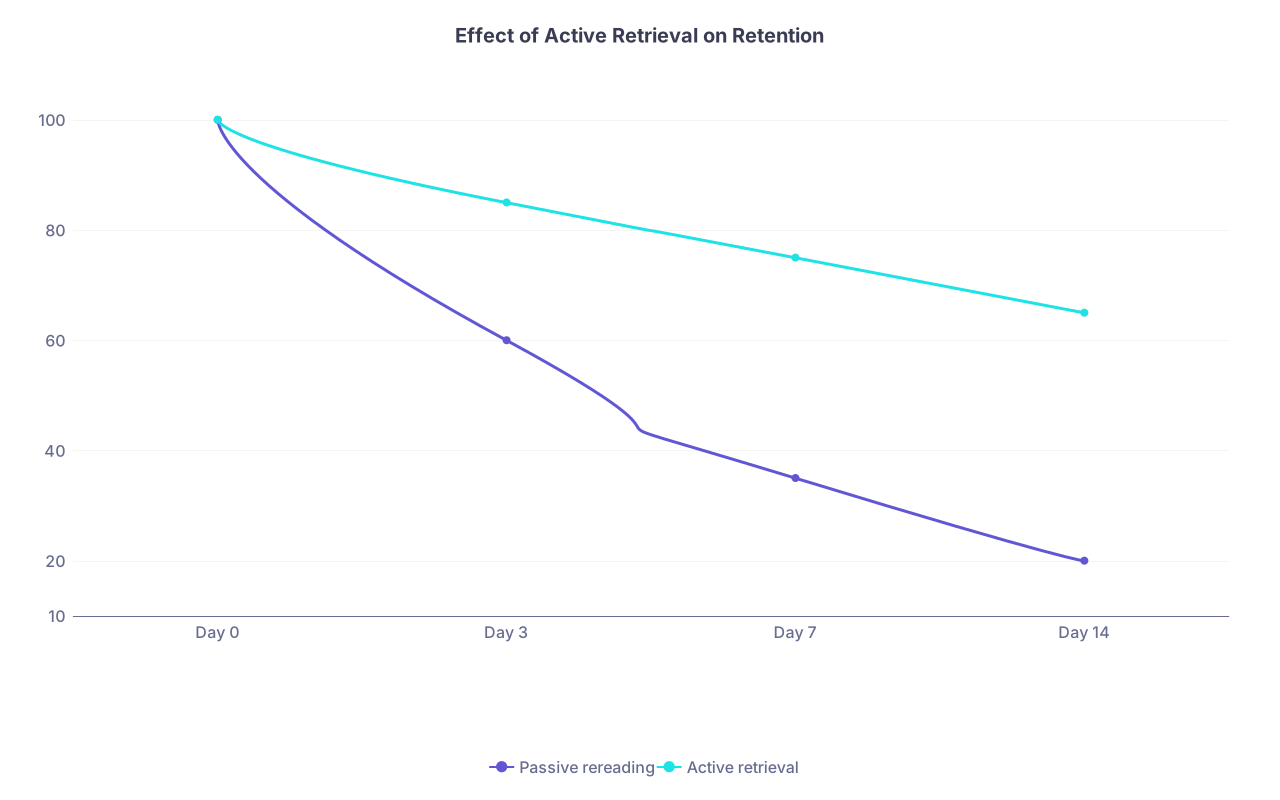
| Category | Passive rereading | [Active retrieval](https://residencyadvisor.com/resources/board-exams-residency/qbank-scores-stuck-at-55-practical-adjustments-that-actually-work) |
|---|---|---|
| Day 0 | 100 | 100 |
| Day 3 | 60 | 85 |
| Day 7 | 35 | 75 |
| Day 14 | 20 | 65 |
Active retrieval + spaced review keeps things above water. Passive rereading lets content sink.
Step 7: Fix Your Question-Taking Process, Not Just Your Knowledge
Sometimes you are not getting a concept wrong. You are getting the process of answering questions wrong.
Look back at 10–15 recent misses and ask:
- Did I misread a key detail (age, lab, “no prior history”)?
- Did I switch my answer last minute and move from right to wrong?
- Did I anchor on a diagnosis early and ignore conflicting data?
- Did I rush because I was behind on time?
If you see a pattern, you need a question protocol. A checklist you run—fast—for each difficult question.
A simple one:
- Read the last line first. Know what they want: diagnosis, next step, test, mechanism.
- Scan age + vitals + key labs. Before diving into the full story.
- Mentally predict the answer before looking at options.
- Use elimination aggressively. Kill obviously wrong options first.
- When tempted to change an answer, require a clear reason. New evidence, not just fear.
For recurrent topics, you may need an extra process step:
- “Any time I see hyponatremia, I must classify volume status before options.”
- “Any time I see chest pain, I must say out loud: kill MI, PE, dissection.”
Seems dumb. Works anyway.
Step 8: Integrate Clinical Work with Board Prep (Instead of Competing)
You are in residency. You have a full-time job. Trying to keep “clinical brain” and “boards brain” separate is how you burn out and still score average.
You should be tying your recurrent board weaknesses directly to daily patients.
The 3-step “same-day integration” rule
Whenever you:
- See a patient on your weak topic
- Or get pimped on a concept you keep missing
- Or see that topic on signout or rounds
Do this the same day:
- Spend 5 focused minutes (phone or computer) on a tight clinical reference:
- UpToDate, guidelines, or a high-yield review section
- Add one micro-anchor or fix to your recurring misses list from that reading.
- Before bed, try to recall the key steps without looking.
Example:
You missed yet another COPD exacerbation management question. That day, you admit a COPD patient.
- After rounds: 5 minutes on “Acute exacerbation of COPD – management.”
- Add to your list: “COPD exac – everyone gets bronchodilators and steroids; add antibiotics if increased sputum purulence, volume, or dyspnea.”
- That night: ask yourself, “What are the indications for NIPPV in COPD again?” and answer from memory.
This welds board-relevant content to emotionally and visually rich clinical experiences. That is how memory works.
Step 9: Use Mini-Blocks to Stress-Test Your Fixes
You do not know if your framework is working until you see it hold up under fire.
Set aside 2–3 short sessions per week (on lighter days):
- 10–15 qbank questions
- Specifically filtered or cherry-picked for:
- Weak systems (renal, ID, heme)
- Weak question types (ethics, stats)
- Your recurrent topics
Before each mini-block, pick 2–3 specific things you are testing:
- “I want to see if my hypercalcemia algorithm works.”
- “I will apply my chest pain ‘kill the killers’ process every time.”
- “I will slow down and enforce my ‘do not change without evidence’ rule.”
After the block:
- Look only at questions linked to those targets.
- For each, ask: did I actually use my new system, or did I revert to old habits?
This is deliberate practice. You are not just grinding questions. You are stress testing new operating procedures.
To structure this over a month:
| Week | Focus Area | Mini-Blocks | Primary Goal |
|---|---|---|---|
| 1 | Top 3 weak systems | 3 | Build basic frameworks |
| 2 | Cross-cutting topics | 3 | Apply hard stop rules |
| 3 | Process / timing | 2 | Fix rushing / changing answers |
| 4 | Mixed review | 3 | Test retention and integration |
Step 10: Decide What You Will Not Fix
Some content is not worth saving. Let it go.
You cannot master every esoteric zebra and obscure enzyme pathway while working 60–80 hours a week. You need triage.
Ask three questions about any stubborn topic:
- Is it genuinely high-yield for my exam? (Not just interesting.)
- Is it catastrophic if I miss it on test day? (MI vs costochondritis, yes. Exact enzyme of rare storage disease, no.)
- Have I already invested a rational amount of time for my return? (1–2 passes, some focused framework work.)
If you answer no / no / yes, then this goes into the “Acceptable Losses” pile.
Your goal is not perfect coverage. Your goal is a margin of safety. That comes from dominating the repeated, high-yield patterns, not chasing every weird thing that ever beat you once.
Step 11: Operationalize All of This in a Real Resident Schedule
None of this matters if it is “nice in theory” but collapses when you are on nights.
Here is how a typical resident can run this without losing their mind.
Baseline weekly structure
Assume a moderately busy rotation.
Daily
- 15–20 board-style questions (even split between timed and tutor mode).
- 5–10 minutes maintaining your “Recurring Misses” list.
- 5–15 minutes of retrieval (flashcards, quick prompts) on 1–2 weak topics.
Twice weekly
- One 10–15 question mini-block:
- Filtered to attack specific weak areas
- Followed by focused review on the 2–3 topics you are “fixing” this week
- One 10–15 question mini-block:
Weekly
- 20–30 minutes “systems check”:
- Look at your list
- Identify the 5 worst offenders this week
- Update their micro-anchors / frameworks
- 20–30 minutes “systems check”:
On brutally busy weeks (trauma, nights, ICU), scale down:
- Minimum viable:
- 10 questions per day
- Add only 1–2 items per day to your recurring misses list
- 5 minutes of recall before bed
Consistency beats intensity. A decent month of this beats one heroic 8-hour pre-exam cram session by a mile.
To show this progression:
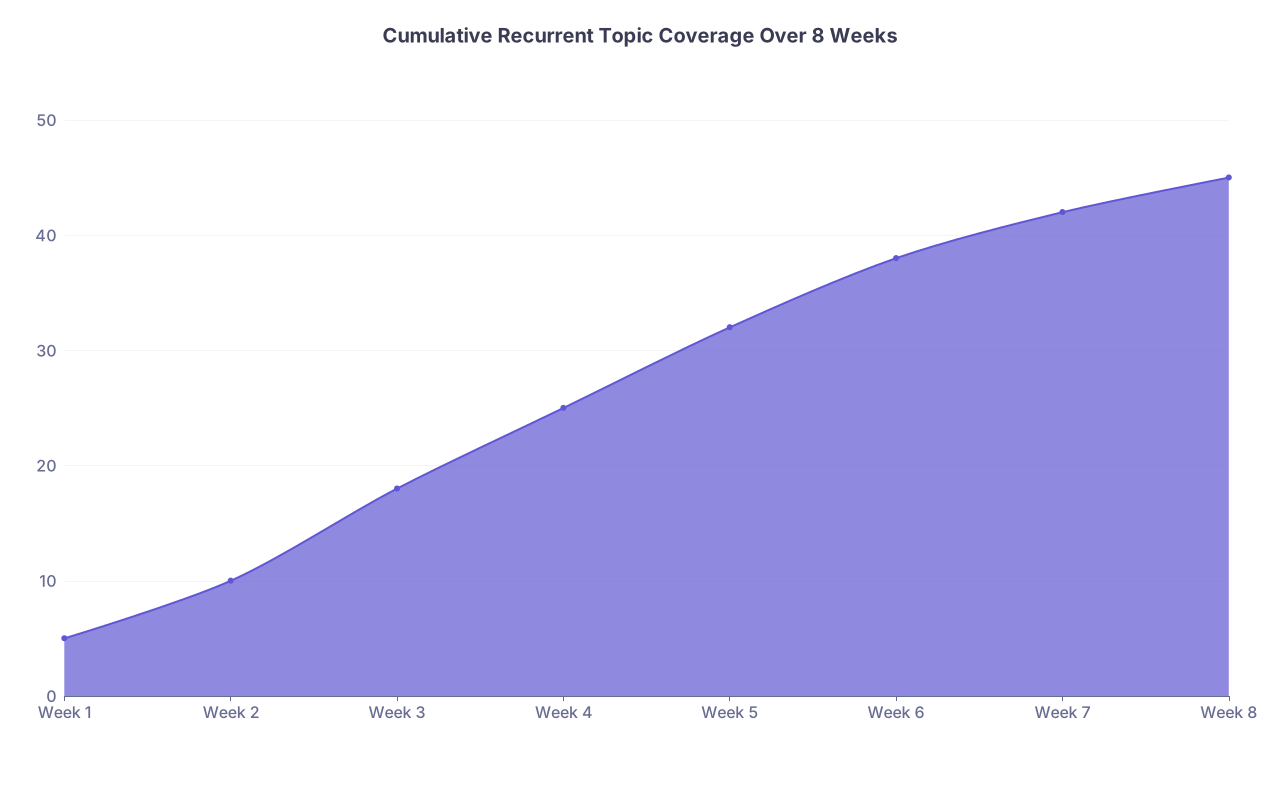
| Category | Value |
|---|---|
| Week 1 | 5 |
| Week 2 | 10 |
| Week 3 | 18 |
| Week 4 | 25 |
| Week 5 | 32 |
| Week 6 | 38 |
| Week 7 | 42 |
| Week 8 | 45 |
Forty-plus recurrent topics systematically addressed before your boards is a different level of readiness. That is how you move from “I hope this goes okay” to “I have already seen and fixed most of the ways I screw this up.”
Step 12: Stop Making It Personal
One last thing. Residents take recurrent misses as a commentary on their intelligence.
“I still don’t get electrolyte disorders. Maybe I am just bad at this.”
No. You are running complex, high-density pattern recognition under sleep deprivation and time pressure. Of course some circuits misfire. The answer is not shame. The answer is engineering.
So here is the full framework boiled down:
- Track repeats separately. Build a “frequent flyer” list for topics that keep beating you.
- Name the failure mode. Knowledge, recognition, framework, process, or bias.
- Install hard stops. Special rules for your worst offenders to force slower thinking.
- Build compact frameworks and micro-anchors. Turn mush into crisp, memorable structures.
- Drill with retrieval and mini-blocks. Test your new systems under exam conditions, over and over.
You do not need to be the smartest resident in your program to do well on boards. You just need a ruthless process for handling the content that will not stay fixed.
This is that process. Use it.