
The way most residents handle exam week is broken—and programs quietly count on your silence.
You are on service, the board exam is in 10 days, and your plan right now is: “I’ll just grind harder and sleep less.” That is not a plan. That is self-sabotage in a white coat.
You do not fix this with “better time management.” You fix it with negotiation. Specific, scripted, uncomfortable conversations that carve out protected study time without making you look lazy, selfish, or unsafe.
Let me walk you through exactly how to do it.
Step 1: Get Clear On What You Actually Need
Do not walk into any negotiation fuzzy. “I just need more time to study” is useless. You must make your ask precise.
Figure out three things:
Your non‑negotiable exam window
- Exact exam date
- What days before you want lighter or no clinical work
- Ideal vs minimum acceptable
Your daily study blocks
- How many hours per day you truly need in the final 7–10 days
- When your brain actually works (early morning vs post‑call vs afternoon)
- What absolutely kills your productivity (night float, long call, 28‑hour stretches)
Your flexibility
- What you can trade: weekends, extra cross‑coverage, extra clinic days later, post‑exam call
- What you cannot accept: night float during last week, 6 nights in a row before exam, 28‑hour call day before exam
Be concrete. Example:
- Exam: Tuesday, June 18
- Ideal: 3 study days off before (Sat–Mon)
- Minimum: At least Sun–Mon off + no call Fri–Sat
- Daily need: 4–5 quality hours in the 7 days prior
- Cannot do: 28‑hour call Sun or Mon, or night float starting Thursday
Write this down. You will use it in your conversations.
Step 2: Know Who To Ask For What
You have multiple “levers” in residency. Use the right one for the right problem.
| Person / Role | What They Can Actually Affect |
|---|---|
| Chief resident | Weekly schedules, call swaps, clinic changes |
| Rotation attending | Daily workload, sign‑outs, expectations |
| Program director | Formal leave, conflicts, policy exceptions |
| Co‑residents | Swaps, informal coverage, trading favors |
Most residents make two mistakes:
- They complain to the wrong person (“my attending is unfair”) instead of the person who owns the schedule (chief).
- They wait until conflict already exists (“I am drowning and my exam is in 4 days”) instead of front‑loading.
Your sequence, in a sane world:
- 6–8 weeks before exam: Email chiefs + PD if needed → get macro‑level scheduling protection.
- 2–3 weeks before exam: Talk to attending on the relevant rotation → adjust expectations and daily workflow.
- 1–2 weeks before exam: Fine‑tune with co‑residents → specific day‑to‑day swaps.
Now let us script each of these.
Step 3: Chief Resident Scripts – Get the Schedule On Your Side
This is where you win or lose. Chiefs control the grid.
Script 1: Initial Ask (6–8 Weeks Before)
Subject line matters. Make it simple and respectful.
Email to chiefs:
Subject: Board Exam Schedule Request – [Your Name, PGY‑X]
Hi [Chief name(s)],
I am scheduled to take my [USMLE Step 3 / ABIM / in‑training exam] on [date]. I want to make sure I am safe and performing well clinically that week.
Would it be possible to structure the schedule so that for the 3–4 days before the exam I am either:
- on a lighter rotation (e.g., clinic, electives) or
- not on 28‑hour call or night float in the 3 days immediately before?
I am happy to be flexible with coverage to make this work. For example, I can:
- pick up extra calls after the exam week
- cover an additional weekend earlier or later in the block
- swap onto a heavier week elsewhere if needed
I know the schedule is tight, so I really appreciate any adjustments you can make to help keep things safe and set me up to pass this exam.
Thank you,
[Name]
PGY‑[X]
This hits all the right notes:
- Clear date
- Specific request
- Offer to trade value
- Safety framing, not “I just do not feel like working”
Script 2: Chiefs Say “We’ll See” or Give You a Bad Week
When they respond vaguely or give you ICU nights ending the day before your exam, you push—politely but firmly.
Thanks for working on this.
I wanted to clarify one piece because I am concerned about safety and performance.
The current schedule has me on 28‑hour call Sunday and exam Tuesday morning. Realistically, that means I will be post‑call Monday, likely sleep‑deprived, and then taking the exam early Tuesday.
Would there be any way to:
- move that call to another resident and I cover one of their calls after my exam week, or
- shift me to a regular day shift on that Sunday and take a different call elsewhere in the block?
I completely understand that things are tight, and I am committed to being fair with swaps. I just want to avoid walking into a 2‑day exam immediately after a 28‑hour shift, which feels unsafe for both the patients and the exam outcome.
If needed I can also talk with [PD name] about whether there is any institutional guidance around call immediately before board exams.
You are not threatening. You are escalating appropriately and framing it around safety and fairness.
Step 4: Program Director Scripts – When You Need Formal Protection
Use the PD when:
- The chiefs say “no bandwidth”
- The rotation is “protected” and hard to change (ICU, ED)
- You need official leave or policy override
Script 3: PD Meeting (In Person or Video)
You:
I wanted to talk about my upcoming [exam] on [date]. I have tried to work with the chiefs on scheduling, and they have done what they can, but I am still slotted for [night float / 28‑hour call / heavy service] immediately before the exam.
I am worried about two things:
- My ability to provide safe patient care when I am also trying to cram right before the exam.
- Walking into the exam sleep‑deprived from call.
My ideal scenario would be:
- [Example] No 28‑hour call or night float in the 72 hours before the exam
- Ability to leave by [time] on the day before, assuming patients are stable and sign‑outs are complete
I have already offered to the chiefs to pick up:
- Extra calls after the exam
- A heavier week on a different block
Is there any program or institutional policy that supports adjusting schedules around board exams? And if not, would you be willing to support this as a one‑off so I can take the exam safely and represent the program well?
You want the PD to explicitly back you. Once they say, “Yes, we should protect that time,” you immediately email the chiefs with:
I spoke with [PD name], who agreed it would be best if I am not on [night float / 28‑hour call] in the 72 hours before my board exam on [date].
Can we revisit the schedule with that in mind? I am still willing to:
- pick up extra calls after the exam week
- trade weekends or heavier days later
Happy to discuss options that are least disruptive to the team.
You are using the PD’s authority without throwing anyone under the bus.
Step 5: Attending Scripts – Protect Daily Study Blocks While On Service
Even if you cannot get full days off, you can carve out predictable study windows.
The worst strategy: quietly suffering, staying late, then “hoping” for time that never comes.
Script 4: Attending Conversation – Start of Rotation (2–3 Weeks Before Exam)
You say this on Day 1 or 2 of the rotation. Face to face.
Dr. [Name], I wanted to mention something early so we can plan around it.
I am scheduled to take my [exam] on [date], which is during or right after this rotation. I want to make sure I am still pulling my weight on the team and that patient care is solid, but I also need some focused time to study in the week or so before.
What I was hoping is that we could structure things so that:
- I am fully engaged during pre‑rounds, rounds, and family/consult discussions
- But if tasks are wrapped up by [time, e.g., 4 pm], I could leave a bit earlier to study, instead of staying for nonessential tasks or “busy work”
If there are days you know will be heavy (admission days, complex discharges), I am completely fine staying later; I just want a few lighter days protected for studying if possible.
Does that seem reasonable, and is there a way you would prefer we structure the day to make that work?
Most decent attendings respect this. You have:
- Shown commitment to patient care
- Offered flexibility
- Asked for specific but modest protection
Script 5: When Attending Is Old‑School or Dismissive
Sometimes you get: “We all took boards during residency. You will be fine.”
You cannot roll over.
I understand, and I know everyone before me has gone through this. My concern is less about comfort and more about safety and performance.
I want to avoid being in a situation where I am so exhausted from staying late multiple days in a row that I am not sharp on the exam or on the wards.
Even if we cannot change the overall workload, could we at least plan for:
- One or two earlier days in the week before the exam
- Me stepping out of nonessential teaching conferences that week to study, while still being present for critical patient care tasks
I am happy to check with the chiefs or PD as well if you prefer more formal guidance, but I wanted to talk with you first.
You acknowledge their perspective, then move back to the specific, safety‑based request.
Step 6: Co‑Resident Scripts – Tactical Swaps That Actually Work
Your co‑residents are not psychic. They are also tired. If you ask for a favor without making it easy and fair, they will resist.
Principles for Asking Peers
- Make it specific (date, time, shift).
- Make the trade attractive.
- Ask early (1–2 weeks out, not the night before).
- Put everything in writing after you agree.
Script 6: Initial Swap Ask
Hey [Name],
I am taking my [exam] on [date], and I am trying to avoid heavy shifts right before it. I saw you are on [shift: e.g., short call Sunday 7a–7p] on [date].
Would you be open to swapping that shift with me for [shift you are offering: e.g., my Friday night cross‑cover 5p–11p on X date, plus I can also take one of your weekend days later in the month if needed]?
I know it is a big ask before my exam, so I am happy to sweeten the deal however makes sense for you (extra weekend, later call, etc.).
If they hesitate, nail down what would make it worth it:
Totally get it. If that exact day does not work, is there any other call or weekend you would actually prefer to give up, that I could take on instead, in exchange for you covering [target shift] before my exam? I am pretty open as long as it is after [exam date].
Step 7: When You Really Are “On Service During Exam Week”
Sometimes the answer is: you are on a core inpatient month, no full days off, no schedule swaps possible. You are stuck on service.
Fine. You still have levers: expectations, scope, and micro‑blocks of time.
Micro‑Negotiations That Add Up
Use your attending and senior to shift work slightly:
I know I am not going to get full days off this week. Since my exam is on [date], could we structure the team so that:
- I focus on fewer but more complex patients (and round deeply on them)
- While [co‑resident] takes the new admits or higher census that day?
That way I can still contribute meaningfully but maybe finish my direct work by [time] so I can get a 3–4 hour study block in the evening.
Or with your senior:
On [day before exam], would you be okay if I sign out a bit earlier once my patients are tucked in, assuming everything is stable, and you and the intern handle any late cross‑cover? I can pay that back by taking more late‑day admissions earlier in the week.
You are not asking to vanish. You are rebalancing workload across the week.
Chart: How Residents Actually Carve Out Study Time
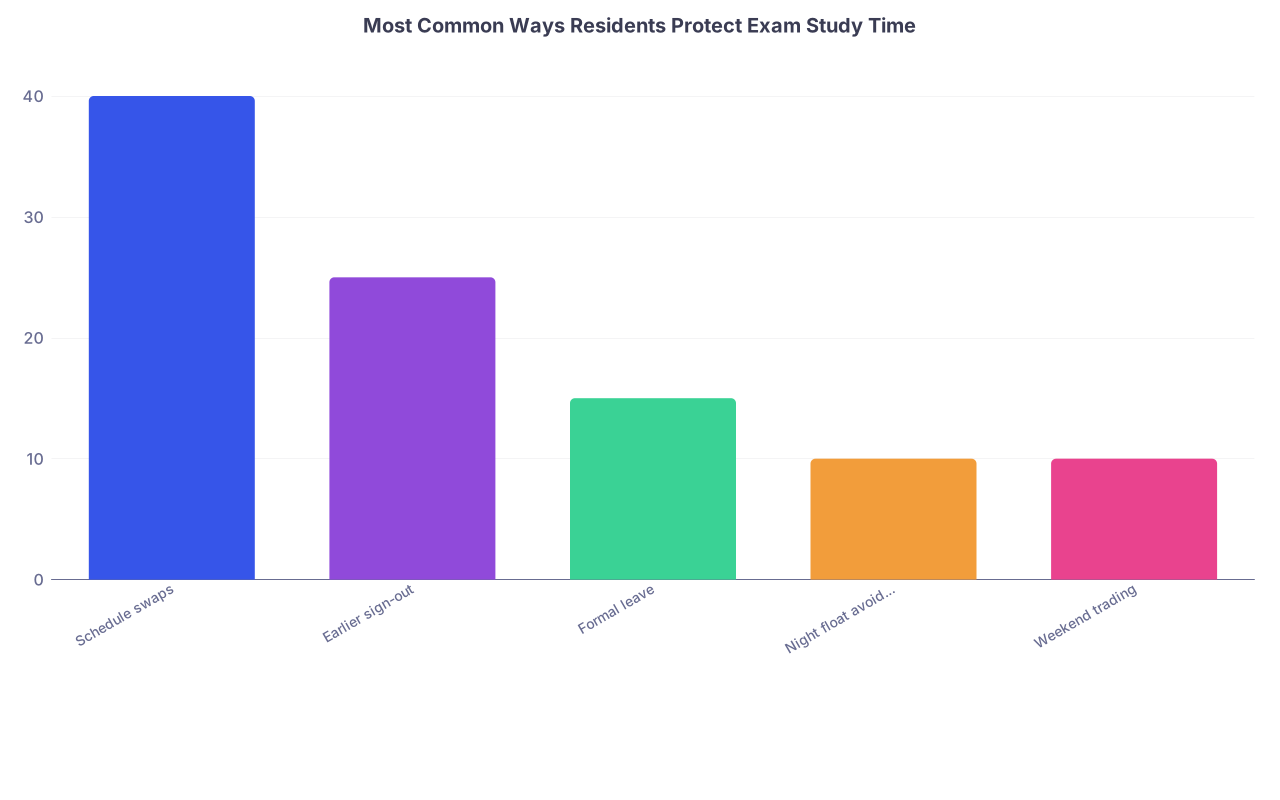
| Category | Value |
|---|---|
| Schedule swaps | 40 |
| Earlier sign-out | 25 |
| Formal leave | 15 |
| Night float avoidance | 10 |
| Weekend trading | 10 |
Step 8: Scripts For When People Push Back Hard
You will occasionally hit a wall: “We can’t change anything.” Sometimes that is true. Sometimes it is lazy thinking.
You need a calm escalation script.
Script 7: Pushback From Chiefs
I hear that the schedule is really tight and that changing it is a burden.
My concern is that as it stands, I am scheduled for [describe objectively: e.g., 28‑hour call ending less than 48 hours before a 2‑day exam]. That feels unsafe from both a patient care and exam perspective.
I am not asking for more total time off than anyone else, just a redistribution of when I work the hardest shifts.
If the current setup really cannot be changed at the chief level, would you be okay with me looping in [PD name] to ask whether there is any flexibility or existing policy around call near board exams?
You are polite but you are not backing down. You are forcing a decision: they either help you or explicitly choose not to—and most reasonable chiefs do not want to be that person on record.
Script 8: Pushback From PD
If even the PD shrugs:
Understood. I want to be sure I am hearing you clearly.
So with my exam on [date], the program stance is that it is acceptable and expected that I work [describe: e.g., 28‑hour call ending Monday morning] and then sit for the exam Tuesday morning without any adjustment.
If that is the official expectation, I will of course follow it. However, if there is any flexibility at all—such as swapping that call for a different one later in the year, taking one less clinic that week, or coming in late the day after— I would very much appreciate exploring that.
I want to represent the program well on the exam and keep my patient care safe, and right now this setup feels like it puts both at risk.
You are documenting that they own this choice. Sometimes that alone makes them reconsider.
Step 9: Protecting Yourself Politically While You Advocate
Residents stay quiet because they are scared of being labeled “difficult.” That fear is not crazy. Some institutions punish squeaky wheels.
You can reduce that risk.
Guardrails
- Always frame around safety and performance, not comfort.
- “I want to be safe for my patients and sharp for the exam.”
- Offer trades first, not ultimatums.
- “I can take extra call after,” “I can cover additional weekends.”
- Document by email after any verbal agreement.
- “Per our conversation, I will switch from X to Y on [date].”
- Avoid trash‑talking colleagues or the system in writing.
- No rant emails. Ever.
Simple Follow‑up Email Template
After any verbal agreement:
Hi [Name],
Thanks again for working with me around my [exam] on [date]. Just to confirm, we agreed that:
- I will [change: e.g., not be on 28‑hour call on Sunday before the exam]
- I will instead cover [new shift] on [date]
I appreciate your flexibility.
Best,
[Name]
Now if someone “forgets” or the schedule does not reflect the deal, you have something to point to.
Step 10: What To Do If Everything Fails
Sometimes, despite your best effort, you end up:
- On heavy service
- With no real call swaps
- With attendings who think suffering is a virtue
Then your tactics shift from negotiation to damage control.
Bare‑Minimum Protection Moves
Block off the night before exam
Tell your senior:I will be leaving by [time] the night before my exam so I can sleep and be functional. I will make sure my work is done and sign out thoroughly before I go.
Not a question. A professional statement.
Say no to new nonessential tasks in the last 3–4 days
Examples you decline:- Extra QI project meeting
- Additional teaching session that is optional
- Voluntary committee work
Script:
I am happy to be involved long term, but with my exam in 3 days I need to decline this one so I can prepare and still be safe on service.
Lower your own perfectionism on the wards temporarily
You do not need Pulitzer‑level daily notes and 6 extra literature reviews per patient in the final days. Safe, thorough, but not ornamental.Use tiny micro‑blocks
15–20 minute gaps between tasks for flashcards or question review:- Waiting for a consult to call back
- Downtime between admissions
- Post‑round lull
Not ideal, but better than nothing.
Visual: Exam Week Negotiation Flow

| Step | Description |
|---|---|
| Step 1 | Know exam date and needs |
| Step 2 | Email chiefs 6-8 weeks before |
| Step 3 | Confirm in writing |
| Step 4 | Meet with PD |
| Step 5 | Chiefs adjust schedule |
| Step 6 | Focus on attendings and peers |
| Step 7 | Talk to attending at start of rotation |
| Step 8 | Negotiate daily study blocks |
| Step 9 | Swap shifts with co residents |
| Step 10 | Implement bare minimum protections |
| Step 11 | Follow plan and study |
| Step 12 | Schedule adequate? |
| Step 13 | PD supportive? |
| Step 14 | Still unsafe/heavy? |
FAQs
1. What if my program culture is very “old school” and everyone brags about suffering through exams on ICU?
You do not need to convert the culture. You just need to protect yourself. Stick to safety‑based language and fairness. You are not asking for special treatment, only for redistribution of burden. When people brag about doing 28‑hour call then Step 3, just say: “I want to be sharp for both my patients and my exam, so I am trying not to repeat that pattern.” Then drop it. You are not trying to win a philosophy debate.
2. Should I ever consider moving my exam date instead of fighting my schedule?
Yes. If you are on an unmovable heavy rotation (ICU, ED) and the program truly cannot adjust, it can be smarter to postpone the exam—if the delay will not wreck future plans (fellowship apps, promotion). Run the math:
- Will a delay change match timeline?
- Will you still have acceptable dates available?
- Will your study momentum actually improve?
If moving the date buys you a saner block and real study time, it is often worth the fee and hassle.
3. How early should I start these conversations?
Six to eight weeks before your exam is the sweet spot for major adjustments. That is when chiefs are still flexible with the grid. Two to three weeks before, you focus on attendings and workflow. One to two weeks before, you work with co‑residents for specific swaps and micro‑adjustments. If you are asking for radical changes 3 days before the test, you are mostly playing defense.
4. How do I avoid resentment from co‑residents when I ask for help?
Make the trade clearly fair. Offer something they actually care about: a weekend off, a hated night shift, an extra clinic day gone. Be transparent about why you need it (“exam on this date, trying not to be post‑call walking into it”). And follow through. If you promise to take a weekend for them in July, put it in your calendar and confirm with the chiefs. Reliability kills resentment. Being the person who always asks and never gives back creates it.
Key points to remember:
- Do not “hope” your exam week will be manageable. Schedule it.
- Use scripts with chiefs, PD, attendings, and co‑residents to trade—not beg—for protection.
- When the system will not move, lock in bare‑minimum protections yourself: one decent sleep night, clear boundaries, and ruthless focus.