
It is 02:17. The vent alarms just quieted down, the cross-cover pager finally stopped screaming, and you are sitting in a cramped ICU workroom staring at a dog‑eared board review book. Your exam date is on the calendar. Your ICU block is four weeks long. Your bandwidth feels… nonexistent.
You are here: exhausted, overrun with tasks, and increasingly convinced that this month will nuke your board preparation.
I am going to be blunt. ICU months can absolutely wreck your board prep if you let them. Long shifts, constant interruptions, emotional cases, and very little control over your schedule. I have watched residents lose all study momentum in a single ICU block and spend the next 3–4 months digging out.
The flip side: I have also seen residents come out of ICU months sharper and ahead for boards—because they treated the rotation like a structured, high-yield bootcamp instead of a black hole.
This article is about becoming the second group.
Step 1: Get Real About the Constraints of ICU Months
Before you fix anything, you need a clear picture of what you are fighting.
Typical ICU month realities:
- 12–14 hour shifts (sometimes more)
- Nights, swings, no circadian rhythm
- 12–28 patients with life‑threatening issues
- Constant pages, codes, family meetings, procedures
- Emotional and cognitive fatigue that follows you home
Here is the mistake residents make: they try to run their usual board‑prep schedule on top of an ICU block. Two hours of QBank daily, an hour of reading, Anki, maybe video lectures.
They last 3 days.
You need an ICU‑mode strategy. Different rules, different expectations.
ICU Reality Check Protocol
Do this before day 1 of the rotation:
Audit your exam timeline
- When is your board exam?
- How many weeks total until then?
- How many of those weeks are “intense clinical” (ICU, nights, wards) vs “lighter”?
Categorize this ICU month
- If your exam is:
4 months away → ICU month is maintenance + integration, not heavy build.
- 2–4 months away → ICU month is targeted maintenance, careful not to regress.
- < 2 months away → ICU month must be hyper‑efficient and protected. You will need to fight for time and energy daily.
- If your exam is:
Set realistic ICU‑specific goals
- NOT: “I will do 80 questions per day.”
- DO: “I will:
- Hit 15–25 quality questions on most days.
- Use ICU patients to deeply understand 2–3 core topics per shift.
- Keep my Anki/spaced repetition streak alive even if it is shorter.”
Write down your ICU‑month goals on paper or your phone. If you do not define them, your default goal becomes “survive,” and board prep vanishes.
Step 2: Build an ICU‑Mode Study Template (Before Day 1)
You do not improvise your way through this. You pre‑decide.
Let us build a simple, realistic daily framework you can adapt.
| Time Block | Primary Goal |
|---|---|
| 15–20 min pre-shift | Light review / Anki |
| Microbreaks on shift | 5–10 questions total |
| 15–30 min post-shift | Debrief + 3–5 Qs |
| 1 longer session on off | 40–60 questions |
This is the floor, not the ceiling. If an unexpectedly light day appears, you can do more. But you plan around the worst‑case baseline, not fantasy.
ICU‑Mode Rules
No “all-or-nothing” thinking
- 10 questions done with focus beats that mythical 60‑question block you never start.
- Any streak is better than perfect streak that fails on day 3.
Everything is pre‑decided
- Which QBank / book?
- Which subject focus this month?
- Which time(s) of day are “protected” for even tiny study blocks?
You optimize for consistency, not volume
- Your brain is already overloaded. Snap, short, targeted reps work best.
I want you to physically write a one‑page ICU Study Plan:
- “Daily minimums”
- Which resources you will use
- When you plug studying in (pre‑shift, intra‑shift, post‑shift, days off)
If it is not written, it is not real.
Step 3: Turn the ICU Itself into a Board Review Machine
If you try to separate “ICU life” and “board prep,” you lose. You do not have the time or mental energy to run two totally separate tracks.
The fix: use the ICU rotation as your primary board resource.
Identify Your ICU-High-Yield Topic List
Most board exams heavily test ICU‑relevant topics:
- Shock (all types)
- Mechanical ventilation
- Sepsis and antibiotic selection
- Acid–base disorders
- AKI and renal replacement
- Arrhythmias, post‑MI care
- ARDS, COPD/asthma exacerbations
- DKA/HHS
- Delirium, sedation, neuromuscular blockade
- Nutrition, TPN, refeeding
- Transfusions, anticoagulation, bleeding
Pick 8–12 of these and make them your ICU Block Topic List.
Now the rule is:
Every single shift, you deliberately deepen your understanding of 1–2 items from that list using your actual patients.
On-Shift “Micro-Learning” Protocol
Here is how you turn a case into board prep without slowing down care.
Anchor to a live patient
- Example: Septic shock on norepinephrine and vasopressin.
- Ask yourself: “What, exactly, would the exam ask about this?”
Ask one focused question
- Examples:
- How do I classify shock hemodynamically?
- When do I add vasopressin?
- What are the board‑relevant MAP targets and why?
- Examples:
Use a tiny resource on shift
- 3–5 minutes max:
- A concise ICU handbook app
- A high-yield review note
- A bookmarked guideline summary
- Not: a 40‑minute video you will not finish or remember.
- 3–5 minutes max:
Create a 1–2 line “board pearl”
- Write it on a sticky note, in your phone, or in a small pocket notebook:
- “Septic shock: start norepi, add vasopressin when NE 0.2–0.3 mcg/kg/min; MAP goal 65.”
- “Metabolic alkalosis post‑NG: think chloride depletion; treat with IV NS + KCl.”
- Write it on a sticky note, in your phone, or in a small pocket notebook:
End-of-shift consolidation
- When you sit down for sign‑out or just before leaving, list 2–3 pearls you picked up on that shift.
- Those are what you will reinforce on your next off day with questions.
This is how you double-dip: everything you learn for patient care is framed as future test fodder.
Step 4: Choose the Right Resources for an ICU Month
ICU months are not the time to start four new resources and binge‑watch lecture series. Your brain is saturated. You want:
- Concise
- Question‑heavy
- Directly aligned with ICU pathology
Here is the resource strategy that works.
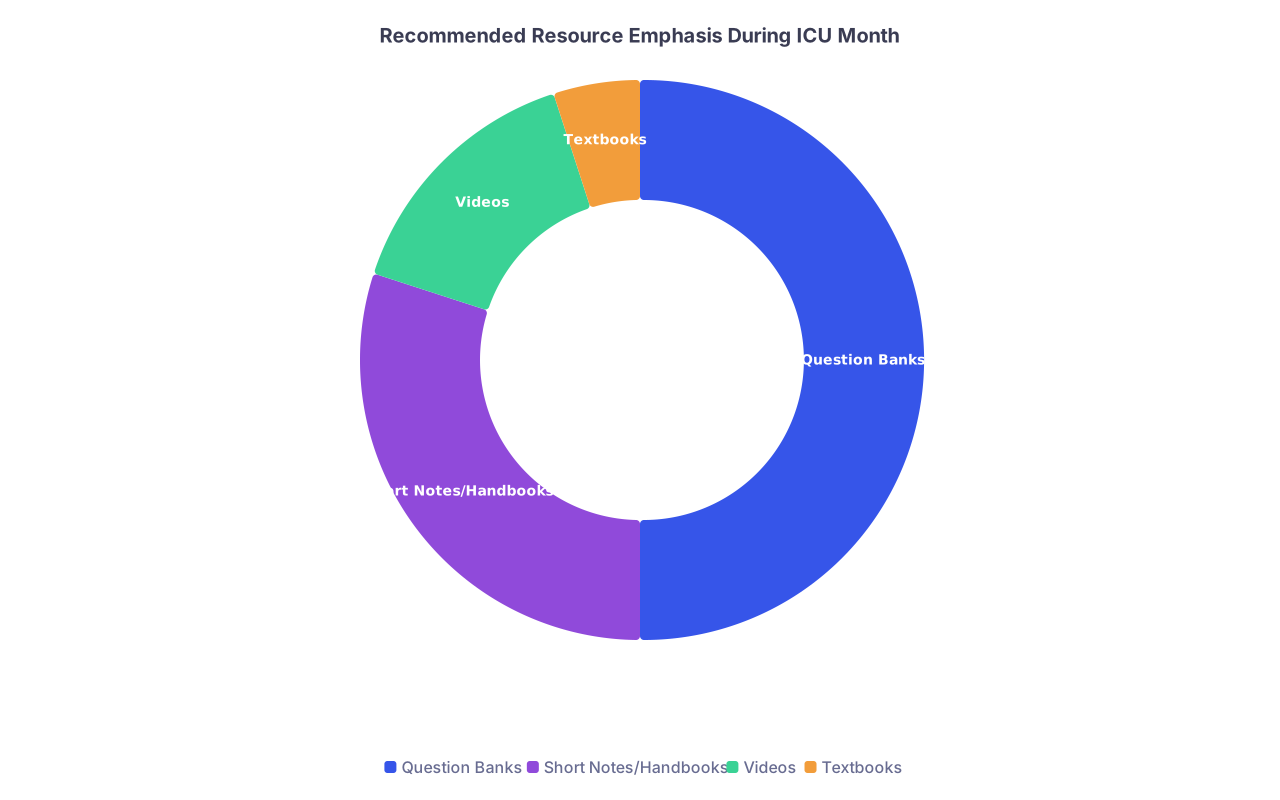
| Category | Value |
|---|---|
| Question Banks | 50 |
| Short Notes/Handbooks | 30 |
| Videos | 15 |
| Textbooks | 5 |
1. Question Bank as the Spine
Pick one primary QBank and stick to it for this month. Stop resource‑hopping.
ICU‑friendly QBank tactics:
- Filter by:
- Critical care / ICU
- Pulm, renal, cardio, ID, endocrine emergencies
- Do small blocks:
- 5–10 questions at a time
- Timed or tutor, but with short review (you do not have 90 minutes to dissect each block)
Targets during ICU month:
- On workdays: 10–25 questions
- On off days: 40–60 questions in 1–2 blocks
2. Short, High-Yield Notes / ICU Handbook
Have one compact resource you can open for 5 minutes and get a clean answer:
- An ICU pocketbook
- A short PDF of your own notes
- A high-yield boards outline for ICU topics
Rule: if it takes more than 10 minutes to understand a single concept from it, it is the wrong resource for ICU month.
3. Limited, Targeted Videos
Videos are easy to “watch” and feel productive while you are actually absorbing very little after a 14‑hour shift. So they are restricted.
Use videos only when:
- It is a day off and you feel cognitively fresh
- You are tackling a confusing concept (e.g., ventilator waveforms, complex acid–base)
- You can immediately follow the video with 5–10 related questions
If you routinely fall asleep mid‑video this month, take the hint. Shift that time into questions instead.
4. Spaced Repetition (Anki or Equivalent)
This is where ICU months quietly destroy people.
They stop reviewing cards “just for this rotation” and then suddenly have 2,000 overdue reviews.
The fix:
- Switch to low‑dose maintenance mode:
- Cap daily reviews at a reasonable number (e.g., 50–100)
- Suspend non‑core decks temporarily
- Use Anki for:
- ICU‑related material
- Fakely “memorization heavy” content (micro, pharm, stats, etc.)
Consistency > volume.
Step 5: Daily and Weekly ICU Study Routines That Actually Work
Let us get concrete. I will lay out three scenarios and what a realistic plan looks like.
A. Day Shift Example (06:30–18:30)
Pre‑shift (06:00–06:20)
- 10–15 min:
- 20–40 Anki reviews OR
- 5 board questions with quick review
On shift
- Two micro‑blocks of 5 questions each when things are stable (yes, this is possible some days):
- After AM rounds
- Late afternoon lull
- 1–2 minutes here and there for tiny lookups tied to actual patients
Post‑shift (19:15–19:35)
- 15–20 minutes:
- Quick debrief: write 2–3 pearls from the day
- 3–5 questions focused on something you saw (e.g., ARDS PEEP settings)
Total: 15–25 questions, 20–40 min of focused studying. No heroics.
B. Night Shift Example (18:30–07:30)
Nights are dangerous. You can either completely crater or actually gain ground.
Pre‑shift (17:45–18:05)
- 15–20 minutes:
- A small QBank block (5–10 questions) to “warm up” the brain
On shift
- Early night:
- Busy with admissions and issues → learning on the move via lookups and quick notes
- Late night:
- If there is a quiet stretch, 10–15 questions in one sitting
- Set a hard cutoff. If you are fighting sleep, stop. Fatigue learning is trash.
Post‑shift (08:00–08:15)
- At home, before bed, only if you are not completely destroyed:
- 10 minutes of Anki or brief review of the 2–3 pearls you wrote
Do not schedule heavy study sessions immediately after a 12‑hour night. You will either fail or wreck your sleep.
C. Day Off During ICU Block
This is where you catch up. Do not waste it.
Morning (after decent sleep)
- 2 focused blocks of 20 questions each (with real review)
- 15–20 minutes reviewing ICU notes from the week
Afternoon/evening
- 30–45 minutes of mixed:
- Weak topics
- A bit of video for a concept that is confusing you
Total: 40–60 questions + 30–60 minutes review. That is it. You are still a human who needs recovery.
Step 6: Protect Your Physical and Cognitive Capacity
You cannot think straight about vasopressors or board vignettes if you are dehydrated, underslept, and fried.
This is not wellness theater. It is simple resource management.
Absolute Minimum Non‑Negotiables
Sleep protection
- Do not “study into” sleep to hit some arbitrary number of questions.
- On a string of days, choose:
- Sleep 7 hours + 10 questions
over
Sleep 5 hours + 40 questions
- Sleep 7 hours + 10 questions
Caffeine sanity
- Front‑load caffeine in the first half of the shift.
- Avoid hammering coffee 2–3 hours before your intended sleep time, especially post‑nights.
Food and hydration
- Pack real food. Waiting for the cafeteria at 2 am means you will end up on vending machine junk.
- Keep a water bottle at the workstation. Actually drink from it. Simple, but most residents fail here.
Micro‑recovery
- 3–4 times per shift:
- Stand, stretch, take 5 slow breaths, look away from screens for 30–60 seconds.
- Sounds trivial. It is not. Your prefrontal cortex will thank you.
- 3–4 times per shift:
Step 7: Use Simple Systems to Track and Adjust
If you are not tracking, you are guessing. And during an ICU month, your perception will be flawed; everything feels like chaos.
You need one small dashboard.
The 1‑Page ICU Board Tracker
Create a simple note or spreadsheet with:
- Columns:
- Date
- Shift type (D/N/OFF)
- Questions done
- Anki done? (Y/N)
- Topics reinforced today
- 1 sentence: “How fried was I?” (1–5 scale)
Update it once per day. Takes 30–60 seconds.
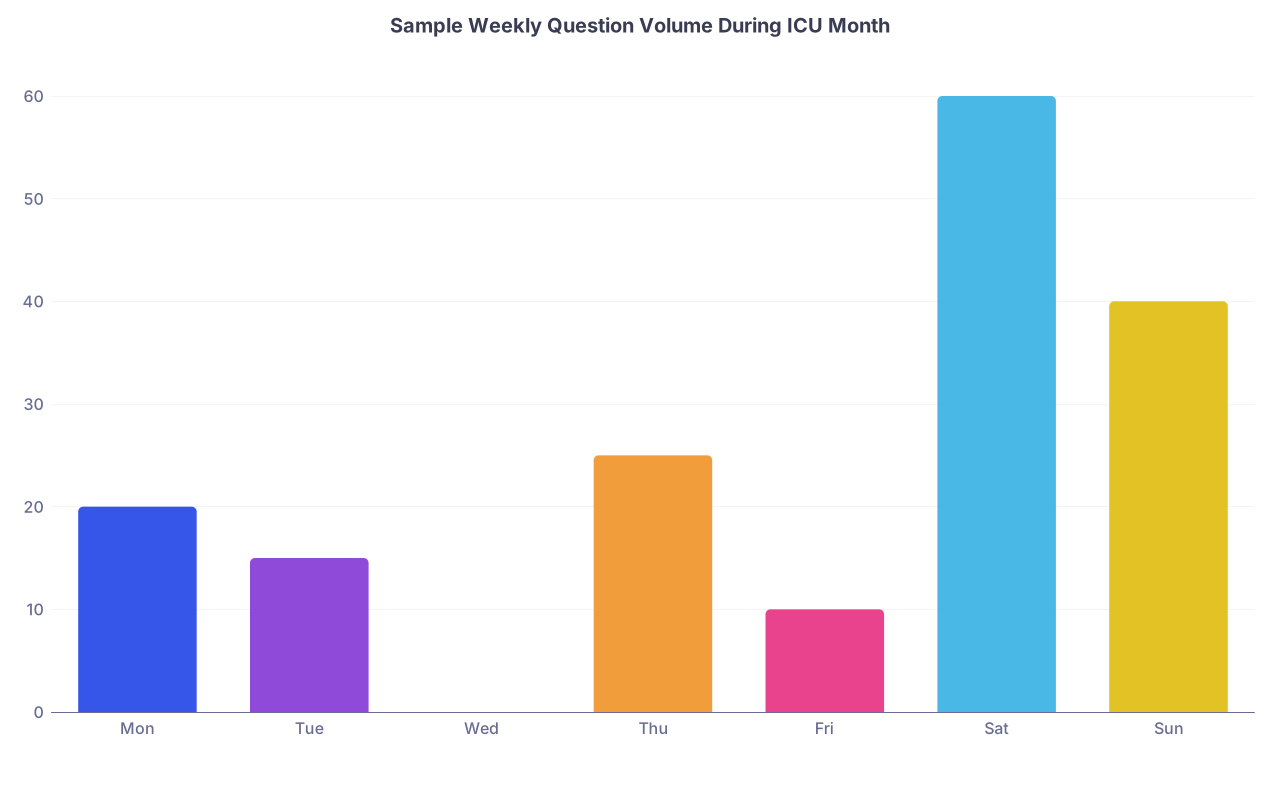
| Category | Value |
|---|---|
| Mon | 20 |
| Tue | 15 |
| Wed | 0 |
| Thu | 25 |
| Fri | 10 |
| Sat | 60 |
| Sun | 40 |
Now you can see patterns:
“I always crash on day 3 of a stretch.”
→ Preemptively plan that as a low‑study day, and make day 2 a bit stronger.“Zero questions on every first night.”
→ Accept that and shift expectations; aim for questions on the second and third nights.
The point: you adjust intentionally, not out of guilt or panic.
Step 8: ICU Month Within the Bigger Exam Timeline
ICU is one piece of the year, not the entire story. You should place it strategically in your exam preparation arc.
If Your Exam Is 4–6+ Months Away
- Use ICU month to:
- Build deep, intuitive understanding of critical care topics.
- Get comfortable managing instability (useful for any board scenario).
- Do not stress about crazy volume numbers.
- Focus on:
- Consistent low‑dose QBank
- Strong integration of clinical and exam thinking
If Your Exam Is 2–4 Months Away
- ICU month becomes about avoiding regression.
- Goals:
- Maintain question rhythm.
- Protect your weak areas from being forgotten by occasional targeted blocks.
- Keep Anki / spaced repetition alive at a smaller scale.
If Your Exam Is < 2 Months Away
This is the tightrope.
You probably should have planned to avoid your heaviest ICU block right before boards. But maybe the schedule is fixed. It happens.
What you do now:
Strip everything to essentials
- One primary QBank
- One compact review resource
- Minimal but daily spaced repetition
Aggressively protect off days
- Those are no longer casual “rest and Netflix” days.
- They are:
- Morning: highest-yield studying
- Afternoon / evening: partial rest
Coordinate with leadership
- Talk to your program director or chief if possible:
- Explain your exam date.
- Ask (politely, professionally) for:
- Preferential scheduling of days off around your heaviest planned study days.
- Avoidance of extraneous nonclinical obligations that month (lectures you are presenting, etc.).
- Talk to your program director or chief if possible:
Not everyone will accommodate you. But you at least put the request out early.
Step 9: Mental Game – Kill the Guilt, Focus on Execution
There is a very specific ICU‑month spiral I have seen repeatedly:
- Day 1–3: They try to maintain pre‑ICU study volume, fail.
- Day 4–7: They feel guilty, label themselves “behind,” and start avoiding studying altogether.
- Week 2–4: They essentially stop board prep entirely, then emerge in full panic mode.
You break that cycle by being realistic on day 1 and then relentlessly executing a small, sustainable plan.
Two ground rules:
You do not compare yourself to your “normal” weeks.
You compare yourself to: “What would I be doing if I had no plan at all?”
Almost always, the answer is “nothing.” So your 15 questions absolutely matter.You measure effort and consistency, not just raw numbers.
Night shift, 10 questions done with real focus after three codes?
That is a win. Treat it like one.
Step 10: A Simple ICU Month Blueprint (Put This On Your Wall)
To pull this all together, here is a stripped-down blueprint you can adapt.
Before the Rotation
- Set ICU‑specific board goals.
- Pick:
- 1 QBank
- 1 ICU/board handbook or outline
- 1 spaced repetition tool (if you use it)
- Make your ICU Topic List (8–12 topics).
- Build a 1‑page daily template and tracker.
During Each Shift
- Pre‑shift: 10–20 min (Anki or 5–10 Qs).
- On shift:
- Use real patients for micro‑learning (1–2 topics per shift).
- Do 5–10 QBank questions if there is a stable window.
- Post‑shift: 10–20 min:
- Document 2–3 pearls.
- Do 3–5 questions tied to what you saw.
On Each Day Off
- 40–60 questions in 1–2 sessions.
- 30–45 min review of ICU‑related weak spots.
- Brief planning for the coming stretch of shifts.

FAQs
1. What if the ICU is so busy that I literally cannot study on shift or when I get home?
Then stop trying to force what is impossible and restructure your expectations.
Use this protocol:
- Admit this rotation is “no on‑shift study” territory.
- Shrink your daily minimums further:
- Workdays:
- 10–15 min before shift only.
- 10–20 questions max, or 20–40 Anki cards.
- That is it. No post‑shift studying demanded.
- Workdays:
- Double‑weight your off days:
- 60–80 questions with proper review.
- 30–60 minutes of targeted reading on ICU topics that came up.
- Lean even harder into “integration”:
- On shift: anytime you look something up for patient care, frame it in board language and jot a 1‑line note.
You are not going to win a volume contest during this block. Your metric is: “Did I keep my brain wired into exam‑style thinking at least briefly every day?” If the answer is yes, you are fine.
2. How do I know if I am falling too far behind and need to change my exam date?
Look at data, not anxiety.
Run this quick check:
- Question progress:
- Total QBank questions done vs your target for this point in the timeline.
- If you are off by a few hundred and your exam is > 2 months away, you can catch up with post‑ICU heavier weeks.
- Recent test performance:
- Any recent NBME / in‑training / practice exam scores?
- If your trend is roughly stable or slightly improving, ICU month did not break you.
- Post‑ICU capacity:
- What does the 4–6 weeks after ICU look like?
- If they are lighter, you can plan a deliberate catch‑up phase.
- Honest self‑assessment:
- Are your fundamentals shaky across the board, or just in certain systems?
- If multiple practice tests are far below passing and your exam is < 6–8 weeks away, you at least consider a date change.
If the numbers are bad and the calendar is tight, delaying the exam is a strategic decision, not a personal failure. But do that based on real performance data—not on how overwhelmed you felt in week 3 of nights.
Now, one actionable next step:
Tonight, before your next ICU shift, create a one‑page ICU Study Plan.
Write down:
- Your daily minimums (questions, Anki, time).
- The 8–12 ICU topics you will focus on this month.
- Your pre‑shift and off‑day routines.
Put it in your bag or in your notes app. Tomorrow, follow it for one shift. Then another. Then the whole block.