
Rounds are the most underused board resource in residency.
You are walking past the highest-yield questions of your boards every single day… and most people are too tired, too rushed, or too disorganized to squeeze any value out of them.
Let us fix that.
You do not need more Qbanks. You need to turn the 2–4 hours you already spend on rounds into systematic, targeted practice for your in‑training exam and boards. That is the only sustainable way to study while working 60–80 hours a week.
Here is how to do it, step by step, without annoying your attending or slowing the team to a crawl.
Step 1: Change Your Rounds Mindset (And Your Goal for Each Patient)
Stop treating rounds as “get through the list and survive.” That mindset kills learning.
Instead, assign a single, concrete exam goal to each patient you present.
For every patient you see, you want one of five things:
- A tested diagnostic framework
- A threshold you will be asked about (vitals, labs, scores)
- A first-line vs second-line treatment distinction
- A contraindication or exception you will get burned on
- A classic board stem pattern
If a conversation you are having does not map to one of these buckets, it is probably low-yield exam noise.
Here is the simple rule:
- One board-relevant takeaway per patient.
- Write it down immediately in a dedicated place.
You will build what I call a Rounds Board Log. More on that in a minute.
Step 2: Build Your “Rounds Board Log” System
Your brain will not remember the pearls from rounds. That is not a weakness; it is reality. You need a capture system.
Use whatever tool you will actually open every day:
- A small pocket notebook
- A dedicated note in Notion / Obsidian / Apple Notes
- A titled note in OneNote or Evernote: “Rounds → Board Pearls”
- A simple Google Doc you can sync across devices
Structure your log in a board-friendly way
Do not write paragraphs. Your log should look like someone’s personal question explanations.
Use this template for each patient:
Format:
- Date / Rotation / Service
- Patient problem: “DKA with AKI”
- Board concept: “DKA insulin initiation and potassium cutoffs”
- Question frame: “In DKA with K+ X, do you give insulin now or later?”
- Key thresholds / rules:
- K < 3.3 → hold insulin, give K first
- K 3.3–5.2 → insulin + K in IV fluids
- K > 5.2 → insulin + fluids, no K yet
- One-line stem reminder: “25F type 1 DM, abd pain, AG 24, K 3.0, board wants you to delay insulin.”
That is it. Short, structured, recognizable.
Over time, you will have hundreds of tiny, highly relevant “micro-explanations” linked to real patients. This is infinitely more memorable than abstract Qbank questions.
| Date/Service | Problem | Board Concept Focus |
|---|---|---|
| 7/3 MICU | Septic shock | Norepi first line, MAP 65 |
| 7/4 Wards | New AFib RVR | CHA₂DS₂-VASc anticoag cutoffs |
| 7/5 Cards | NSTEMI on DOAC | Heparin vs hold decisions |
| 7/6 Heme | ITP | Platelet transfusion rules |
| 7/7 Onc | Febrile neutro | Empiric abx selection |
That table is what you are aiming for in your own log.
Step 3: Use a Pre-Rounds “Board Prep” Checklist (10 Minutes Max)
You do not have time for an hour of studying before rounds. You do have time for 10 focused minutes.
Here is a pre‑rounds protocol that actually works:
1. Pick 1–2 “anchor patients”
- These are the ones with:
- A classic diagnosis (DKA, COPD exacerbation, pancreatitis, CHF)
- A management decision pending (anticoagulation, pressors, antibiotics)
- Tell yourself: “I will use these patients to learn 1 board concept each.”
2. Look up one high-yield question per anchor patient Limit yourself to 5 minutes per anchor:
- Search “UptoDate + ‘DKA insulin potassium’”
- Or open your review book (e.g., Step-Up, MKSAP, UWorld notes) and skim section headings
- You are not doing deep reading; you are hunting for:
- Cutoff values
- First-line therapy
- Classic contraindications
- Risk scores (Wells, CHA₂DS₂-VASc, etc.)
3. Convert it immediately to a board-style question frame
Example:
- Patient: Upper GI bleed on warfarin
- Board frame: “Which reversal strategy is recommended for life-threatening warfarin-associated bleeding?”
Write just the question in your log before rounds. You will fill the answer after or during rounds.
This is “preloading” your brain. During rounds, you are simply confirming or correcting your pre-guess.
Step 4: Ask Tiny, High-Yield Questions On Rounds Without Being That Person
Nobody wants to be on the team with the resident who turns rounds into a 3-hour pimp session. But you can absolutely inject 10‑second board questions that sharpen both you and the med students.
Here is the rule:
Ask one, very specific, board-framed question per 2–3 patients.
Not per student. Per patient.
And keep them:
- Concrete
- Closed-ended
- Time-boxed
Examples that work well and are fast:
- “In a boards question, what lactate or MAP values push you to start norepi in septic shock?”
- “On exams, what EF cutoff are they thinking about when they say HFrEF?”
- “From a test perspective, what makes this NSTEMI a cath-lab-now situation vs tomorrow?”
What not to do:
- “So… what can you tell me about sepsis?” (vague, time-wasting)
- “Walk me through COPD from A to Z.” (overkill)
- “Tell me everything you know about MI management.” (you will derail workflow)
Pro move:
If your attending is into teaching, frame it as:
“I have a quick boards-style question for the team, 10 seconds.”
Most academic attendings love that. Non-academic ones at least know you will be brief.
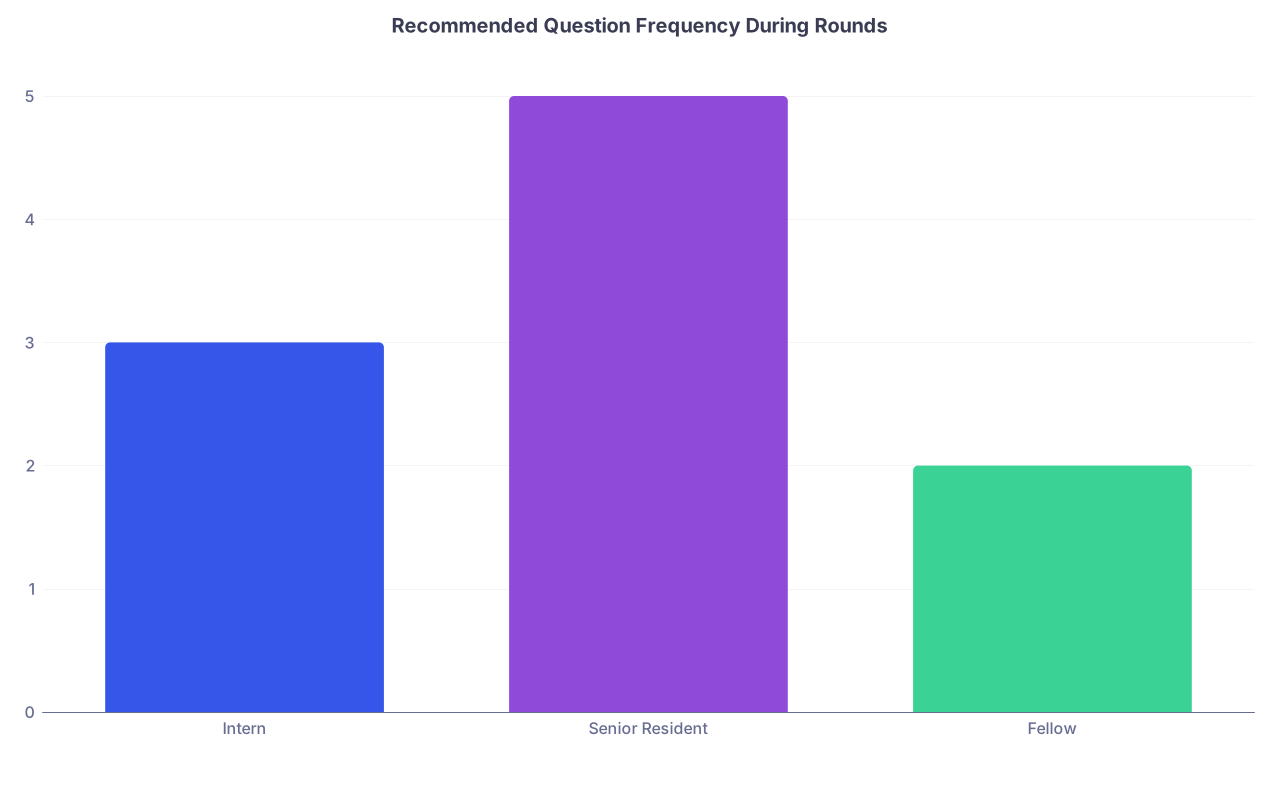
| Category | Value |
|---|---|
| Intern | 3 |
| Senior Resident | 5 |
| Fellow | 2 |
That bar chart is the ballpark:
- Intern: ~3 tiny questions per full set of rounds
- Senior: ~5 (you control more of the teaching)
- Fellow: ~2 focused, subspecialty-level clarifications
Step 5: Turn Every Common Admission Into a Board Template
You are seeing the same 20 diagnoses over and over. That is exactly how Qbanks are built. Use that repetition.
For each common problem, build a 3-part mini-template in your log:
- Buzzwords / Presentation
- First steps (stabilization and tests)
- First-line treatment + thresholds
Example: COPD Exacerbation
- Buzzwords:
- Smoker, chronic cough, wheeze, hyperinflated lungs
- Worsening dyspnea, increased sputum, change in sputum color
- First steps:
- Assess for red flags: altered mental status, use of accessory muscles, PaCO₂ rising
- VBG/ABG, CXR, infectious workup if indicated
- Treatment + thresholds:
- SABA + SAMA → albuterol + ipratropium
- Systemic steroids → typical board dose: prednisone 40 mg x 5 days (or equivalent)
- Antibiotics if ≥2 of: ↑ dyspnea, ↑ sputum volume, ↑ sputum purulence
- NIPPV (BiPAP) if pH <7.35 with hypercapnia or significant distress
Now each time you see COPD, you check and refine this template. Your “rounds” become applied spaced repetition.
Do this for:
- DKA / HHS
- Sepsis / septic shock
- CHF exacerbation
- NSTEMI / STEMI
- AFib with RVR
- PE / DVT
- AKI (pre/post/intra)
- Pneumonia (CAP, HAP, VAP)
- Stroke / TIA
- Cellulitis / nec fasc
Those 10–15 conditions account for a massive chunk of internal medicine exam questions.
Step 6: Use a Post-Rounds “Micro-Debrief” (15 Minutes Max)
Most residents finish rounds, collapse into the workroom, and drown in pages and orders. You cannot change that. But you can carve out 10–15 minutes for a ruthless, focused debrief.
Your job in that debrief:
Turn what you saw into something you can recall on exam day.
Here is the protocol:
- Open your Rounds Board Log
- Add 2–3 new entries from:
- The most confusing cases
- The attendings’ mini-lectures
- Any argument between consultants (those are exam gold)
- For each:
- Write the board question they were implicitly debating
- Write the best one-sentence answer with 1–3 key bullets
Example from a consultant disagreement:
- Case: Elderly patient with subsegmental PE, stable, no DVT on Doppler, high bleed risk
- Question frame: “On boards, when is it acceptable NOT to anticoagulate a PE?”
- One-sentence answer: Subsegmental PE in a stable patient with no DVT and high bleeding risk can sometimes be observed without anticoagulation, especially if reliable follow-up and no significant cardiopulmonary disease.
This kind of nuance shows up on exams all the time. Your memory will tag it to that specific cranky pulmonary attending who rolled their eyes. Which means you will remember it.

| Step | Description |
|---|---|
| Step 1 | Pre rounds 10 min |
| Step 2 | Pick 1 to 2 anchor patients |
| Step 3 | Find 1 board concept each |
| Step 4 | Write question frames in log |
| Step 5 | Run rounds |
| Step 6 | Ask 3 to 5 tiny board questions |
| Step 7 | Post rounds 15 min |
| Step 8 | Add 2 to 3 log entries |
| Step 9 | Review log on commute or pre bed |
That is your daily system. Once it is habit, it costs almost no extra energy.
Step 7: Convert Real Patients Into “Exam Stems”
Your boards are not written from Mars. They are written from the chart.
You can build exam fluency by occasionally rewriting a real case as a USMLE-style stem. Fast and dirty, not fancy.
Take 1–2 interesting patients per week and do this:
- Write a 2–3 sentence stem:
- Age, sex
- Chief complaint and duration
- 3–5 key findings (vitals, labs, imaging, risk factors)
- End with a clear question:
- “What is the next best step in management?”
- “What is the most likely diagnosis?”
- “Which of the following is a contraindication to this therapy?”
Example:
“An 82-year-old man with a history of hypertension and chronic kidney disease presents with fever and confusion. He is hypotensive to 82/48, tachycardic to 118, RR 26, O2 sat 93% RA. Labs show WBC 19K, creatinine 2.5 (baseline 1.3), lactate 5.2. After a 30 mL/kg crystalloid bolus, MAP remains 58. What is the next best step in management?”
Answer: Start norepinephrine to maintain MAP ≥65.
Write this in your log. Underneath, bullet the key points:
- Sepsis with fluid-refractory hypotension = septic shock
- Norepi first-line vasopressor
- Target MAP 65 on boards
These homegrown stems are more vivid than Qbank questions because you can picture the patient. That matters when you are 5 hours into an exam and your brain is tired.
Step 8: Align With Your In-Training Exam / Board Blueprint
Residents waste time mastering obscure, rare zebras they saw once and ignoring the frequent flyers that show up 15 times per exam.
Pull the blueprint for your exam:
- ABIM / ABS / ABOG / ABEM etc. content outlines
- In‑training exam breakdowns by topic
Map your Rounds Board Log entries to those categories.
Example for internal medicine:
| ABIM Category | Common Rounds Topics |
|---|---|
| Cardiology | CHF, AFib, NSTEMI, STEMI |
| Pulmonary | COPD, asthma, pneumonia, PE |
| Endocrinology | DKA/HHS, thyroid disease |
| Infectious Dis. | Sepsis, HIV, endocarditis |
| Nephrology | AKI, CKD, electrolyte issues |
If your log is full of zebras (HLH, TTP, rare vasculitides) and almost empty for CHF, COPD, DM, sepsis, you are misusing rounds.
Fix it by:
- Intentionally targeting high-yield topics on common patients
- Asking: “From an exam standpoint, what is the key issue with this routine case?”
Example:
- Stable CHF patient? Fine. But:
“On the boards, what meds improve mortality in HFrEF, and which are just for symptoms?”
That is what you log, not the patient’s specific nursing notes drama.
Step 9: Use Time Between Patients and On the Move
You do not need a desk and silence to study. You need chunks.
Here is how to squeeze board prep into micro-gaps created by rounds:
Elevator rides / walking between floors
- Open your Rounds Board Log on your phone
- Read 1–2 entries, quiz yourself on the key thresholds
Waiting for an attending to review imaging / talk to a consultant
- Rewrite 1 patient into a stem in your notes
- Or look up 1 specific unclear point from that morning (“What exactly are the criteria for severe C. diff again?”)
Pre-signout downtime
- Flip through today’s log additions and highlight 1–2 to review again tonight
You are not “studying” in the classic sense. You are compressing and reinforcing what you already saw.
This is how residents who look like they are not studying magically crush their boards.
Step 10: Weekly “Rounds → Boards” Review Ritual (30–45 Minutes)
Daily micro-work is good. Weekly consolidation is what locks it in.
Once a week (usually on a post-call or lighter day), do this:
Open your Rounds Board Log for the week
Sort entries by organ system or exam category
Pick:
- 3 bread-and-butter topics (CHF, COPD, DM, sepsis, etc.)
- 1–2 more advanced / nuance topics that tripped you up
For each chosen topic:
- Write 2–3 rapid-fire questions in your own words
- Answer them from memory
- THEN quickly cross-check with a trusted resource (UWorld explanation, MKSAP, review book, UpToDate summary)
Adjust your log entries where you were slightly off. Especially:
- Dosages, thresholds, contraindications
- Algorithm steps (what comes first, what comes later)
This is where you turn messy, on-the-fly clinical teaching into clean, exam-grade knowledge.
Common Pitfalls (And How to Fix Them Fast)
You will mess this up at first. That is fine. Fix these three patterns early:
Pitfall 1: Writing too much
If your Rounds Board Log looks like a novel, you will stop using it. Set a hard cap:
- 4–6 bullet points per patient
- Less than 1 minute to write each entry
If you cannot summarize the key board point in six bullets, you do not understand it yet. That is your signal to clarify later.
Pitfall 2: Being passive on rounds
If you are just standing there holding your list, you are wasting the best study resource in the hospital.
Fix: Before each room, silently ask yourself:
- “What is the board issue here?”
- “What would the exam writer try to trick me on?”
It snaps your brain into active mode, even if you never say anything out loud.
Pitfall 3: Chasing random tangents
Attendings love side stories. Many are clinically valuable. A lot are exam-useless.
You do not need to be rude. Just:
- Capture one board-relevant nugget from a tangent and ignore the rest
- Ask yourself: “Will a test writer care about this?”
If the answer is no, do not log it.
Putting It All Together: A Realistic Day Example
Let me walk you through how this looks on a normal busy day.
6:30–6:40 AM – Pre‑rounds
- Identify 2 anchor patients: new DKA admission, new AFib with RVR
- DKA: Skim DKA section, focus on insulin + K thresholds → write question in log:
“K is 3.0 in DKA. Start insulin now or later?” - AFib: Look up CHA₂DS₂-VASc scoring quickly → log question:
“Score at which boards expect anticoagulation?”
7:00–10:30 AM – Rounds
- For DKA patient:
- Present case
- When discussing management, ask:
“Just to be clear for exams, what is the K cutoff before starting insulin?” - Attending gives short answer → you confirm your pre-loaded concept
- For AFib patient:
- Ask the intern: “Quick board thing: what CHA₂DS₂-VASc score do we start anticoag on?”
- Attending may chime in with nuance → log that later
You sprinkle 3–5 similar micro-questions across the list, each ≤20 seconds.
10:45–11:00 AM – Micro-debrief
- You grab 15 minutes at your workstation
- Open log:
- Add DKA insulin/K bullet rules
- Add AFib CHA₂DS₂-VASc cutoffs and exception (mechanical valve → warfarin, not DOAC)
- Add one extra entry about sepsis patient and MAP 65 + norepi choice
Evening – 15–20 minutes before bed
- Open your log on your phone
- Review just today’s entries
- Quiz yourself:
- “What was the K cutoff before insulin again?”
- “What score is anticoag recommended for AFib?”
- Close computer. Sleep.
That is it. No heroic 3‑hour study session. But you learned 3–5 exam-ready concepts, tied to real patients and repeated multiple times that day.
Do that 200 days in a year. You will be fine.