
The way most residents “study” for boards in the last two weeks is useless.
Random questions. Half-read chapters. Panic scrolling. Then they walk into a high‑stakes in‑training exam and get blindsided by basic physiology and bread‑and‑butter management they should have crushed.
You can do better in 14 days. But only if you stop pretending you have three months and build a rescue plan that is brutally focused and realistic for a resident schedule.
Here is that plan.
Step 1: Hard Reset – One Hour to Build a Realistic Battle Plan
Before you touch a question bank, you need a map. No map = wasted time.
1.1 Define the actual constraints
Take 10 minutes. Be honest.
- How many days until the exam? Count today as Day 0.
- How many call shifts?
- Any 24‑hour calls, nights, or jeopardy?
- What is your average “protected” study time on:
- Non‑call days?
- Post‑call days?
- Call nights?
Write this down. Not in your head. On paper or a note.
Example for a PGY‑2 in IM, exam in 14 days:
- 6 full clinic/ward days
- 3 lighter elective days
- 2 night float shifts
- 2 golden weekends
- 1 28‑hour call
Realistic daily study time:
- Full ward day: 1.5 hours
- Elective: 3 hours
- Golden weekend: 6 hours each day
- Night float: 0–1 hour targeted review
- Post‑call: 0.5–1 hour max (light flashcards, no heavy lifting)
Now you know your actual capacity. Most residents overestimate and then feel like failures. Do not do that.
1.2 Choose your tools (and cut the rest)
In a two‑week rescue plan, every extra resource is a liability. You get:
- 1 primary Qbank
- 1 rapid‑review source (outline, notes, or high‑yield book)
- Optional: 1 flashcard deck (Anki or premade) you already use
If you are starting a new book now, you have already lost the plot. Use:
- Internal in‑training exam syllabus + trusted Qbank (e.g., NEJM Knowledge+, UWorld, MKSAP, TrueLearn, Rosh, specialty board Qbank)
- Board‑style high‑yield outline (e.g., IM: MKSAP Quick Q&A, cardiology chapter summaries; EM: Rosh/EMCrit/PEER notes; Anesthesia: Hall/Miller review notes; Surgery: SCORE high‑yield, ABSITE review notes)
Pick. Commit. Delete everything else from your mental space for two weeks.
1.3 Lock the study targets
For a 2‑week rescue, your priorities are:
- Weak core topics that are high yield on exam
- Question pattern recognition
- Recall speed and accuracy
You are not “finishing” a Qbank. You are building exam‑ready pattern recognition in the highest‑yield zones.
Step 2: 14‑Day Macro‑Plan – What You Will Actually Do
Stop hand‑waving about “a couple hundred questions.” Put numbers on paper.
Here is a realistic template for most residents:
| Phase | Days | Focus | Daily Questions | Daily Review Time |
|---|---|---|---|---|
| Phase 1 – Baseline & Triage | 1–2 | Full-length blocks + weak area ID | 80–120 | 2–3 hours |
| Phase 2 – Targeted System Blocks | 3–8 | System-based Qblocks + focused review | 60–100 | 2–4 hours |
| Phase 3 – Mixed Blocks + Simulation | 9–12 | Mixed blocks timed + refinement | 60–80 | 2–3 hours |
| Phase 4 – Taper & Rapid Review | 13–14 | Short blocks + high-yield facts | 40–60 | 1.5–3 hours |
That typically totals:
- 800–1200 questions across 2 weeks
- Enough to meaningfully move the needle without burning you out
Adjust up or down by 20–30% depending on your schedule and baseline.
Step 3: Day‑by‑Day Framework (with Call‑Friendly Adjustments)
Let me lay out a skeleton schedule. You will plug in your specialty content.
Days 1–2: Baseline and Triage (Stop Guessing Where You Are Weak)
Goal: Identify weak systems and common pattern failures.
Morning or first study block:
- Do 1 full, timed exam‑style block:
- 40–50 questions
- Mixed subjects/systems
- Timed at real exam pace
- Do not pause or look up answers mid‑block
Second block (later same day):
- Another 40–50 questions (timed or tutor mode depending on your stamina)
Review protocol (this matters more than question count): For each missed or guessed question:
- Identify:
- Was this a knowledge gap?
- A misread question?
- Time pressure?
- Overthinking / second‑guessing?
- Write a 1‑sentence takeaway:
- “Malignant hyperthermia: think succinylcholine + volatile, treat with dantrolene.”
- “In septic shock, norepinephrine is first‑line pressor, not dopamine.”
- Tag the topic/system (CV, pulm, ICU, trauma, OB, pharm, etc.).
At the end of Day 2, look at your tags:
- Which 3 systems show up most often?
- Which topic types? (pharm, ECGs, imaging, acid‑base, stats, etc.)
Those are your Tier 1 priorities for Days 3–8.
Days 3–8: Targeted System Attack (Where the Score Actually Moves)
Goal: Hammer your highest‑yield weak areas while keeping mixed exposure.
Each day you do:
- 1 mixed block (40–50 questions)
- 1–2 targeted blocks (20–40 questions) focusing on priority systems
- Focused content review ONLY on what came up in questions
Example for an IM resident:
- Tier 1: Cardiology, Pulm/ICU, Infectious Disease
- Tier 2: Renal, Endocrine, Heme/Onc
- Tier 3: Rheum, Derm, Neuro, Stats
Daily structure (on a normal ward day):
- Early morning (if possible): 20–30 min flashcards or quick‑hit facts
- After work:
- Block 1: 40–50 mixed timed questions
- Immediate review: 60–75 min
- Short break
- Block 2: 20–30 targeted questions in 1 weak system
- Review: 30–45 min
- 15–20 min: Rapid‑review of 1–2 key topics from those missed (short notes, not a whole chapter)
On light/elective days:
- Add:
- A third small block (20–30 questions) for another weak system
- 45–60 min of more in‑depth reading on your single weakest area (e.g., ventilator management, arrhythmias, trauma resuscitation)
On heavy call/post‑call days:
- Cut to absolute minimum:
- 10–20 questions (even if it takes two short bursts)
- 15–20 minutes of review
- 10 minutes of flashcards before bed
- Goal: Maintain contact, not huge progress
Days 9–12: Simulation and Integration (Make It Feel Like the Real Exam)
Goal: Switch from “learning mode” to “exam athlete.”
You now know:
- Your worst systems
- Your most common mistake patterns
- Your realistic pace under pressure
These days should feel harder and more like test day.
Daily framework:
- Block 1: 40–50 mixed, timed questions
- Block 2: 30–40 mixed OR focused on your worst 1–2 systems
- Question review: 2–3 hours total
- 30–45 minutes: rapid‑review notes / flashcards on repeatedly missed topics
Start tightening your test‑taking behaviors:
- No changing answers unless you realize a clear mistake
- Hard cutoff for each question (do not stare 2+ minutes at any single stem)
- Practice skipping and coming back logically if allowed by exam format
If you can, schedule:
- One “mock exam” day with:
- 2–3 back‑to‑back timed blocks
- Same start time as your actual in‑training exam
- Same break pattern
This is where your brain learns endurance, not just content.
Days 13–14: Taper, Consolidate, and Protect Your Brain
The last 48 hours are not for cramming entire books. That just increases anxiety and confusion.
Your goals:
- Consolidate high‑yield facts and algorithms
- Keep your recall sharp but not fried
- Enter the exam with a clear, calm routine
Day 13:
- 2 short blocks:
- 20–30 questions each, mixed topics
- Timed
- Review: 60–90 minutes
- 60–90 minutes: Rapid‑review of:
- Emergencies and must‑not‑miss diagnoses
- Core management protocols
- Your personal “Hall of Shame” topics (the ones you repeatedly miss)
Day 14 (day before exam):
- 1 small block only:
- 15–20 questions max
- Slow, careful thinking, not speed
- Light review (1–2 hours) of:
- Summary sheets
- Algorithms
- Formulas / drug names / intervals
- No new topics.
- Bedtime: Aim for an actual decent night. Even 1–2 hours more sleep here beats 50 extra random facts.
Specialty‑Specific Prioritization: Where Scores Hide
The blueprint is the same across specialties, but content emphasis changes.
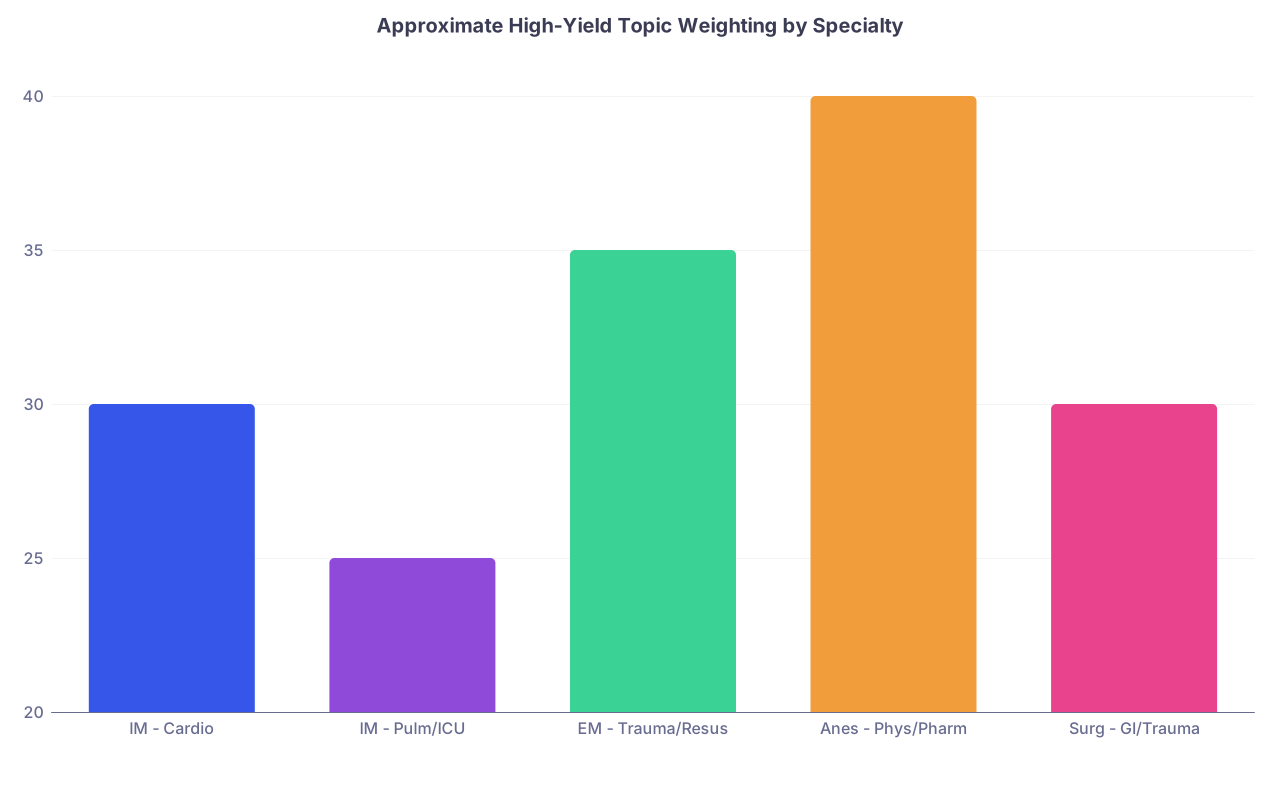
| Category | Value |
|---|---|
| IM - Cardio | 30 |
| IM - Pulm/ICU | 25 |
| EM - Trauma/Resus | 35 |
| Anes - Phys/Pharm | 40 |
| Surg - GI/Trauma | 30 |
These are rough, but you get the point: not all systems are equal.
Internal Medicine
If you are short on time, your minimum non‑negotiable coverage:
- Cardiology:
- ACS, HF management, arrhythmias, valvular lesions, anticoagulation
- Pulm/ICU:
- Ventilator settings, ARDS, shock, sepsis, ABG interpretation
- Infectious Disease:
- Pneumonia, endocarditis, meningitis, HIV basics, antibiotics, stewardship
- Renal:
- AKI vs CKD, electrolytes (Na, K, Ca, Mg), acid‑base disorders
These 4 areas often account for an outsized portion of IM in‑training questions.
Emergency Medicine
Priority domains:
- Resuscitation algorithms (ACLS, PALS, trauma resuscitation)
- Airway and ventilation, including difficult airway and RSI meds
- Trauma:
- C-spine, head injury, thoracoabdominal trauma, FAST interpretation
- Toxicology:
- Common toxidromes, antidotes, EKG patterns (e.g., TCA, dig, hyper‑K)
- High‑risk complaints:
- Chest pain, headache, SOB, abdominal pain, vaginal bleeding in pregnancy
Anesthesiology
Focus on:
- Airway management, induction agents, neuromuscular blockers
- Hemodynamics:
- Shock, vasoactive drips, intra‑op hypotension / hypertension
- Pharmacology of anesthetic agents and adjuncts
- Respiratory physiology and ventilator management
- Post‑op complications: MH, PONV, aspiration, residual blockade
General Surgery / ABSITE‑style exams
Core high‑yield:
- Trauma and shock
- GI and hepatobiliary:
- Appendicitis, cholecystitis, pancreatitis, bowel obstruction, GI bleed
- Perioperative management:
- Fluids, electrolytes, nutrition, DVT prophylaxis, antibiotics
- Surgical oncology basics (breast, colon, melanoma)
- Critical care and sepsis
You do not need a perfect breadth review. You need deep familiarity with the 4–5 content clusters that keep appearing on in‑training and boards.
Micro‑Technique: How to Review Questions So They Stick
Most residents waste half their review time chasing every reference link and reading enormous explanations.
Do not do this. Use a strict review protocol.
For each missed question:
Classify the error
- Pure knowledge gap (“I did not know this”)
- Application/logic error (“I knew, but applied it wrong”)
- Misread (“I missed the word chronic vs acute”)
- Testmanship (“I picked a plausible but not best answer”)
Capture a minimal takeaway
- One to two lines max.
- Example:
- “SIADH: euvolemic hyponatremia, low serum osm, high urine osm; treat with fluid restriction.”
- “Subdural hematoma: crescent‑shaped, crosses suture lines; usually due to bridging veins.”
Decide action
- If it is a core topic → add to:
- Anki (if you already use it)
- Or a simple “Last 3‑Day List” note
- If very obscure → understand it once, then move on.
- If it is a core topic → add to:
Look for patterns after every 40–60 questions
- Are you consistently missing:
- ECGs?
- OB questions?
- Endocrine emergencies?
- Promote those to “mini‑bootcamp” topics for your next study block.
- Are you consistently missing:
This is how you stop repeating the same mistakes over and over.
Call Days, Night Float, and Real‑World Chaos
This plan is useless if it ignores how residency actually works.
You will have days that blow up:
- A crashing patient right before your study block
- A 3‑hour family meeting that nukes your evening
- A cross‑cover night from hell
Plan for this:
Build “Call‑Mode Study” into your system
On days that are obviously crushed:
- Minimum viable dose:
- 10–15 questions (even in small 5‑question bursts)
- 10–15 minutes of flashcards or summary notes
- Accept that this is enough for that day
- Do not “make up” 80 questions the next day. You will just burn out.
Protect at least 3 “anchor” days
Pick 3 calendar days in this 14‑day window that you will treat as high‑priority study days (usually lighter clinic days or weekend days).
On those days:
- Aim for your highest question counts
- Schedule 2–3 uninterrupted 60–90 minute blocks
- Push your deep review and weak‑area bootcamps
If you get these 3 days right, they often compensate for the inevitable chaos elsewhere.
How to Handle Anxiety and Mental Fatigue (Without Going Soft)
You cannot ignore the mental side.
Two weeks of high‑intensity studying on top of residency is brutal. If you do not manage your energy, your attention will tank by exam day.
Use a few simple rules:
No study marathons longer than 90 minutes without a break
- 5–10 minutes:
- Walk the hall
- Stretch
- Water and a snack
- Do not open doom‑scroll social media
- 5–10 minutes:
Caffeine with discipline
- Front‑load most caffeine before early afternoon.
- Last dose at least 6 hours before planned sleep time.
Sleep: non‑negotiable in the last 3–4 days
- Cutting sleep the last nights before exam is a terrible trade.
- You lose processing speed, working memory, and judgment. Which is exactly what an in‑training exam punishes.
Mini‑reset routine when you are spiraling
- 3 deep breaths
- Remind yourself: “I am here to improve 1–2 points today, not fix everything.”
- Do 5 questions. Just 5. Momentum matters more than motivation.
Test‑Day Tactics: Do Not Throw Points Away
You did the work. Now do not sabotage yourself in the exam room.
The 4‑Pass Question Approach
For each question:
Pass 1: Clean wins
- If you know it cold, answer and move on.
- No second‑guessing unless you see a clear contradiction later.
Pass 2: Reasonable guesses
- If you can narrow to 2 options, pick the best and move on.
- Mark only if you genuinely think you might change it later.
Pass 3: Hard grinds
- Return to marked questions at the end of the block.
- Spend your remaining time here.
- Use logic:
- Remove obviously wrong options
- Match question stem mechanisms to answer mechanisms
- Ask: “What is the exam trying to test here?”
Pass 4: Last 1–2 minutes
- No omissions unless the exam penalizes guessing (most in‑training exams do not).
- Fill every blank.
Hard rules for the exam itself
- Do not change answers based purely on anxiety.
- If you misread the question, fix it, but do not spiral.
- If a block goes badly, it is gone. Next block is a fresh chance.
- Eat and hydrate during breaks. Even if you are not that hungry.

| Step | Description |
|---|---|
| Step 1 | Day 1 - Baseline Block |
| Step 2 | Triage Weak Systems |
| Step 3 | Days 3-8 Targeted Blocks |
| Step 4 | Days 9-12 Mixed Timed Blocks |
| Step 5 | Day 13 Light Blocks + Rapid Review |
| Step 6 | Day 14 Taper + Rest |
| Step 7 | Exam Day Strategy |
Example: A Realistic Two‑Week Snapshot for a PGY‑2 in IM
To make this less abstract, here is a concrete layout.
You:
- Work 6 ward days, 2 calls, 2 clinic, 4 weekend days partly free.
- Have UWorld IM Qbank and MKSAP Quick Questions.
Day 1 (ward):
- 40 mixed UWorld, timed after work
- 30 targeted MKSAP cardio questions
- Review: 2 hours total
- Tag: cardio, pulm/ICU are weak
Day 2 (clinic, lighter):
- 40 mixed UWorld
- 20 pulm/ICU, 20 ID targeted
- Review: 3 hours
- 30 minutes reading ventilator basics and sepsis bundles
Day 3 (ward):
- 40 mixed
- 20 cardio
- Short reviews only, 90 minutes
Day 4 (post‑call, tired):
- 20 questions max (even in 2 bursts of 10)
- 20 minutes flashcards / high‑yield cardio/pulm notes
Day 5 (golden weekend):
- Morning:
- 50 mixed, timed
- 90 min review
- Afternoon:
- 30 ID
- 60 min review
- Evening:
- 60 min targeted reading on your worst ID and cardio topics
Day 6 (golden weekend):
- Repeat similar structure with renal + endocrine emphasis
Days 7–8 (ward + clinic):
- 40 mixed each day
- 20–30 targeted in worst system
- 60–90 min review
Days 9–11 (simulate and integrate):
- One day with:
- 2× 40‑question timed mixed blocks
- Long review
- Other days:
- 40–50 mixed
- 20–30 targeted in recurring weak topics
Day 12 (lighter):
- 40 mixed
- 20 targeted electrolytes/acid‑base + ABGs
- 60 min summary review
Day 13:
- 2× 25‑question mixed blocks
- Review + rapid pass through “Hall of Shame” note list
Day 14:
- 15–20 very easy/mid‑level questions
- 1–2 hours light review
- Device fully charged, route to exam center checked
- Early bed
You are not perfect. But you are sharp, practiced, and pattern‑tuned. That is what moves scores.
The Bottom Line
Two weeks is short, but it is not nothing. Residents salvage board‑style exams in this window every year if they are disciplined.
Key points:
- Build a realistic 14‑day plan around your actual schedule, not your fantasy self.
- Prioritize high‑yield weak systems and rigorous question review over “finishing” resources.
- Simulate the exam with timed mixed blocks, then taper and protect your brain the last 48 hours.
You do not need perfect. You need better than you are today, in a focused way, for 14 days. That is absolutely achievable.