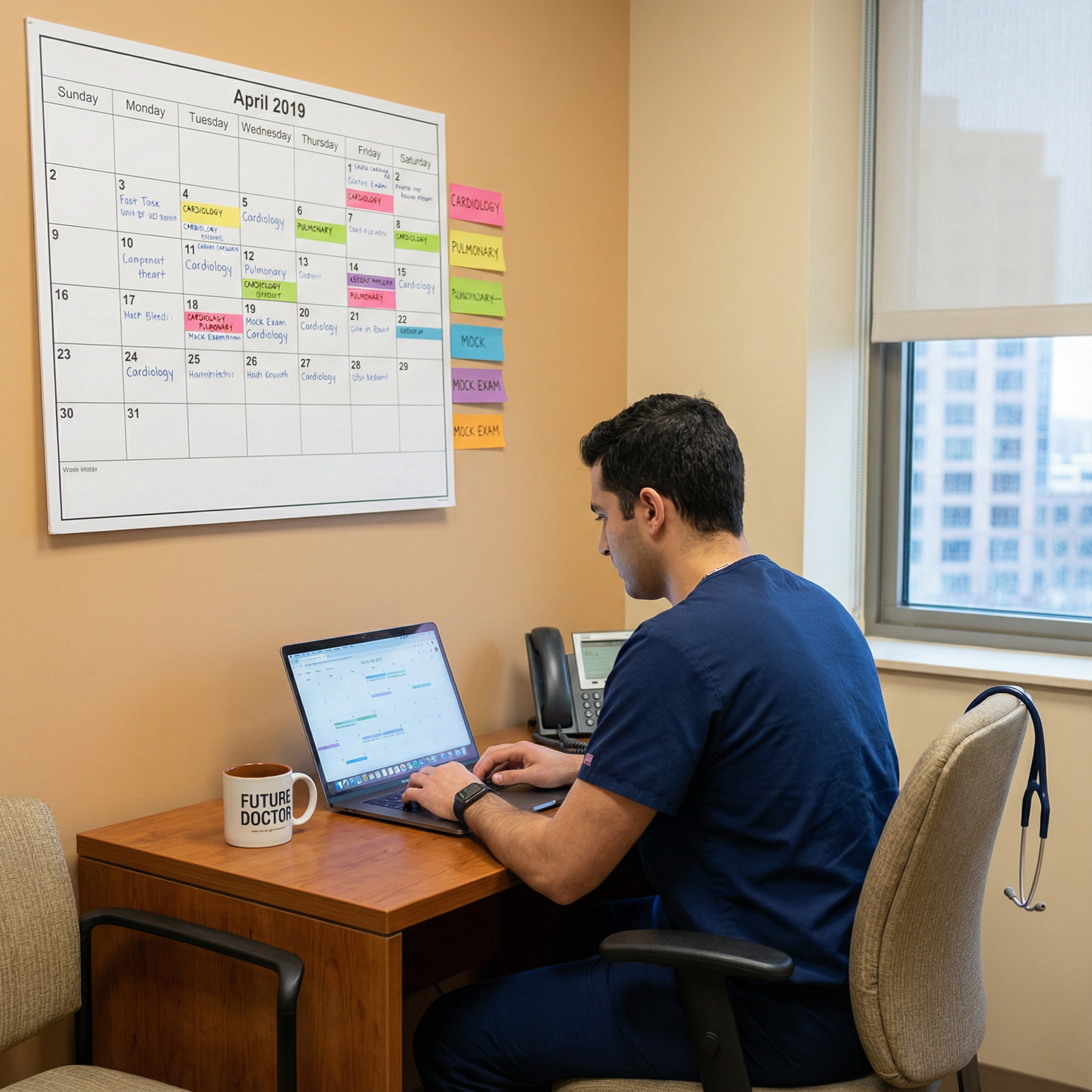
The way most residents respond to failing boards is wrong. They panic, hide it, and start doing more of the same studying that already did not work. Then they fail again.
You need a system. Not more effort. A structured 12‑month recovery plan that fits residency, protects your mental health, and gets you across the finish line once and for all.
You failed once. Fine. That is data. Now we use it.
Step 1: First 2–4 Weeks – Stabilize, Decompress, Get The Facts
You are not starting with “study more.” You are starting with “stabilize the damage” and “get objective data.”
A. Contain the emotional and professional fallout
You are probably dealing with three problems at once:
- Shame and anxiety
- Program expectations
- A clock ticking on your retake window
Here is your first‑month protocol:
Tell your program director early (if not already required).
Do not wait until they find out from the exam body or GME. You want to show:- Ownership (“I failed. No excuses.”)
- A concrete plan (“Here is what I am already doing about it.”)
Clarify your program’s requirements in writing. Ask directly:
- What is the latest acceptable date for my retake?
- Are there mandatory remediation steps (courses, meetings, documentation)?
- Will my rotation schedule be adjusted to support preparation?
- What are the consequences if I do not pass on the next attempt?
Schedule a brief meeting with a trusted faculty mentor.
Someone who has seen residents struggle and recover. Use it to:- Pressure test your initial plan
- Ask how other residents in your program who failed once ended up doing
- Get honest feedback on whether you have a knowledge gap, test‑taking issue, or burnout problem (often all three)
Protect your mental health aggressively.
Board failure triggers depression and anxiety more often than anyone admits.- If you are not already, get a therapist—preferably through your institution’s confidential services
- Cut alcohol and other “coping” crutches to near zero
- Commit to 7 days of real sleep hygiene: same bedtime/wake time, no screens in bed, caffeine cut after 2 p.m.
If you are not mentally stable, no 12‑month plan matters.
B. Get the data: Why you failed
You cannot fix what you do not measure. You need forensic detail.
Do all of the following in the first 2–3 weeks:
Get your score breakdown.
For USMLE/COMLEX/ABIM/other boards, obtain whatever performance profile they provide:- Total score
- Content area subscores
- Question format breakdown (if given)
Reconstruct your test‑day behavior.
Sit down literally the next weekend and write down:- How many blocks did you finish with <2 minutes left?
- Did you feel rushed or bored?
- How many questions did you mark per block?
- Any sections where you felt you “blanked out”?
Audit your prior study approach. Be brutally specific:
- Resources used (e.g., UWorld 60%, Anki 20%, random PDFs 20%)
- Number of questions done and % correct
- How many passes of your question bank?
- Did you actually review explanations or just “check the answer”?
Categorize your failure type (this matters for the plan):
- Type 1 – Knowledge gap: Scores low across most content areas; question bank average <55–60%.
- Type 2 – Test‑taking / strategy issue: Question bank 65–70% but boards barely passing or failing; big time‑management problems.
- Type 3 – Burnout / executive dysfunction: You knew what to do but did not do it consistently. Crammed, procrastinated, limited review.
Most residents are a mix of Types 1–3. Write down your dominant two.
Step 2: 12‑Month Macro Plan – Big Picture First
Now you build a one‑year framework that fits residency instead of fighting it.
You probably have:
- Inconsistent hours
- 4–6 weeks of elective or lighter time
- 1–2 potential dedicated blocks (if your program cooperates)
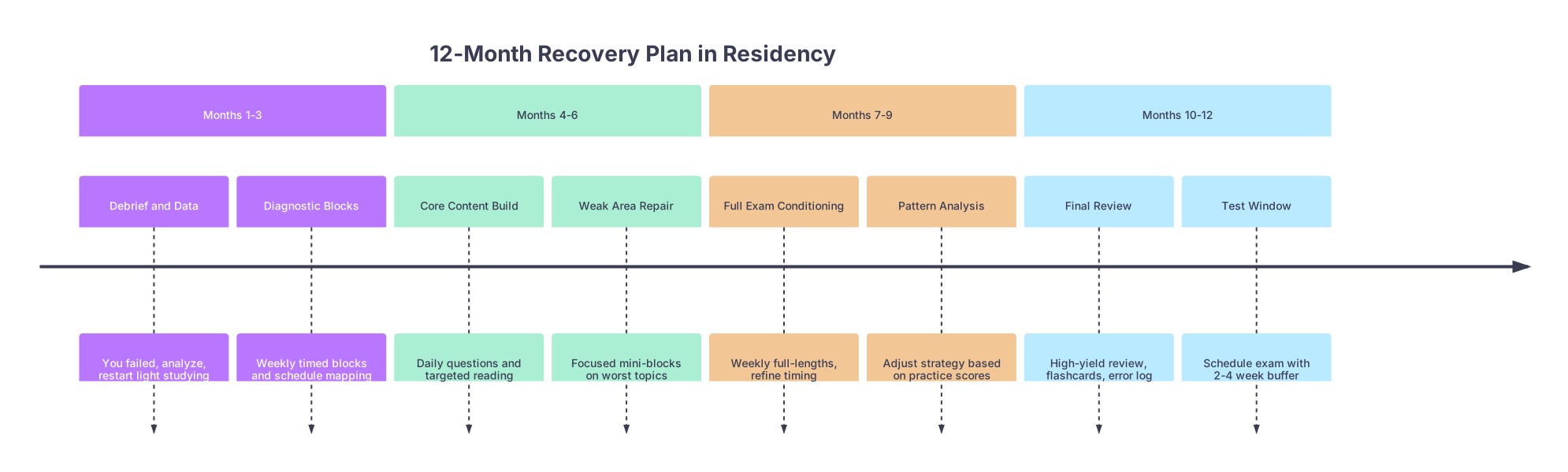
You are going to phase your year:
- Months 1–3: Light restart & diagnostics
- Months 4–6: Heavy build phase
- Months 7–9: Exam‑style conditioning
- Months 10–12: Final run‑up and buffer
Here is the bird’s‑eye view.
| Period | Event |
|---|---|
| Months 1-3 - Debrief and Data | You failed, analyze, restart light studying |
| Months 1-3 - Diagnostic Blocks | Weekly timed blocks and schedule mapping |
| Months 4-6 - Core Content Build | Daily questions and targeted reading |
| Months 4-6 - Weak Area Repair | Focused mini-blocks on worst topics |
| Months 7-9 - Full Exam Conditioning | Weekly full-lengths, refine timing |
| Months 7-9 - Pattern Analysis | Adjust strategy based on practice scores |
| Months 10-12 - Final Review | High-yield review, flashcards, error log |
| Months 10-12 - Test Window | Schedule exam with 2-4 week buffer |
Now let us get specific.
Step 3: Months 1–3 – Light Restart, Diagnostics, and Systems
You are still licking your wounds. Fine. Use these months to rebuild structure without burning out.
A. Build a realistic weekly schedule around residency
Stop fantasizing about “4 hours every day”. You will not do that on ICU nights.
Do this instead:
Map your rotations for the next 6 months.
Mark them:- “Red” – brutal (ICU, nights, ED)
- “Yellow” – medium (wards, consults)
- “Green” – lighter (clinic, electives, research)
Assign MINIMUM study time by color:
- Red weeks: 3–4 hours total spread over the week
- Yellow weeks: 6–8 hours total
- Green weeks: 10–12 hours total
This is floor, not ceiling. If you consistently hit the floor, you will improve.
- Fix a non‑negotiable daily study block.
- 30–60 minutes, same time daily on most days (e.g., 6–7 a.m. before sign‑out or 8–9 p.m. before bed)
- Protect it like sign‑out. Do not trade it away for scrolling your phone.
B. Choose and simplify your resources
You failed once. You do not need “more resources.” You need fewer.
For almost everyone, the core stack should be:
- One primary question bank (UWorld, TrueLearn, Rosh, etc. depending on exam)
- One concise text or video series for reference (Boards & Beyond, OnlineMedEd, MKSAP, etc.)
- One flashcard system (Anki or self‑made minimal deck)
Nothing else until you are consistently executing those.
C. Diagnostic blocks and pattern recognition
During Months 1–3:
- Do 2–3 blocks per week of 10–20 timed questions (not tutor mode).
- Immediately after each block, do a structured review:
- Classify each miss:
- “Did not know basic fact”
- “Knew but misread / rushed”
- “Overthought / changed correct to wrong”
- “Guessed between 2 but did not know which”
- Classify each miss:
Keep a simple log in a spreadsheet or notebook.
| Category | Description | |
|---|---|---|
| Knowledge gap | Never learned / do not recall fact | Targeted reading |
| Misread / rushed | Skimmed stem, missed key detail | Slow first 10 questions |
| Overthought / changed | Switched from right to wrong | Lock in first instinct |
| Pure guess between 2 | Conceptual confusion | Review concept map |
Patterns will emerge by the end of Month 3. You will know whether you are more Type 1, 2, or 3 failure.
Step 4: Months 4–6 – Build the Core Knowledge and Habits
Now you start doing real damage.
A. Question‑first, always
Your main engine is questions. Not reading. Not videos.
Target:
- Yellow weeks: 80–120 questions / week
- Green weeks: 120–160 questions / week
- Red weeks: 40–60 questions / week
Protocol for each session:
- Do 10–20 questions, timed, random mix (or weighted toward weak areas).
- For review:
- For every incorrect, read the full explanation and write a 1‑sentence “takeaway” in your notebook or digital doc.
- For every lucky correct guess, treat it like incorrect.
- Add only high‑yield, reusable facts to Anki or flashcards (no walls of text).
If your Q‑bank average is not improving by ~5 percentage points over these months, you are either:
- Not reviewing deeply enough
- Doing too many questions while too fatigued
- Or still using too many scattered resources
B. Focused content repair on weak areas
Based on your performance profile and log, pick 2–3 weak domains for Months 4–6.
Example for Internal Medicine boards:
- Cardiology
- Infectious Disease
- Endocrine
Each week:
- Choose 1–2 focused topics (e.g., atrial fibrillation, endocarditis, DKA).
- Spend 30–60 minutes on reference (video/text) after you have done questions in that topic.
- Immediately reinforce with another mini‑block of 5–10 questions in that domain within 48 hours.
You are building depth, not skimming.
C. Fix the test‑taking mechanics
If your issue is timing, guessing poorly, or changing answers, you must run drills:
Pacing drill:
- First 10 questions of any block: force yourself to slow down. 1–1.2 minutes per question.
- Last 10: allow yourself to push. You will discover your natural speed when not anxious.
Marking discipline:
- You are allowed to mark at most 5 questions per 40‑question block.
- This forces decision‑making instead of punting.
No change rule (with exceptions):
- You can only change an answer if you find explicit contradicting information in the stem on re‑read.
- “Gut discomfort” alone is not a valid reason.
Step 5: Months 7–9 – Full Exam Conditioning
By now you should be:
- Consistently studying on most days
- Seeing your Q‑bank average approach or exceed the passing benchmark
- Less emotionally raw when facing questions
Now you simulate the real thing.
A. Schedule full or half practice exams
Goal for Months 7–9:
- At least 2–3 full‑length exams (official practice if available, or well‑constructed third‑party).
- If full days are impossible, do half exams (e.g., 3–4 blocks in a row) on lighter weekends.
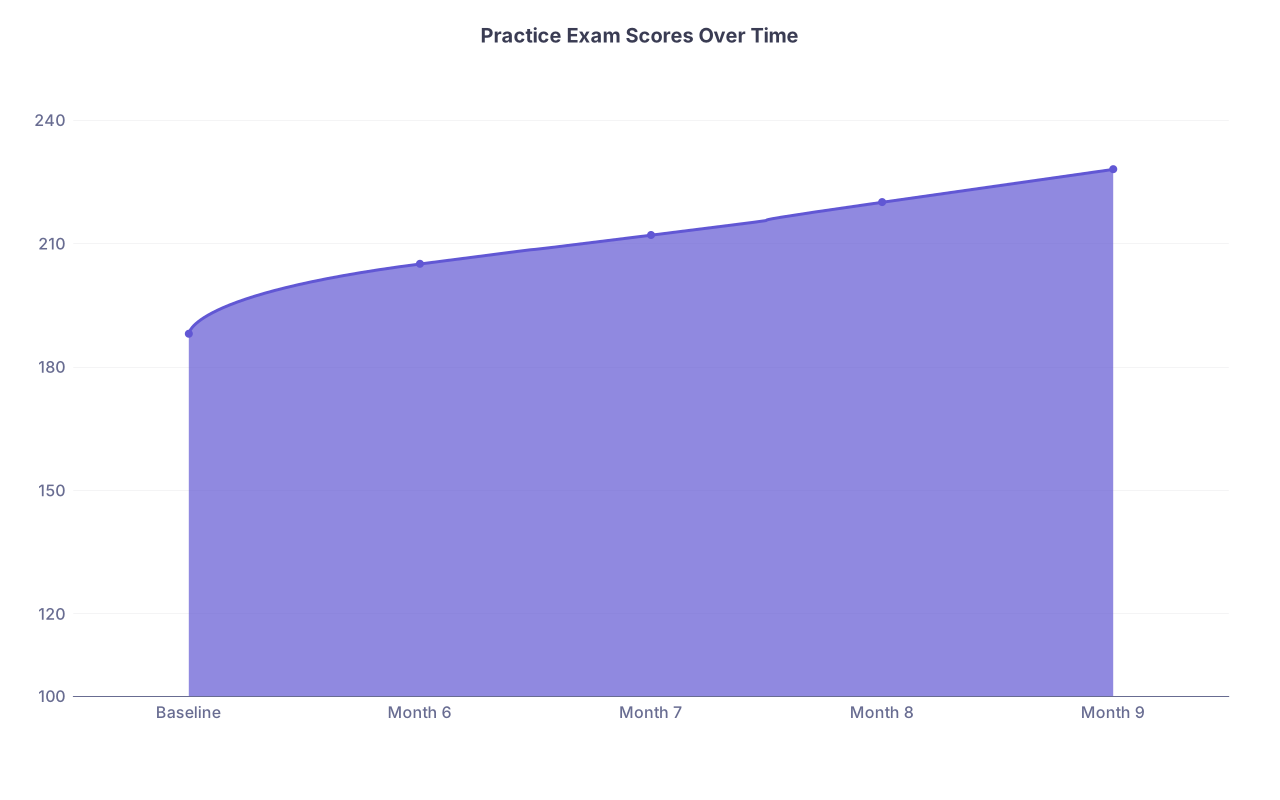
Track:
- Total score / predicted score
- Block‑to‑block fatigue
- Timing (how many questions left at 5 minutes remaining per block)
| Category | Value |
|---|---|
| Baseline | 188 |
| Month 6 | 205 |
| Month 7 | 212 |
| Month 8 | 220 |
| Month 9 | 228 |
If your practice scores are not trending upward by Month 9, you change strategy, not just “try harder.” That may mean:
- Different Q‑bank
- Dedicated time off from clinical work (negotiate with PD)
- Professional test‑prep coach if anxiety/strategy is the bottleneck
B. Analyze practice tests like a surgeon, not a victim
After each practice exam, do a post‑mortem within 48 hours:
Categorize misses by:
- Content domain
- Failure type (knowledge vs misread vs overthought)
- Block (early vs late fatigue)
Identify any persistently weak content areas. Those get targeted mini‑blocks and brief content refreshers over the next 2–3 weeks.
Look for behavioral patterns:
- Collapsing on last block every time → endurance problem
- Overcalling rare zebras when stem screams “common thing” → overthinking problem
- Struggling with graphs / images disproportionately → specific skill deficit you can train
Then you adjust your next 4‑week micro‑plan based on this.
Step 6: Months 10–12 – High‑Yield Review and Buffer
If you schedule the exam smartly, you want it in Months 10–11, with Month 12 as a buffer for life events, illness, scheduling chaos.
A. Confirm readiness with objective criteria
You are “ready” when:
- Your last 2–3 practice exams are at or above the passing threshold plus a margin (usually +10–15 points depending on the exam).
- Your Q‑bank average is:
- For many specialties: > 65–70% overall in timed, random mode.
- Your misses are mostly:
- Very obscure facts
- Or “I narrowed to 2 and guessed wrong honestly”
If you are hovering right at the pass line in Month 10, resist the temptation to “just get it over with.” That is how people fail a second time.
B. High‑yield consolidation
In the final 6–8 weeks before the test:
Shift priority to:
- Reviewing your error log
- Rapid‑fire Q‑bank review of marked / incorrect questions
- Short, high‑yield resources (cheat sheets, summary tables, flashcards)
Reduce new content:
- No brand‑new big video series
- No switching primary resources this late
Tighten sleep and schedule:
- Align your sleep cycle with your planned test‑day schedule at least 2 weeks before
- Practice a “mock test day” including wake time, breakfast, commute, and breaks
C. The last 7 days
Non‑negotiables:
- No marathon 12‑hour cram days. You are practicing recall, not punishing yourself.
- Each day:
- 1–2 smaller blocks of questions (10–20 each)
- 60–90 minutes light review of flashcards / high‑yield notes
- Physical movement (walks, light exercise)
- Day before exam:
- Short review only in the morning.
- Afternoon off. Do normal, calming activities.
- Pack everything: ID, snacks, earplugs, layers.
Step 7: How to Do All This While Actually Being a Resident
The main threat is not lack of intelligence. It is chaos.
You must create systems that survive bad call nights and schedule shifts.
A. Non‑negotiable rules
Touch boards 6 days per week.
Even on brutal weeks, you can do:- 5–10 questions
- Or 20–30 minutes of flashcards
Pre‑plan your week every Sunday.
Sit down with your calendar for 10 minutes:- Block off specific times (with location) for study sessions
- Pre‑choose which resource and how many questions you will do in each block
- Write it down physically or in a digital planner
-
- 10 questions between cases.
- 5 minutes of Anki on the elevator.
- Review 2 missed questions on your lunch break.
Those micro‑blocks add up shockingly fast over 12 months.
B. Negotiate with your program
You are not a passive victim of the schedule. Programs do not want you failing boards twice.
Ask for:
- One or two board‑focused elective blocks in the 6 months before your exam
- A lighter call schedule in the final 4–6 weeks before your test, if possible
- Protected educational half‑days to be respected, not casually violated
Most PDs are more flexible than residents assume—when approached early and with a concrete plan.
Step 8: Avoiding the Landmines That Lead to a Second Failure
I have seen residents who are clearly capable fail twice. The reasons repeat.
Watch for these traps:
Using too many resources.
The “maybe this other video series will save me” fantasy. It will not. It will fragment your attention.Hiding from practice tests.
They fear seeing a bad score, so they avoid full‑length practice. Then the real exam blindsides them again.Overstudying on red rotations and then crashing.
You go all‑out on ICU weeks, sleep 4 hours, and convince yourself you are a hero. Until you burn out and stop studying entirely for a month.Treating this like a moral failure instead of a solvable performance problem.
Shame leads to secrecy and isolation. That kills plans.Pretending mental health is “fine” when it is clearly not.
If you cannot concentrate, cannot sleep, or cry randomly, no amount of Anki cards will fix that. Get treatment.
Sample Weekly Plans (Realistic, Not Fantasy)
To make this concrete, here is what an actual week can look like on two different rotations.
| Rotation Type | Total Study Hours | Questions / Week | Key Focus |
|---|---|---|---|
| ICU Nights (Red) | 3–4 hours | 40–60 | Maintain habit, light review |
| Wards (Yellow) | 6–8 hours | 80–120 | Core Qbank progress |
| Elective (Green) | 10–12 hours | 120–160 | Full blocks, weak-area repair |
For example, Yellow week – wards:
- Mon–Fri:
- 30–45 minutes early morning: 10–15 questions + review
- Sat:
- 2‑hour block: 20–30 questions + deeper review + error log
- Sun:
- 60 minutes: flashcards + plan next week
You are not doing heroic 6‑hour daily grinds. You are being consistent.
Quick Reality Check: What “Recovery” Actually Looks Like
Here is the emotional pattern I see over and over in residents who ultimately pass on second attempt:
- Month 1–2: Shame, anger, embarrassed to talk about it. Studying feels heavy and slow.
- Month 3–4: Small wins. Question percentages inch up. Less dread opening the Q‑bank.
- Month 5–6: You start diagnosing your own thinking errors. Less flailing, more targeted work.
- Month 7–9: Practice exams are still scary, but now informative rather than humiliating.
- Month 10–12: You now think, “I am not guaranteed to pass, but I would be surprised if I failed.” That is the right zone.
You do not need perfect confidence. You need a consistent track record that your performance is rising and stable.

FAQs
1. Should I take time off from residency for dedicated studying after failing once?
Maybe, but not automatically. If your practice scores are close to passing (within 5–10 points) and your problem is mostly consistency, you can often fix this with structured studying integrated into your schedule plus one lighter elective. If you are far below the pass line or repeatedly bombing practice exams, then negotiating 4–8 weeks of dedicated or lighter time in the 3 months before your retake is smart. Time off without a clear daily schedule and measurable goals is wasted.
2. Do I need a formal board review course or expensive tutor?
Not by default. For most residents, a solid question bank, targeted content resource, and this 12‑month structure are enough. Consider a formal course or tutor if:
- You have failed more than once
- Your practice scores plateau far below passing despite consistent studying
- You identify a clear test‑taking or anxiety pattern you cannot fix on your own
If you do hire someone, demand specifics: schedules, metrics, and how they will adjust if you do not improve.
3. How many full‑length practice tests should I take before my retake?
Aim for at least 2–3 true full‑length practice exams in the 3–4 months before your retake, plus several half‑length simulations. More is not always better; you want quality analysis after each one. If each practice test is not leading to concrete changes in your next 2–3 weeks of studying, you are wasting them.
4. What if my failure was mostly due to anxiety and panic on test day?
Then you need a dual track: content and performance. Continue structured studying, but add:
- Regular exposure to exam‑like conditions (timed blocks, quiet room, same breaks)
- Work with a therapist, ideally one who understands performance anxiety
- Basic physiological tools: breathing drills, progressive muscle relaxation, and pre‑performance routines practiced weekly
Do not assume “I will just be less anxious next time.” Treat anxiety as a skill‑based problem that you can train.
Key Points:
- Failing boards once is a solvable performance problem, not a verdict on your career.
- A 12‑month recovery plan must align with residency reality: variable rotations, limited energy, and the need for ruthless focus on a few resources.
- Consistent, question‑driven studying plus honest data review and mental health support beats heroic last‑minute cramming every single time.